
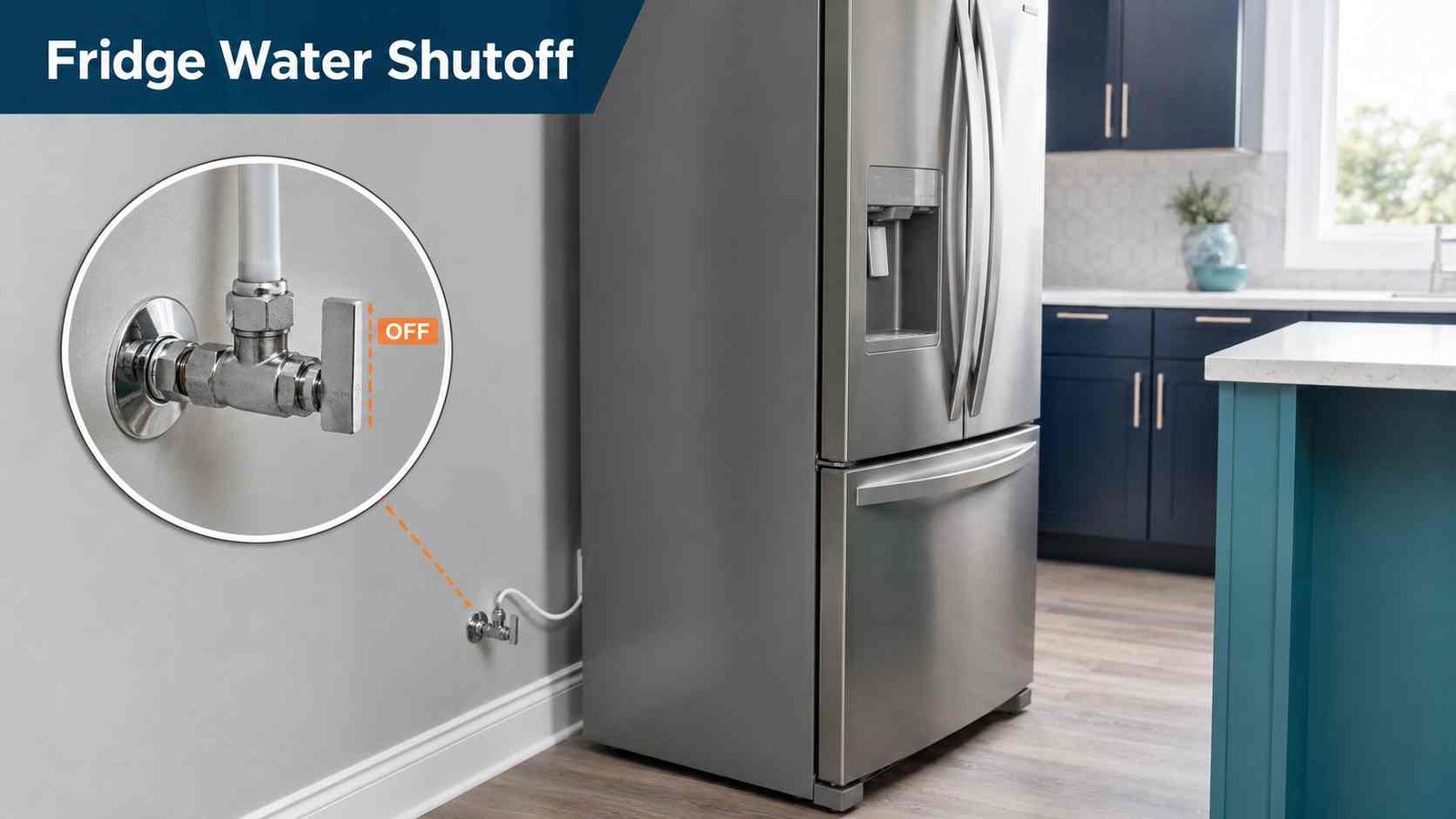
 To turn off the water line to a fridge, first switch off the automatic ice maker, then find the household shutoff valve feeding the refrigerator. If it has a round handwheel, turn it clockwise until it stops. If it has a lever-style ball valve, rotate the handle 90 degrees so it sits perpendicular to the pipe. GE, Maytag, and KitchenAid provide the same basic shutoff guidance for these common arrangements.
After closing the valve, operate the water dispenser over a container. A little residual water can come out at first, but a steady flow should stop. Maytag recommends testing for about 30 seconds.
If you are dealing with an active leak, a valve that will not close, or a corroded plumbing connection, stop before disconnecting the line and isolate the upstream or main household water supply instead.
How Do You Shut Off Water to a Refrigerator?
| Step | What to do |
|---|---|
| 1 | Turn off the refrigerator’s automatic ice maker |
| 2 | Locate the household water shutoff supplying the fridge |
| 3 | Identify whether it is a round valve or lever valve |
| 4 | Turn a round valve clockwise until closed |
| 5 | Turn a lever valve 90° until perpendicular to the pipe |
| 6 | Test the dispenser until steady water flow stops |
| 7 | Check the valve and visible connections for leaks |
GE specifically recommends turning off the ice maker when the refrigerator water supply is shut off. An ice maker left operating without water may continue attempting to fill, potentially causing noise or problems with the ice-maker or water-valve system.
Important: The household shutoff valve is not the same thing as the refrigerator’s electrically operated water inlet valve. For normal water isolation, you are looking for the plumbing valve that controls water flowing to the refrigerator.
Where Is the Fridge Water Shutoff Valve?
There is no single location used in every home.
Manufacturer guidance identifies several common places:
- Behind the refrigerator
- Under the kitchen sink
- Inside a nearby cabinet
- In the basement
- In a crawl space
GE says refrigerator water-line shutoff valves are commonly found behind the appliance, under the sink, or in the basement or crawl space. KitchenAid lists those locations as well as nearby cabinets.
Behind the refrigerator
Carefully look behind the fridge for a small water-supply tube leading from the appliance toward the wall or floor.
Do not pull the refrigerator abruptly. Refrigerator water tubing needs enough slack to permit movement without kinking or being pulled from its connection. KitchenAid documentation recommends a service loop for this reason.
Under the kitchen sink
Look near the cold-water plumbing. A small-diameter refrigerator supply tube may branch from that plumbing through its own shutoff.
In a nearby cabinet
Some installations route the refrigerator supply through an adjacent kitchen cabinet, especially when the sink plumbing is nearby.
Basement or crawl space
If the refrigerator is on the floor above accessible plumbing, the shutoff may be located below the kitchen.
If you still cannot find it
Trace the refrigerator’s supply tubing back toward its connection to the home’s plumbing. KitchenAid recommends following the copper or other refrigerator water line when the valve location is not obvious.
How to Turn Off the Water Line to Your Fridge
1. Turn off the ice maker
Before isolating the water, switch the automatic ice maker off using the method specified for your refrigerator.
Depending on the model, this may involve:
- Raising a wire shutoff arm
- Moving an ON/OFF switch
- Using an ice-maker setting on the control panel
GE confirms that the exact control varies by refrigerator design, so the owner’s manual should be used if the correct control is not obvious.
Turning off the dispenser’s control lock is not the same thing as turning off the ice maker or household water supply. On applicable KitchenAid refrigerators, the control lock only prevents dispenser operation.
2. Locate the household water line
Find the small supply line entering the back of the refrigerator and trace it toward the household plumbing.
North American manufacturer documentation commonly refers to 1/4-inch (6.35 mm) outside-diameter copper or PEX tubing, although your actual installation may differ.
3. Identify the shutoff valve
The two easiest common types to identify are:
| Valve type | Appearance | Closed position |
|---|---|---|
| Round handwheel/gate-style valve | Small round wheel | Turn clockwise until it stops |
| Ball valve | Lever handle | Handle perpendicular to the pipe |
| Older saddle-style valve | Small valve attached to a supply pipe | Usually closes clockwise; treat older valves cautiously |
Maytag and KitchenAid specifically state that a gate valve closes clockwise and a ball valve closes when rotated 90 degrees perpendicular to the pipe.
4. Close the valve
For a round valve, turn it clockwise gently until it reaches its closed position.
For a lever valve, rotate it one-quarter turn until the lever is perpendicular to the pipe.
You should not need excessive force. If an old valve is seized, badly corroded, or starts leaking around its stem when moved, stop rather than forcing it.
5. Test the water dispenser
Place a container under the refrigerator dispenser and operate it.
Some water may initially leave the dispenser because water remains in the refrigerator and tubing after the supply is closed. KitchenAid and Maytag both recommend running the dispenser until the residual flow stops; Maytag suggests testing for approximately 30 seconds.
If you continue getting a normal steady stream, do not assume the line is safe to disconnect. You may have closed the wrong valve or the shutoff may not be sealing properly.
6. Inspect for leaks
Look around the shutoff valve, tubing, and accessible fittings.
If you notice dripping from the plumbing line itself, GE recommends treating it as a household plumbing issue and contacting a plumber where appropriate.
Which Way Do You Turn a Fridge Water Valve?
For most round refrigerator supply valves:
Clockwise = OFF
An easy memory aid is the familiar phrase right to tight, but stop when the valve reaches its normal closed position. Do not overtighten it.
For a quarter-turn ball valve:
Parallel with pipe = ON
Perpendicular to pipe = OFF
Maytag’s current refrigerator guidance confirms both positions.
What About an Older Saddle Valve?
Older refrigerator installations sometimes use a saddle valve, a small valve attached directly to a household water pipe.
GE confirms that these valves have historically been used to control refrigerator water supplies. However, GE and Whirlpool advise against self-piercing or self-tapping versions because their restricted openings can reduce refrigerator water flow. Whirlpool also notes that saddle-valve requirements can depend on local plumbing codes.
If your old saddle valve works normally, closing it clockwise may isolate the refrigerator.
If it is corroded, seized, leaking, or fails to stop the water, do not dismantle it while the pipe remains pressurized. Shut off the upstream household water supply and have the valve assessed or replaced.
What If There Is No Shutoff Valve for the Refrigerator?
Some refrigerators do not have a dedicated accessible shutoff.
KitchenAid recommends using the home’s main water shutoff when there is no individual refrigerator valve and suggests having a professional install a dedicated valve for easier future maintenance.
So if you need to disconnect the refrigerator:
- Turn off the ice maker.
- Shut off the home’s main water supply.
- Verify that the supply is isolated.
- Only then proceed with the refrigerator-water-line work appropriate for your model.
Adding or modifying permanent household plumbing is better handled according to local plumbing requirements.
What If Water Still Flows After the Valve Is Off?
A brief amount of water from the dispenser does not necessarily mean the valve failed. Water already inside the line and refrigerator may still drain out.
A continued normal flow, however, means you should investigate before disconnecting anything.
Possible explanations include:
- You closed the wrong valve.
- The valve did not reach its fully closed position.
- The shutoff valve is worn and no longer seals.
- Another plumbing arrangement is supplying the refrigerator.
When uncertain, isolate the appropriate upstream or main water supply before touching the connection.
What If the Shutoff Valve Won’t Turn?
Do not immediately reach for a large wrench and force an old valve.
A valve that has remained untouched for years can be seized or deteriorated. Excessive force can turn a simple refrigerator job into a plumbing leak.
A safer approach is to stop, locate the upstream or main water shutoff, and contact a plumber if the refrigerator valve itself requires repair or replacement.
The same applies if moving the valve causes water to appear around the stem, body, pipe, or fitting.
Do You Need to Unplug the Refrigerator?
Not necessarily if you are only closing an accessible household water valve.
However, disconnecting the supply line, moving the appliance for installation or service, or working around electrical connections is a different situation. Manufacturer service and installation guidance may require disconnecting electrical power before performing work around the refrigerator. KitchenAid’s water-line inspection instructions, for example, tell users to unplug the refrigerator for safety before working around the line at the appliance.
Follow the instructions for your exact model whenever you go beyond simply operating the household shutoff valve.
Can a Fridge Run With the Water Turned Off?
For refrigerators designed to operate with optional water and ice features, refrigeration can generally continue while the household water supply is isolated. However, turn the automatic ice maker off while water is unavailable.
GE says an ice maker operating without a water supply can produce repeated valve noise and recommends switching the ice maker off when the appliance is not connected to water.
The water dispenser and automatic ice production will naturally be unavailable until the supply is restored.
Turning the Refrigerator Water Back On
Once the work is finished and all connections are secure:
For a round gate-style valve, turn it counterclockwise to reopen it.
For a ball valve, rotate the lever until it is parallel with the pipe.
Maytag gives these positions for restoring refrigerator water service.
Afterward:
- Check the shutoff valve for leaks.
- Check the refrigerator connection and accessible tubing.
- Restore the ice maker according to the refrigerator manual.
- Flush or operate the dispenser as required by your manufacturer’s instructions.
Watch the connections for any sign of moisture after the water pressure returns.
When Should You Call a Plumber?
Stop DIY troubleshooting and consider a qualified plumber when:
- The shutoff valve is stuck.
- The valve will not completely stop water flow.
- The valve starts leaking when operated.
- The supply pipe or connection is badly corroded.
- You cannot find any refrigerator shutoff.
- A dedicated valve needs to be installed.
- The main household shutoff does not work correctly.
- There is a hidden or continuing plumbing leak.
If water appears to be leaking from the refrigerator itself rather than the household supply line, appliance service may be more appropriate. GE distinguishes household supply-line leaks from problems involving the refrigerator’s own water valve or internal tubing.
Refrigerator Water-Line Safety Checklist
Before disconnecting a refrigerator water line, make sure:
- The automatic ice maker is off.
- You identified the correct household shutoff.
- The valve is fully closed.
- A steady dispenser flow has stopped.
- There is no new leak around the shutoff.
- You are not relying only on the dispenser’s control lock.
- You have stopped if the plumbing valve is seized or damaged.
The main goal is simple: verify that the water is actually isolated before opening any connection.
Frequently Asked Questions
Where is the water shutoff valve for my refrigerator?
Check behind the refrigerator, under the kitchen sink, inside a nearby cabinet, or in the basement or crawl space. If it is not obvious, trace the refrigerator’s small water-supply line back toward the home’s cold-water plumbing.
Which way do I turn the refrigerator water valve off?
Turn a round handwheel valve clockwise until closed. For a lever-style ball valve, rotate the lever 90 degrees until it is perpendicular to the pipe.
Should I turn off the ice maker before shutting off the water?
Yes. GE specifically recommends switching off the ice maker when the refrigerator’s water supply is shut off. The exact ice-maker control varies by model.
Why does water still come out after I close the valve?
A small amount may be residual water already inside the refrigerator and supply line. Run the dispenser into a container until it stops. If a normal steady stream continues after about 30 seconds, verify that the correct valve has been fully closed.
Can I disconnect the fridge line if there is no shutoff valve?
Do not disconnect a pressurized line. KitchenAid recommends turning off the home’s main water supply when no dedicated refrigerator shutoff exists.
Can I leave my refrigerator running without a water connection?
On refrigerators where the water supply serves the optional dispenser and automatic ice maker, the refrigerator can normally continue cooling, but the ice maker should be turned off while water is unavailable. GE specifically recommends disabling the ice maker when there is no water supply.
Is the valve on the back of my refrigerator the shutoff valve?
Not necessarily. Refrigerators can contain an electrically controlled water inlet valve as part of the appliance. The valve you normally use to isolate the refrigerator is part of the household plumbing feeding the appliance.
What should I do if the refrigerator shutoff valve leaks?
Stop operating or disconnecting the line, isolate the upstream or main water supply if necessary, and have the faulty plumbing valve inspected. GE recommends plumbing assistance when a leak originates from the household supply plumbing rather than the refrigerator.
Daniel Brooks is a US-based appliance troubleshooting researcher with 12 years of experience studying washer, dryer, refrigerator, and dishwasher faults. He reviews manufacturer manuals and converts technical error codes into safe, practical guidance for homeowners.