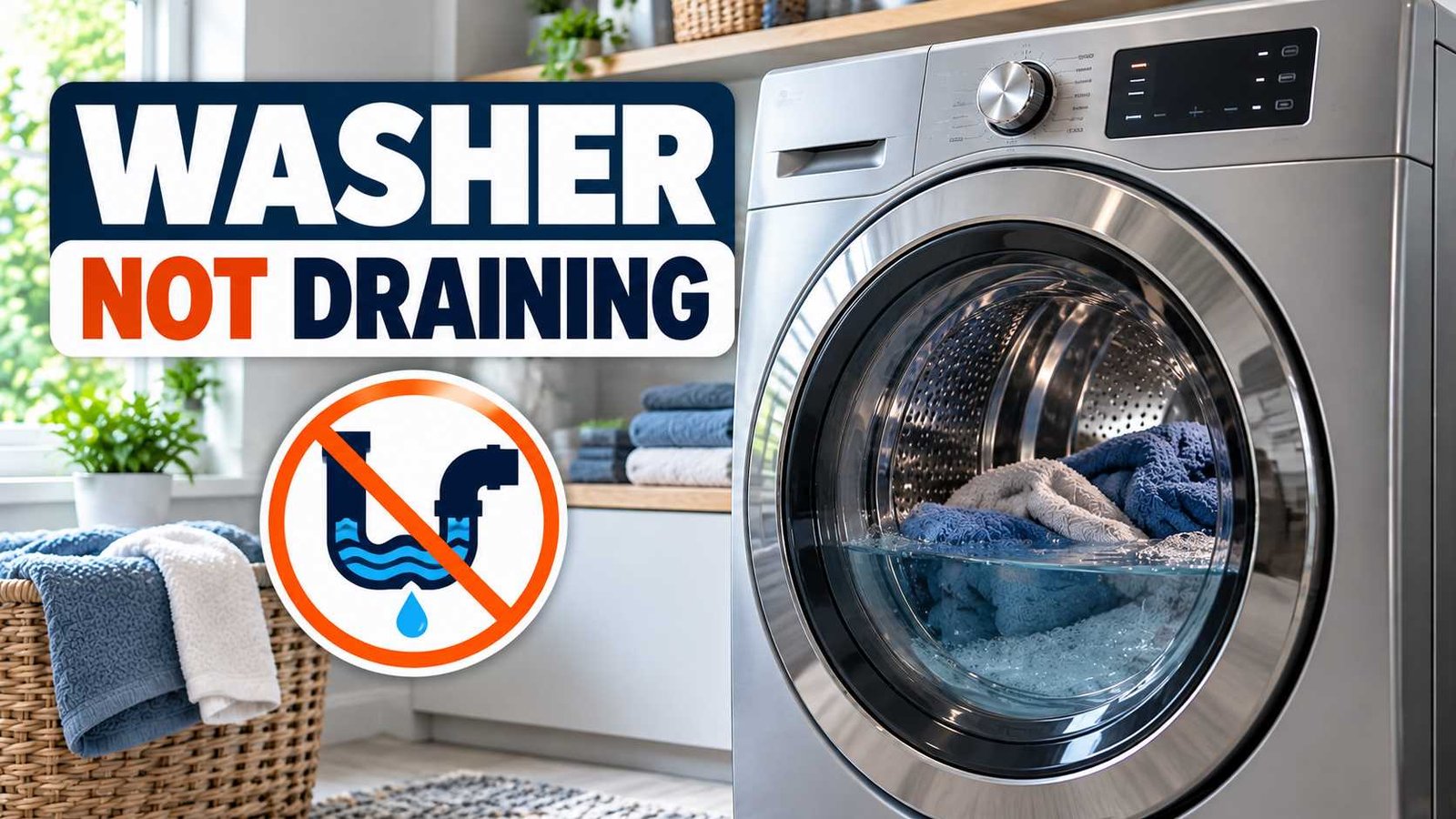
 If your GE washer will not drain, check the drain hose for kinks, look for a blocked household standpipe, and allow for a normal pause between wash stages before assuming the pump has failed. On many GE front-load washers, an accessible pump filter can also collect coins, lint, and small clothing items. Top-load and front-load models differ, so the correct next step depends on the machine you have.
First, stop the washer if water is overflowing, leaking near an electrical outlet, or accompanied by a burning smell. Do not reach into a moving machine or open an energized cabinet. If a front-load drum is visibly full of water, do not force the door open; water may spill onto the floor. Disconnect power before inspecting an accessible filter or working around the drain hose, and use towels and a shallow container to manage residual water.
Start by identifying what the washer is doing
Water left in the tub is not always caused by a failed drain pump. A paused cycle, blocked hose, unbalanced load, or household plumbing issue may produce similar symptoms. Note whether the machine makes a pump sound and whether it shows a warning.
| What you notice | Possible explanation | Useful next check |
|---|---|---|
| Washer pauses briefly before draining | Normal cycle pause on some GE models | Allow several minutes without advancing a mechanical timer |
| Water stays in tub and hose is bent | Drain hose restriction | Inspect safely accessible hose routing |
| Front-loader drains slowly or stops with water inside | Clogged user-accessible pump filter on equipped models | Follow that model’s filter-cleaning instructions |
| Top-loader flashes Rinse or displays Po | Drain took too long on certain 2015-and-newer models | Check hose and try the manual-approved Drain & Spin function |
| Water backs up at wall standpipe | Household drain blockage | Stop use and arrange plumbing inspection |
| Tub remains full while washer only hums | Pump obstruction or another internal fault | Stop attempts and arrange service |
1. Give the cycle time to finish its normal pause
GE notes that pauses of up to about three minutes can occur between stages on many washers. If the machine is quiet after agitation, observe it briefly before interpreting the pause as a failure. On older washers with a manual cycle dial, do not advance the timer through the drain stage; that can skip the pump-out portion.
If the machine shows a fault, remains full of water well beyond its normal pause, or begins humming without moving water, move on to the safe checks below rather than running repeated cycles.
2. Inspect the drain hose without disconnecting it unnecessarily
Switch the washer off. Look at the visible drain hose behind the machine for a sharp bend, flattening, or a section trapped against the wall. Do not pull a heavy washer forward alone, stretch a connected hose, or disturb nearby electrical outlets. If the hose is visibly damaged or cannot be reached safely, ask a technician to inspect it.
The drain hose must also enter the standpipe or laundry sink as described in the installation instructions. A hose pushed too far into a standpipe or sealed airtight can cause siphoning or other drainage problems. Incorrect drain height may prevent proper operation. GE’s limits vary by washer type and model: many full-size machines can pump to a maximum of eight feet, while some compact or portable models have a lower maximum of five feet. Use your model’s manual for both the minimum and maximum permitted heights.
What if water is backing up from the standpipe?
Water spilling from the wall drain or laundry sink points toward a household plumbing restriction, even if the washer pump is working. Stop the washer, avoid running another discharge into the overflowing drain, and have the plumbing cleared. Disconnecting a hose full of water can create a sudden spill; leave that work to someone equipped to contain it.
3. Clean the front-load washer pump filter, if your model has one
Some GE front-load washers have a small access door near the bottom front of the cabinet. Behind it is a pump-filter cleanout that can catch coins, hairpins, lint, and other debris before those items reach the plumbing. Do not assume every GE washer has a user-serviceable filter. If there is no access door or the owner’s manual does not describe filter cleaning, do not remove cabinet panels to reach the pump.
For a model whose manual permits filter cleaning, follow its exact procedure. In GE’s guidance for front-load machines equipped with a lower access cover, the general process is:
- Switch off and unplug the washer. Let hot wash water cool if necessary.
- Protect the floor with towels and position a shallow pan under the access opening.
- Open the designated lower filter access cover and use its pour spout if fitted.
- Loosen the filter slowly, allowing water to drain in controlled amounts. Tighten it again whenever the pan needs emptying.
- Remove accessible debris from the filter and reinstall it securely according to the manual.
- Close the access door. Check for leakage only after everything has been properly reassembled.
GE warns that some residual water is normal when the filter is removed. However, if the tub is still full, there may be far more water than a shallow pan can hold. Do not unscrew the filter all at once or continue if you cannot control the flow. Arrange service instead. Never work on the filter with the washer powered or running.
4. Check the special signs on GE top-load washers
Top-load machines generally do not have the same lower-front pump-filter access as many front-load models. Start with the hose, drain plumbing, and the cycle controls. On certain GE top-load washers made in 2015 or later, a flashing Rinse light or scrolling Po indicates that draining has taken too long. GE advises checking for a pinched or flattened drain hose and using the applicable Start or Drain & Spin option after the obstruction is corrected.
On GE top-load models from 1994 or earlier, the lid must be closed for their combined spin-and-drain operation. Do not defeat a lid lock or safety switch. On newer models, lid-lock behavior varies; consult the model’s manual rather than treating a locked lid as proof of pump failure.
Is the water sound coming from an empty tub?
If no water is visible but you hear liquid sloshing as you move the basket, GE says this can be the normal liquid-filled balance ring. That sound alone does not indicate water trapped in the outer tub. Judge a drainage problem by visible standing water, soaked laundry, a failed cycle, or an applicable warning instead.
5. If the washer will not drain or spin
GE front-load models may refuse to proceed with a normal spin when water has not drained sufficiently. An unbalanced load can also delay or interrupt spinning. If the washer has safely drained and the manual allows it, redistribute tangled clothing or adjust a very small load, then select the appropriate spin program. Do not reach inside until all movement has stopped and any lock has released normally.
If water remains in the tub, address the drainage problem first. Repeating Spin while the machine is full does not clear a clogged pump or hose and can prolong the fault. A machine that runs but only hums while the tub stays full should be switched off and professionally inspected.
6. What if the drain pump is clogged or failing?
The pump moves wash water from the tub to the household drain. Small objects can obstruct its inlet or impeller, and a damaged pump or electrical problem can prevent it from operating. A humming sound may be consistent with an obstructed pump, but it does not prove that the motor or pump has failed.
If the user-accessible filter is clean and the hose and plumbing are not blocked, the remaining checks may require cabinet disassembly and electrical diagnosis. Those steps belong with a qualified appliance technician, especially where trapped water could reach electrical components. Order a replacement pump only after the exact model and failed part are confirmed.
Can resetting a GE washer fix a drain problem?
A power interruption or cycle restart may resolve a temporary control issue on some models, but it cannot remove a sock from the pump or straighten a crushed hose. Use only the reset or cancel procedure in your owner’s manual. If a drain error returns or water remains inside, investigate the physical drainage path instead of repeatedly resetting the machine.
When to stop and call for service
- The tub remains full and the washer hums or repeatedly fails to pump out water.
- You cannot control water safely at a front-load filter access point.
- The hose is clear but the washer still will not drain, or a drain warning repeatedly returns.
- The machine leaks near electrical connections, trips the breaker, smells hot, or makes a harsh mechanical noise.
- There is no user-accessible cleanout and a blockage appears to be inside the cabinet.
Before scheduling repair, locate the full GE model number on the appliance label. Tell the service provider whether it is a top-loader or front-loader, whether water is standing in the drum, what the display shows, whether the pump hums, and which checks you completed. This helps distinguish plumbing, pump, and control problems without guessing at replacement parts.
Help prevent the next drain blockage
Empty pockets, secure small washable items in a suitable laundry bag, avoid overloading, and keep the drain hose free of crushing or sharp bends. On GE front-load models with a user-cleanable filter, follow the maintenance interval and cleaning instructions in the owner’s manual. If the household standpipe drains slowly, have the plumbing assessed before it backs up during another cycle.
Bottom line: when a GE washer will not drain, the best starting points are its normal cycle timing, visible drain-hose condition, and household plumbing. A front-load pump filter may be the next check if the model provides safe access. Persistent standing water, humming without drainage, or recurring warnings call for model-specific service rather than repeated test cycles.
Daniel Brooks is a US-based appliance troubleshooting researcher with 12 years of experience studying washer, dryer, refrigerator, and dishwasher faults. He reviews manufacturer manuals and converts technical error codes into safe, practical guidance for homeowners.