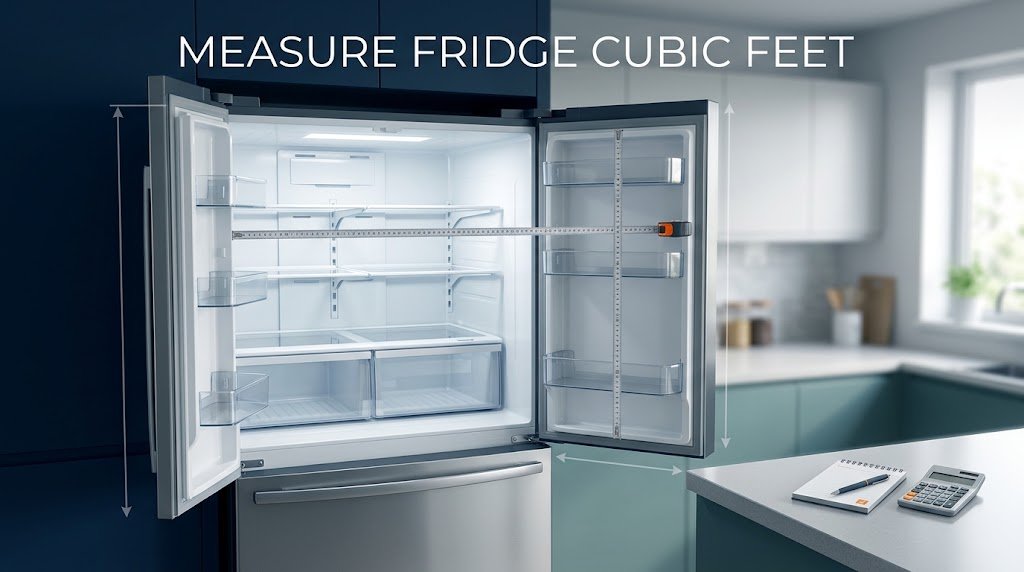
 To figure out the cubic feet of a refrigerator, first check its model number and manufacturer specifications. If that information is unavailable, measure the inside height, width and depth in inches, multiply the three measurements, and divide by 1,728. Measure the refrigerator and freezer compartments separately, then add their estimated volumes if you want a total.
That calculation is useful, but it is an estimate. Interior compartments are rarely perfect boxes, and a manufacturer’s advertised capacity may be calculated using a standardized method rather than a few tape-measure readings. If you are replacing an older fridge, it helps to know both its stated capacity and its outside dimensions.
What Does Cubic Feet Mean for a Refrigerator?
Cubic feet (cu. ft. or ft³) is a measurement of volume, not the amount of floor space a refrigerator occupies. One cubic foot is a cube measuring 12 inches on every side. Because 12 × 12 × 12 equals 1,728, one cubic foot contains 1,728 cubic inches.
Many full-size refrigerators have separate fresh-food and freezer capacities. The advertised total refrigerator capacity generally combines those compartments. A refrigerator advertised as 20 cubic feet does not necessarily have 20 cubic feet available for fresh food alone.
Method 1: Find the Cubic Feet Using the Model Number
This is usually the best way to identify a refrigerator’s official rated capacity. Look for a model or rating label inside the fresh-food section, often on a side wall, near the crisper area, or around the door opening. On some models it may be behind a drawer or in another manufacturer-specified location.
- Open the refrigerator and locate the model identification label without removing fixed panels.
- Write down the complete model number, including any letters or suffixes. Do not confuse it with the serial number.
- Find the model’s official specification sheet, product manual, or manufacturer’s support listing.
- Look for total capacity, fresh-food capacity, and freezer capacity. Note which figure you are using.
Some labels show electrical ratings and refrigerant information but not cubic feet. That is normal. A model number can help you locate the published specifications; a serial number alone generally will not tell you the capacity. Avoid assuming a model’s first two digits always indicate its size—naming conventions vary by brand and product line.
Method 2: Calculate Refrigerator Cubic Feet by Measuring Inside
For a basic rectangular section, the formula is:
Cubic feet = (interior height × interior width × interior depth in inches) ÷ 1,728
Use a tape measure and calculator. Keep all measurements in inches, and measure the storage cavity rather than the outside cabinet.
Step 1: Measure the Fresh-Food Compartment
- Open the door and move food or removable storage items out of the way as needed. Do not leave perishable food unrefrigerated longer than necessary.
- Measure the interior width from side wall to side wall.
- Measure the interior height from the usable cavity floor to its ceiling.
- Measure the interior depth from the back wall toward the front boundary of the compartment, without counting the door’s external thickness.
- Record the figures. For an irregularly shaped interior, measure separate rectangular sections instead of treating the entire cavity as one large box.
Shelves and drawers can change how convenient the space is to use, but removing them does not turn insulated walls or cooling-system housings into storage space. Treat the result as approximate, especially when the bottom or back of the compartment is stepped.
Step 2: Work Through a Simple Example
Suppose a fresh-food cavity measures 28 inches high, 24 inches wide and 20 inches deep:
28 × 24 × 20 = 13,440 cubic inches
13,440 ÷ 1,728 = 7.78 cubic feet
The estimated volume of that rectangular section is about 7.8 cu. ft. If an ice-maker housing, large obstruction or sloping section takes up some of this box, the actual space within the cavity will be smaller.
Step 3: Measure the Freezer Separately
If your appliance has a freezer, repeat the measurements there. A freezer section measuring 14 inches high, 24 inches wide and 18 inches deep would be:
14 × 24 × 18 ÷ 1,728 = 3.5 cubic feet
Add the two estimates: 7.78 + 3.5 = 11.28 cubic feet, or about 11.3 cu. ft. total for this simplified example. Do not count a shared wall or the same storage area twice.
Quick Refrigerator Cubic Feet Calculation Table
| Interior height | Interior width | Interior depth | Calculated volume |
|---|---|---|---|
| 20 in. | 18 in. | 18 in. | 3.75 cu. ft. |
| 24 in. | 20 in. | 18 in. | 5.00 cu. ft. |
| 30 in. | 24 in. | 20 in. | 8.33 cu. ft. |
| 36 in. | 25 in. | 22 in. | 11.46 cu. ft. |
These are examples of rectangular interior spaces, not advertised capacities of particular refrigerator models. For a two-compartment appliance, calculate each section and add them.
Can You Calculate Refrigerator Capacity from Outside Dimensions?
You can multiply the outside height, width and depth to find a rough cabinet envelope volume, but that number is not the refrigerator’s food-storage capacity. Exterior measurements include insulation, door thickness, mechanical spaces and other parts that cannot store food.
For example, an appliance 70 inches tall, 30 inches wide and 30 inches deep occupies a simple outer box of 36.46 cubic feet (70 × 30 × 30 ÷ 1,728). It would be incorrect to describe this as a 36.5-cubic-foot refrigerator. The actual rated internal capacity may be substantially smaller.
Outside dimensions still matter when buying a replacement. Measure the available kitchen opening, including height under cabinets, depth at the counter, doorway clearance and any installation clearances specified by the new refrigerator’s manufacturer. Cubic-foot capacity alone cannot tell you whether an appliance will fit.
How to Measure a Refrigerator with an Irregular Interior
Side-by-side units, bottom-freezer models and compact refrigerators often contain shaped liners, bins, ice-maker spaces or a raised area over mechanical components. Using the longest height, widest width and deepest point together can overstate the interior volume.
For a better estimate, break the cavity into a few smaller rectangular sections. Calculate each section’s height × width × depth ÷ 1,728 and add the results. This will still be approximate: door bins, curved surfaces and drawers make precision difficult with a tape measure alone.
How Many Litres Are in a Cubic Foot?
Refrigerator capacities may be listed in litres (L), especially outside the United States. Use these conversions:
- Cubic feet to litres: multiply by approximately 28.3168.
- Litres to cubic feet: divide by approximately 28.3168.
A refrigerator rated at 400 litres is approximately 14.13 cubic feet (400 ÷ 28.3168). When comparing appliances, check whether the litre figure is total, fresh-food only or freezer only. Also make sure you are comparing capacities reported on a similar basis.
Why Your Measurement Might Not Match the Product Specification
| Reason | What it means |
|---|---|
| Uneven interior shape | A single rectangular calculation can include space occupied by a hump, housing or curved wall. |
| Different capacity definitions | Advertised total volume, compartment volume and everyday usable storage are not interchangeable. |
| Measuring the exterior | The outside cabinet includes doors, insulation and spaces that are not inside the storage cavity. |
| Rounding | Product listings often use rounded cubic-foot figures. |
| Model variation | Similar-looking refrigerators may have different internal layouts and published capacities. |
If accuracy matters for a purchase comparison, use the capacity on the manufacturer’s specification sheet for the exact model. Use your own measurements to understand where food will actually fit, not to challenge a rating based on a simple box calculation.
Which Number Should You Use When Replacing a Refrigerator?
Start with the old appliance’s published total cubic feet so you can compare approximate overall storage sizes. Then look at the separate fridge and freezer capacities. A model with the same total volume may divide its space differently, so freezer-heavy households should not rely on the total alone.
Check outside width, height and depth separately. Also consider shelf layout, door-bin space, crisper size and how far the doors need to open. Two refrigerators with similar rated capacities can feel surprisingly different in everyday use.
The simplest rule: use the model number for the official capacity; use interior dimensions and divide by 1,728 for a rough estimate. Keep exterior dimensions for installation planning, not for calculating storage cubic feet.

Daniel Brooks is a US-based appliance troubleshooting researcher with 12 years of experience studying washer, dryer, refrigerator, and dishwasher faults. He reviews manufacturer manuals and converts technical error codes into safe, practical guidance for homeowners.