
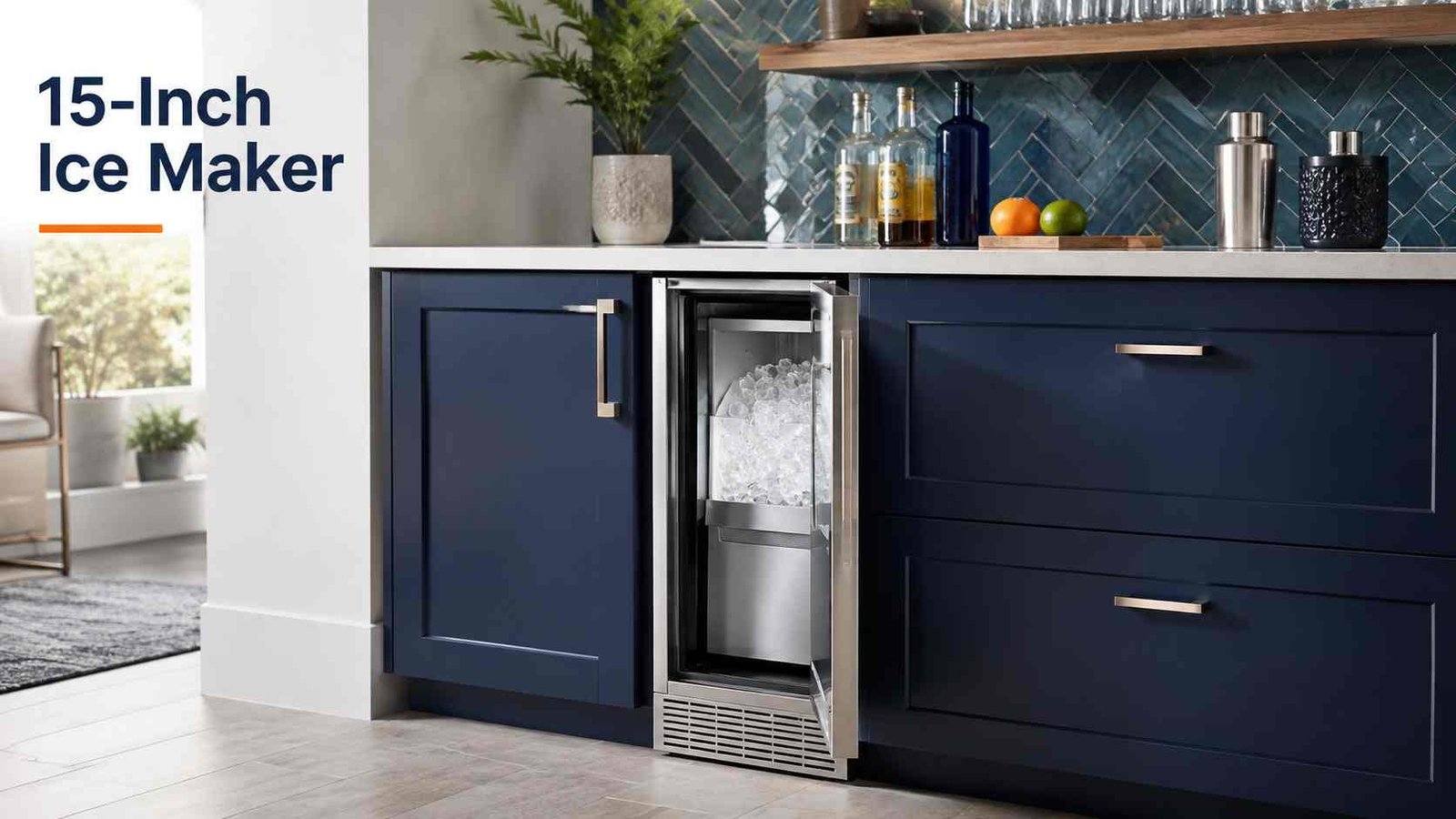
 A 15-inch undercounter ice maker is a compact ice machine designed to fit into a narrow cabinet opening, usually in a kitchen, home bar, entertainment room, or outdoor kitchen. But 15-inch models differ considerably in the type of ice they make, how much they produce, and especially how they handle drainage.
Before buying one, check three things first: the exact cabinet opening, the available water connection, and the drain arrangement. Some machines use a gravity drain, some include or accept a drain pump, and selected refrigerated crescent-ice models need no drain at all. Current manufacturer specifications confirm all three configurations are available.
If plumbing, electrical work, cabinet alteration, or a new drain is required, follow the installation instructions for the exact model and use an appropriately qualified professional where required.
15-Inch Undercounter Ice Maker at a Glance
| Feature | What to Know |
|---|---|
| Nominal width | About 15 inches |
| Actual width | Often slightly under 15 inches |
| Common ice types | Clear, crescent, nugget, craft clear |
| Water connection | Normally required for this type of machine |
| Drain | Depends on the model |
| Drain options | Gravity, pump, or no-drain design |
| Typical locations | Kitchen, wet bar, entertainment room |
| Outdoor installation | Only if the specific model is approved for it |
| Built-in installation | Common, but confirm ventilation requirements |
| Panel-ready options | Available from several premium brands |
| Main buying concern | Fit, drainage, ice type and production capacity |
What Is a 15-Inch Undercounter Ice Maker?
A 15-inch undercounter ice maker is a dedicated appliance that produces considerably more ice than the small ice maker built into many refrigerators.
The term 15-inch normally describes the appliance’s nominal width category. It does not mean every machine measures exactly 15.00 inches across.
For example, KitchenAid currently lists its KUIX315SPS 15-inch model at 14.69 inches wide, 33.96 inches high and 24.03 inches deep. Hoshizaki’s current AM-50BAK measures 14.875 inches wide.
That small difference matters. You should buy according to the manufacturer’s required opening dimensions, not simply assume that any appliance labelled 15-inch will fit your existing space.
Measure the Space Before Buying
Width is only the beginning.
Measure:
- The cabinet opening at the top, middle and bottom.
- The available height under the countertop.
- The usable depth.
- Space required for the door to open.
- The location of the water supply.
- The position and type of drain, if one is needed.
- The electrical outlet location.
- Any clearances required by the installation manual.
Do not force a machine into an opening because its advertised width appears correct.
Some undercounter machines are designed with front airflow specifically to work in enclosed spaces. Hoshizaki, for example, describes the AM-50BAK as a front-in, front-out air-cooled machine that does not require side and rear ventilation clearance. That specification applies to that model and should not be assumed for every ice maker.
Door clearance matters too
Check whether the door can open without hitting:
- Adjacent cabinets
- Drawer handles
- Walls
- Islands
- Trim
- Baseboards
Some models use special hinges to reduce door swing beyond the cabinet width. KitchenAid’s KUIX315SPS, for example, uses an articulating hinge designed to allow a 90-degree opening while maintaining a flush built-in appearance.
Production Capacity Is Not the Same as Storage Capacity
This is one of the easiest specifications to misunderstand.
Daily production tells you approximately how much ice the machine can make over 24 hours under specified conditions.
Storage capacity tells you approximately how much ice can be in the bin at one time.
They are not the same number.
For example, U-Line’s current 15-inch clear-ice machine is rated to produce up to 55 lb per day, but its bin capacity is 25 lb. Hoshizaki’s AM-50BAK can produce approximately 54 lb per day while storing up to 27 lb.
A machine can therefore produce much more ice during a full day than it holds at once.
Manufacturer production ratings are also maximum or test-condition figures. Actual production can change with water temperature, ambient temperature, usage and operating conditions.
Current 15-Inch Ice Maker Examples
These are examples, not a best-product ranking. Specifications were checked against current manufacturer information.
| Model or Series | Ice Type | Key Capacity | Drain Arrangement |
|---|---|---|---|
| KitchenAid KUIX315SPS | Clear | 25 lb storage | Gravity drain; optional pump |
| Whirlpool WUI95X15HZ | Clear | 25 lb storage | Built-in drain pump |
| U-Line HCL/HCP115 | Clear | Up to 55 lb/day; 25 lb storage | Drain required |
| U-Line HCR115 | Crescent | Up to 25 lb/day; 25 lb storage | No drain required |
| U-Line RNP115 | Nugget | Up to 65 lb/day | Drain-dependent ice-machine design |
| Hoshizaki AM-50BAK | Top Hat | Up to 54 lb/day; 27 lb storage | Drain connection; pump available |
| Sub-Zero DEU1550 family | Clear | Model-dependent | Pumped and non-pumped versions |
KitchenAid confirms a 25-pound storage bin and gravity-drain system on the KUIX315SPS. Whirlpool’s WUI95X15HZ has a 25-pound bin and built-in drain pump. U-Line currently offers 15-inch crescent, clear, craft-clear and nugget machines, while Hoshizaki’s AM-50BAK produces approximately 54 lb per day.
Model specifications can change, so verify the current installation document before ordering.
Which Type of Ice Should You Choose?
A 15-inch cabinet opening does not limit you to one ice style.
Clear ice
Clear ice is dense, attractive and commonly associated with cocktails, spirits and premium drink presentation.
Instead of freezing cloudy water into ordinary cubes all at once, some clear-ice systems circulate water over a freezing surface while the cube forms. KitchenAid describes this process on its current clear-ice machines.
Clear ice is a good choice if you:
- Entertain frequently
- Make cocktails
- Want visually clear cubes
- Prefer dense ice rather than soft nugget ice
The trade-off is that many clear-ice machines need a drain.
Crescent ice
Crescent ice is a practical everyday option for water, soda, iced tea and mixed drinks.
It can also simplify installation. U-Line’s current HCR115 15-inch crescent model produces up to 25 lb of ice per day, stores 25 lb and is specifically designed to operate without a drain. It can be used built-in or freestanding.
That makes a no-drain crescent machine worth considering when adding a drain would be difficult or expensive.
Nugget ice
Nugget ice is softer and easier to chew than hard clear cubes. Its small compressed pieces also chill drinks quickly.
U-Line’s current RNP115 is a 15-inch nugget machine rated for production of up to 65 lb per day.
Nugget ice may suit households that use a lot of:
- Soft drinks
- Iced beverages
- Mocktails
- Lemonade
- Blended or specialty drinks
Check maintenance and drainage requirements carefully because nugget machines use a different ice-making mechanism from basic crescent units.
Craft clear ice
Large clear cubes are aimed more at cocktails and spirits than everyday high-volume beverage service.
U-Line currently sells a 15-inch RCC115 craft-clear machine rated to produce up to 160 large clear cubes per day.
This type makes the most sense when ice shape and slow dilution matter more than producing the largest possible number of ordinary cubes.
Does a 15-Inch Undercounter Ice Maker Need a Drain?
Some do. Some do not.
This question should be answered before choosing the machine.
Gravity drain
A gravity system relies on the drain line running downward to an approved drain location.
KitchenAid’s KUIX315SPS is currently supplied as a gravity-drain model. KitchenAid also lists an optional drain pump for installations where the appropriate gravity-drain arrangement is not available.
Gravity drainage can be relatively straightforward when the drain is correctly positioned, but it limits where you can install the machine.
Built-in drain pump
A pump gives more flexibility because waste water does not have to depend entirely on gravity.
Whirlpool’s WUI95X15HZ has a built-in drain pump. Whirlpool states that the configuration can reach an under-sink drain line substantially farther away than a basic gravity installation.
Do not use that distance as a universal rule. Pumping height, total run and permitted drain layout depend on the exact model and installation manual.
Optional drain pump
Some machines start as gravity-drain units but accept a manufacturer-approved pump kit.
Whirlpool notes that some of its ice makers include a pump while other compatible models can use an approved accessory pump.
Check compatibility before buying a pump separately.
No-drain ice maker
A drain is not unavoidable.
U-Line’s HCR115 crescent ice maker is one current example that specifically states no drain required.
This can be a major advantage in a bar, office or renovation where installing new drainage would otherwise add considerable work.
Does an Undercounter Ice Maker Need a Water Line?
The plumbed undercounter machines covered in this guide require a water supply.
The exact connection size, acceptable tubing, pressure and shutoff requirements are model-specific. Hoshizaki, for example, publishes dedicated water-inlet and drain specifications for the AM-50BAK rather than treating the connection as generic.
Before purchasing, identify:
- Where the cold-water connection will come from
- Whether an accessible shutoff valve is available
- Whether a filter is recommended or optional
- The manufacturer’s permitted tubing
- Required water pressure
- How the line will be routed without being crushed
Do not improvise plumbing connections based only on another brand’s instructions.
If a new water line, shutoff valve or drain needs to be installed, professional plumbing help may be sensible.
Is a Water Filter Necessary?
It depends on the appliance and local water conditions.
Some machines have an optional filtration system rather than requiring a filter. KitchenAid, for example, describes the KUIX315SPS as filter-ready and states that a filter can be added to help improve taste and clarity.
Water quality also affects mineral buildup.
If your home has hard water, pay particular attention to the manufacturer’s cleaning instructions. Scale can collect within the water system and ice-making surfaces over time.
Never assume that a household drinking-water filter is automatically compatible with the appliance.
Built-In vs Freestanding Ice Makers
A model described as built-in is designed to operate inside cabinetry when installed according to its required clearances and ventilation arrangement.
A freestanding-capable model can also operate outside a cabinet.
Some products support both. U-Line describes its current HCR115 crescent ice maker as suitable for built-in or freestanding installation.
However, do not assume any built-in machine can safely be used anywhere simply because the cabinet fits.
Check:
- Ventilation
- Leveling
- Electrical supply
- Water line
- Drain
- Door opening
- Ambient operating temperature
These requirements can affect both ice production and appliance life.
Panel-Ready or Stainless Steel?
If appearance matters, 15-inch machines are available in more than exposed stainless steel.
Panel-ready models accept a compatible custom cabinet panel so the ice maker can blend with surrounding cabinetry.
KitchenAid currently offers panel-ready 15-inch ice makers, and Sub-Zero’s Designer undercounter line offers 15-inch panel-ready configurations with both pumped and non-pumped drainage options.
Before ordering a custom panel, check the exact:
- Panel dimensions
- Panel thickness
- Maximum weight
- Handle requirements
- Hinge orientation
Those measurements are appliance-specific.
Indoor vs Outdoor Undercounter Ice Makers
A stainless-steel exterior alone does not prove that an ice maker is suitable for outdoor installation.
Use a machine outdoors only when the manufacturer approves that particular model or configuration for the intended environment.
U-Line currently maintains separate outdoor 15-inch products, including an outdoor nugget machine. Its ONP115 is listed for outdoor use, produces up to 65 lb of nugget ice per day and includes a factory-installed drain pump.
Hoshizaki also states that its AM-50BAK is UL approved for outdoor use.
Even an outdoor-approved machine still has specified ambient-temperature, water, drainage and electrical requirements.
Which 15-Inch Ice Maker Is Right for You?
| Your Priority | Type to Consider |
|---|---|
| Simple everyday ice | Crescent |
| No convenient drain | No-drain crescent model |
| Cocktails and clear cubes | Clear-ice machine |
| Soft, chewable ice | Nugget machine |
| Whiskey or premium spirits | Craft-clear machine |
| Large gatherings | Higher daily-production model |
| Integrated cabinetry | Panel-ready model |
| Outdoor kitchen | Specifically outdoor-approved model |
| Difficult drain location | Pump-equipped model |
There is no single configuration that is right for every installation.
For many buyers, drainage should actually be decided before ice style. A machine that looks ideal on paper can become impractical if the required drain cannot be installed correctly.
Cleaning and Maintenance
Undercounter ice machines need routine cleaning because water constantly moves through the ice-making system.
The exact procedure varies by model.
Typical maintenance concerns include:
- Mineral scale
- Water-filter replacement where applicable
- Cleaning cycles
- Ice-bin cleaning
- Ventilation openings
- Long periods of non-use
KitchenAid’s current KUIX315SPS includes a cleaning cycle, while U-Line notes that its clear and nugget machines require periodic cleaning and directs owners to the product-specific user guide.
Use only cleaners and procedures approved for your model.
Do not dismantle refrigeration components or access live electrical parts as part of routine homeowner maintenance.
One Important Detail: Does the Bin Actually Freeze the Ice?
Not always.
Some dedicated ice machines make ice continuously while allowing a controlled amount of melting. Meltwater is then removed through the drain.
U-Line specifically explains that the bins in its clear and nugget ice machines function as coolers rather than freezers. This is one reason those designs require drainage.
This is different from assuming that every undercounter unit works like a conventional freezer.
It also explains why daily production can be much greater than storage capacity.
Common Mistakes to Avoid Before Buying
- Buying from the advertised width alone. Check the exact appliance and opening dimensions.
- Ignoring the drain. Find out whether the machine uses gravity, a pump or no drain before ordering it.
- Confusing production and storage. A 55 lb/day rating does not mean the machine stores 55 lb.
- Choosing only by ice appearance. Maintenance, drainage and usage matter too.
- Assuming stainless steel means outdoor-rated. Verify outdoor approval for the exact model.
- Forgetting door clearance. A machine can fit the opening but still have an obstructed door.
- Copying another model’s installation. Water, drain, ventilation and electrical requirements differ.
- Buying an overseas model without checking electrical specifications. A North American machine may not be appropriate for another country’s electrical supply.
US, Canada, UK and Australian Buyers
The exact phrase 15-inch undercounter ice maker is particularly common in North American residential appliance ranges.
Current North American examples commonly use 115 V/60 Hz electrical systems. Hoshizaki’s AM-50BAK, for example, is specified at 115 V/60 Hz, and U-Line lists 115 V/60 Hz for selected current 15-inch models.
Do not import one of these machines into another electrical market simply because the physical dimensions fit.
For reference:
15 inches = 381 mm
UK, Ireland, Australia and New Zealand buyers should choose a model officially intended for their country and verify:
- Supply voltage and frequency
- Plug and circuit requirements
- Plumbing standards
- Local product certification
- Warranty coverage
- Parts availability
- Service support
Physical size alone is not enough.
When Professional Installation Makes Sense
Professional installation is worth considering when:
- No water connection exists near the cabinet
- A new shutoff valve is needed
- A drain must be installed or relocated
- A pump discharge route is complicated
- The electrical supply does not meet the manufacturer’s specification
- Cabinetry requires modification
- The appliance is being installed outdoors
- Local codes require licensed plumbing or electrical work
Homeowners can safely measure the opening, compare specifications and inspect available utility connections. Internal electrical work, refrigerant work and modifications to appliance safety systems should be left to qualified service personnel.
Frequently Asked Questions
Is a 15-inch undercounter ice maker exactly 15 inches wide?
Not necessarily. The term generally describes the width class. KitchenAid’s current KUIX315SPS, for example, is listed at 14.69 inches wide, while Hoshizaki’s AM-50BAK is 14.875 inches wide. Always use the exact manufacturer’s dimensions.
Does every undercounter ice maker need a drain?
No. Many clear and nugget ice machines require drainage, but some crescent-ice designs do not. U-Line’s HCR115 is a current 15-inch example specifically listed as requiring no drain.
Should I choose a gravity drain or drain pump?
Use the configuration supported by your installation. Gravity drainage works when an approved drain is correctly located below the machine’s discharge arrangement. A pump provides more flexibility when gravity drainage is impractical. Follow the exact installation manual rather than choosing solely by convenience.
How much ice can a 15-inch ice maker produce?
It varies considerably. Current examples range from about 25 lb/day for selected crescent machines to 55 lb/day for U-Line clear-ice units and 65 lb/day for U-Line nugget machines. Hoshizaki’s AM-50BAK is rated at approximately 54 lb/day.
Does an undercounter ice maker keep the ice permanently frozen?
Not every model does. U-Line explains that the bins in its clear and nugget machines act as coolers rather than freezers, so some melting is part of normal operation and water is drained away. Other ice-maker designs operate differently.
Can a 15-inch ice maker be installed outside?
Only if the manufacturer approves the specific model for outdoor use. U-Line sells dedicated outdoor models, and Hoshizaki identifies the AM-50BAK as UL approved for outdoor use.
Which ice type is best for cocktails?
Clear cubes are a strong general choice for cocktails, while larger craft-clear cubes are particularly suited to whiskey and spirits where slower melting is desirable. Nugget ice is softer and better suited to drinks where texture and rapid chilling are priorities. U-Line’s current product guidance distinguishes these uses in a similar way.
Is a 15-inch undercounter ice maker worth it?
It can be if your household regularly uses more ice than a refrigerator ice maker supplies or you want a particular ice style. The extra plumbing, drainage, cleaning and cabinet space make less sense for occasional ice use. The decision depends more on usage and installation feasibility than on the machine’s production rating alone.

Daniel Brooks is a US-based appliance troubleshooting researcher with 12 years of experience studying washer, dryer, refrigerator, and dishwasher faults. He reviews manufacturer manuals and converts technical error codes into safe, practical guidance for homeowners.