
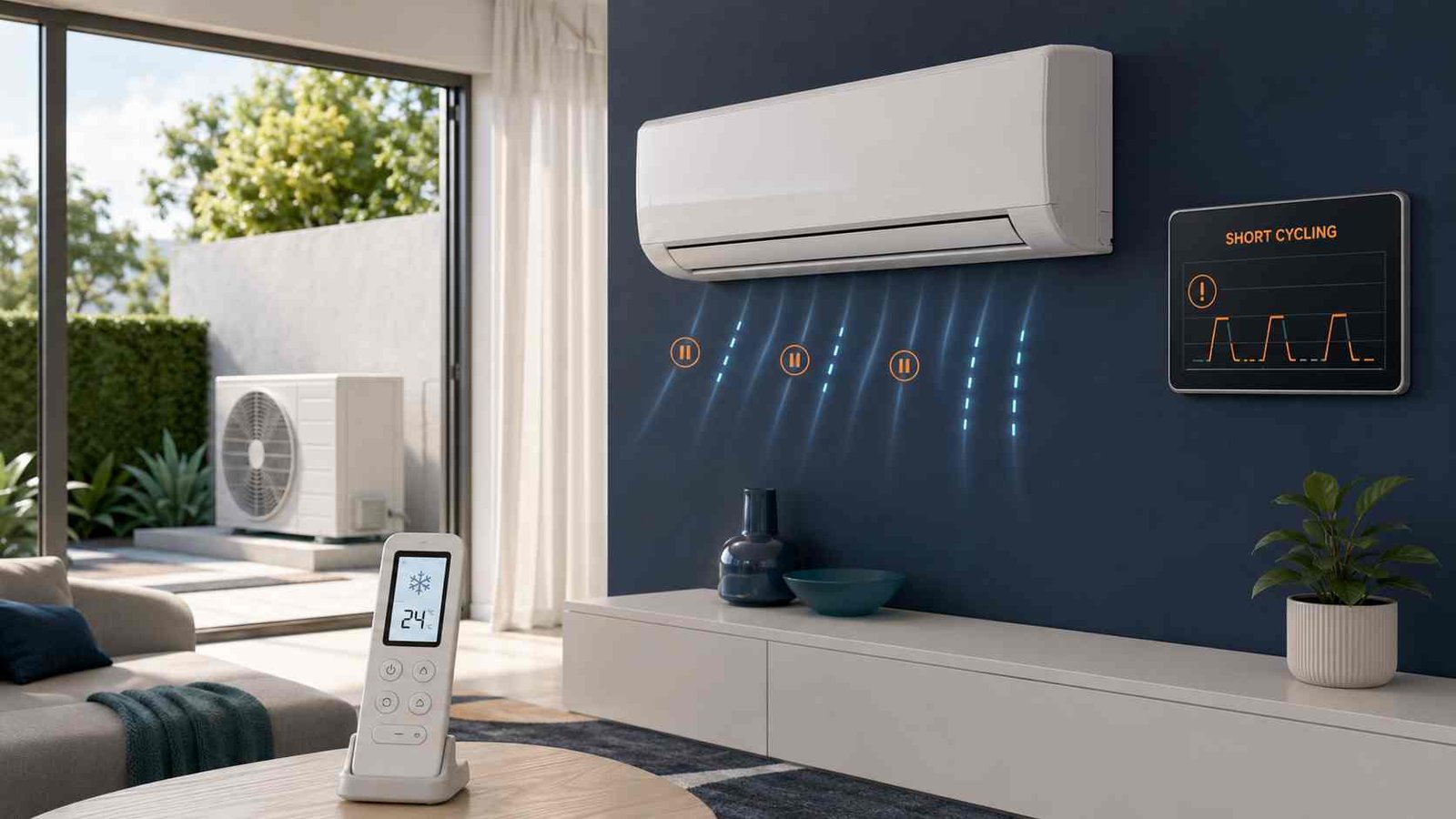
 An air conditioner that keeps turning off may be operating normally, or it may be shutting down before completing a proper cooling cycle. Normal explanations include reaching the selected temperature, an active Eco mode, a timer, or a full water tank on a portable unit. Abnormally rapid on-and-off operation is usually called short cycling.
Start by checking the operating mode, temperature setting, timer, filter, and visible airflow openings. Do not remove electrical covers or open refrigerant components. Stop using the system if it repeatedly trips a breaker, smells burnt, makes unusual electrical noises, leaks water near wiring, or develops recurring ice.
| Item | Details |
|---|---|
| Problem | Air conditioner stops unexpectedly or repeatedly turns on and off |
| Universal error code | None |
| Normal explanations | Temperature reached, Eco mode, timer, restart delay, portable tank full |
| Common fault-related causes | Restricted airflow, thermostat problem, frozen coil, blocked drain, low refrigerant, electrical fault |
| Safe first check | Review the mode, temperature, timer, filter, vents, and error display |
| Repair difficulty | Easy for settings and filter checks; professional diagnosis for internal faults |
| Can it still be used? | Only when the shutdown appears normal and no warning signs are present |
| Call a technician when | Short cycling continues, ice returns, water reaches electrical areas, or a breaker trips repeatedly |
Why Does an Air Conditioner Keep Turning Off?
The answer depends on what actually stops.
In some systems, the compressor turns off while the fan continues running. This may simply mean the selected temperature has been reached. On some window and portable air conditioners, Eco or Energy Saver mode turns off both the compressor and fan, then restarts them when more cooling is needed. GE confirms that its Energy Saver mode can cycle the fan off with the compressor.
The behaviour is more concerning when the unit runs for only a brief period, stops before the room becomes comfortable, and repeatedly restarts. Carrier identifies restricted airflow, thermostat problems, low refrigerant, and incorrect system sizing among the common causes of AC short cycling.
First Check What Is Actually Turning Off
Before changing settings or arranging a repair, watch one complete cycle and note what happens.
The compressor stops but the fan continues
This can be normal. Many air conditioners stop the compressor once the room reaches the target temperature while keeping the fan running to circulate air or monitor room temperature.
A portable unit may also keep its fan running while cycling the compressor. De’Longhi explains that the compressor starts when the measured room temperature rises above the setting and stops when the desired temperature is reached.
The indoor fan and compressor both stop
Check for:
- Eco or Energy Saver mode
- An off timer
- Sleep mode
- A smart-home or app schedule
- The room reaching the selected temperature
- A full water tank on a portable unit
- A displayed error code
The indoor fan runs but the outdoor unit stops
On a central or split system, this may involve the outdoor fan, compressor, electrical controls, refrigerant circuit, or a protective shutdown. Further diagnosis normally requires a qualified HVAC technician.
The display and all power disappear
Check whether:
- The power plug is secure on a portable or window unit
- A wall switch has been turned off
- The circuit breaker has tripped
- A plug-mounted safety device has activated
- Another high-load appliance is sharing the circuit
Do not use an extension lead unless the appliance manual specifically permits it.
The breaker trips
Turn the air conditioner off. A breaker that trips repeatedly may indicate an overloaded circuit, wiring fault, compressor problem, or another electrical defect. Samsung advises professional diagnosis when power problems continue or the breaker trips frequently.
Do not keep resetting the breaker to force the air conditioner to run.
Normal Reasons an Air Conditioner Turns Off
Not every shutdown indicates a failed part.
The selected temperature has been reached
An air conditioner is designed to stop or reduce cooling once the thermostat or temperature sensor detects that the set temperature has been reached.
For a simple test, make sure the unit is in cooling mode and that the selected temperature is below the current room temperature. Do not set the temperature unusually low in an attempt to make the unit cool faster.
Eco or Energy Saver mode is active
Eco mode may stop both the compressor and fan. This can make a correctly operating window or portable air conditioner appear to be losing power.
GE explains that the fan may turn off with the compressor in Energy Saver mode, producing wider temperature changes before the unit restarts.
Temporarily select normal Cool mode to see whether the cycling pattern changes.
A timer or schedule is active
Check the remote control, onboard control panel, mobile app, and smart-home platform for:
- Off timer
- Sleep timer
- Weekly schedule
- Energy-management routine
- Geofencing routine
- Demand-response setting
Cancel the schedule according to the model’s user manual.
A portable AC water tank is full
Portable air conditioners remove moisture from indoor air. Some models shut down when the internal tank reaches its limit to prevent overflowing.
De’Longhi states that its portable units can shut down when the tank fills and must be drained before restarting. Its guidance also recommends checking the water indicator, temperature setting, exhaust hose, and filter when the compressor keeps stopping.
A compressor restart delay is active
Many systems delay compressor restart after being switched off or after a power interruption. This protects the compressor from restarting immediately against high refrigerant pressure.
Leave the controls alone and allow the model’s normal delay to finish. The precise delay varies, so consult the user manual rather than repeatedly switching the power.
A heat pump is defrosting
This applies to heat pumps operating in heating mode, not ordinary cooling operation.
During defrosting, the indoor airflow may stop temporarily while the outdoor unit removes frost. LG notes that the display and duration vary by model and that normal heating should resume automatically after defrosting.
What Is AC Short Cycling?
Short cycling means the air conditioner repeatedly starts and stops without running long enough to cool and dehumidify the space effectively.
Common signs include:
- The unit starts again soon after stopping
- The room remains warmer than the set temperature
- Indoor humidity remains uncomfortable
- The compressor repeatedly starts with a noticeable click or surge
- Different rooms remain unevenly cooled
- The system stops more frequently during hot weather
- Electricity use rises without better comfort
There is no universal minimum runtime that applies to every air conditioner. Runtime changes with outdoor temperature, room size, insulation, humidity, equipment capacity, inverter operation, and the difference between room temperature and the selected setting.
Focus on the pattern. A system that repeatedly stops before providing useful cooling needs attention.
Common Causes of Short Cycling
1. Dirty or incorrectly installed air filter
A clogged filter restricts airflow through the indoor coil. This can reduce cooling, contribute to coil freezing, and force the system to work outside normal conditions.
Carrier and Trane both identify restricted airflow and dirty filters as common AC problems. Trane also notes that reduced airflow can contribute to a frozen evaporator coil.
Clean or replace the filter only according to the appliance manual. Reinstall it in the correct direction and make sure it sits properly in its frame.
2. Blocked indoor airflow
Airflow can also be restricted by:
- Furniture covering a return grille
- Curtains across a wall-unit inlet
- Closed or obstructed supply vents
- Dust on accessible intake grilles
- Items placed directly beneath a wall-mounted unit
- A portable unit pushed too close to a wall
Clear visible obstructions without opening service panels.
3. Incorrect thermostat settings
Confirm that the thermostat is:
- Set to Cool
- Set below room temperature
- Not programmed to turn off
- Not operating in Away or Eco mode
- Displaying a realistic room temperature
- Using fresh batteries, where applicable
A thermostat that intermittently loses power or incorrectly senses room temperature may stop cooling prematurely.
4. Poor thermostat location
A thermostat or room sensor can produce misleading readings when exposed to:
- Direct sunlight
- Air from a supply vent
- Heat from a lamp, television, or kitchen
- Draughts from a door or window
- A warmer or cooler adjoining wall
Carrier and Trane include thermostat problems among recognised short-cycling causes.
Relocating or testing a fixed thermostat is technician-level work.
5. Dirty or obstructed outdoor unit
Leaves, packaging, vegetation, lint, or stored objects around the outdoor unit can restrict airflow and heat rejection.
With the system off, remove only loose items from the surrounding area. Do not remove the grille, place objects inside the coil, or use high-pressure water.
A heavily contaminated coil should be professionally cleaned.
6. Frozen evaporator coil
A frozen coil can be associated with restricted airflow, a fan problem, contamination, or a refrigerant fault.
Possible signs include:
- Ice on accessible refrigerant pipes
- Weak airflow
- Water appearing after the system stops
- Cooling becoming weaker before shutdown
- Ice returning after the filter has been cleaned
Carrier links frozen coils with restricted airflow and refrigerant problems and recommends professional attention when freezing persists.
Turn the cooling system off if visible ice is present. Do not chip, scrape, or heat the ice.
7. Blocked condensate drain or activated float switch
Central and ducted systems remove water through a condensate drain. If that drain blocks, water can rise in the pan.
Some systems have a float or overflow switch that shuts down the indoor unit to reduce the risk of water damage. Not every installation has this safety device.
Look for water around the indoor unit and check whether the accessible drain outlet appears to be flowing normally. Stop the system when water is leaking near electrical parts.
Do not bypass or hold down a float switch.
8. Oversized air conditioner
A system that is too large for the room or building may lower the temperature near the sensor too quickly and shut off before removing enough humidity or distributing cool air evenly.
ENERGY STAR and Trane warn that oversized equipment can cycle too frequently, reduce humidity control, shorten equipment life, and produce uneven comfort.
This problem may have existed since installation. It cannot usually be corrected through a reset or filter change.
9. Temperature sensor or thermistor problem
Window, portable, and split air conditioners often use an electronic temperature sensor rather than a separate wall thermostat.
A loose, damaged, incorrectly positioned, or inaccurate sensor may cause premature shutdown. The exact location and testing procedure vary by model, so internal sensor diagnosis should be left to an authorised service provider.
10. Low refrigerant or a refrigerant leak
Low refrigerant may reduce cooling, contribute to coil freezing, and cause some systems to shut down through pressure or temperature protection.
Refrigerant does not normally need routine topping up in a sealed system. A low charge may indicate leakage, incorrect commissioning, or previous service work.
Do not open refrigerant connections or use a DIY charging kit. In the United States, technicians handling stationary air-conditioning refrigerants generally require EPA Section 608 certification. UK companies servicing stationary F-gas air-conditioning equipment must meet applicable certification requirements.
11. Electrical or control component failure
A technician may need to inspect components such as:
- Capacitor
- Contactor or relay
- Compressor overload protector
- Indoor or outdoor fan motor
- Control board
- Power supply connections
- Thermostat circuit
- Pressure or temperature safety controls
Do not test capacitors, live wiring, compressor terminals, or internal voltage.
Safe Step-by-Step Troubleshooting
Step 1: Observe one shutdown cycle
Record:
- How long the unit runs
- Whether the room reaches the set temperature
- Whether the fan, compressor, or entire unit stops
- Whether the display stays on
- Whether an error code appears
- How soon the system restarts
A short video of the control panel or indicator lights can help a technician identify the pattern.
Step 2: Check the mode and temperature
Select Cool mode and cancel Auto, Dry, Fan Only, Sleep, or Eco mode temporarily.
Set a normal cooling temperature below the measured room temperature. Make sure the remote is controlling the correct unit.
Step 3: Cancel timers and schedules
Review the remote, control panel, mobile app, and smart-home routines. Cancel active off timers and automated schedules.
Step 4: Inspect the filter
Switch the unit off and follow the manual’s filter-removal instructions. Clean a washable filter or replace a disposable filter as specified by the manufacturer.
Do not run the air conditioner without its filter unless the manual explicitly instructs you to do so for a brief diagnostic check.
Step 5: Clear visible airflow obstructions
Open normal supply vents and move furniture, curtains, or stored items away from air inlets and outlets.
Check that the outdoor unit has clear surrounding space.
Step 6: Check portable-unit items
For a portable air conditioner:
- Look for a tank-full or drain symbol
- Drain it according to the manual
- Straighten the exhaust hose
- Confirm the hose is securely connected
- Keep the hose as short and direct as the installation instructions allow
- Check the window panel and room seal
- Clean the accessible filter
Step 7: Look for water or ice
Stop cooling if you find:
- Ice on accessible pipes or coils
- Water near wiring or plugs
- Water overflowing from the indoor unit
- A saturated ceiling or wall near concealed equipment
- Repeated drain or tank warnings
Step 8: Read error codes and light patterns
Write down the exact letters, numbers, and flashing sequence. Do not assume that similar-looking codes have the same meaning across brands.
Search by the complete brand and model number.
Step 9: Perform one model-approved restart
Use the restart instructions in the owner’s manual. For many units, this means switching the appliance off through its normal controls before disconnecting power.
Do not repeatedly cycle the breaker. Do not use a reset as a substitute for investigating a recurring fault.
Step 10: Arrange service if the problem returns
A shutdown that returns after the filter, settings, timer, airflow, and portable drainage checks may require electrical, sensor, refrigerant, drain, or compressor diagnosis.
What Shutdown Timing May Suggest
| Shutdown pattern | Possible explanation | Safe next action |
|---|---|---|
| Stops when room becomes comfortable | Normal thermostat operation | Monitor the temperature and restart pattern |
| Stops immediately after starting | Power, control, sensor, or compressor protection issue | Record any code and stop repeated restarting |
| Stops after a few minutes | Short cycling, poor airflow, sensor fault, ice, or electrical protection | Check settings, filter, airflow, water, and ice |
| Stops only on very hot days | Outdoor airflow issue, overheating, electrical load, or system capacity problem | Clear visible obstructions and arrange diagnosis |
| Stops when water appears | Blocked drain, full portable tank, or float-switch shutdown | Turn off and address the water source |
| Stops and trips the breaker | Electrical, wiring, motor, or compressor fault | Leave it off and call a qualified professional |
| Stops in heating mode with a defrost indication | Normal heat-pump defrost may be active | Allow the cycle to complete |
| Stops but fan keeps running | Temperature reached or compressor-related shutdown | Compare room temperature with the setting |
When the Filter Is Clean but the AC Still Turns Off
A clean filter rules out only one possible cause.
Next, check:
- Whether Eco mode or a schedule is active.
- Whether the thermostat is exposed to sunlight or supply air.
- Whether the outdoor unit is obstructed.
- Whether water has activated a drain safety switch.
- Whether ice is forming.
- Whether a portable unit has a blocked exhaust hose.
- Whether an error code or flashing pattern appears.
- Whether the breaker, plug, or display loses power.
Continued short cycling after these checks usually needs professional diagnosis.
Is It Safe to Keep Using the Air Conditioner?
Continued use may be reasonable when the system is simply reaching its set temperature or following an enabled Eco, timer, or defrost function.
Turn the system off and arrange service when:
- The breaker trips more than once
- A plug, cable, switch, or outlet becomes hot
- There is a burning or electrical smell
- Buzzing, arcing, or sparking occurs
- Water reaches electrical parts
- Ice repeatedly returns
- The unit restarts every few minutes without cooling
- An error code returns after a normal restart
- The outdoor unit becomes unusually noisy or stops repeatedly
- Refrigerant leakage is suspected
When to Call an HVAC Technician
Professional help is appropriate when basic user checks do not correct the problem.
Give the technician:
- The complete brand and model number
- The thermostat or remote settings
- The approximate runtime before shutdown
- The time before it restarts
- Any error code or flashing-light sequence
- Whether the fan or complete system stops
- Whether the breaker trips
- Whether ice or water is present
- Whether the problem began after installation, maintenance, or a power interruption
This information can reduce guesswork and help the technician choose the correct service documents.
Frequently Asked Questions
Why does my AC turn off after five minutes?
Possible causes include Eco mode, an incorrect thermostat reading, restricted airflow, a blocked drain, a frozen coil, a temperature sensor problem, or an electrical protection shutdown. Record what stops and whether an error code appears.
Is it normal for an air conditioner to turn on and off?
Yes. A conventional air conditioner normally cycles as the room temperature changes. It becomes a concern when it restarts rapidly, fails to cool the room, trips a breaker, or shows other fault symptoms.
Can a dirty filter make an air conditioner shut off?
Yes. A severely restricted filter can reduce airflow and contribute to poor cooling or coil freezing. Clean or replace it according to the manufacturer’s instructions.
Why does my portable air conditioner keep turning off?
Check whether the room has reached the set temperature, the water tank is full, the exhaust hose is kinked, the filter is dirty, or a timer is enabled. These are among the checks recommended in De’Longhi’s portable-unit guidance.
Why does the air conditioner stop but the fan keeps running?
The compressor may have reached the selected temperature while the fan continues circulating air. It can also indicate a compressor, refrigerant, or control problem if the room remains warm.
Can low refrigerant cause short cycling?
Low refrigerant may contribute to poor cooling, coil freezing, and protective shutdowns. Refrigerant pressure and leak diagnosis require appropriate tools and qualified handling.
Should I reset the AC breaker?
A tripped breaker can be reset once only when there is no burning smell, visible damage, water near electrical parts, or other obvious hazard. Leave the unit off if the breaker trips again.
Can an oversized air conditioner keep turning off?
Yes. An oversized system may cool the area near the thermostat too quickly, causing frequent cycling and weak humidity control. Correct equipment sizing requires a proper load assessment.

Emily Carter is an Australian home-appliance safety editor with 9 years of experience researching washers, air conditioners, refrigerators, and coffee machines. She checks troubleshooting steps for accuracy, regional model differences, and homeowner safety before publication.