
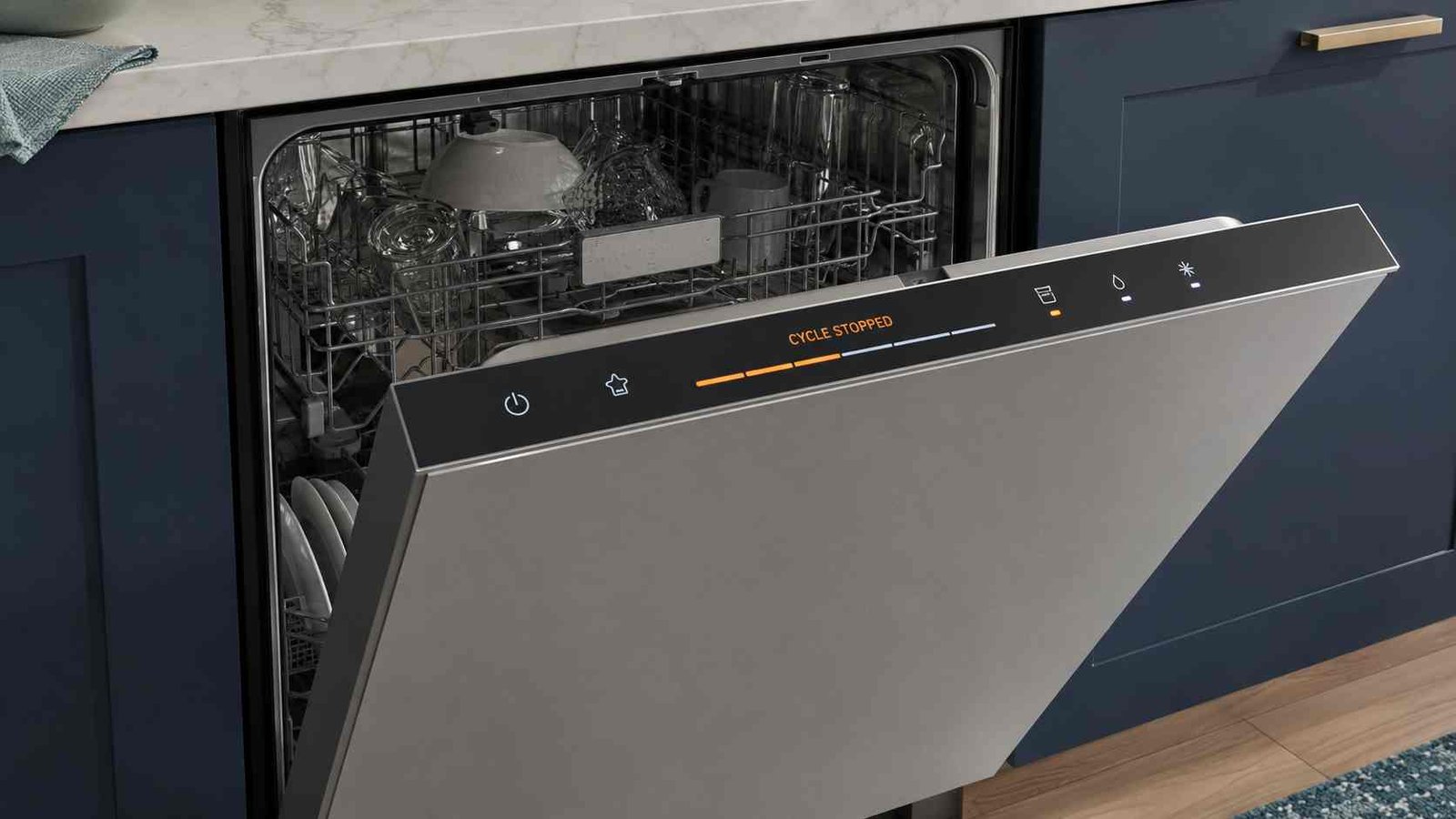
 A dishwasher that starts but stops mid-cycle may have an interrupted door latch, drainage problem, restricted water supply, power issue, leak warning, or internal component fault. However, a short pause does not always mean something is broken. Some dishwashers pause while heating water, changing spray arms, or draining.
Start by waiting a few minutes to see whether the cycle continues. If it remains stopped, record any error code, flashing light, or beep pattern. Then check that the door is firmly closed, the water valve is open, the filter is clean, and the visible drain hose is not kinked.
Stop using the dishwasher if it leaks, smells burnt, repeatedly trips the circuit breaker, or runs the drain pump continuously.
| Detail | Answer |
|---|---|
| Appliance | Dishwasher |
| Main symptom | Starts normally but stops before completing the cycle |
| Most common areas to check | Door latch, loading, filter, drain hose, water supply, power |
| Safe first action | Wait briefly, record warning indicators, then check the door and filter |
| Error code | May be absent, displayed as a code, or shown through flashing lights |
| Basic repair difficulty | Easy for external checks and filter cleaning |
| Advanced repair difficulty | Moderate to high for pumps, sensors, wiring, or control faults |
| Can it still be used? | Only when there is no leak, electrical warning, or recurring fault |
| Call a technician when | The fault returns after basic checks and one model-appropriate reset |
Is the Dishwasher Actually Stopping?
Dishwashers do not operate continuously from the moment Start is pressed until the cycle ends. The wash motor, drain pump, inlet valve, and heater run at different stages.
A quiet period may therefore be part of normal operation.
Normal drain-pump pauses
Some dishwashers intentionally stop and restart the drain pump during the draining stage. GE states that this start-and-stop pattern can be normal because it helps remove food particles from the filter area.
Alternating spray-arm operation
On selected models, the wash pump directs water to different spray arms in sequence. The motor may stop for several seconds as the flow changes between the upper and lower arms. This can sound as though the cycle has stopped even though it is progressing normally.
Water-heating pauses
Some dishwashers pause while raising the water to the temperature required for the selected programme. Depending on the model and incoming water temperature, the timer may appear not to move for an extended period. Whirlpool and GE both describe heating pauses as part of normal operation on selected models.
A pause is more likely to indicate a problem when:
- The dishwasher never restarts
- The display becomes completely blank
- Water remains across the tub floor
- The same problem occurs at the same point every time
- An error code, warning symbol, or repeating beep appears
- The door has moved open
- The drain pump runs without stopping
- The household breaker has tripped
Check When the Cycle Stops
The point at which the dishwasher stops can narrow down the likely cause.
| When it stops | Possible area | First safe check |
|---|---|---|
| Immediately after Start | Door, Start/Resume command, water supply or control setting | Close the door firmly and press Start as directed by the manual |
| After filling with water | Circulation system, door switch or internal control | Listen for spraying and check for a warning code |
| During the main wash | Door movement, power, heating, motor or control fault | Check loading, power and warning indicators |
| During draining | Filter, drain hose, sink connection or drain pump | Inspect and clean the user-accessible drain path |
| Near the drying stage | Normal cycle completion, venting or heating issue | Confirm whether the End or Clean indicator is showing |
| At random with a blank display | Household power, connection or internal electrical fault | Check the breaker once and stop if it trips again |
1. The Dishwasher Stops Immediately After Starting
If the dishwasher stops within seconds, first check whether the door is fully latched.
A large plate, pan handle, utensil, or incorrectly positioned rack can press against the door. The machine may start when the door is pushed closed but stop when pressure from the load causes the latch to move.
Bosch recommends checking the door closure, loading, power supply, water supply and latch when a dishwasher stops mid-cycle.
Try the following:
- Open the dishwasher.
- Push both racks fully into position.
- Move large items away from the front of the racks.
- Check that no utensil extends through a rack.
- Close the door until the latch engages.
- Press Start or Resume if your model requires it.
On some dishwashers, closing the door is not enough after an interruption. The Start or Resume control must also be pressed within a specified time. Consult the model’s user manual rather than guessing the button sequence.
2. The Dishwasher Fills and Then Stops
If water enters the tub but spraying never begins, listen carefully after the filling sound ends.
A functioning circulation system normally produces a clear rushing or spraying sound. Silence after filling may indicate that the circulation motor has not started. It may also involve a door-switch interruption, control problem, thermal protection device, or another internal fault.
Maytag states that a dishwasher which fills but stops before washing may have a technical problem involving the thermal fuse or electronic control board. Those parts require professional diagnosis rather than live electrical testing by a homeowner.
Before requesting service:
- Confirm the door remains firmly closed
- Check for a displayed code or flashing-light pattern
- Cancel and drain the cycle according to the manual
- Perform one controlled reset
- Run a short empty test programme
If the dishwasher fills and stops again, do not keep restarting it. The symptom alone cannot confirm whether the circulation pump, control, fuse, sensor, or wiring is responsible.
3. The Dishwasher Stops During the Main Wash
A machine that sprays normally and then stops may have experienced a door interruption, loss of water, power interruption, heating problem, motor protection event, or control fault.
Check whether:
- A dish or utensil is touching the door
- The latch feels loose or damaged
- The display remains illuminated
- The remaining time is frozen
- The circuit breaker has tripped
- A warning light is flashing
- A code appears after opening the door
Dishwashers without text displays may communicate faults through combinations of blinking lights. Samsung advises treating blinking lights as an error indication when the machine is also behaving abnormally, such as stopping mid-cycle.
Record exactly which lights flash. Do not assume that the same pattern has the same meaning across brands or model families.
4. The Dishwasher Stops While Draining
Drainage is one of the first areas to inspect when a dishwasher stops with water inside.
Whirlpool recommends checking the filter, drain hose and sink-disposal connection when a dishwasher stops mid-cycle. A kinked, pinched or clogged hose can prevent the machine from completing the drain stage.
Clean the filter
- Turn the dishwasher off.
- Allow hot water and dishes to cool.
- Remove the lower rack.
- Locate the removable filter using the owner’s manual.
- Remove it carefully.
- Rinse it under running water.
- Remove food deposits with a soft brush.
- Reinstall and lock it correctly.
Wear protective gloves if broken glass, bones, toothpicks or sharp food fragments may be present.
Do not force a filter that does not release easily. Filter designs vary, and incorrect removal can damage the locking tabs or sump cover.
Check the drain hose
Inspect only the visible and safely accessible part of the hose.
Look for:
- A sharp bend
- A compressed section behind the machine
- Damage or flattening
- A blockage near the sink connection
- A hose displaced after items were stored under the sink
Avoid pulling an integrated dishwasher out of its cabinet unless the installation instructions clearly permit it and the power and water supplies have been safely isolated.
Check the sink connection
Run water in the kitchen sink. If the sink drains slowly, the problem may be in the household plumbing rather than the dishwasher.
For machines connected to a garbage disposal, make sure the disposal is clear. A newly installed disposal may still have its dishwasher knockout plug in place. Samsung also advises checking for a proper air gap or high drain loop where local installation rules require one.
5. Check the Water Supply
A dishwasher may stop if it cannot obtain enough water for the next stage.
Make sure:
- The dishwasher water valve is fully open
- The household water supply is operating
- The inlet hose is not visibly kinked
- No water-supply warning is displayed
- Another plumbing issue has not reduced water flow
Bosch and Whirlpool both identify an interrupted or closed water supply as a possible reason a dishwasher cannot start or continue normally.
Do not disconnect pressurised hoses or dismantle the inlet valve as part of a basic homeowner check.
6. Check the Household Power
Look at the control panel when the dishwasher stops.
If the lights remain on, the problem may be related to the programme, door, water, drainage, or an appliance component.
If the control panel becomes completely blank:
- Check whether other appliances or lights have lost power.
- Inspect the dishwasher’s circuit breaker or fuse.
- Reset a tripped breaker once.
- Run the dishwasher only if power remains stable and there are no other warning signs.
Stop if the breaker trips again. Repeated tripping may indicate a shorted component, damaged connection, heater fault, wiring problem, or fault in the household circuit. Do not repeatedly reset the breaker or perform live-voltage testing.
7. Look for a Leak or Continuous Draining
A dishwasher that stops washing but continues to run its drain pump may be reacting to detected water in its base.
On some Electrolux models, an i30 code, three flashes, three beeps, or persistent draining may indicate that the anti-flood system has detected water beneath the wash compartment. Electrolux recommends closing the water tap and arranging service when the condition occurs or returns.
Samsung also explains that selected leakage errors can make the dishwasher continue trying to drain rather than operate normally.
Stop using the dishwasher when:
- Water is visible beneath or around it
- A leak code appears
- The drain pump continues indefinitely
- The machine starts draining by itself
- Water returns after being cleaned up
- The water-supply hose appears wet or damaged
Turn off the water supply when it is safe and accessible. Disconnect power according to the manufacturer’s instructions, then arrange professional inspection.
Step-by-Step Troubleshooting Order
Use this sequence to avoid unnecessary disassembly.
Step 1: Wait briefly
Give the dishwasher enough time to complete a normal heating, spray-change, or drain pause.
Step 2: Record the symptoms
Write down:
- The programme selected
- Time before the stop
- Remaining time on the display
- Error code
- Flashing lights
- Number of beeps
- Whether water remains
- Whether the machine still has power
Step 3: Check the door and loading
Move large items away from the door and confirm that both racks are fully seated.
Step 4: Cancel and drain the cycle
Use the Cancel or Drain control described in the model’s manual. Allow the pump to finish before opening the filter area.
Step 5: Clean the filter
Remove accumulated food and reinstall the filter correctly.
Step 6: Inspect the external drain path
Check the visible hose, sink drain, garbage disposal, air gap, high loop, sink spigot or trap connection as applicable.
Step 7: Confirm water and power
Make sure the water valve is open and the household electrical supply is stable.
Step 8: Perform one reset
Reset the controls only after completing the physical checks.
Step 9: Run a short test cycle
Run the dishwasher empty or with a small safe load. Stay nearby during the test.
Stop the test immediately if the machine leaks, smells hot, produces unusual electrical sounds, or trips the breaker.
How to Reset a Dishwasher That Stops Mid-Cycle
Reset procedures are not universal. Control labels and button combinations differ between brands, product series, integrated machines and freestanding models.
A commonly supported process is:
- Press Cancel or Drain if the control panel responds.
- Allow the drain cycle to finish.
- Switch the dishwasher off.
- Unplug it, or switch off its dedicated breaker if the plug is inaccessible.
- Wait at least one minute.
- Restore power.
- Close the door firmly.
- Select a new cycle and press Start.
Whirlpool describes a similar cancel, drain and one-minute power-cycle process. Electrolux notes that some integrated and freestanding models use different controls to cancel a programme, while Bosch provides model-specific reset guidance. Always follow the manual for the exact appliance.
A reset may clear a temporary control interruption. It will not repair:
- A blocked drain
- A door that will not latch
- A water leak
- A failed pump
- A defective sensor
- Damaged wiring
- A recurring heating fault
- A failed electronic control
Do not reset the dishwasher repeatedly when the same problem returns.
What Standing Water Can Tell You
The amount and condition of the water provide useful clues.
A small amount near the filter
A shallow amount of clean water near the sump or filter may be normal on selected models. GE notes that some dishwashers retain a small amount of water in the bottom of the tub. Check the manual before treating every visible drop as a drainage fault.
Water covering the tub floor
Water spread across the bottom of the dishwasher is more consistent with an interrupted or failed drain stage.
Check:
- Filter
- Drain hose
- Sink drain
- Disposal connection
- Air gap or high loop
- Sink spigot or trap
Dirty water returning later
Water that disappears and later returns may indicate backflow from the sink drain. Drain-hose routing and the sink connection should be checked.
Continuous pump noise with little visible water
This may indicate a leak-protection response rather than a simple blocked filter. Stop the machine and check for an error code or water beneath the appliance.
Possible Faulty Parts
The following parts may be involved when basic checks do not solve the problem. The symptom alone cannot confirm a failed part.
| Part or system | Supporting symptom | Homeowner repair? |
|---|---|---|
| Door latch or door switch | Stops when the door moves or requires pressure to run | Visual inspection only |
| Drain pump | Water remains and the machine cannot complete draining | Professional diagnosis recommended |
| Circulation pump or motor | Fills but no spraying begins | Professional diagnosis |
| Water inlet valve | Inadequate filling or water-supply code | Professional diagnosis |
| Float or water-level sensor | Incorrect fill behaviour or repeated draining | Professional diagnosis |
| Leak or anti-flood sensor | Continuous draining or leak warning | Find visible leaks only; arrange service |
| Thermal fuse | Unit stops or loses internal functions | Do not bypass; professional replacement |
| Heater or temperature sensor | Stops or waits during a heating stage | Professional diagnosis |
| Electronic control board | Random stopping or failure to advance | Professional diagnosis |
| Wiring or power connection | Intermittent power or breaker trip | Qualified appliance professional or electrician |
Internal testing may involve mains voltage, sharp metal edges, stored electrical energy and water near live components. Do not bypass switches, fuses, leak sensors or other safety devices.
Regional and Model Differences
The basic troubleshooting approach is similar across the United States, Canada, United Kingdom, Ireland, Australia and New Zealand. The main differences involve terminology, installation and control layouts.
United States and Canada
Drainage instructions may refer to:
- Garbage disposal
- Disposal knockout plug
- Countertop air gap
- High drain loop
- Sink drain connection
Samsung Canada notes that local regulations may require an air gap or high loop to prevent wastewater from flowing back into the dishwasher.
United Kingdom and Ireland
Instructions may instead refer to:
- Sink spigot
- Siphon or sink trap
- Blanking plug
- Waste-water connection
- Programme rather than cycle
Electrolux UK identifies a blocked sink spigot or an unremoved blanking plug as possible causes of dishwasher drainage trouble.
Integrated and top-control dishwashers
A top-control model may appear completely inactive when the door is closed because its display is hidden beneath the counter. Check the floor-status light, audible signals or app notification where fitted.
Integrated and freestanding models may also use different cancel procedures, even within the same brand.
Dishwashers without a digital display
A model without a text display may communicate a fault through:
- Flashing programme lights
- A repeating Start light
- Beep sequences
- Tap, drain or door symbols
- Status lights projected onto the floor
Record the exact pattern and look it up using the complete model number.
When to Stop Troubleshooting
Turn the dishwasher off and arrange professional help when:
- Water is leaking beneath the appliance
- A leak or anti-flood warning appears
- The drain pump operates continuously
- The breaker or fuse trips more than once
- There is a burning smell, smoke or unusual heat
- The power cord, plug or connection appears damaged
- The dishwasher fills but never starts spraying
- The machine stops at the same stage after one reset
- An error code returns after the recommended checks
- Accessing the suspected part requires major disassembly
What to Tell the Technician
Providing clear observations can reduce unnecessary diagnosis time.
Have the following ready:
- Full model number
- Serial number
- Displayed error code
- Flashing-light or beep pattern
- Selected programme
- Approximate time before stopping
- Whether the dishwasher filled
- Whether spraying began
- Whether it drained
- Amount of water left inside
- Whether power was lost
- Whether the problem repeats on every programme
- Any recent installation, plumbing or disposal work
Frequently Asked Questions
Why does my dishwasher run for a few minutes and then stop?
First determine whether it restarts by itself. A brief pause may be normal during heating, draining or spray-arm changes. If it remains stopped, check the door, displayed warnings, filter, drain hose, water supply and household power.
Why does my dishwasher fill with water but not start washing?
The circulation system may not be starting. A door-switch interruption, circulation-pump fault, thermal fuse, control problem or another internal issue may be involved. Cancel the cycle, perform the safe external checks and request service if the condition repeats.
Can a clogged filter make a dishwasher stop mid-cycle?
Yes. A heavily restricted filter can contribute to poor drainage and prevent the machine from completing the drain stage. Clean only the user-removable filter according to the owner’s manual.
Is it normal for a dishwasher to pause during washing?
Short pauses can be normal. Some dishwashers pause while heating water, changing the active spray arm, or pulsing the drain pump. A long pause accompanied by standing water, warning lights or loss of power needs investigation.
Why does my dishwasher stop and start beeping?
The beeping may indicate an open door, interrupted programme, completed cycle or fault. Count the beeps and record any flashing lights or symbols. Their meaning varies by brand and model.
Can I restart a dishwasher after opening the door?
Usually, but the method differs. Some models resume after the door is closed, while others require the Start or Resume button to be pressed before or immediately after closing. Follow the instructions for the specific model.
Is it safe to use a dishwasher that keeps stopping?
Do not continue using it if there is leaking, repeated breaker tripping, burning smell, continuous draining or a recurring error. A machine with no safety warning may be tested once after basic checks and a proper reset.
Why does my dishwasher stop even though the filter is clean?
The cause may be elsewhere, such as the door latch, drain hose, sink connection, water supply, circulation pump, sensor, heating system, thermal fuse or electronic control. Further diagnosis may require a qualified technician.
Daniel Brooks is a US-based appliance troubleshooting researcher with 12 years of experience studying washer, dryer, refrigerator, and dishwasher faults. He reviews manufacturer manuals and converts technical error codes into safe, practical guidance for homeowners.