
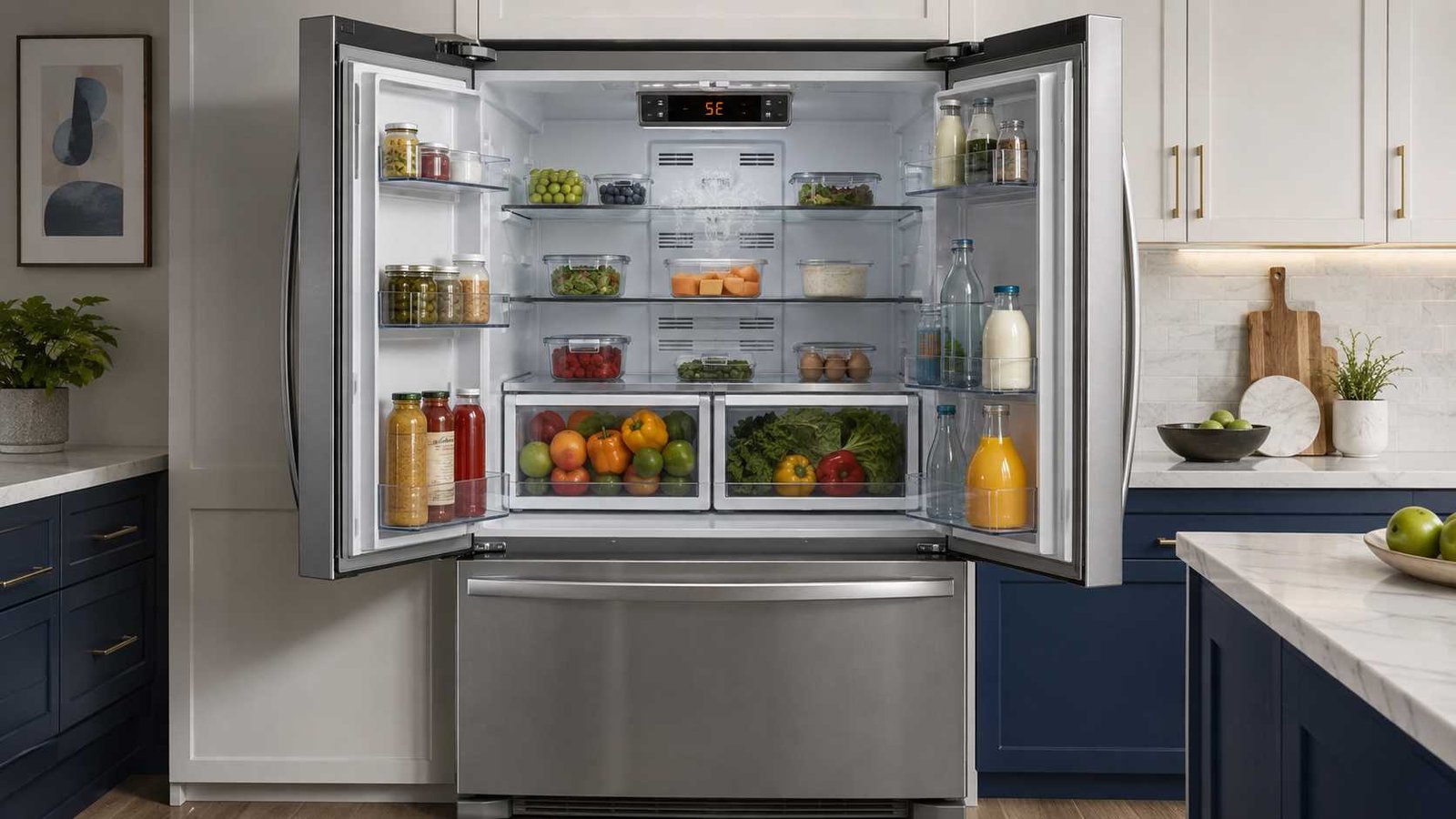
 The Samsung Refrigerator 5E Error usually means the appliance has detected a problem with the refrigerator compartment’s defrost sensor. On some models, the same fault may appear as 5C.
Start by photographing the code, finding the complete refrigerator model number, and checking the actual compartment temperature with an appliance thermometer. Avoid immediately unplugging the refrigerator or pressing random button combinations. Samsung warns that clearing an error without instructions can make the underlying fault harder for a technician to diagnose.
You may continue storing food only while the refrigerator remains at 40°F or 4°C or below and the freezer remains at 0°F or −18°C or below. Move perishable food elsewhere if temperatures begin rising or cooling becomes unreliable.
Important: This guide applies to Samsung refrigerators and fridge freezers. On Samsung washing machines and dishwashers, 5E or 5C commonly means a drainage problem instead.
Samsung Refrigerator 5E
| Item | Details |
|---|---|
| Error code | 5E, or 5C on selected models |
| Confirmed meaning | Refrigerator defrost sensor error |
| Appliance area | Fresh-food or refrigerator compartment |
| What the control detects | An open or shorted sensor signal |
| Safe first action | Photograph the code and check the actual temperature |
| Can you reset it? | Do not use an unverified reset sequence |
| Can the fridge still be used? | Only while safe temperatures are confirmed |
| Repair difficulty | Usually technician-level |
| When service is needed | When the code persists, returns or cooling weakens |
Samsung’s US error-code guide identifies 5E as a fridge defrost sensor error. Samsung’s model-specific Canadian documentation shows that selected refrigerators may display either 5E or 5C for this condition.
What Does 5E Mean on a Samsung Refrigerator?
A Samsung refrigerator uses temperature sensors to help its control system manage cooling and defrost operation. The defrost sensor monitors conditions around the refrigerator compartment’s evaporator area so the control can determine how the system is behaving.
Code 5E appears when the control receives a sensor reading that it interprets as an open or shorted circuit. Samsung’s model-specific documentation describes an open-sensor condition as an implausibly low reading and a short-sensor condition as an implausibly high reading. These figures are fault-detection values, not the actual temperature inside your refrigerator.
The code confirms a problem with the sensor signal. It does not, by itself, prove which individual component has failed.
Is 5E the same as 5C?
On selected Samsung refrigerators, yes. Samsung documents 5E or 5C as a refrigerator defrost sensor error for model RF32FMQDBSR/AA. Other models or regional control panels may use a different code format.
Do not assume every Samsung model treats 5E and 5C identically. Check the manual or support page for the complete model code, including the suffix after the slash where applicable.
Could the display actually say SE?
Possibly. Segmented displays can make the number 5 look like the letter S. Photograph the display and compare it with the refrigerator manual before searching for parts or repair instructions.
Do Not Confuse Refrigerator 5E with a Drainage Error
Samsung uses the same or similar codes across different appliance types.
On Samsung washing machines, 5E or 5C generally means the washer cannot drain correctly. Samsung also uses 5E or 5C for drainage faults on selected dishwashers. Those appliances may require drain-filter or hose checks, but those instructions do not apply to a refrigerator.
| Samsung appliance | Typical meaning of 5E or 5C |
|---|---|
| Refrigerator | Refrigerator defrost sensor error |
| Washing machine | Drainage problem on many models |
| Dishwasher | Drainage problem on many models |
Always include the appliance type when searching for the code.
Possible Causes of Samsung Refrigerator Code 5E
The confirmed issue is an abnormal defrost-sensor signal. The exact underlying cause requires model-specific testing.
1. Failed defrost sensor
The sensor itself may have failed internally and may be sending an open or shorted signal to the control.
2. Loose or damaged connection
A connector in the sensor circuit may be loose, damaged or affected by moisture. This cannot be confirmed from the display alone.
3. Open or shorted wiring
A broken wire can produce an open-circuit reading, while damaged insulation or a pinched harness may create a shorted signal.
4. Control-system input problem
Less commonly, the sensor input at the control may not be processing the signal correctly.
Samsung’s consumer documentation confirms that the appliance is detecting an open or shorted sensor condition. Checking the sensor, connector, wire harness and control input is therefore a reasonable technician-level diagnostic path, but Samsung does not identify one universal failed part for every 5E case.
Do not order a replacement sensor using only the 5E code. Sensor designs and part numbers differ by model, production revision and market.
Symptoms That May Appear with the 5E Error
The refrigerator may show the code before there is an obvious cooling problem. Possible accompanying symptoms include:
- The refrigerator compartment becoming warmer
- Uneven temperatures between shelves
- Frost around the back wall or air vents
- Longer compressor or fan running periods
- Food freezing near one area while warming elsewhere
- Another cooling or fan-related code appearing
- Normal cooling at first, followed by reduced performance
Visible frost does not automatically prove that the defrost sensor has failed. Samsung explains that frost can also develop when warm air enters through an open or poorly sealing door, hot food is stored inside, or rear vents are obstructed.
Safe Checks You Can Perform
These checks do not require removing internal panels or testing electrical components.
1. Photograph the error code
Take a clear photo before pressing any controls. Also note:
- Whether it says 5E, 5C or SE
- Any other displayed codes
- Whether the temperature display is blinking
- Whether the code appeared after a power interruption
- Whether cooling has changed
Samsung advises against clearing an error without specific instructions because the stored or displayed information can help with diagnosis.
2. Find the complete model number
Check the rating label inside the refrigerator compartment, commonly near a side wall, upper interior area or crisper section. Record the full model code and serial number.
Do not use the appearance of the refrigerator to identify a part. Two visually similar French-door refrigerators may use different sensors, harnesses or control systems.
3. Check the actual temperature
Place an appliance thermometer in the centre of the refrigerator compartment. Avoid relying only on the control-panel setting because it may show the selected temperature rather than the current food temperature.
The refrigerator should remain at 40°F or 4°C or below, while the freezer should remain at 0°F or −18°C or below. Samsung’s Canadian guidance recommends 3°C or 38°F for the refrigerator and −19°C or −2°F for the freezer as normal settings, while recognising 4°C and −18°C as safe limits.
4. Keep the doors closed
Limit door openings while checking cooling. Each opening allows warm, moist air inside and makes it harder to determine whether the appliance can maintain temperature.
5. Check that the doors close fully
Look for food packages, drawers or shelves preventing a door from closing. Inspect the gasket for folded areas, dirt or visible gaps.
Samsung notes that a door that does not close correctly can affect cooling and contribute to frost formation.
6. Keep food away from the vents
Do not pack food tightly against rear air openings. Leave space for cold air to circulate.
Samsung advises leaving approximately two inches of space in front of rear vents because blocked airflow can contribute to moisture and frost.
7. Look for visible frost
Check accessible surfaces around the back wall and vents without removing shelves, covers or screws.
A small amount of surface frost may result from a door or airflow problem. Heavy frost, recurring ice or frost behind an internal cover requires further diagnosis.
Never use a hair dryer or heat gun to melt refrigerator frost. Samsung warns that a hair dryer can damage the refrigerator.
Should You Reset a Samsung Refrigerator Showing 5E?
A reset may clear the display temporarily, but it cannot repair a failed sensor, damaged wire or faulty connection.
Samsung Canada specifically advises users not to unplug the refrigerator or interact with the control panel merely to clear an error unless they have been instructed to do so. Erasing the code can make professional diagnosis more difficult. Samsung’s US guide directs users to request service for refrigerator error codes without a listed homeowner solution, including codes such as 5E.
Recommended approach
- Photograph the code.
- Record the model and serial numbers.
- Verify refrigerator and freezer temperatures.
- Check the doors, seals and airflow.
- Review the model-specific manual.
- Contact Samsung support or a qualified refrigerator technician if the code remains.
Only perform a power cycle or button sequence when the manual or Samsung support instructions for your exact model tell you to do so.
What if 5E appeared after a power outage?
Samsung states that all icons flashing briefly after the refrigerator is plugged in or power is restored can be part of the normal self-diagnostic process. A persistent 5E display, however, is identified separately as a defrost-sensor error.
Allow the startup display to finish. If 5E remains or returns, document it and arrange further support rather than repeatedly restarting the appliance.
What Not to Do
Stop before any procedure involving internal electrical components or significant disassembly.
Do not:
- Remove the evaporator or rear interior cover
- Test live voltage
- Probe control-board terminals
- Cut, splice or bypass sensor wiring
- Bypass a safety or temperature device
- Use a heat gun or hair dryer
- Strike or chip ice with a knife or metal tool
- Replace the control board based only on the code
- Install a part without confirming model compatibility
- Repeatedly erase the error before a technician sees it
The defrost sensor is normally located in an area that requires internal access. Reaching it may expose wiring, sharp metal, fragile plastic, refrigerant tubing or heavily frozen components.
Can You Still Use the Refrigerator?
The code does not automatically mean that all stored food is unsafe. What matters immediately is the actual temperature.
You may continue using the appliance temporarily when:
- The refrigerator remains at 40°F or 4°C or below
- The freezer remains at 0°F or −18°C or below
- Temperatures are stable
- Doors close correctly
- There is no burning smell, repeated tripping or unusual electrical noise
Move perishable food to another working refrigerator or an ice-filled cooler when the temperature begins rising or cannot be verified.
The FDA advises that food is generally safe when the refrigerator remains at or below 40°F. When food has been above 40°F for more than two hours, or the time is unknown, it may need to be discarded. Do not rely on smell or appearance alone to judge safety.
Homeowner Checks Versus Technician Diagnosis
| Check or action | Homeowner | Technician |
|---|---|---|
| Photograph the code | ✓ | |
| Record model and serial number | ✓ | |
| Measure compartment temperature | ✓ | |
| Check doors and accessible gaskets | ✓ | |
| Move food away from vents | ✓ | |
| Observe accessible frost | ✓ | |
| Remove evaporator cover | ✓ | |
| Test defrost sensor electrically | ✓ | |
| Inspect concealed connectors | ✓ | |
| Test internal wire harness | ✓ | |
| Confirm control-board input | ✓ | |
| Replace model-specific parts | ✓ |
What a Technician May Check
A qualified technician may use the model’s service information to inspect:
Defrost-sensor operation
The technician may verify whether the sensor’s output changes correctly with temperature and whether it remains within the model’s expected range.
Sensor connector and harness
The connection may be inspected for corrosion, moisture, loose pins, damaged insulation or broken conductors.
Frost pattern
The location and amount of frost can help distinguish a sensor-circuit problem from airflow, door-sealing or another defrost-system issue.
Related defrost components
Depending on the model and symptoms, the technician may inspect associated components. Code 5E specifically identifies the sensor signal, so another part should not be replaced without testing.
Control input
If the sensor and wiring test correctly, the control system’s ability to read the sensor may require evaluation.
Model and Regional Differences
Samsung refrigerators sold in the United States, Canada, United Kingdom, Ireland, Australia and New Zealand do not all use identical displays, model numbers or service procedures.
Important differences may include:
- The code appearing as 5E or 5C
- Touch controls versus physical buttons
- External panels versus internal displays
- Standard displays versus Family Hub screens
- Different sensor designs and harness routes
- Different model suffixes and replacement parts
- Different support and warranty arrangements
Samsung officially documents 5E generally in its US refrigerator code list and 5E or 5C for Canadian model RF32FMQDBSR/AA. That does not establish a complete compatibility list for all Samsung refrigerators.
Use your country’s Samsung support site and the complete model number when checking manuals, parts or repair options.
When to Contact Samsung or a Refrigerator Technician
Arrange professional help when:
- The 5E or 5C code remains displayed
- The code returns after an instructed restart
- Refrigerator temperature rises above 40°F or 4°C
- Freezer temperature rises above 0°F or −18°C
- Heavy or recurring frost develops
- Cooling becomes uneven
- An additional fan, compressor or communication code appears
- The appliance trips the breaker
- You notice a burning smell or unusual electrical sound
- The refrigerator is still covered by a warranty or service plan
Samsung’s consumer error-code guidance does not provide a universal homeowner repair for 5E. Its recommended path for unlisted self-service codes is to contact support or request service.
Frequently Asked Questions
What does 5E mean on a Samsung refrigerator?
It normally means the refrigerator has detected a fridge defrost sensor error. The control is receiving a signal that appears open or shorted.
Is Samsung refrigerator code 5E the same as 5C?
It can be on selected models. Samsung documents 5E or 5C as the same refrigerator defrost-sensor error for model RF32FMQDBSR/AA. Check your exact model documentation before assuming the codes are interchangeable.
Can I clear the 5E error by unplugging the refrigerator?
Unplugging may clear the display temporarily, but it will not correct a failed sensor or damaged circuit. Samsung advises against unplugging or clearing refrigerator codes unless specifically instructed because it may interfere with diagnosis.
Why is my Samsung refrigerator still cooling with a 5E code?
A sensor fault may be detected before cooling stops completely. The refrigerator may also continue cooling with reduced accuracy or intermittent operation. Monitor it with an appliance thermometer rather than assuming it is safe because the air feels cold.
Is 5E a drainage error?
Not on a Samsung refrigerator. It is documented as a refrigerator defrost-sensor error. On many Samsung washers and dishwashers, however, 5E or 5C refers to drainage.
Can blocked vents cause the 5E code?
Blocked vents can reduce airflow and contribute to frost or uneven temperatures, but Samsung identifies 5E specifically as a defrost-sensor error. Clearing the vents is a useful safe check, not a guaranteed repair.
Can I replace the defrost sensor myself?
Sensor access commonly requires internal panel removal and electrical testing. Because location, resistance specifications and replacement parts vary by model, this is usually better handled by a qualified refrigerator technician.
Should I throw away the food inside?
Not automatically. Check the temperature. Refrigerated food can generally remain in place while the compartment stays at 40°F or 4°C or below. If perishable food has been above 40°F for more than two hours, or you cannot determine how long it was warm, the FDA advises discarding it. This version is ready to paste into WordPress and format with your existing tables and warning-box styles.

Daniel Brooks is a US-based appliance troubleshooting researcher with 12 years of experience studying washer, dryer, refrigerator, and dishwasher faults. He reviews manufacturer manuals and converts technical error codes into safe, practical guidance for homeowners.