
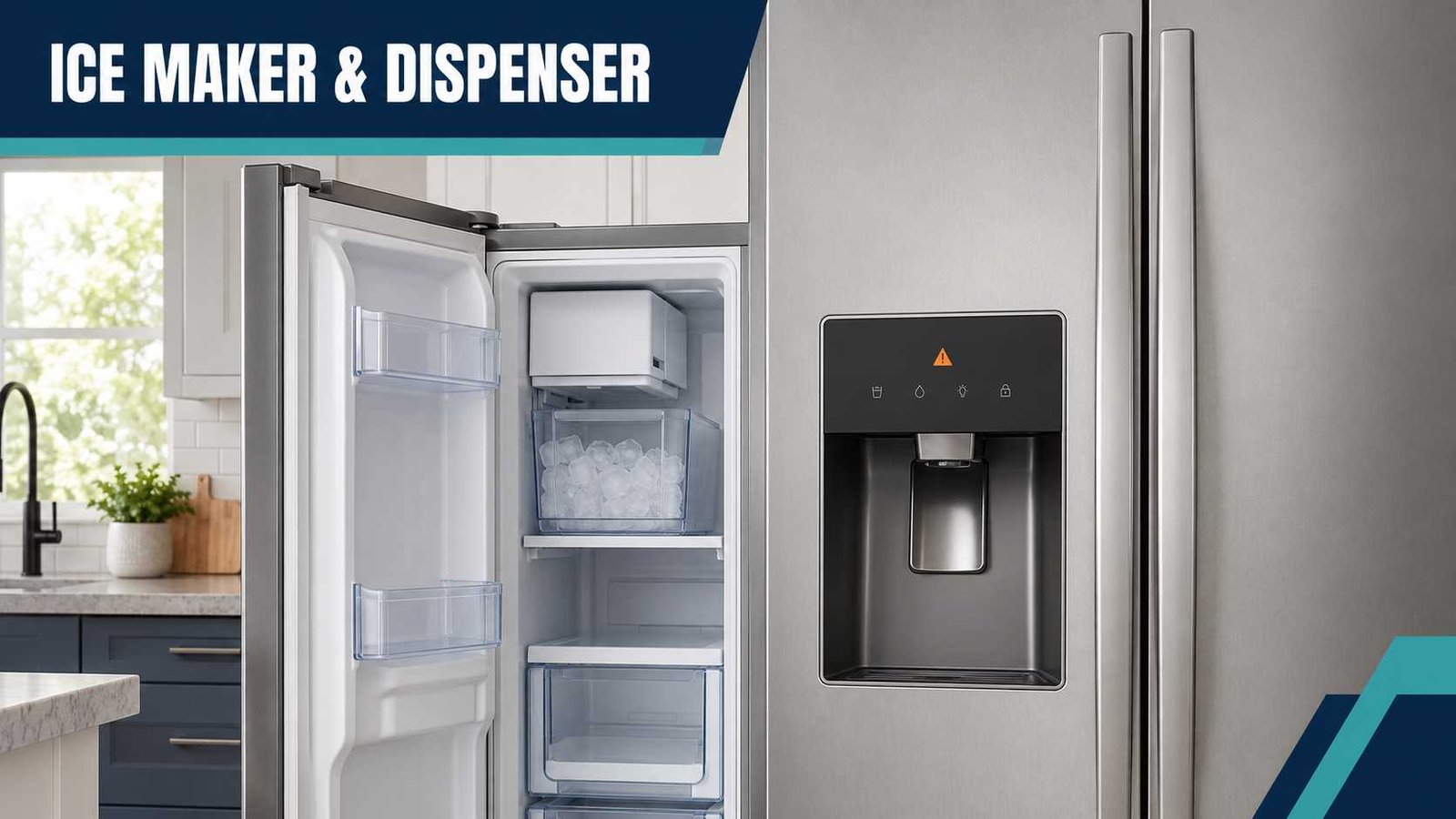
 A refrigerator ice maker and dispenser can fail in several different ways. The machine may stop making ice, make ice but refuse to dispense it, lose water flow, or have both the ice and water functions stop at the same time.
The first safe check is not to replace a part or repeatedly reset the refrigerator. Instead, identify which function has actually failed. If both water and ice are affected, start with shared causes such as the water supply, filter, control lock, and installation. If ice is already sitting in the bin but will not come out, concentrate on the dispenser, ice chute, bin, and controls.
Do not continue troubleshooting if there is uncontrolled water leakage near electrical components, a burning smell, repeated circuit-breaker tripping, or exposed wiring.
Ice Maker and Dispenser Problems:
| Symptom | Likely area to check first | Safe first check |
|---|---|---|
| No ice being made | Water supply, filter, temperature, ice maker setting | Confirm ice maker is switched on |
| Ice is made but will not dispense | Ice bin, chute, lock, door status | Check for clumped ice and Control Lock |
| No ice or water | Shared water supply or controls | Confirm water supply and filter condition |
| Water works but no ice | Ice-making system | Check ice maker setting and freezer temperature |
| Ice works but no water | Water-dispenser path | Check filter, lock and water selection |
| Small or hollow ice cubes | Restricted water flow | Check filter and accessible supply line |
| Dispenser completely unresponsive | Lock, door sensing or control system | Unlock controls and fully close doors |
These are starting points rather than final diagnoses. Refrigerator designs differ by brand and model.
How an Ice Maker and Dispenser Work Together
An automatic refrigerator ice system performs several jobs in sequence.
Water first enters the refrigerator through its water supply system. A controlled amount is sent to the ice maker, where it freezes in a mold or tray. When the ice is ready, the ice maker releases the cubes into a storage bin.
When you select ice at the exterior dispenser and press its paddle or actuator, a separate dispensing mechanism moves ice from that bin toward the chute.
The water dispenser usually shares part of the refrigerator’s incoming water system with the ice maker. This is why a restricted water supply or filter problem can sometimes affect both ice production and drinking-water flow.
Whirlpool states that a clogged or improperly installed filter can reduce flow to the ice maker and dispenser, resulting in symptoms such as low ice production or slow water dispensing.
Main stages of the system
- Household water enters the refrigerator.
- Water passes through the refrigerator’s filtration system on models that use one.
- The ice maker receives water.
- Water freezes in the ice mold or tray.
- The harvesting mechanism releases finished ice.
- Ice drops into the storage bin.
- The dispenser mechanism moves ice through the chute when requested.
The exact sequence and hardware differ by refrigerator design.
What Is the Most Common Problem With Ice Makers?
There is no single component failure that can accurately be called the most common problem on every refrigerator.
Manufacturer troubleshooting repeatedly starts with a group of simpler causes:
- Ice maker switched off
- Restricted water supply
- Clogged or incorrectly fitted filter
- Freezer temperature too warm
- Frozen or obstructed fill path
- Ice blockage
- Control or shut-off mechanism preventing production
Whirlpool’s current ice-maker guidance specifically lists restricted water supply, freezer temperature, the ice maker being turned off, and water-filter problems among the main troubleshooting areas.
Maytag also describes an accidentally switched-off ice maker as a common reason for no ice.
That means replacing the complete ice maker should not normally be the first response.
1. The ice maker is switched off
This sounds obvious, but refrigerators can provide several ways to disable ice production.
Depending on the model, you may find:
- A physical shut-off arm
- An Ice Maker On/Off switch
- A control-panel setting
- A touchscreen menu
Maytag notes that some ice makers are switched on with a button while others use a lever.
Check your refrigerator’s manual if the setting is not obvious.
2. Water is not reaching the ice maker properly
Poor water flow can lead to:
- No ice
- Slow ice production
- Small cubes
- Hollow cubes
- Weak dispenser flow
Check that the household shutoff valve supplying the refrigerator is open and that the accessible tubing behind the refrigerator is not sharply kinked.
Do not loosen pressurized plumbing fittings unless you are comfortable safely shutting off the water first.
3. The water filter is restricted
A refrigerator filter can affect more than drinking water.
Maytag notes that a clogged or incorrectly installed filter may cause low ice production, no ice, slow water dispensing, or no water dispensing.
If the problem appeared soon after changing the filter, also consider:
- Filter not fully seated
- Wrong filter for the refrigerator
- Filter installed in the wrong orientation
- Air remaining in the water system
Follow the flushing instructions for your specific model after installing a new filter.
4. The freezer is too warm
Automatic ice production depends on sufficiently cold conditions.
For Whirlpool refrigerators covered by its current troubleshooting guidance, the company recommends a freezer setting around 0°F (-18°C).
Do not assume that one temperature recommendation overrides your own refrigerator manual. Check the manufacturer’s setting for your model.
If the freezer is noticeably too warm or food is beginning to soften, the problem may extend beyond the ice maker.
What Causes an Ice and Water Dispenser Not Working?
When both ice and water dispensing stop, look for something the two functions share before assuming two separate components failed.
Control Lock or Dispenser Lock is enabled
Many refrigerators allow the dispenser controls to be locked to prevent accidental operation.
Whirlpool lists Control Lock among its first checks when a refrigerator does not dispense water.
LG likewise advises checking the lock status if pressing the dispenser does not produce ice or water.
The exact unlock procedure varies. Follow the instructions displayed on the control panel or in the model manual.
Water supply is restricted
If neither water nor newly produced ice is available, inspect the shared supply side.
Check:
- Household refrigerator water valve
- Visible supply tubing
- Water filter
- Recent plumbing work
- Recent refrigerator installation or movement
A kink can develop when a refrigerator is pushed back against a wall.
The water filter is blocked or incorrectly installed
This becomes especially likely if water flow gradually became slower before stopping.
It is also worth checking if the problem started immediately after changing the filter.
The doors are not fully closed
Some refrigerators deliberately prevent dispenser operation when a door is open.
If the door looks closed but the dispenser remains inactive, inspect for:
- Food preventing full closure
- Misaligned bin or shelf
- Door gasket obstruction
- Door-status warning on the display
A persistent door-switch or sensor fault requires model-specific diagnosis.
The dispenser paddle is not being activated
Whirlpool notes that the dispenser will not operate unless the paddle or pad is properly engaged.
Try a normal sturdy drinking glass and press the paddle as intended. Do not pry or force the mechanism.
Refrigerator Makes Ice but Will Not Dispense It
This symptom is particularly useful because it tells you the refrigerator can already perform the ice-making part of the job.
If the bin contains normal ice, the problem is more likely on the dispensing side.
Whirlpool’s dispenser troubleshooting specifically directs users to check door closure, dispenser lock, the dispenser paddle, clumped ice, a clogged chute, and correct ice-bin installation.
Check for clumped ice
Ice can freeze together into a solid mass, particularly if:
- Ice has remained unused for a long period
- Freezer temperature has fluctuated
- Ice has partially melted and refrozen
- Moisture has entered the ice bin
Remove the bin only as described in the user manual.
If loose cubes can be safely separated without touching internal moving mechanisms, clear the clumps. Do not use knives, screwdrivers, or other sharp objects to chip ice from the dispenser.
Check the ice chute
A blockage near the door chute can stop cubes even when the storage bin is full.
Look from the user-accessible side for visible ice.
Do not dismantle the dispenser housing merely to reach frozen ice.
Reseat the ice bin
Some dispensers rely on the ice bucket engaging correctly with the drive mechanism.
Remove and reinstall it according to the manual. Make sure it sits completely in its normal position.
Check the ice selection
If your refrigerator offers crushed and cubed ice, switch between the normal options once and try again.
Do not repeatedly activate a dispenser that is obviously jammed.
Water Dispenser Works but the Ice Maker Does Not
Working drinking water is a useful clue.
It suggests that at least part of the incoming household water system is functioning. However, it does not prove that water is reaching the ice maker correctly.
Concentrate on:
- Ice Maker On/Off setting
- Freezer temperature
- Ice-level or shut-off condition
- Ice-maker fill path
- Ice maker itself
- Model-specific control problems
If the ice maker has only recently been enabled, allow the time specified by the manufacturer before deciding that it has failed.
Samsung Canada, for example, separates the situation where ice is present but will not dispense from the situation where the ice maker produces no ice. It also advises checking whether the ice maker is enabled and examining the water line during no-ice troubleshooting.
Ice Dispenses but Water Does Not
If ice production continues normally but the drinking-water dispenser does not work, focus more closely on the water-dispenser path.
Start with:
- Water selection on the control panel
- Control Lock
- Filter installation
- Recent filter replacement
- Accessible water supply
- Dispenser paddle
- Model-specific water reservoir or tubing
A refrigerator may have separate paths or valves controlling ice-maker fill and drinking-water dispensing, so one function can fail while the other remains operational.
Internal valves and electrical controls should be diagnosed by a qualified technician rather than by live-voltage testing at home.
Safe Step-by-Step Ice Maker and Dispenser Troubleshooting
Step 1: Identify exactly what has stopped
Check three things separately:
Does the refrigerator make new ice?
Will existing ice dispense?
Will drinking water dispense?
Writing those three answers down can immediately narrow the problem.
Step 2: Confirm the ice maker is on
Look for an ice-maker setting, switch, lever, or shut-off arm.
Do not force a mechanical arm that does not move normally.
Step 3: Close all refrigerator and freezer doors
Make sure no packages, drawers, shelves, or ice bins prevent complete closure.
Then test the dispenser again.
Step 4: Check Control Lock
Look for terms such as:
- Lock
- Control Lock
- Dispenser Lock
- Child Lock
Use only the unlock procedure for your control panel.
Step 5: Confirm the refrigerator has water
Check the accessible household shutoff valve and visible line.
If the refrigerator was recently pulled forward, make sure the line was not crushed when it was moved back.
Step 6: Inspect the water filter
Ask:
- Is it overdue for replacement?
- Was it recently replaced?
- Is it fully seated?
- Is it the correct filter?
- Did the problem begin immediately after replacement?
Follow the manufacturer’s flushing procedure after fitting a new filter.
Step 7: Look inside the ice bin
If the bin is empty, concentrate on ice production.
If the bin contains ice, concentrate on the dispenser.
This is one of the quickest ways to avoid troubleshooting the wrong system.
Step 8: Check for ice clumps and visible chute blockage
Clear only easily accessible loose ice.
Do not put fingers into moving dispensing mechanisms.
Step 9: Reseat the ice bucket
Remove and reinstall the bucket according to your refrigerator manual.
Make sure it engages normally without forcing it.
Step 10: Check freezer temperature
If the freezer is too warm, deal with the cooling problem before blaming the ice maker.
Whirlpool notes that excessive freezer temperature can slow ice production, produce small cubes, or stop production.
Step 11: Test the dispenser normally
Select water or ice, then activate the dispenser.
Pay attention to whether you hear:
- A normal motor sound
- A hum
- Clicking
- No response at all
These observations can help a technician later even if they do not identify the failed component by themselves.
How to Reset an Ice Maker Dispenser
A reset is one of the most frequently searched solutions, but it is also where inaccurate advice is common.
There is no universal ice-maker reset procedure.
Do not copy a reset sequence from another refrigerator simply because the appliances look similar.
Samsung ice maker reset or test
Samsung states that resetting an ice maker generally should be a last resort after other troubleshooting, rather than the first step. Selected Samsung models use a Test button located on or near the ice-maker assembly.
On some Samsung refrigerator configurations, the procedure involves removing the ice bucket and holding the Test button until a chime or test response occurs. The exact button position and sequence depend on the design.
Use Samsung’s instructions for the exact model rather than assuming that one timing applies to every Samsung refrigerator.
Maytag reset differences
Maytag documentation shows why generic reset advice is risky.
On selected refrigerators, an ice maker may have a reset button. Some models without that arrangement may instead use a refrigerator power cycle as part of troubleshooting.
That does not mean every Maytag, Whirlpool, KitchenAid, or related appliance follows the same procedure.
If a reset does not work
Do not repeatedly reset the machine.
Return to the symptoms:
- Is water reaching the refrigerator?
- Is the freezer cold enough?
- Is the filter restricted?
- Is the ice maker enabled?
- Is ice already present?
- Does the dispenser respond?
- Is there a warning or error code?
Repeated resetting cannot repair a failed valve, motor, sensor, control, or mechanical blockage.
What Are the Components of an Ice Maker?
Exact construction varies, but Maytag identifies several common refrigerator ice-maker components.
| Component | General function |
|---|---|
| Water valve | Controls water entering the ice-making system |
| Ice mold | Holds water while it freezes |
| Motor | Drives part of the harvesting mechanism |
| Thermistor | Helps monitor temperature on designs using one |
| Heating coil | Helps release frozen cubes on certain designs |
| Shut-off arm | Stops production when sufficient ice is present |
| Collection bin | Stores completed ice |
Other models may use electronic ice-level sensors, different tray designs, separate control boards, or more integrated ice-maker assemblies.
Do not buy a replacement component based only on this generic list.
What Are the Parts of a Water and Ice Dispenser?
The exterior dispenser is a separate system from the ice-making tray, even though the two work together.
Depending on the refrigerator, dispenser-related parts may include:
| Part | What it does |
|---|---|
| Dispenser paddle or actuator | Receives the user’s request for ice or water |
| Display/control panel | Selects water, cubed ice, crushed ice or other options |
| Ice storage bin | Holds ice before dispensing |
| Auger | Moves ice toward the dispenser chute |
| Auger drive system | Powers movement of stored ice |
| Ice chute | Guides ice into the glass |
| Chute door/flap | Opens and closes the dispenser outlet |
| Water tubing | Carries drinking water |
| Water filter | Filters incoming water on equipped models |
| Water inlet valve system | Controls water movement |
| Door switch/sensor | Can prevent operation when a door is open |
This is a general system map, not a parts diagram for a particular refrigerator.
Which Parts Can Cause an Ice Maker or Dispenser Failure?
Once simple checks are ruled out, possible faults can include:
Water inlet valve
A valve problem can interfere with water reaching the ice maker or dispenser.
Do not attempt live electrical testing of the valve.
Ice-maker assembly
Internal mechanical or electronic failure may prevent filling, freezing detection, harvesting, or cycling.
Auger motor or drive mechanism
This becomes more relevant when there is plenty of ice in the bucket but the dispenser cannot move it.
Door switch or sensor
A refrigerator that incorrectly believes a door is open may prevent dispensing on designs with this safety/control behavior.
Dispenser switch or actuator
The refrigerator may not recognize that the dispenser paddle has been pressed.
Electronic control
Some faults can involve the dispenser control or refrigerator electronics.
Control-board replacement should not be guessed from symptoms alone because other faults can produce similar behavior.
Where Can I Find Spare Parts for My Ice Machine?
For a refrigerator ice maker or dispenser, start with the complete refrigerator model number.
Do not search only for phrases such as universal ice maker motor or refrigerator water valve.
GE Appliances, for example, instructs customers to enter the appliance model number into its official parts search to obtain compatible components and diagrams.
A safer parts-buying process
- Find the refrigerator’s model/serial label.
- Record the complete model number exactly.
- Search the manufacturer’s official parts system.
- Check the illustrated parts diagram if available.
- Confirm compatibility before ordering.
- Check whether the manufacturer sells the individual part or a complete assembly.
- Use an authorized distributor when the manufacturer directs you to one.
A part that looks identical may have different connectors, dimensions, electronics, operating specifications, or compatibility.
What If the Filter Was Changed but the Problem Remains?
A new filter does not automatically rule the filter system out.
Check whether:
- The filter is fully locked into place
- The correct replacement was installed
- Protective caps were removed where applicable
- The water system was flushed as instructed
- Water flow changed immediately after installation
Fisher & Paykel’s Australian instructions, for example, emphasize correct filter alignment and full locking because water flow depends on proper installation.
Bosch UK similarly instructs owners to use their appliance instructions when locating and replacing a water filter and to flush the water system after installation.
Do not automatically conclude that a new filter is defective without checking installation.
Ice Maker Still Does Not Work After Reset
A reset that completes successfully but does not restore ice production suggests that the original condition still exists.
Check again for:
- Insufficient water
- Filter restriction
- Warm freezer
- Incorrect ice-maker setting
- Frozen fill path
- Ice-level sensing issue
- Internal ice-maker fault
Samsung itself describes the reset/test as a later troubleshooting step rather than the default solution for every no-ice problem.
If the basic checks are good and the appliance still does not make ice, model-specific service diagnosis is more useful than repeated resetting.
Regional and Model Differences
The general troubleshooting logic is similar internationally, but the hardware may not be.
United States and Canada
North American refrigerators commonly use terms such as:
- Refrigerator
- Ice maker
- Water dispenser
- Control Lock
- Ice bin
Samsung Canada’s current support guidance specifically warns that available settings and options can differ from appliances sold in other countries.
United Kingdom and Ireland
The term fridge freezer is common.
Bosch UK directs owners to use the control panel to confirm that the ice maker is enabled and to consult the instruction manual for model-specific operation.
Do not automatically apply a US model’s reset procedure to a UK refrigerator with a similar exterior design.
Australia and New Zealand
Refrigerators may use different water arrangements, including plumbed and model-specific dispensing systems.
Fisher & Paykel’s Australian troubleshooting, for example, includes blocked or kinked supply lines, trapped air, and filter-related checks for dispenser problems.
The practical rule is simple: use general troubleshooting to identify the affected system, but use the model manual for settings, reset commands, filters, pressure requirements, and component access.
When Should You Call a Refrigerator Technician?
Stop at homeowner-level troubleshooting when the remaining diagnosis requires internal electrical or mechanical work.
Professional service is appropriate when:
- Water supply and filter checks are normal but there is still no fill
- The refrigerator makes repeated abnormal mechanical noises
- Ice is available but the auger system will not operate
- The dispenser remains dead after checking locks and door closure
- A model-specific reset/test fails
- An error code appears
- Water leaks inside inaccessible appliance areas
- The refrigerator is also failing to maintain safe temperature
- Internal wiring, motors, valves, sensors, or control boards need diagnosis
- The appliance repeatedly trips a circuit breaker
Do not bypass switches, sensors, interlocks, or safety devices to make an ice maker operate.
Safety Warning
Disconnecting panels or reaching internal ice-maker and dispenser components can expose wiring and moving parts. Do not perform live-voltage tests, bypass door switches, modify wiring, or force frozen mechanisms. Stop using the water system if uncontrolled leakage is reaching electrical areas.
Frequently Asked Questions
What is the most common problem with ice makers?
There is no universal single failure. Common first checks include an ice maker that has been switched off, restricted water flow, a clogged filter, unsuitable freezer temperature, or an ice/fill blockage. Manufacturer guidance usually recommends checking these conditions before assuming the ice-maker assembly has failed.
What causes an ice and water dispenser not working?
If both stop together, start with shared causes such as Control Lock, household water supply, water filter, supply tubing, refrigerator door status, and dispenser operation. A component fault is possible if those checks are normal.
What is the most common reason for an ice maker not working?
An ice maker being accidentally switched off is specifically described as a common reason in Maytag’s guidance, but water restrictions, filter problems, and temperature issues are also frequently listed by manufacturers.
Why is my refrigerator making ice but not dispensing it?
If the bin is full, look at the dispensing side rather than the ice-making side. Check Control Lock, door closure, clumped ice, chute blockage, correct bin installation, and normal dispenser-paddle operation.
Why does the water dispenser work but the ice maker does not?
Water reaching the dispenser means part of the supply system is operating, but the ice maker can still have its own setting, temperature, fill, sensor, or mechanical problem. Confirm that the ice maker is enabled and the freezer is cold enough before moving to component diagnosis.
How do I reset an ice maker dispenser?
Use the reset or test procedure specified for the exact refrigerator model. Some Samsung ice makers use a Test button, while other brands and models use different procedures. A universal reset sequence should not be used.
What are the components of an ice maker?
Typical components can include a water valve, motor, thermistor, ice mold, heating coil, shut-off arm and ice collection bin. The exact design varies by refrigerator.
Where can I find replacement ice-maker parts?
Start with the manufacturer’s official parts website or authorized parts distributor and search using the refrigerator’s complete model number. Model compatibility matters even when two components look identical. GE Appliances, for example, provides a model-number parts lookup with diagrams.
Daniel Brooks is a US-based appliance troubleshooting researcher with 12 years of experience studying washer, dryer, refrigerator, and dishwasher faults. He reviews manufacturer manuals and converts technical error codes into safe, practical guidance for homeowners.