
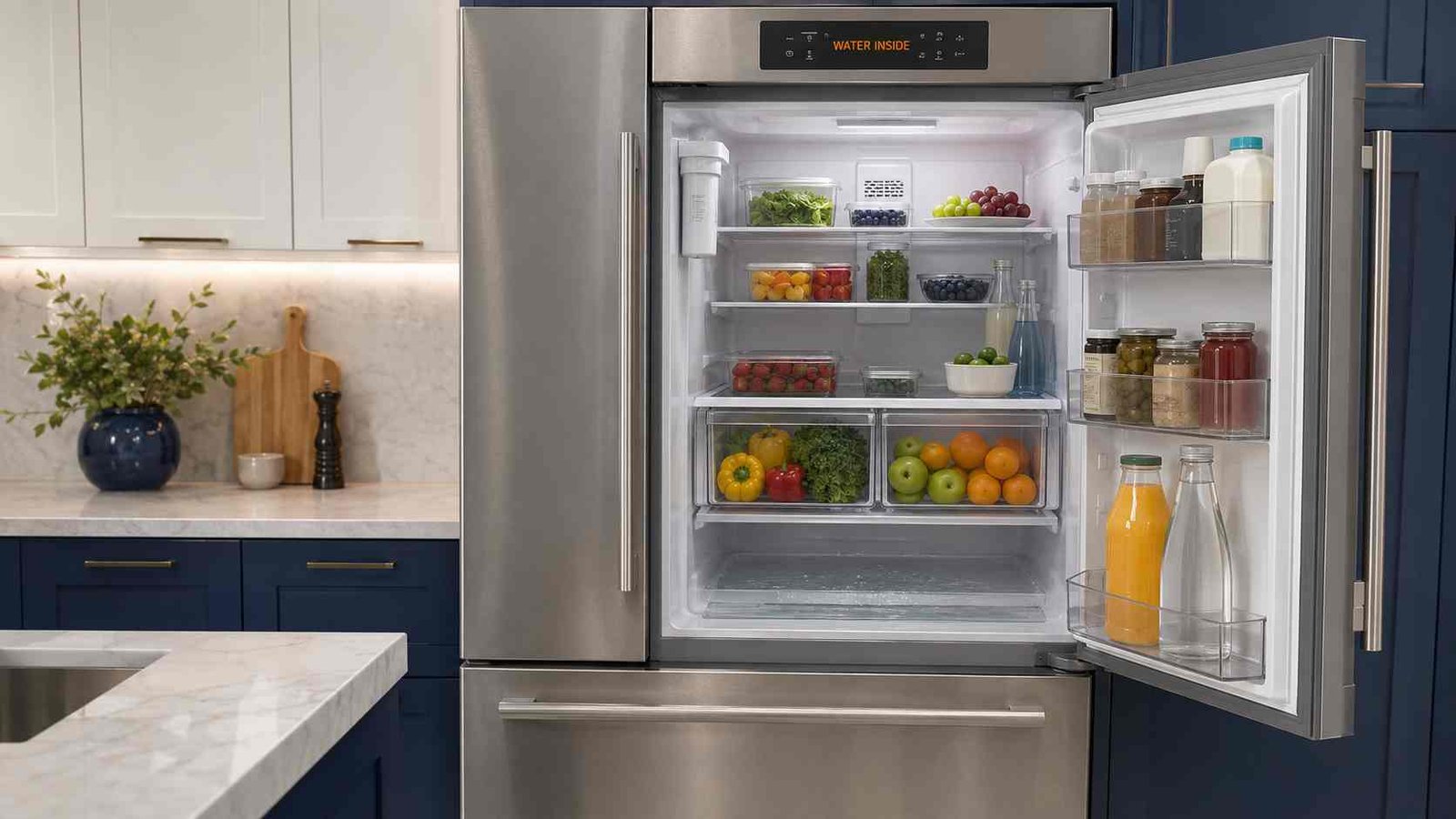
 A refrigerator leaking water inside usually has a blocked defrost drain, excess condensation, an incorrectly fitted water filter, or a leak from the ice maker or internal water system. Water under the crisper drawers often points to a drainage problem, while moisture near the filter or ice compartment suggests a pressurised-water leak.
Start by drying the compartment completely and noting where the water returns. Check for spilled containers, food touching the rear wall, an obstructed drain opening, and a door that is not closing properly.
Stop using the water dispenser and close the household water-supply valve if water continues flowing, appears near electrical components, or comes from a cracked filter housing or internal tube. Do not remove evaporator covers or electrical panels to reach a hidden drain.
| Item | Details |
|---|---|
| Problem | Water pooling or dripping inside the refrigerator |
| Most common causes | Blocked drain, condensation, filter leak, poor door seal or ice-maker leak |
| First safe check | Dry the compartment and identify exactly where water returns |
| Most common location | Beneath crisper, vegetable or salad drawers |
| Repair difficulty | Easy for spills and visible obstructions; professional diagnosis may be required for hidden leaks |
| Can the refrigerator still be used? | Usually, if it is cooling normally and the leak is minor and away from electrical parts |
| Shut off the water supply when | Water continues flowing or appears connected to the filter, dispenser or ice maker |
| Call a technician when | The drain is hidden, the leak returns, a housing is cracked, or internal tubing is involved |
Why Is My Refrigerator Leaking Water Inside?
Water inside a refrigerator can come from two broad systems.
The first is the condensation and defrost drainage system. Moisture naturally forms during refrigeration and defrost cycles. It should flow through a drain opening and tube into a tray, where it normally evaporates. If that route becomes blocked by ice, food residue or debris, water can collect inside the appliance.
The second is the plumbed water system found on refrigerators with filters, dispensers or automatic ice makers. A loose filter, damaged seal, cracked housing, overfilling ice maker or leaking tube may release water directly into the cabinet.
A basic refrigerator without a water dispenser or ice maker does not have most of these pressurised-water components. On those models, investigate condensation, spills, door closure and drainage first.
Identify Where the Water Is Coming From
The position of the water often provides the strongest clue.
| Water location | Likely causes | First safe check |
|---|---|---|
| Under the crisper drawers | Blocked drain, diverted condensation or spill | Remove the drawers, dry the area and inspect the visible drain channel |
| On the rear interior wall | Normal condensation, food touching the wall or poor airflow | Move food forward and check whether droplets drain normally |
| Around the water filter | Loose filter, damaged filter seal, cracked filter or housing | Stop dispensing water and check that the filter is seated correctly |
| Below the ice maker | Melting ice, overfilling, misaligned fill system or ice buildup | Inspect the ice bin and compartment without removing panels |
| On a shelf | Spilled drink, leaking container or condensation | Remove and inspect containers |
| On the freezer floor | Frozen or blocked defrost drain | Look for an ice sheet or repeated water after defrosting |
| Near the front door | Door not closing, damaged gasket or overflowing internal water | Check the gasket, door alignment and stored items |
| From behind an internal panel | Hidden drain, reservoir, tubing or component leak | Stop troubleshooting and arrange service |
Water Under the Crisper or Vegetable Drawers
Water beneath a crisper, vegetable or salad drawer commonly indicates that defrost or condensation water is not reaching its drain tray.
Many refrigerators have a condensation channel or drain opening near the lower part of the rear interior wall. During normal operation, moisture moves down this channel. Food residue, packaging or ice may obstruct the opening and cause water to overflow into the bottom of the refrigerator.
Bosch states that water which does not drain correctly is usually linked to contamination in the defrost-water drain or drainage hole. Beko similarly identifies a blocked condensation drainage channel as a common reason for water at the bottom of the refrigerator.
Water may also be redirected if containers or food packages touch the rear wall. Instead of flowing down the intended channel, moisture can run along the packaging and drip below the drawers.
Is Water on the Rear Wall Normal?
A small amount of moisture or light frost on the rear wall can be normal on some refrigerators.
When the cooling system cycles off, light frost may melt and run into the condensation channel. Beko explains that small droplets or limited ice on the rear wall can be part of normal operation, provided the water drains and there is no heavy frost buildup.
It becomes more concerning when:
- Water remains pooled at the bottom
- Large sheets of ice form repeatedly
- The drain channel overflows
- Food freezes against the rear wall
- The door gasket does not seal
- The refrigerator is no longer maintaining a safe temperature
The design varies by model. Some frost-free refrigerators hide the defrost drain behind an internal freezer cover, while other models have a visible drainage hole intended for routine cleaning.
Common Causes of Water Inside a Refrigerator
1. Blocked Defrost or Condensation Drain
A blocked drain is one of the most common explanations for water under drawers or ice on a freezer floor.
During an automatic defrost cycle, frost melts from the evaporator area. The water should travel through a drain tube to a pan below or behind the refrigerator. A blockage can cause it to back up into the refrigerator or freezer compartment.
Whirlpool notes that defrost-drain blockages can cause water to puddle inside the refrigerator and eventually leak through the lower door area.
2. Frozen Drain Opening
The drain may be blocked by ice rather than loose debris. This can happen after excess frost forms, the door remains open, or warm air repeatedly enters through a poor seal.
A frozen drain may appear clear at the surface while remaining blocked farther inside. If the water returns after the visible ice melts, further diagnosis may be required.
Do not remove an evaporator cover or apply heat near plastic liners, wiring or refrigeration components.
3. Food Touching the Rear Wall
Containers pressed against the rear wall may interrupt normal airflow and redirect condensation. This is more common when the refrigerator is tightly packed.
Move packages a few centimetres or about an inch away from the rear wall where the appliance design allows. Avoid covering air vents.
4. Incorrectly Installed Water Filter
A leak that begins immediately after a filter replacement should be investigated at the filter first.
The filter may not be fully inserted, locked or aligned. Its seal may also be damaged or displaced. Frigidaire advises checking that a recently changed filter is installed securely and checking it for cracks.
Use only the filter type specified for the exact refrigerator model. A filter that appears similar may not seal correctly.
5. Cracked Filter or Filter Housing
A damaged filter can leak into the cabinet and may also reduce water flow at the dispenser. A cracked filter head or housing may continue leaking even after the filter is reinstalled.
LG states that improper filter installation is a common reason for filter-area leakage. A continuing leak or damaged housing requires further service rather than repeated tightening or forcing of the filter.
6. Door Not Closing Properly
A door left partly open allows warm, humid air to enter. The extra moisture can create condensation or frost, which later melts and appears as a leak.
Common door-closing problems include:
- Food or drawers obstructing the door
- A twisted or dirty gasket
- A damaged seal
- A refrigerator that is incorrectly positioned
- A door bin that is overloaded
- Ice preventing a freezer drawer from closing
Frigidaire notes that prolonged door opening can lead to evaporator icing and water leakage.
7. Excessive Frost Melting
A large amount of frost may produce more water than the drainage system can handle during defrosting.
Heavy frost can result from frequent door opening, an unsealed door, warm food, blocked airflow or a component problem. Correcting the visible ice without addressing the cause may allow the leak to return.
8. Ice-Maker or Ice-Bin Leak
Water near the ice compartment may come from melting ice, an ice jam, an overfilling tray, a misaligned fill area or a water connection.
Whirlpool lists ice buildup, loose connections, poor alignment and defrost-drain problems among possible causes of ice-maker leakage. LG also advises checking for water or melting ice around the ice maker and dispenser system.
Do not adjust an internal fill valve or dismantle the ice-maker mechanism unless the manufacturer’s instructions explicitly provide a user procedure.
9. Internal Reservoir or Tubing Leak
Some plumbed refrigerators store chilled water in an internal reservoir or route tubing through the fresh-food compartment.
A cracked reservoir, split tube, loose connector or faulty valve may cause water to appear behind drawers or internal panels. These faults can resemble a blocked drain but often worsen after the dispenser or ice maker operates.
Internal pressurised-water components should be inspected by a qualified appliance technician.
10. Refrigerator Position or Levelling
Incorrect installation can affect door closure and water drainage.
The required position varies. Some refrigerators should be level from side to side with the front slightly raised to help the doors close. Other models provide different levelling instructions.
Do not rely on a universal angle. Follow the installation section of the manual for the exact model.
11. Spilled or Leaking Food Container
A leaking bottle, defrosting food package or cracked storage container can create a surprisingly large pool of water.
Before treating the problem as an appliance fault:
- Remove containers from the affected shelf.
- Check caps and seams.
- Look for damaged food packaging.
- Clean and dry the entire area.
- Monitor the refrigerator without returning the suspected container.
How to Troubleshoot a Refrigerator Leaking Water Inside
1. Protect the Floor and Food
Place towels around the appliance if water has reached the door or floor. Move uncovered food away from the wet area.
Discard food directly contaminated by dirty drain water. Clean food-contact surfaces using the cleaning method recommended in the appliance manual.
2. Dry the Interior Completely
Remove the affected drawers or shelves if they are designed for normal user removal. Wipe away all visible water.
Drying the area establishes a clear starting point. Without this step, it can be difficult to tell whether the leak is continuing or whether old water is simply moving around.
3. Observe When the Water Returns
The timing helps separate drainage problems from plumbed-water leaks.
- Water returns without using the dispenser: inspect condensation, drainage and door closure.
- Water appears after dispensing: inspect the filter and accessible dispenser area.
- Water appears after the ice maker fills: stop the ice maker if the controls allow and arrange diagnosis if the leak continues.
- Water appears after a defrost period: a blocked or frozen drain is more likely.
- Water appears only below one container: check for a spill.
4. Check the Door Seal
Look for packaging, drawers or ice preventing the door from closing.
Clean the gasket gently with warm water and a soft cloth. Check for folds, loose sections, cracks or hardened areas. Do not apply adhesives, oils or strong chemicals unless the manufacturer recommends them.
A damaged gasket usually requires model-compatible replacement.
5. Check Food Placement and Air Vents
Move food away from the rear wall, condensation channel and visible air vents.
Do not pack the refrigerator so tightly that cold air cannot circulate. Poor airflow can create uneven temperatures, local freezing and excess moisture.
6. Inspect a Visible Drain Opening
Only inspect a drain that is openly accessible without removing an appliance panel.
Remove loose food particles or visible residue with a soft cloth or other method approved in the model manual. Some manufacturers permit gentle flushing with warm water. Other manufacturers recommend service for frozen or inaccessible drainage systems.
Never:
- Pour boiling water into the refrigerator
- Insert sharp metal wire
- Force an object deep into a drain tube
- Use a heat gun or open flame
- Remove an evaporator cover
- puncture ice with a knife or screwdriver
Samsung guidance varies by model and market. Some support instructions allow removal of visible debris or gentle warm-water flushing, while others direct owners to arrange service for frozen or hidden drains. Follow the manual for the exact refrigerator.
7. Check the Water Filter
If the refrigerator has a water filter:
- Stop using the water dispenser.
- Check whether the leak began after a filter change.
- Follow the manual to remove and reinstall the filter.
- Inspect the filter for visible cracks.
- Check accessible seals for damage or displacement.
- Confirm that the filter is the correct type.
- Dry the area and monitor it.
Do not force a filter that will not lock into place. Stop if the housing is cracked, loose or leaking with the filter correctly installed.
8. Check the Ice Compartment
Open the ice compartment normally and inspect the bin.
Look for:
- Melted or clumped ice
- An overflowing tray
- Ice obstructing the chute
- A bin that is not seated correctly
- Water appearing immediately after a fill cycle
Turn off the ice maker through its normal control if a leak appears connected to the fill cycle. Close the household water-supply valve if water continues entering the appliance.
9. Isolate a Pressurised-Water Leak
For an active leak from a plumbed refrigerator:
- Stop using the dispenser and ice maker.
- Unplug the refrigerator if water is near electrical parts or the manufacturer directs you to do so.
- Close the refrigerator’s household water-supply valve.
- Protect nearby flooring.
- Arrange repair for damaged filters, housings, valves, reservoirs or tubing.
Whirlpool recommends disconnecting power and closing the water shut-off valve before checking an external supply connection.
10. Find the Model Number
Drain locations, filter designs and safe access procedures vary widely.
The model number may be printed:
- On an interior side wall
- Near the crisper drawers
- On the ceiling of the fresh-food compartment
- Around the door frame
- Behind a lower drawer
- On a rating label at the rear
Use the full model number to locate the official owner’s manual. Do not use a button sequence, part number or disassembly guide written for a similar-looking refrigerator.
What to Do When the Drain Looks Clear but Water Returns
A visible drain opening can appear clear even when ice or debris remains farther inside the tube.
Check whether:
- An ice sheet is forming on the freezer floor
- The door gasket is allowing warm air inside
- Food is covering a drain channel
- Water appears only after dispensing
- The filter was recently changed
- The ice maker is overfilling
- The refrigerator is cooling incorrectly
- The leak originates behind an interior cover
Repeated drain freezing may indicate an airflow, sealing, drainage or defrost-system problem. Further testing can involve internal panels, electrical components and model-specific parts, so it should be performed by a qualified technician.
Refrigerator Leaking After a Water-Filter Change
A newly installed filter is a strong clue when water begins leaking inside the refrigerator.
First, confirm that the filter:
- Matches the exact model
- Has been inserted in the correct direction
- Is fully locked into position
- Has no visible cracks
- Has intact seals
- Has had all protective caps or packaging removed as instructed
Air trapped in the water system can cause temporary dripping at some dispensers after filter installation, but it should not create a continuing pool inside the refrigerator. LG notes that trapped air may cause leakage from the dispenser or ice maker following installation or filter replacement.
Follow the manufacturer’s priming or flushing instructions. Stop using the water system if the filter area itself remains wet.
Possible Faulty Parts
| Possible part | Typical clue | Homeowner action |
|---|---|---|
| Water filter | Leak started after replacement | Reinstall according to the manual and inspect for cracks |
| Filter seal or O-ring | Water around filter connection | Inspect only if accessible; replace with approved component |
| Filter housing | Leak continues with filter seated | Professional repair |
| Door gasket | Moisture, frost or door not sealing | Clean and inspect; replace if damaged |
| Defrost drain | Water under drawers or ice on freezer floor | Clean only if openly accessible and manufacturer-approved |
| Drain tube or fitting | Leak returns after visible drain is cleared | Professional diagnosis |
| Water reservoir | Water behind drawers after dispenser use | Professional repair |
| Internal water tubing | Water behind liner or panel | Shut off supply and arrange service |
| Ice-maker fill system | Leak occurs during fill cycle | Turn off ice maker and arrange diagnosis |
| Water inlet valve | Water continues entering or ice maker overfills | Close water supply and arrange service |
| Drain pan | Water below appliance rather than inside | Inspect only as allowed by the manual |
Do not order a part from the symptom alone. Several different faults can produce water in the same location.
Can You Keep Using a Refrigerator That Is Leaking Inside?
You may be able to continue using the cooling compartment temporarily when:
- The water amount is small
- The source is a spill or normal condensation
- The refrigerator remains cold
- Water is not near lights, wiring or controls
- There is no active filter, dispenser or ice-maker leak
- Food has not been contaminated
Stop using the water and ice system when a plumbed component is leaking.
Disconnect the appliance and arrange prompt service when:
- Water reaches electrical components
- The refrigerator trips a circuit breaker
- There is a burning smell
- Cooling has stopped
- A large amount of water is entering continuously
- Water comes from behind a fixed internal panel
- The cabinet or floor is becoming damaged
Food Safety While the Refrigerator Is Off
Keep the doors closed as much as possible while the appliance is unplugged.
FoodSafety.gov recommends maintaining a refrigerator temperature of 40°F or 4°C or below. The UK Food Standards Agency recommends keeping a domestic refrigerator between 0°C and 5°C.
Use a refrigerator thermometer rather than relying only on the control setting. Move perishable foods to another refrigerator or an insulated cooler with enough ice if the temperature begins rising.
Do not taste food to decide whether it is safe.
When to Call a Refrigerator Technician
Arrange professional diagnosis when:
- Water returns after visible debris is removed
- The drain is hidden behind an internal cover
- The drain repeatedly freezes
- The filter housing is cracked
- Internal tubing or a reservoir is leaking
- The ice maker overfills
- Water continues after the ice maker is switched off
- The supply valve or internal inlet valve may be faulty
- The refrigerator is not cooling correctly
- Water is close to wiring, lighting or controls
- The repair requires major disassembly
A technician may need to check the drainage route, defrost system, door alignment, filter head, reservoir, tubing, valve or ice-maker fill operation.
How to Prevent Water From Collecting Again
Keep the refrigerator interior clean and avoid placing food directly against the rear wall.
Check that:
- Drainage channels remain free of packaging and food residue
- Air vents are unobstructed
- Doors close without being pushed
- Gaskets remain clean and flexible
- Drawers and shelves are correctly installed
- Filters are fitted according to the manual
- The filter area is checked after replacement
- The refrigerator follows its model-specific levelling instructions
- Ice buildup is investigated before it becomes severe
A reset will not repair a blocked drain, cracked filter or leaking tube. The physical source of the water must be identified.
Frequently Asked Questions
Why is water collecting under the crisper drawers?
The most likely causes are a blocked condensation or defrost drain, food touching the rear wall, or water redirected from a spill. Dry the area, move food away from the wall and inspect only the visible drain channel.
How do I unblock a refrigerator drain hole?
Remove loose debris only when the drain is openly accessible and the manufacturer permits user cleaning. Use the method in the owner’s manual. Do not insert sharp wire, pour boiling water into the drain or remove an evaporator cover.
Why does my refrigerator drain keep freezing?
Repeated freezing may result from warm air entering through a poor door seal, excess frost, a drainage problem or a defrost-system fault. A hidden or repeatedly frozen drain normally needs model-specific diagnosis.
Is water on the back wall of a refrigerator normal?
Small droplets or light frost can be normal on selected models, especially when the moisture flows into the drain channel. Large ice buildup, standing water or moisture that does not drain is not normal.
Why is my refrigerator leaking after I changed the filter?
The filter may be incorrectly seated, incompatible, cracked or fitted with a damaged seal. Reinstall it exactly as directed. Stop using the dispenser and arrange service if the filter housing continues leaking.
Can an ice maker leak water into the refrigerator?
Yes. Possible causes include melting ice, a blocked chute, an overfilling tray, a fill-system alignment problem or a leaking connection. Turn off the ice maker using its normal control and close the water-supply valve if leakage continues.
Is it safe to use a refrigerator that has water inside?
A small amount from condensation or a spill may not require shutting down the appliance if it is cooling correctly. Stop using it when water is near electrical parts, cooling has failed or an active pressurised-water leak is present.
Will resetting the refrigerator stop the leak?
Usually not. A reset does not clear a physical blockage or repair a damaged filter, seal, valve, reservoir or water tube. Find and correct the source instead of repeatedly cycling the power.
Daniel Brooks is a US-based appliance troubleshooting researcher with 12 years of experience studying washer, dryer, refrigerator, and dishwasher faults. He reviews manufacturer manuals and converts technical error codes into safe, practical guidance for homeowners.