
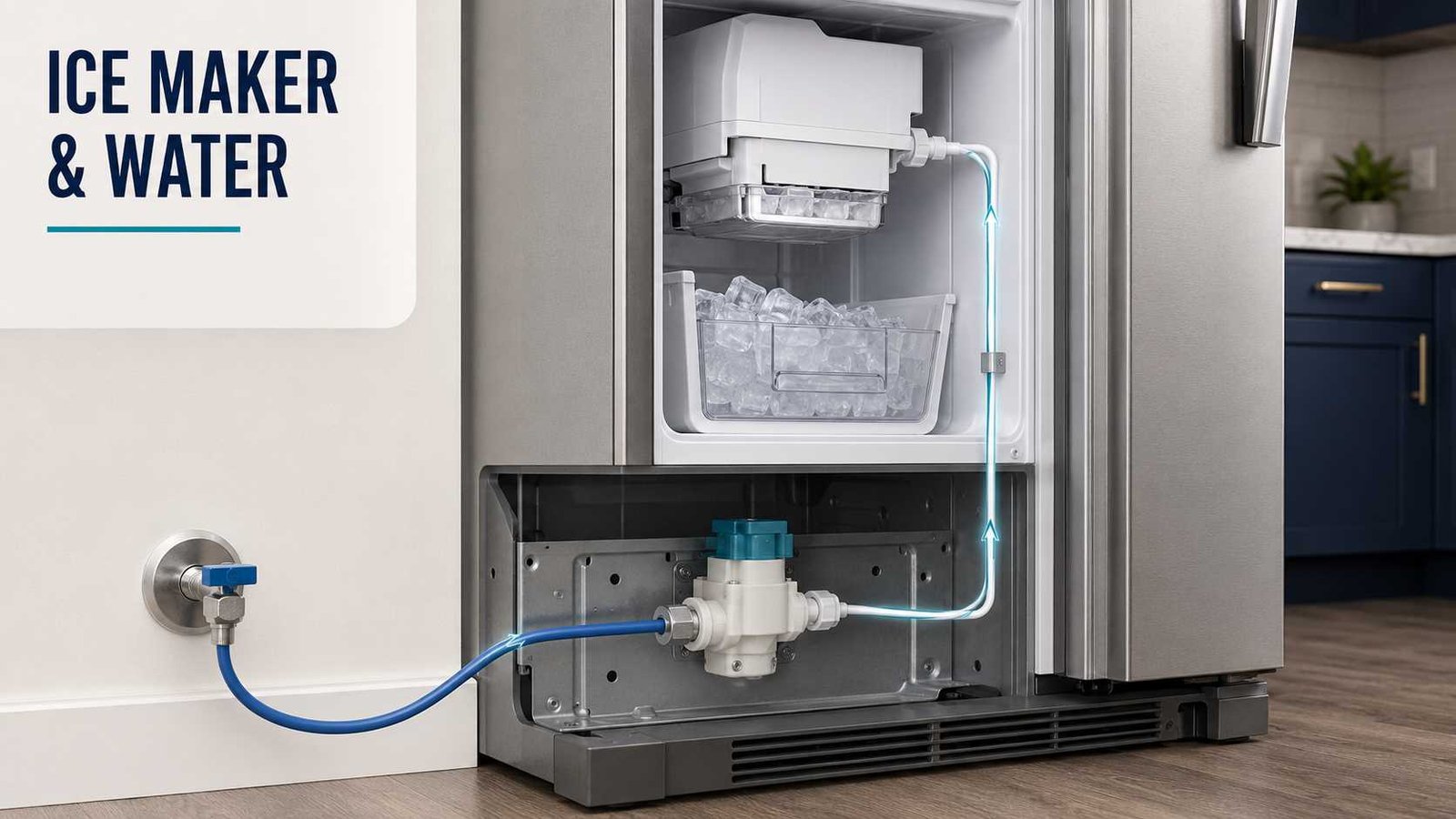
 An automatic refrigerator ice maker needs both water and sufficiently cold freezer conditions to produce ice. On a plumbed refrigerator, water normally comes from the household cold-water supply and travels through the refrigerator’s water system to the ice maker. Some non-plumbed refrigerators instead use a refillable internal water tank.
If your ice maker is not making ice, a safe first check is to confirm that it is switched on, the water source is available, the external supply line is not kinked, and any installed water filter is not causing obviously restricted flow. Samsung’s current guidance also tells owners of tank-fed models to make sure the tank is clean and filled.
Stop homeowner troubleshooting if the refrigerator is leaking significantly, requires internal electrical testing, has exposed wiring, or is no longer cooling normally.
Ice Maker and Water System at a Glance
| Question | Quick answer |
|---|---|
| Where does ice-maker water come from? | Usually a household cold-water connection or, on some models, a refillable internal tank |
| What controls water entering the ice maker? | A water inlet valve system on automatic plumbed designs |
| Does a working water dispenser prove the ice maker has enough water? | No |
| Can a clogged filter reduce ice production? | Yes, restricted flow can interfere with filling |
| Does every ice maker use identical parts? | No, construction varies by model and ice-maker design |
| Should replacement parts be chosen by appearance? | No, use the refrigerator model number |
| Can I test internal electrical components myself? | Internal electrical diagnosis is better left to a qualified appliance professional |
How Does an Ice Maker Get Water?
The exact route depends on the refrigerator design.
Plumbed refrigerator ice makers
A plumbed refrigerator is connected directly to a household water source. During an ice-making cycle, the ice-maker controls signal a water valve to allow a measured amount of water to enter the ice mold. Whirlpool describes the water valve as one of the main components involved in this process.
A simplified water path looks like this:
Cold-water supply → refrigerator connection → filter if fitted → inlet valve system → internal tubing/fill tube → ice mold
The precise arrangement is model-specific. Some refrigerators use more than one valve or separate internal paths for the dispenser and ice maker, so the owner’s manual or model-specific parts diagram remains the better reference for a particular appliance. GE documents refrigerator designs where incoming household water is divided internally to serve the dispenser and ice maker.
Non-plumbed refrigerator ice makers
Not every automatic ice system needs a permanent household water connection.
Samsung UK currently sells both plumbed and non-plumbed refrigerator designs. Some non-plumbed systems can provide ice without connecting the appliance directly to household plumbing.
LG Australia also describes non-plumbed refrigerator models with refillable water tanks. In some LG French-door models, water from the internal tank supplies the ice-making system.
This matters when troubleshooting. Telling a user to check a wall shutoff valve is useless if the refrigerator actually gets its water from an internal reservoir.
What Are the Components of an Ice Maker?
The parts vary by refrigerator, but a conventional automatic ice maker may contain or depend on the following components.
| Component | What it does | Possible symptom when something is wrong |
|---|---|---|
| Water inlet valve | Controls water entering the ice-making system | No fill, insufficient fill, or possible leaking |
| Fill tube or fill path | Carries water into the mold | No water or restricted filling |
| Ice mold | Holds water while it freezes | Irregular ice release or mold-related problems |
| Temperature sensor/control | Helps determine when freezing conditions are suitable | Ice cycle may not proceed normally |
| Mold heater or release mechanism | Helps release frozen cubes on certain designs | Ice freezes but does not eject |
| Motor/ejector | Moves finished cubes from the mold | Ice remains in the maker |
| Shut-off arm or electronic level sensor | Stops production when the bin is full | No production or continuous cycling if the system malfunctions |
| Ice bin | Stores finished ice | Ice level or dispensing problems |
| Water filter | Filters incoming water on models equipped with one | Reduced water flow or low ice production |
| Water tubing | Moves water through the refrigerator | Restricted flow or leaking |
Whirlpool identifies the water valve, ice mold, thermistor, heating element or coil, motor, collection bin, and shut-off mechanism among common refrigerator ice-maker components. It also notes that designs vary; not every system releases cubes in exactly the same way.
Water inlet valve
The inlet valve opens when the ice maker requests water and closes after the required fill period.
It is an important part of the system, but no water in the ice mold does not automatically prove that the valve has failed. A closed supply valve, restricted filter, kinked tube, frozen fill path, or control problem can create similar symptoms. Manufacturer troubleshooting guidance recommends checking the simpler water-supply conditions first.
Ice mold
This is where the incoming water freezes. Whirlpool describes ice molds as commonly made from plastic or die-cast aluminum, depending on design.
Ice-release system
Once the water has frozen, the cubes need to separate from the mold. Some designs use a small heater to help release the cubes before the ejector moves them into the ice bin. Other designs can use a different mechanical release method.
Shut-off system
The ice maker must also know when to stop. Depending on the refrigerator, this may involve a mechanical arm or an electronic ice-level system.
Do not assume that a control arm or sensor from one model is interchangeable with another.
What Happens During an Ice-Making Cycle?
A typical automatic refrigerator ice-making cycle can be simplified into five stages:
- The system determines that conditions are suitable for another batch.
- The water valve allows water to enter the ice mold.
- The freezer removes heat from the water until it freezes.
- The release and ejector system moves the cubes into the storage bin.
- The ice maker repeats the process until its shut-off system detects enough stored ice.
Whirlpool’s description of refrigerator ice-maker operation follows this basic sequence, although exact timing, sensors, controls, and release mechanisms vary by appliance.
Avoid applying an exact universal fill time, temperature threshold, or diagnostic sequence to every refrigerator. Those specifications need to come from the documentation for the actual model.
https://www.youtube.com/watch?v=ph-3mLur-4Q
What Is the Most Common Problem With Ice Makers?
There is no reliable universal answer such as the water valve is always the most common failed part.
Manufacturer troubleshooting information points to several recurring problem groups, including water-supply restrictions, clogged filters, incorrect temperature, the ice maker being switched off, problems with the inlet valve, and ice-maker mechanism faults.
For homeowners, the water supply is one of the most useful places to begin checking because several simple problems can interrupt or reduce the fill.
Common possibilities include:
- Ice maker switched off
- Empty water reservoir on a tank-fed model
- Household water valve closed or partially closed
- Kinked external water line
- Restricted or overdue water filter
- Frozen or obstructed fill path
- Inlet-valve problem
- Freezer temperature problem
- Ice-level mechanism blocked by clumped ice
- Internal ice-maker or control failure
These are possible causes, not a diagnosis of a specific refrigerator.
Water Dispenser Works but Ice Maker Does Not
This symptom often creates confusion.
A water dispenser producing water does not necessarily prove that sufficient water is reaching the ice maker.
GE explains that many refrigerator ice makers use a timed fill. If water flow is restricted, the valve may be open for the expected filling period but not deliver enough water to fill the mold properly. A dispenser behaves differently because its valve can remain activated while the user continues pressing the dispenser control.
GE also notes that a partially clogged filter can result in slow dispenser flow while leaving insufficient flow for normal ice-maker filling.
So if the dispenser works but there is little or no ice, look at the quality and strength of the water flow, not merely whether water comes out at all.
Ice Maker Not Getting Water: Safe Checks
Work from the simplest checks toward the more technical possibilities.
1. Make sure the ice maker is on
Check the refrigerator’s normal user controls, switch, shut-off arm, or menu according to the owner’s manual.
Do not use a diagnostic button sequence copied from another refrigerator model.
2. Identify the refrigerator’s water source
For a plumbed refrigerator, confirm that the cold-water supply is connected and the accessible shutoff valve is fully open.
For a tank-fed refrigerator, check that the reservoir contains clean water and is installed correctly. Samsung specifically recommends checking both situations according to refrigerator type.
3. Inspect the accessible water line
Look behind the refrigerator for a visibly kinked, crushed, leaking, or sharply bent supply line.
Do not pull aggressively on tubing or fittings.
4. Check water-dispenser flow if the refrigerator has one
A weak dispenser stream can support the possibility of restricted water flow.
Remember that normal dispenser operation still does not eliminate an ice-maker-specific restriction.
5. Check the water filter
If the model uses a filter, confirm that it is correctly installed and has not exceeded the replacement interval stated by the manufacturer.
GE identifies clogged filters as a potential cause of restricted flow to the ice maker.
Use the filter specified for the refrigerator rather than assuming cartridges that look similar are interchangeable.
6. Look for accessible ice around the fill area
Ice around an accessible fill opening can indicate that the water path is obstructed or that water is not entering the mold normally.
Avoid dismantling internal electrical assemblies to reach a frozen section.
7. Confirm the freezer is cooling normally
Ice production depends on the freezer reaching appropriate operating conditions. If food is softening or the refrigerator has a broader cooling problem, treat the cooling fault as more significant than the ice-maker symptom.
8. Use only model-specific reset instructions
Some manufacturers provide ice-maker reset or test procedures, but the buttons and sequences vary widely.
Find the refrigerator’s model number and consult its official manual or support page before initiating a test.
Symptoms and What They May Point To
| Symptom | Possible areas to investigate |
|---|---|
| Ice mold remains dry | Water source, filter, supply line, fill path, valve or control |
| Cubes are unusually small | Restricted water flow or incomplete fill |
| Cubes are hollow | Possible low water fill or freezing-condition issue |
| Water appears in the ice bin | Fill alignment, overfilling, tubing or other leak source |
| Ice freezes but remains in mold | Release/ejector mechanism or control issue |
| Ice production is intermittent | Water flow, temperature, controls or ice-level system |
| Ice dispenser jams | Clumped/frozen ice or dispenser mechanism rather than necessarily the ice maker itself |
Whirlpool notes that loose fittings, alignment problems and other water-system conditions can contribute to water appearing around the ice maker. GE likewise advises checking secure water-line fittings and the valve when investigating refrigerator ice-maker leaks.
A symptom table narrows down the system to inspect, but it cannot identify a failed component with certainty.
Where Can I Find Spare Parts for My Ice Machine?
Start with the appliance model number, not a photograph of the existing part.
GE Appliances’ official parts store specifically recommends locating the appliance model number and using it to find suitable replacement parts. Its individual ice-maker listings also warn users to confirm compatibility against the refrigerator model.
Depending on the appliance, available parts may include:
- Complete ice-maker assembly
- Water inlet valve
- Ice bin or bucket assembly
- Water filter
- Internal tubing
- Fill components
- Ice-level or shut-off components
- Model-specific hardware or wiring harnesses
Availability differs considerably between models. Sometimes a small component is available individually; on another refrigerator, the manufacturer may supply only a larger assembly.
A safer way to order a part
- Record the full refrigerator model number.
- Open the manufacturer’s official parts lookup or documentation.
- Search using that model number.
- Locate the ice-maker or water-system diagram if available.
- Verify that the replacement is listed for that exact model.
- Check the installation instructions before deciding whether the work is suitable for a homeowner.
GE’s official parts pages demonstrate why this matters: even apparently similar ice-maker assemblies carry explicit model-compatibility checks.
Do not order a water valve or ice-maker assembly simply because its shape and electrical connectors look similar.
Refrigerator Ice Maker vs Freestanding Ice Machine
The phrase ice machine can also refer to countertop, freestanding, or undercounter appliances.
These should not automatically be diagnosed like a refrigerator ice maker.
For example, GE’s Opal countertop ice-maker support discusses a separate side-tank and hose arrangement for certain models, while refrigerator ice makers normally form part of the refrigerator’s own water and freezer system.
A freestanding machine can also have refrigeration and water-circulation components that do not correspond directly to the compact ice-making mechanism found inside a household refrigerator.
Always identify the appliance type before ordering parts or following troubleshooting instructions.
When Should You Stop Troubleshooting?
Stop and arrange qualified appliance service when:
- Water continues leaking and the source cannot be safely isolated.
- Internal wiring or electrical measurements would be required.
- The water inlet valve requires electrical diagnosis.
- The refrigerator is also failing to cool.
- Major cabinet or freezer disassembly is necessary.
- A control-board problem is suspected.
- Refrigeration-system components may be involved.
- The ice maker repeatedly fails after the basic water and operating checks.
Unplugging an appliance does not make every internal repair appropriate for DIY work. Follow the manufacturer’s instructions for the specific model and stay within work you can perform safely.
Frequently Asked Questions
Where does the water come from in an ice maker?
A plumbed refrigerator usually gets ice-maker water from the household cold-water supply. Some non-plumbed refrigerators instead use an internal refillable water tank. The correct answer therefore depends on the refrigerator design.
What are the main components of an ice maker?
A refrigerator ice maker can include an ice mold, water valve, temperature-sensing components, an ice-release mechanism, motor/ejector, shut-off system and ice bin. The refrigerator’s water filter and tubing can also directly affect ice production. Exact components vary by model.
What is the most common problem with ice makers?
There is no single failure that can accurately be called the most common for every refrigerator. Water-supply restrictions, filter problems, temperature issues, inlet-valve faults and ice-maker mechanism problems are all common troubleshooting areas.
Can a clogged water filter stop an ice maker?
Yes. A sufficiently restricted filter can reduce water flow enough to interfere with ice-maker filling. GE specifically identifies a clogged water filter as a possible cause of poor or absent ice production.
Why does my water dispenser work but my ice maker does not?
The dispenser and ice maker do not necessarily use water in the same way. GE explains that many ice makers operate with a timed fill, so restricted flow may provide some dispenser water yet fail to deliver enough water during the ice maker’s fill period.
Does every refrigerator ice maker need a water line?
No. Many automatic ice makers use a household water connection, but manufacturers also sell non-plumbed refrigerators that use refillable water tanks or manually operated ice-making systems.
Where should I buy replacement ice-maker parts?
Start with the appliance manufacturer’s official parts system when available. Search using the refrigerator’s complete model number and confirm compatibility before ordering an ice-maker assembly, valve or related component.

Daniel Brooks is a US-based appliance troubleshooting researcher with 12 years of experience studying washer, dryer, refrigerator, and dishwasher faults. He reviews manufacturer manuals and converts technical error codes into safe, practical guidance for homeowners.