
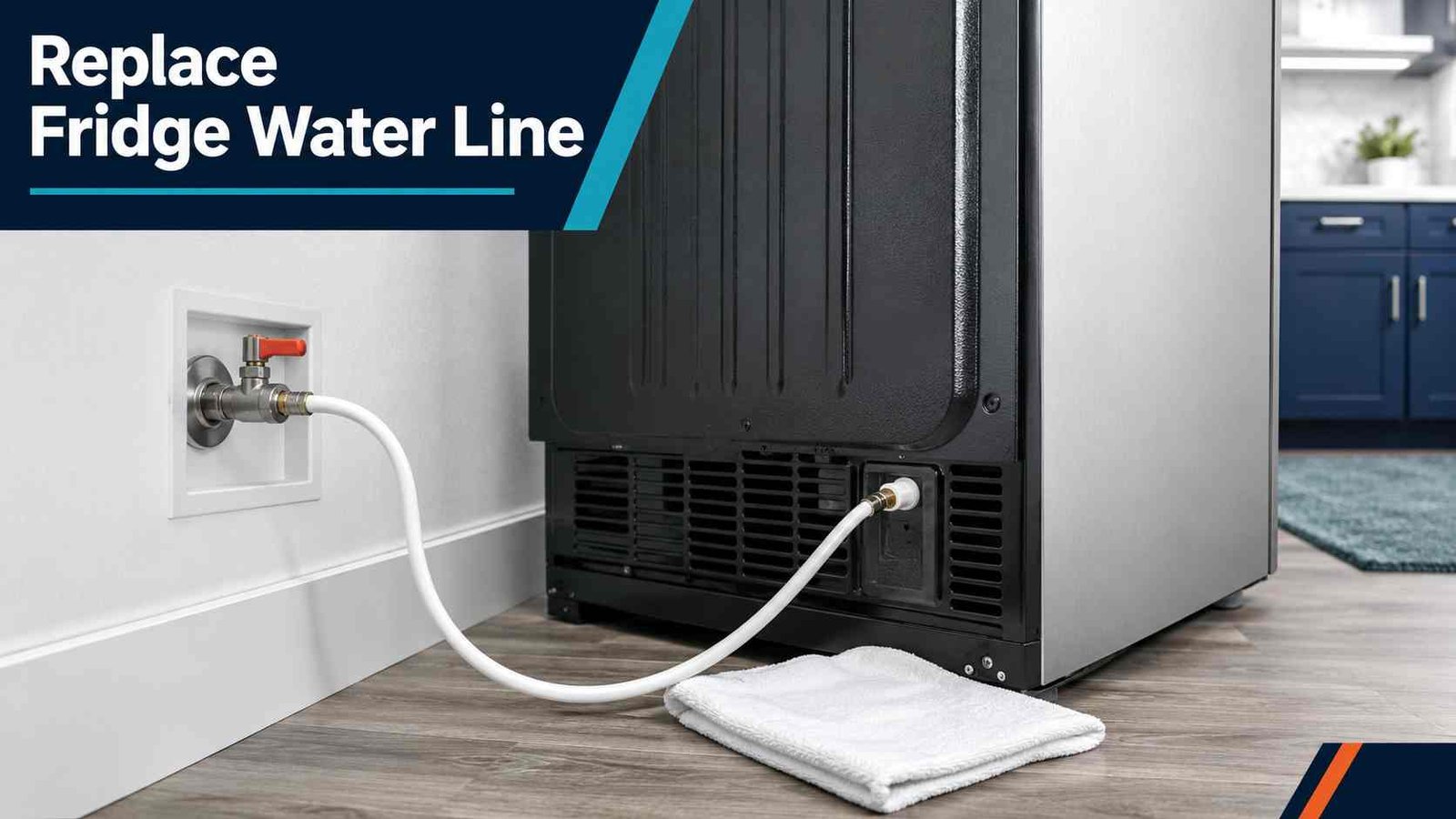
 If the water line behind your refrigerator is cracked, leaking, kinked, or no longer suitable for the appliance, replacing it is usually straightforward when an existing shutoff valve is already available.
The basic job is to turn off the cold-water supply, disconnect refrigerator power, remove the old supply line, install a compatible replacement, restore water pressure, and carefully check for leaks.
The important part is choosing the correct tubing and fittings for your refrigerator. A 1/4-inch outside-diameter connection is common on North American refrigerators, but manufacturers do not all approve exactly the same tubing materials. Whirlpool, for example, specifies 1/4-inch soft copper or PEX on current support pages, while GE recommends copper or its approved cross-linked refrigerator tubing.
Safety note: This guide covers the external supply line between an existing household shutoff valve and the refrigerator. If the valve itself leaks, household plumbing needs alteration, or the refrigerator’s internal tubing or water valve is damaged, stop and use a qualified plumber or appliance professional.
| Item | What to know |
|---|---|
| Job | Replace the external refrigerator water-supply line |
| Common North American size | 1/4-inch outside diameter on many models |
| Water source | Cold potable water |
| First action | Shut off the refrigerator’s water supply |
| Electrical precaution | Unplug the refrigerator before working behind it |
| Tubing | Use material approved for your refrigerator model |
| Main installation risk | Leaks from damaged, incorrect, or poorly seated fittings |
| Final step | Restore water slowly and inspect every connection |
| Professional help | Needed for faulty valves, household plumbing changes, or internal refrigerator leaks |
Whirlpool and GE documentation commonly describes 1/4-inch refrigerator supply connections, while manufacturer installation instructions should still be checked for the specific model.
Which Refrigerator Water Line Are You Replacing?
There are two different things homeowners may call the refrigerator water line.
External refrigerator supply line
This is the line running from a household cold-water shutoff valve to the connection behind the refrigerator. It supplies water to the dispenser and automatic ice maker.
This is the line covered in this guide.
Internal refrigerator tubing
A refrigerator may also contain smaller tubes inside the cabinet, doors, filter assembly, dispenser system, or ice-maker circuit.
Replacing those tubes can require model-specific disassembly. Do not assume the instructions for the external supply line apply to internal tubing.
When Should You Replace a Refrigerator Water Line?
Replace or investigate the line when you find:
- Visible cracks or splits
- Water dripping from the tubing itself
- Permanent kinks that restrict water flow
- Tubing damaged while moving the refrigerator
- Brittle or deteriorated plastic tubing
- A connection that cannot be made safely with the new refrigerator
- Tubing that does not meet the new appliance manufacturer’s installation requirements
Whirlpool specifically recommends inspecting refrigerator supply tubing for cracks, damage, and kinks. A kink can reduce water flow, especially when the refrigerator has been pushed too tightly against the wall.
A wet floor does not automatically mean the tubing itself has failed. Water can also escape from the shutoff valve, compression fitting, refrigerator inlet connection, filter housing, drain system, or another internal component.
Dry the area and identify where the water actually begins before buying parts.
What Size Refrigerator Water Line Do You Need?
For many refrigerators sold in the United States and Canada, 1/4-inch outside-diameter tubing is standard for the household connection.
Whirlpool currently specifies 1/4-inch, or 6.35 mm, soft copper or PEX tubing between the shutoff valve and refrigerator. GE also specifies a 1/4-inch outside-diameter connection for current ice-maker installations. Samsung’s US installation guidance recommends a 1/4-inch copper tubing kit with matching compression hardware.
Do not buy a replacement based only on the old tube’s appearance. Check the installation manual for your refrigerator model first.
Copper, PEX, Plastic, or Braided Line?
There is no single tubing material that can safely be called the correct choice for every refrigerator.
| Material | What to know |
|---|---|
| Soft copper | Commonly accepted by major manufacturers; requires proper compression fittings and careful routing |
| PEX/cross-linked tubing | Approved on some refrigerators; flexible and less prone to permanent kinking than soft metal |
| Plain plastic tubing | Compatibility varies; do not substitute generic plastic without manufacturer approval |
| Braided refrigerator connector | Convenient on some installations, but connector and appliance compatibility must be verified |
Whirlpool currently lists soft copper or PEX. GE recommends copper or GE SmartConnect refrigerator tubing. Samsung recommends copper for its US installations and says that if plastic tubing is used, it needs the appropriate molded end or bulb; Samsung does not recommend a generic plastic tubing kit.
Why ordinary plastic tubing needs caution
A refrigerator supply line remains under water pressure even when nobody is dispensing water.
GE specifically advises against unapproved plastic tubing and recommends approved cross-linked tubing or copper instead. Samsung similarly states that its plastic-tubing option requires the correct molded end and is not its recommended option.
The safer rule is simple: match the tubing and fitting system specified for your refrigerator.
Tools and Materials
For a straightforward replacement using an existing shutoff valve, you may need:
- Correct refrigerator supply tubing or connector
- Correct compression nuts, ferrules, inserts, or manufacturer-specified fittings
- Adjustable wrench
- Second wrench if the fitting requires support
- Small bucket or bowl
- Towels
- Flashlight
- Floor protection
Do not automatically reuse old ferrules, compression hardware, inserts, or damaged fittings with a new line unless the tubing or appliance instructions specifically permit it.
How to Replace a Refrigerator Water Line
1. Check the refrigerator manual first
Find the refrigerator model number and check its installation instructions.
Confirm:
- Tubing size
- Approved tubing material
- Refrigerator-side fitting
- Required connection hardware
- Water-pressure requirements
- Flushing instructions
This matters because the connection arrangement can differ even within the same brand.
Samsung, for example, notes that some RS27T and RS22T refrigerators use two water-line connections, and crossing them can prevent normal ice and water operation.
2. Shut off the water
Locate the shutoff controlling the refrigerator line and close it.
The valve may be under the sink, in a nearby cabinet, basement, crawl space, or another accessible location near the kitchen. GE describes these as common locations for refrigerator shutoff valves.
If the shutoff will not close completely or begins leaking when operated, stop. That is a household plumbing problem rather than a refrigerator-line replacement.
3. Disconnect refrigerator power
Unplug the refrigerator before pulling it away from the wall or working around connections behind it.
LG’s installation guidance for plumbed refrigerators specifically instructs users to unplug the appliance before making the water connection.
If reaching the plug requires moving the refrigerator, move it only enough to gain safe access first.
4. Protect the floor
Place towels or suitable floor protection in front of and behind the refrigerator.
A small amount of water may remain inside the old line even after the valve has been closed.
5. Pull the refrigerator forward carefully
Move the refrigerator slowly.
Watch the water line and power cord as it moves. Do not pull against either one.
Heavy refrigerators can damage soft flooring, so use appropriate appliance-moving protection where needed.
6. Place a bowl under the connection
Put a shallow container or towel beneath the refrigerator connection before disconnecting the old line.
Samsung similarly recommends preparing towels and a container when disconnecting water connections during refrigerator setup.
7. Disconnect the old line from the refrigerator
How it disconnects depends on the fitting.
A copper line commonly uses a compression connection. Some plastic arrangements use a connector or model-specific release mechanism.
Do not twist or pull hard against the refrigerator’s water inlet.
If you cannot identify how the fitting releases, use the model’s installation manual before proceeding.
8. Disconnect the line from the household shutoff
Place a towel beneath the valve.
Loosen the tubing connection while avoiding unnecessary force on the household valve or pipe.
If the valve turns, bends, corrodes, or begins leaking around its body or stem, stop and have the plumbing repaired.
9. Inspect both connection points
Before installing anything new, inspect:
- Refrigerator-side fitting
- Shutoff valve connection
- Threads or compression surfaces
- Existing nuts and adapters
- Nearby tubing
- Signs of corrosion
- Signs of previous leaking
Replacing the tubing will not solve a leak caused by a damaged shutoff valve or damaged refrigerator fitting.
10. Route the new line
Run the replacement line from the shutoff valve to the refrigerator without creating sharp bends.
Leave enough extra tubing behind the refrigerator so the appliance can be pulled forward later.
Whirlpool recommends leaving a coil or service loop of copper or PEX for cleaning and servicing. It also warns that pushing the refrigerator too far back can pinch the line and reduce water flow.
Do not leave so much excess tubing that it folds sharply or gets trapped under the refrigerator.
11. Connect the line to the shutoff valve
Use the fitting arrangement specified by the tubing manufacturer and refrigerator installation instructions.
For compression systems, the tubing should be correctly positioned before the nut is tightened.
Avoid treating tighter as safer. Excessive tightening can distort a fitting or tubing.
12. Flush the supply tubing when required
Some manufacturer installation procedures call for flushing the new supply tubing before connecting it to the refrigerator.
Whirlpool instructs users to place the free end into a bucket or sink and allow water to run through until clear before completing the refrigerator connection.
Follow your appliance’s installation instructions.
Turn the water off again before making the final refrigerator connection.
13. Connect the line to the refrigerator
Seat the tubing or connector exactly as shown in the refrigerator manual.
Samsung’s copper installation uses a compression nut and ferrule. For its permitted plastic arrangement, the tubing requires the proper molded end or bulb.
Do not substitute a fitting merely because it appears to fit.
14. Tighten carefully
Make the fitting secure without overtightening it.
Samsung explicitly warns that overtightening the compression nut can cause a leak. Whirlpool also cautions against excessive tightening during refrigerator water-line installation.
15. Restore the water slowly
Open the shutoff valve and allow pressure to return.
Immediately inspect:
- The shutoff-valve connection
- The full accessible length of tubing
- The refrigerator connection
Run a dry finger or paper towel around a fitting if necessary to detect very small droplets.
If you see water, close the supply before correcting the connection.
16. Restore refrigerator power
Once the connections remain dry, plug the refrigerator back in.
Move it toward the wall gradually while watching the service loop.
Make sure the tubing does not fold, pinch, rub against a sharp edge, or become trapped beneath the refrigerator.
How Tight Should a Refrigerator Water-Line Fitting Be?
A compression fitting needs to be secure, but more force does not automatically create a better seal.
Samsung specifically states that overtightening its water-line compression nut can cause leakage.
If a connection continues dripping after reasonable tightening:
- Shut off the water.
- Release pressure.
- Inspect how the tubing and fitting are seated.
- Check that the correct hardware has been used.
- Replace damaged connection components where required.
Repeatedly forcing a leaking fitting tighter can make the problem worse.
Flush the Refrigerator Water System
After installation, flush the refrigerator’s dispenser according to the manufacturer instructions.
There is no universal flushing quantity.
Samsung US currently instructs users to dispense one gallon after connecting the water line on relevant dispenser models. LG US says to dispense at least two gallons after installing its refrigerator water line.
Follow your refrigerator’s manual rather than choosing an arbitrary amount.
Flushing helps remove trapped air and material introduced during installation.
If the refrigerator has just been installed or reconnected, the manufacturer may also instruct you to discard the first batches of ice. Samsung, for example, tells users following its installation procedure to discard the first two buckets produced.
Check Again for Leaks
Do not make the first leak inspection your last one.
Check again after the refrigerator has been returned to position and the system has remained pressurized.
Look at:
- Shutoff valve
- Supply-line fitting
- Tubing
- Refrigerator inlet
- Floor beneath the refrigerator
A connection that initially appears dry may reveal a slow drip after remaining under pressure.
New Refrigerator Water Line Still Leaking
If the new line leaks, identify the exact location before making another adjustment.
Leak at the compression connection
Possible causes include:
- Tubing not fully seated
- Incorrect ferrule or insert
- Damaged tubing end
- Incorrect fitting
- Overtightened connection
Turn the water off before releasing the fitting.
Leak along the tubing
Replace damaged tubing. Do not rely on a temporary patch for a continuously pressurized refrigerator supply line.
Leak at the shutoff valve
The valve itself may be failing.
That is a household plumbing repair and may require a plumber.
Water appears to come from inside the refrigerator
The external line may not be the problem.
Possible locations include internal tubing, an inlet-valve connection, filter housing, dispenser plumbing, or another refrigerator component. At that point, model-specific diagnosis is required.
Water Flow Is Low After Replacing the Line
A successful installation should not leave the refrigerator with badly restricted water flow.
Check the simple things first.
Look for a kink
Inspect the tubing behind the refrigerator.
Whirlpool specifically identifies a kinked supply line as a cause of reduced water flow and advises leaving enough room so the refrigerator does not pinch the tubing against the wall.
Make sure the valve is fully open
Confirm the refrigerator shutoff valve is in its normal fully open position.
Check the refrigerator filter
A restricted, incorrectly fitted, or model-incompatible filter can also affect dispenser performance.
Check the valve type
Whirlpool warns that piercing-type or undersized saddle valves can restrict flow and clog more readily. It advises verifying local plumbing-code requirements and contacting a licensed plumber when there are questions about household plumbing.
Do not modify a household water pipe simply to troubleshoot low refrigerator flow unless you are qualified to perform that work.
Can You Reuse the Old Refrigerator Water Line?
Sometimes, but do not assume that you should.
Reuse depends on:
- Condition of the tubing
- Material
- Age
- Existing fittings
- New refrigerator connection
- Manufacturer requirements
Samsung notes that an existing line from a previous refrigerator can sometimes be reused, but its connection requirements still need to be followed.
Replace the line rather than reuse it if you find cracking, brittleness, damaged fittings, severe kinks, or questionable compatibility.
Regional Differences Matter
North American manufacturer instructions frequently reference 1/4-inch refrigerator supply connections, but that should not be turned into a worldwide rule.
In Australia, LG distinguishes between plumbed models, which connect directly to household water, and non-plumbed models, which use a refillable internal tank. Its Australian installation guidance also says plumbed models should use the correct connector for the valve type.
Some Australian LG refrigerator documentation goes further and requires qualified service personnel for installation of particular plumbed models.
UK refrigerators can also use model-specific compression connections, as shown in LG UK’s water-line guidance.
For that reason, readers in the UK, Ireland, Australia, and New Zealand should follow the installation documentation supplied for their exact regional model rather than converting US fitting instructions directly.
When to Call a Plumber or Appliance Professional
Stop the DIY replacement when:
- The household shutoff valve leaks
- The valve will not close
- New household plumbing must be installed
- A water pipe needs drilling, cutting, or alteration
- The refrigerator-side fitting is damaged
- The leak originates inside the refrigerator
- You cannot identify the required tubing or fitting
- The manufacturer’s instructions require professional installation
- Local plumbing rules restrict the work
Replacing a removable supply line between two healthy existing connections is very different from modifying household plumbing.
Refrigerator Water Line Replacement FAQs
Can I replace a refrigerator water line myself?
Often, yes, when you are replacing an accessible external line between a working shutoff valve and the refrigerator using manufacturer-approved tubing and fittings.
If household plumbing, a leaking valve, or internal refrigerator components are involved, professional service is the safer option.
Are refrigerator water lines always 1/4 inch?
No universal size should be assumed. However, 1/4-inch outside-diameter tubing is very common in current North American Whirlpool, GE, and Samsung refrigerator guidance. Check the installation manual for your exact model.
Is copper or PEX better for a refrigerator?
Neither is universally correct. Whirlpool currently permits soft copper or PEX in its guidance, while GE recommends copper or approved SmartConnect cross-linked tubing. Use the material approved for your appliance and installation.
Should I replace an old plastic refrigerator water line?
Replace it if it is brittle, cracked, damaged, leaking, or incompatible with the refrigerator. Do not automatically replace generic plastic with more generic plastic. Check what the manufacturer approves.
Why does my new refrigerator water line leak at the fitting?
Common possibilities include poor seating, incompatible hardware, tubing damage, or excessive tightening. Samsung specifically warns that overtightening its compression connection can cause a leak.
Why is the dispenser slow after replacing the line?
First check for a kink behind the refrigerator and confirm that the shutoff valve is fully open. Whirlpool identifies line kinks and restrictive valve arrangements as possible causes of low refrigerator water flow.
How much water should I flush after replacing the line?
Follow your manufacturer instructions. Samsung US specifies one gallon in its current connection guide, while LG US specifies at least two gallons in its water-line installation guidance, showing why a universal quantity should not be assumed.
Can the refrigerator run without a water line connected?
Many refrigerators can continue cooling without an active household water connection, but the dispenser and automatic ice maker will not have a water supply. Follow the model instructions regarding the ice maker when the water supply is shut off.

Daniel Brooks is a US-based appliance troubleshooting researcher with 12 years of experience studying washer, dryer, refrigerator, and dishwasher faults. He reviews manufacturer manuals and converts technical error codes into safe, practical guidance for homeowners.