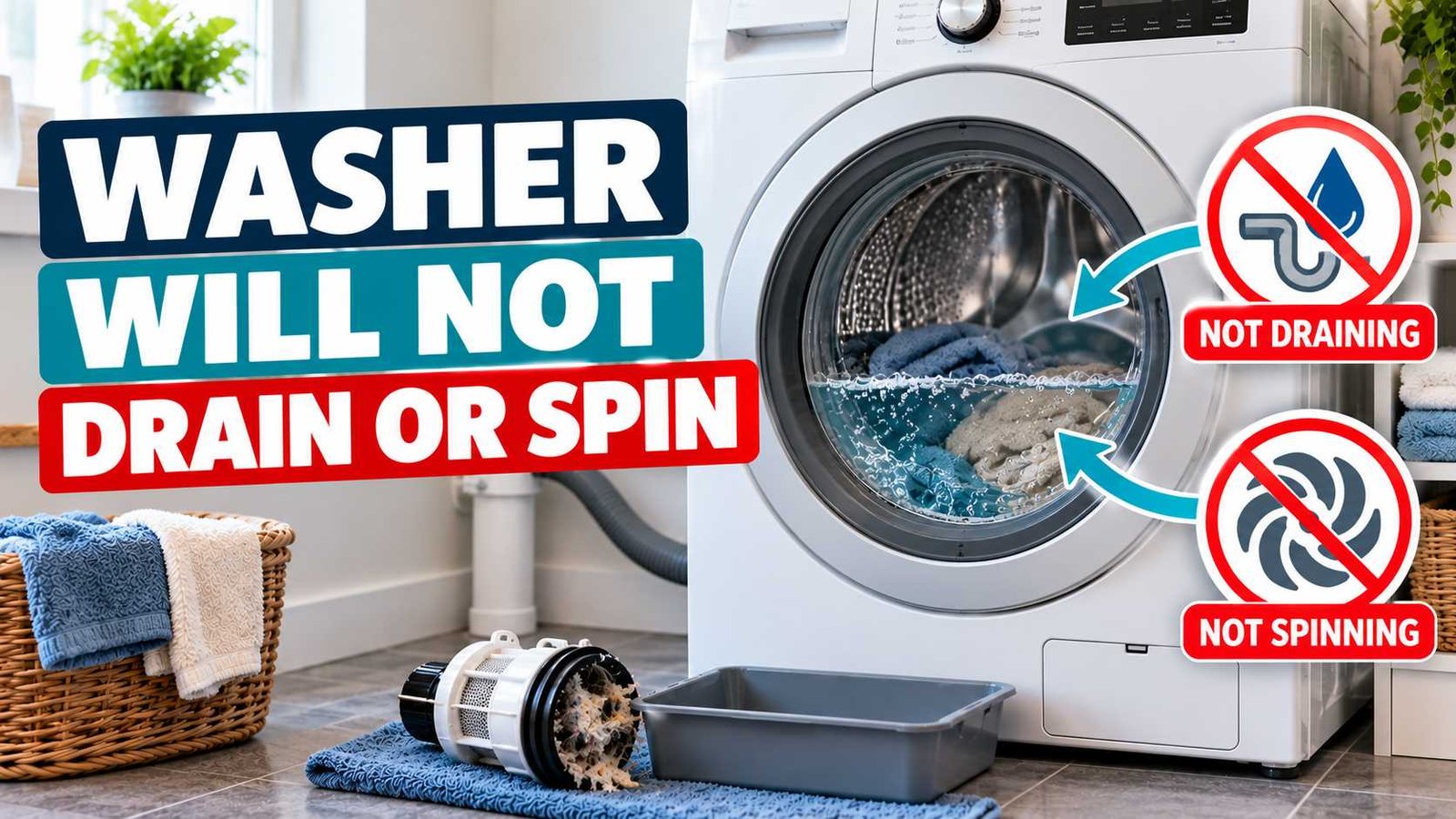
 If your washer will not drain or spin, check whether water is still standing in the tub. Many washing machines delay or prevent high-speed spinning until enough water has drained. A kinked drain hose, blocked pump filter or household drain may explain both symptoms. If the tub is already empty, an unbalanced load, incorrect spin setting, or lid or door-lock problem becomes more relevant.
Stop the washer if water is leaking near electrical equipment, there is a burning smell, or the machine trips a breaker. Disconnect power only when the plug and surrounding area are dry and safe. Do not force open a front-load door full of water, bypass an interlock, or run the machine with its cabinet open.
First, decide whether it is a drain problem or a spin problem
Do not replace the drain pump or motor based on the two symptoms alone. Look for standing water, listen for a pump attempting to run, and note any code displayed on the control panel.
| What you observe | What it may mean | Next safe check |
|---|---|---|
| Water remains in the tub; no final spin | Drainage is restricted or the cycle has stopped | Check the cycle, visible hose and household drain |
| Pump hums but little water leaves | Possible obstruction or pump fault | Stop repeated attempts; check a user-serviceable filter if equipped |
| Tub is empty; load is soaking wet | Spin was reduced, skipped or interrupted | Review spin speed and redistribute the load |
| Machine tries to spin, shakes, then stops | Unbalanced or unsuitable load | Wait for the lock to release, then rebalance safely |
| Door or lid will not lock | Interlock or closure issue | Clear fabric from the opening and check for a displayed warning |
| Water backs up from the standpipe | Likely household drainage restriction | Stop operation and arrange plumbing inspection |
1. Check whether the cycle is paused or holding water
Some programs intentionally retain rinse water or use a lower final spin speed. Others pause while checking load balance. Confirm that the cycle has finished and that Rinse Hold, No Spin, or a comparable option was not selected. Consult the exact manual before choosing a Drain & Spin or Spin Only program; on some models, these options also initiate a pump-out.
If the machine displays a drain error or remains full after its normal pause, do not keep restarting the same cycle. Repeated attempts cannot clear a physically blocked hose or pump.
2. Inspect the external drain hose and standpipe
With the machine stopped, look for an accessible hose that is crushed behind the cabinet, sharply bent, or kinked. Do not pull a heavy washer forward alone or stretch hoses attached to plumbing. The drain hose must be routed at the height and insertion depth specified for your washer. These requirements vary between front-load, top-load and regional models.
Check whether the laundry sink or standpipe is backing up when the washer tries to discharge. If water escapes from the household drain, stop the cycle and contact a plumber. Do not disconnect a hose containing a full tub of water unless there is a controlled, manufacturer-approved way to contain it.
3. Clean a pump filter only if your washer provides safe access
Some front-load washers have a lower-front access flap with a pump filter and, in certain models, an emergency-drain tube. Coins, lint and small fabric items can obstruct this filter and prevent the machine from pumping out enough water to spin. Not every washer has a user-removable filter. Many top-load models do not have this type of access.
- Turn off the washer, unplug it where conditions are dry and safe, and allow hot wash water to cool.
- Check the manual for the approved emergency-drain or filter-cleaning procedure. Lay towels down and put a shallow container beneath the access point.
- If a capped emergency-drain tube is provided, drain water into the container in controlled batches as instructed.
- Only after water has been safely released, remove and clean the designated filter according to the manual. Do not force a stuck cap or insert tools into the pump.
- Refit the filter, cap and drain tube securely. Check for leaks after reassembly before using another cycle.
If the tub contains more water than you can safely manage, stop and arrange service. Do not unscrew a filter all at once while the drum is full or try to tip the washer to empty it.
4. When the tub is empty but the washer will not spin
Rebalance heavy or tangled laundry
A single bathmat, wet duvet or a few heavy towels can gather on one side of the drum. Many washers detect the imbalance and reduce spin speed or stop the attempt to prevent excessive vibration. Once the drum is completely still and the door or lid has unlocked normally, untangle and redistribute the items. Follow the model’s load-size guidance; do not overload the washer.
Check spin-speed and fabric settings
Delicate and bulky programs may use a gentler spin, leaving clothes wetter than a normal cotton cycle. Verify that No Spin or a low spin speed was not selected accidentally. If the drum is empty of standing water and the manufacturer’s instructions permit it, try the appropriate spin program with a suitable, balanced load. A successful spin suggests the problem may be related to load or program selection rather than a completely failed drive system.
Look at excess suds
Too much detergent, or detergent unsuitable for a high-efficiency machine, can cause excess foam and interfere with normal rinsing and spin performance on some washers. Use the detergent type and measured amount specified by the manufacturer. If the machine shows a suds warning, follow the manual instead of adding more detergent or repeatedly running the same wash.
5. Check the lid or door closure without bypassing it
Washers generally have safety systems that prevent unsafe drum movement when the lid or door is not secured. Make sure clothing is not trapped in the opening and that the door or lid closes as designed. Do not slam it, attempt to defeat the lock, or open the casing to test switch wiring. If the lock warning remains or the door is mechanically damaged, arrange a model-specific repair.
6. What a humming drain pump can and cannot tell you
A hum during the drain stage can indicate that the pump is being commanded to operate, but it does not prove that water is flowing or that the pump is healthy. An impeller obstruction, restricted internal hose, damaged pump or electrical-control fault can produce similar symptoms. If the external hose, household drain and any permitted filter checks do not restore drainage, further diagnosis may require safe internal access by a qualified technician.
Why the washer stops before the final spin
Many machines monitor water level, drum balance and lock status before increasing spin speed. A slow drain can prevent the control from approving a final spin; an imbalance may cause repeated attempts to redistribute the load; a failed lock signal can also interrupt the program. These are different faults even when the final result is the same: wet laundry.
If the drum does not rotate at all during washing as well as spinning, tell the technician. That observation changes the diagnosis and may point toward a drive-system or control problem rather than drainage alone.
Front-load and top-load washers need different checks
| Design | Likely user-accessible checks | What not to assume |
|---|---|---|
| Front-load | Program, hose, load balance, door closure and filter where provided | Not every model has an emergency tube or accessible pump filter |
| Top-load | Program, hose, household drain, load distribution and lid closure | Do not assume a front-load-style filter exists |
| Washer-dryer combination | Exact manual’s drain, spin and filter instructions | Controls and filter locations differ substantially by design |
What do common drain and spin error codes mean?
Codes must be matched to the brand and model. For example, LG uses OE for a drainage problem on supported models, while certain Samsung washers use 5C or 5E for drain issues. Samsung also uses Ub or UE for some unbalanced-spin conditions. Similar-looking letters and numbers are not interchangeable across brands, and a code alone does not identify a defective part.
Write down exactly what appears on the panel before clearing it, including any letters that look like numbers. Use the manufacturer’s guidance for that specific model.
Can a reset restore draining and spinning?
Canceling a stalled program or using a manufacturer-approved reset may help with a temporary control interruption. It will not remove a clog, mend a crushed hose or repair a damaged lock. Avoid generic reset button combinations from unrelated models. If the same symptoms immediately return, move from resetting to proper diagnosis.
When to stop and arrange professional repair
- The tub remains full after the visible hose and permitted filter checks.
- The washer hums or grinds but cannot pump out water.
- The drum is empty but never spins on an appropriate program with a balanced load.
- A door-lock, drain or imbalance warning returns despite the manufacturer’s approved steps.
- Water leaks near electricity, the breaker trips, or you notice smoke, burning or violent movement.
For service, provide the full model number, whether water remains visible, the selected program, any error code, and whether the motor or pump can be heard. Ask for confirmation of the failed component and a complete repair quote before ordering parts.
Prevent another drain-and-spin failure
Empty pockets, secure small garments in a suitable laundry bag, avoid stuffing the drum and measure detergent correctly. Keep the drain hose free of sharp bends and clean any user-serviceable filter at the interval specified in your manual. Watch for slower draining or increasing vibration before either symptom becomes severe.
Bottom line: a washer that will not drain or spin usually needs the water-removal problem checked first. If it already drains but will not spin, focus on load balance, program settings and the door or lid lock. Stop at safe external or manufacturer-approved maintenance checks; persistent faults need model-specific service.

Ahmad Raza is the website administrator and content operations manager at Error Code Vault. With 11 years of experience in technical publishing, he manages site accuracy, author verification, source quality, updates, user feedback, and editorial compliance.