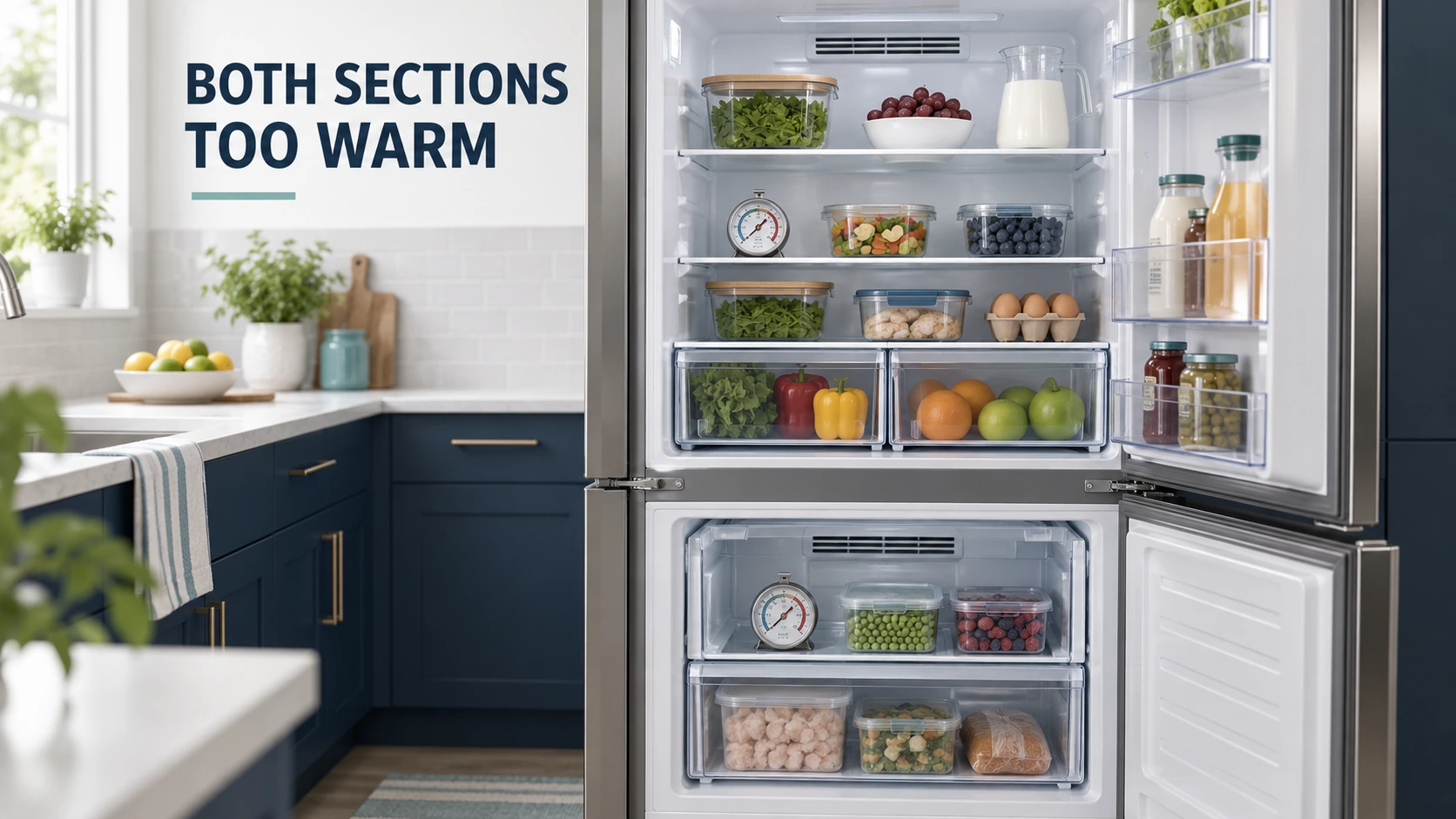
If both your fridge and freezer are not cold enough, check the actual compartment temperatures first, then the temperature settings, door closure, blocked vents, and airflow around the cabinet. When both sections are warming together, the problem may affect the appliance’s overall cooling rather than just the transfer of cold air into the fresh-food section.
Protect the food before spending hours troubleshooting. A refrigerator should hold food at 40°F (4°C) or below, and a freezer should be at 0°F (-18°C) or below. Use independent appliance thermometers where possible; a control-panel setting is not necessarily the measured food-storage temperature. If refrigerated perishables have been above 40°F (4°C) for more than two hours, discard them. If you cannot establish how long food has been warm, use the FoodSafety.gov discard chart instead of tasting it.
First, confirm how warm each compartment really is
- Place a refrigerator thermometer in the fresh-food compartment and a freezer-safe thermometer in the freezer, following each thermometer’s instructions.
- Record both readings and whether they are rising or falling. Note if frozen food is softening or ice cream has become unusually soft.
- Check the selected temperature settings. A useful food-safety target is a refrigerator at or below 40°F (4°C) and a freezer at or below 0°F (-18°C); consult the manual for the correct controls.
- Keep the doors closed as much as possible while you assess the situation, and move vulnerable food to a working appliance or properly iced cooler if cooling is not being maintained.
After a recent installation, a long power outage or loading a large amount of warm food, temperatures may take time to stabilize. But this does not make unsafe food temperatures acceptable, and it is not a reason to leave perishable food warm while waiting.
What both temperature readings suggest
| What you find | What it suggests | Next safe action |
|---|---|---|
| Both sections are warmer than their targets | Cooling capacity, power, ventilation, settings or door sealing may be involved. | Follow the shared cooling checks below and arrange service if temperatures do not improve. |
| Freezer is at its target, fridge is warm | This is more likely a fresh-food airflow or compartment-specific issue. | Use the separate freezer-cold, fridge-warm guide for the different symptom. |
| Both sections warmed after a power cut | The unit may still be recovering, or power or cooling has not been restored correctly. | Verify electrical supply safely, protect the food, and monitor measured temperatures. |
| Temperatures rise and fall repeatedly | Intermittent door sealing, electrical supply or refrigeration control problems are possible. | Record temperatures and noises for a technician; avoid repeated resets. |
| Heavy frost and poor cooling | A door not sealing or a defrost/airflow problem may be involved. | Check visible door obstructions; do not chip ice or open internal panels. |
Check the simple causes that can warm both sections
1. Check the settings and operating mode
Confirm that cooling is turned on and neither compartment has been placed into a model-specific cooling-off, showroom or vacation setting that changes operation. These features differ widely by manufacturer and market, so consult the exact model manual rather than following a generic button sequence. A displayed number may be a setpoint, not the current measured temperature.
2. Make sure both doors actually seal
Check for protruding food packages, misaligned drawers, or shelves preventing a door from closing. Inspect the accessible rubber gaskets for crumbs, gaps, tears or folding, then clean them gently according to the manual. A door left slightly open can admit warm, moist air and cause frost. If the door is misaligned or the gasket is damaged, seek model-specific service rather than forcing hinges.
3. Unblock air vents inside the appliance
Move containers away from visible vents in both compartments and leave room for air to circulate. Overpacking can obstruct airflow, while placing large quantities of room-temperature groceries inside can temporarily raise the measured temperature. Whirlpool, GE Appliances and LG all include airflow and food loading among their basic cooling checks, although individual layouts differ.
4. Check external ventilation and location
Make sure the appliance has the installation clearance specified in its manual. Avoid positioning it beside strong heat sources or in a garage whose temperature falls outside the model’s climate rating. Do not assume another brand’s clearance measurements apply to your refrigerator.
5. Check accessible condenser cleaning instructions
On models with user-accessible condenser coils, dust buildup may contribute to poor heat rejection. Only clean the areas the manufacturer identifies as owner maintenance, with the appliance isolated as instructed and without touching electrical components or moving parts. Some refrigerators have enclosed or maintenance-free condenser designs; do not remove service covers or pull the machine into an unsafe position just to find coils.
If the appliance is running but neither compartment gets cold
If settings, doors, load and ventilation are correct but both measured temperatures remain high, possible causes include a non-running condenser fan on applicable models, compressor-start or control problems, a sensor fault, or a sealed refrigeration-system fault. These are diagnostic possibilities, not reasons to order parts.
A hum, click, or apparently running compressor does not prove refrigerant is circulating correctly. Likewise, a silent period can be normal for some operating cycles. Record whether the unit has unusual repeated clicking, continuous running, error messages or a recurring trip at the circuit breaker, and give that information to the service provider.
Stop and call for qualified help if the plug or cable is damaged, there is an electrical burning smell, a breaker repeatedly trips, or you suspect refrigerant leakage. Do not pierce tubing, open the sealed refrigeration circuit, test live wiring or bypass protective switches. Qualified technicians must determine whether a component or sealed-system repair is appropriate.
How long should you wait for cooling to recover?
There is no universal recovery time. It depends on the model, room temperature, initial compartment temperature, food load and whether the cooling system is healthy. Some manufacturers explain that a newly installed or heavily loaded refrigerator may require extended stabilization. If food is warming, act on the measured temperature and food-safety history instead of assuming that waiting will fix it.
FoodSafety.gov states that during a power outage, an unopened refrigerator generally keeps food safe for about four hours, while an unopened full freezer can hold its temperature for roughly 48 hours, or 24 hours when half full. Those estimates assume the doors stay closed and are not blanket permission to keep food after a prolonged cooling failure. Frozen foods with ice crystals or that remain at 40°F (4°C) or below may be evaluated for refreezing using the agency’s food-safety guidance.
When to arrange repair instead of trying more checks
- Both independent thermometers show temperatures above the target range and the basic checks have not restored cooling.
- Temperatures continue rising, thawing progresses, or the appliance never begins recovering after normal power has returned.
- The compressor area makes repeated abnormal clicking noises, an error persists, or the appliance trips the breaker.
- There is an electrical hazard, suspected refrigerant leak, or a repair requires opening panels or the sealed system.
Before contacting service, note the make and full model number, measured fridge and freezer temperatures, room conditions, when the problem started, recent power interruptions, frost patterns, and whether doors are sealing. Check warranty coverage before authorizing repairs. The distinction matters: both compartments warming points toward shared cooling or installation conditions, while a cold freezer with a warm fridge calls for a different diagnostic path.

Ahmad Raza is the website administrator and content operations manager at Error Code Vault. With 11 years of experience in technical publishing, he manages site accuracy, author verification, source quality, updates, user feedback, and editorial compliance.