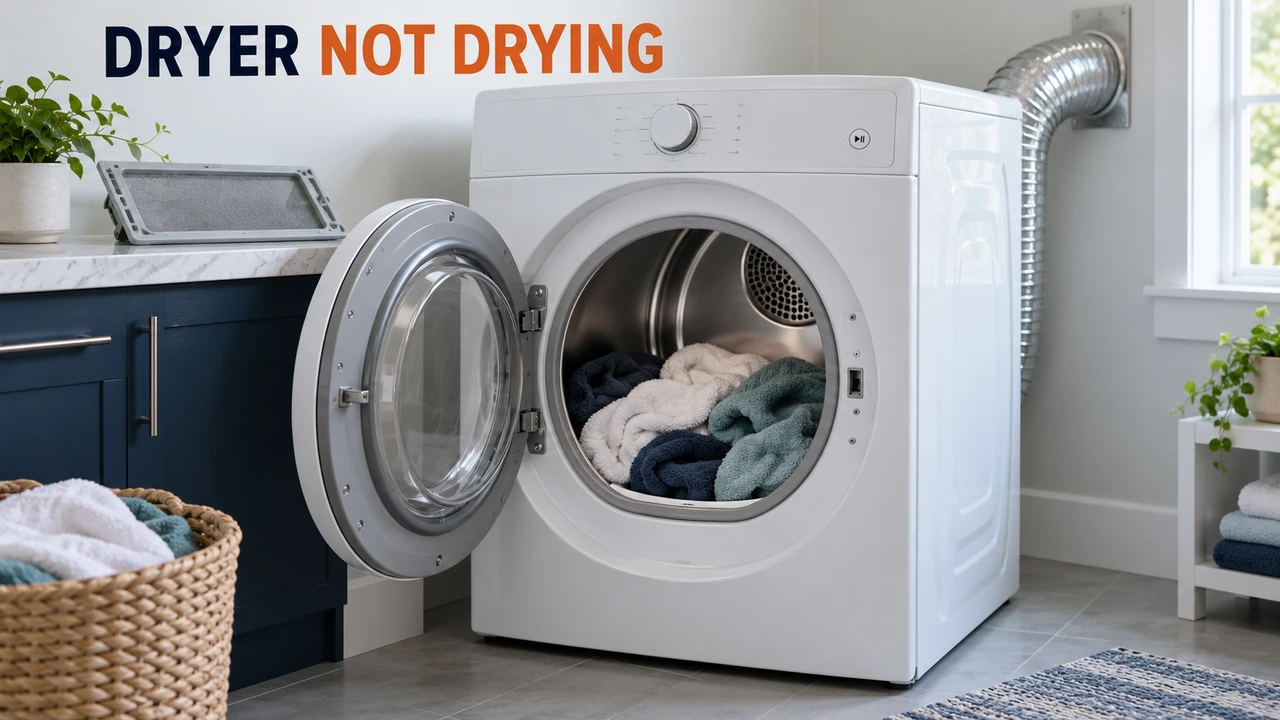
 If your clothes dryer isn’t drying, start with the lint screen, the exhaust vent and the size of the laundry load. A dryer can heat the clothes but still leave them damp when moist air cannot escape. Another possibility is that the washer left the clothes unusually wet. The first useful question is whether the clothes are warm but damp, cold and damp, or still wet after the cycle ends early.
Fire-safety warning: Stop using the dryer if you notice a burning smell, scorching, unusual overheating, smoke or a damaged vent. Do not run another load to test a suspected blocked exhaust. Switch the appliance off; unplug it only if you can do so safely. Have the vent or dryer assessed before using it again. If there is smoke or fire, leave and call emergency services. Never operate a dryer without its lint filter.
Check These Four Things Before Repeating the Cycle
- Clean the lint screen. Remove lint before each load and reinstall the screen securely. If detergent or fabric-softener residue coats the mesh, clean it as the manufacturer recommends and dry it completely before replacing it.
- Reduce the load. Wet clothes need space to tumble and expose fabric to moving air. Separate an overloaded drum into smaller loads, especially when towels or bedding are mixed with lightweight clothing.
- Choose an appropriate cycle. Air Fluff or No Heat will not heat clothes. Quick cycles are often intended for small loads. If a sensor cycle stops while clothes are still damp, confirm the correct dryness setting for the fabric.
- Notice how wet the load was at the start. Clothes that emerge dripping or unusually heavy from the washer need a suitable spin cycle or washer diagnosis. The dryer should not have to compensate for poor water extraction.
Dryer Gets Hot but Clothes Are Still Damp
Warm, damp laundry is a strong reason to inspect the dryer exhaust system. On a conventional vented dryer, heated air picks up moisture from the fabric and carries it outdoors. When lint, a crushed hose or an obstructed outlet restricts that airflow, the drum can stay warm while drying takes much longer. Heat alone does not show that the vent is clear.
Inspect the visible exhaust hose
Turn the dryer off and disconnect electrical power before any manufacturer-approved inspection. Look only at accessible hose sections for a sharp kink, a crushed section behind the machine, visible tears or a loose fitting. Avoid moving a heavy appliance alone. A long or badly routed duct with too many bends can also restrict airflow, and allowed duct length varies with the model and installation.
Do not substitute plastic or thin foil ducting for a code-compliant metal exhaust arrangement. Have a qualified installer correct damaged, unsuitable or inaccessible venting. Gas dryers also require proper combustion-air supply and outdoor exhaust; never vent a gas dryer into a room, attic or crawlspace.
Check the outdoor vent hood
Locate the external termination if it can be reached safely from the ground. With the dryer operating normally and no evidence of overheating or a suspected blockage, the flap should open and air should discharge. A flap that stays closed, visible lint buildup or weak exhaust may indicate a restriction. Stop the appliance and arrange full-duct cleaning rather than continuing to run repeated loads. Do not climb a roof or ladder to reach the outlet.
The U.S. Fire Administration recommends keeping the entire exhaust route clean and checking that the outdoor vent opens. Cleaning the removable lint screen does not remove lint trapped deeper in the duct.
Dryer Runs but Clothes Stay Cold
If laundry is cold after a correctly selected heated cycle, the problem differs from slow drying with normal heat. Confirm the cycle is not Air Fluff or No Heat and that the control has not been set to a non-heated option. An electric dryer can sometimes turn its drum even when its heating supply or a heating component has failed. A gas dryer may tumble without its burner heating.
Do not remove panels, test live voltage, replace a heating element or work on a gas burner as a homeowner experiment. A technician can check the supply, thermal protection, ignition or heating components using procedures for your exact model. If a breaker has tripped repeatedly, leave it off and contact qualified service rather than cycling it again.
Dryer Takes Two or Three Cycles to Dry a Load
Repeated cycles often mean a combination of restricted airflow, excessive load size or an unsuitable program. Compare a modest load of similar-weight items with the oversized or mixed load that caused trouble. Make sure heavy towels are not wrapped inside sheets or duvet covers, where they may remain wet even while outer fabrics dry.
If a smaller, properly spun load still stays damp after the expected program, do not simply raise the heat to compensate. Look for signs of restricted venting and arrange appropriate cleaning or service. Prolonged drying, hot laundry that never becomes dry and a laundry room that grows unusually hot or humid all deserve attention.
Why an Automatic Dryer Cycle May End Too Soon
On dryers with moisture sensing, the machine estimates dryness from contact with the load and other control inputs. Small loads, mixed fabrics, incorrect dryness settings or an unlevel appliance may affect how some models sense moisture. Consult the owner manual before cleaning any accessible moisture-sensor strips, and use only the specified cleaning method.
If clothes are damp at the end of an automatic program but a correctly selected timed-heated cycle works as expected, cycle choice or sensing may be involved. That comparison is a clue, not proof of a failed sensor. Never bypass a moisture sensor or other safety device.
What Your Dryer Symptoms Suggest
| What you notice | Possible explanation | Best next action |
|---|---|---|
| Clothes are hot but damp | Restricted exhaust airflow or a load that cannot tumble freely | Stop if overheating is suspected; inspect the lint screen and accessible duct, and arrange vent cleaning |
| Clothes remain cold | No-heat program, power issue or heating-system fault | Confirm the heated cycle; seek qualified service if still cold |
| Loads take several cycles | Vent restriction, overload or very wet laundry | Check load size, washer spin and exhaust condition |
| Automatic cycle stops too soon | Small load, dryness selection or sensing issue | Review cycle settings and model-approved sensor care |
| Outdoor hood does not open | Blocked or improperly installed exhaust route | Stop using the dryer and arrange a vent inspection |
| Only thick items remain damp | Mixed fabric weights or items folded inside bedding | Separate bulky and light items for suitable cycles |
Do Heat-Pump and Condenser Dryers Need the Same Checks?
No. A conventional vented dryer expels moist air through an outside exhaust duct. Many condenser and heat-pump dryers collect extracted water in a tank or send it to a drain and do not use the same outdoor vent. On these models, an overfull water container, blocked lint filters or a condenser/heat-exchanger area that needs manufacturer-approved maintenance can interfere with drying.
Follow your particular machine’s guidance for emptying the collection tank and cleaning user-accessible filters. Heat-pump cycles may run at lower temperatures and can take longer than conventional heated cycles. Never open refrigerant-system parts, bypass sensors or wash components the manufacturer says must remain dry.
What Does a Check Vent or Airflow Warning Mean?
Some dryers can display a vent restriction message. On applicable Whirlpool models, AF or Check Vent indicates restricted airflow, but those labels are not universal across brands. Write down the complete message and model number before attempting a model-approved acknowledgment.
Clearing a warning does not clear lint from a duct. If an airflow warning returns, or the dryer continues to overheat or take too long, stop using it until the exhaust route and appliance are checked.
When to Call a Dryer or Venting Professional
Arrange service when the machine remains cold on a heated cycle, produces unusual noises, ends cycles unpredictably or continues to dry poorly after the simple checks. Have the vent professionally cleaned when it is inaccessible, obstructed, improperly routed or repeatedly triggers airflow warnings. For a gas dryer, an unexplained gas smell requires leaving the building and calling the gas utility or emergency services from outdoors; do not operate switches or attempt a repair.
Before booking the visit, note the full model number, whether the dryer is gas, electric, vented or heat-pump, whether clothes feel hot or cold, the selected cycle and whether the washer finishes spinning properly. These details help distinguish a drying-performance problem from a heating failure without guessing at replacement parts.
For most dryers that tumble but leave clothes damp, begin with a clean lint screen, a manageable load and the correct cycle. Then verify the exhaust path or the model’s moisture-collection system. If the dryer overheats, has poor exhaust airflow or cannot heat, stop at the safe exterior checks and have it diagnosed.

Ahmad Raza is the website administrator and content operations manager at Error Code Vault. With 11 years of experience in technical publishing, he manages site accuracy, author verification, source quality, updates, user feedback, and editorial compliance.