
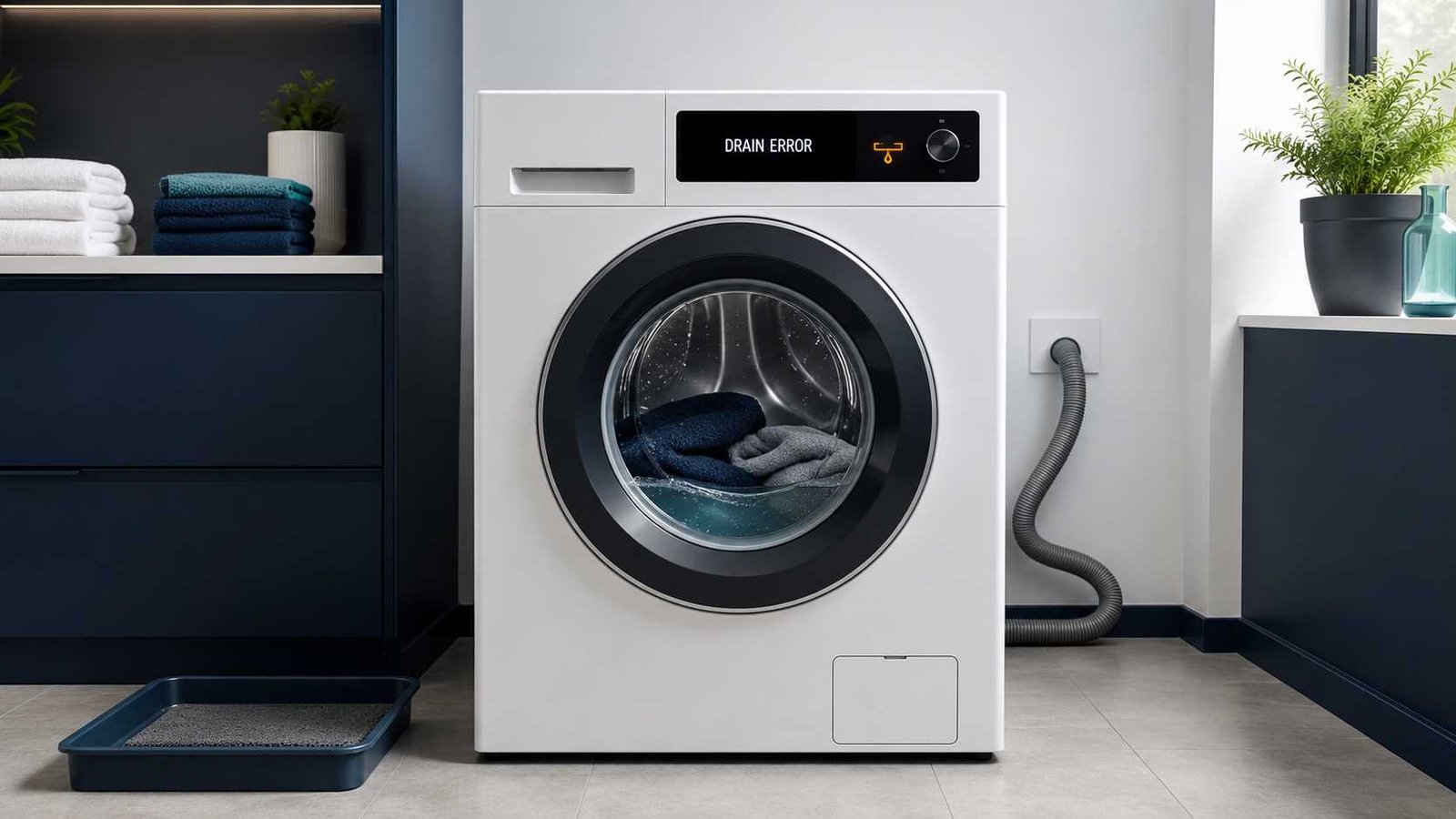
 A washing machine that is not draining usually has a restricted drain hose, clogged pump filter, blocked household drain, excessive detergent foam, or a drain-pump problem. The first safe check is to cancel the cycle and select Drain, Spin, or Drain and Spin, depending on the controls available on your machine.
Do not continue using the washer while water remains inside. Disconnect it from power before opening any user-accessible filter, and allow hot wash water to cool before attempting manual drainage. Stop immediately if you notice leaking near electrical parts, a burning smell, scorching, crackling, repeated breaker trips, or an unusually hot plug or socket.
Quick Answer
| Item | Guidance |
|---|---|
| Problem | Water remains in the drum or drains too slowly |
| Most common causes | Kinked hose, clogged filter, blocked household drain, excessive suds or faulty drain pump |
| First safe check | Run a Drain or Spin program and listen for the pump |
| Appliance types | Front-loaders, top-loaders, washer-dryers and compact washers |
| Can it still be used? | Not until the water drains normally and the cause is addressed |
| Homeowner difficulty | Low to moderate for visible hose and accessible filter checks |
| Professional help needed | When basic checks fail, the pump is silent, water leaks, or internal access is required |
| Possible codes | OE, 5C, 5E, E18, F18, d02, E20, E21, C2, F9 E1, DRN, LD or Err2 |
Before You Start: Make the Washer Safe
Take a few precautions before handling standing water.
- Cancel or pause the current cycle.
- Switch the washing machine off.
- Unplug it from the wall outlet when the plug is safely accessible.
- Turn off the water-supply taps if the washer is continuing to fill.
- Allow water from a hot or sanitising cycle to cool.
- Place towels and a low tray near the filter area.
- Keep children and pets away from the wet floor.
Do not force open a locked front-loader door. Many front-load washing machines keep the door locked while they detect water inside. Forcing it can damage the lock, door or seal and may release a large amount of water.
Bosch and Samsung specifically warn that retained wash water may be hot enough to cause injury. Electrical Safety First also advises watching for burn marks, damaged wiring and other signs of electrical trouble.
First, Try a Drain or Spin Program
Before removing any parts, try the simplest controlled test.
Depending on the machine, select one of the following:
- Drain
- Empty
- Spin
- Drain and Spin
- Pump Out
Wait a few minutes. Some washers pause before the pump starts, so an immediate lack of sound does not always mean something has failed. GE notes that selected models may pause for several minutes between stages.
Listen carefully when the drain stage begins.
The pump hums but water does not leave
A humming sound suggests that the pump motor is receiving a command, but it does not prove that the complete drainage system is healthy.
Possible causes include:
- A clogged pump filter
- A blocked hose
- An object restricting the pump impeller
- A weak pump that cannot move water effectively
- A blocked household drain
LG uses a spin-only cycle as a pump test and recommends checking the drain filter when a humming sound is present but drainage remains poor.
The pump is completely silent
If the washer is definitely in a drain stage but no pump sound is heard, the pump may not be operating. Other possibilities include a wiring, control, door-lock, lid-lock or sensing problem.
Do not remove panels or test live wiring. Further diagnosis should be completed by a qualified appliance technician.
The pump makes rattling or grinding sounds
An unusual noise during drainage may be caused by coins, buttons, clips, fabric debris or another object near the pump. A damaged pump can produce similar sounds, so noise alone does not confirm which part is faulty. Electrolux includes an unusual pump noise among the symptoms of a drainage blockage.
How to Remove Standing Water Safely
The correct method depends on the washer design.
Front-loader with an emergency drain hose
Some front-loaders have a small emergency hose behind the lower service flap.
- Confirm the appliance is unplugged.
- Allow hot water to cool.
- Place a shallow container beneath the hose.
- Remove the hose cap slowly.
- Drain a small amount at a time.
- Refit the cap securely when the flow stops.
- Keep towels ready because more water may remain behind the pump filter.
LG and Bosch use this general arrangement on selected front-loading models.
Front-loader with a pump filter but no obvious hose
Check the user manual before loosening the filter.
Opening the filter while the drum is full can release water rapidly. Use a very shallow tray, loosen the filter gradually and retighten it whenever the tray needs emptying.
Do not force a filter that will not turn. A trapped object may be jamming it from behind, and excessive force can break the filter cap or pump housing.
Top-loader without a front pump filter
Many top-load washers do not have a removable lower-front filter. Samsung states that its pump-filter cleaning step applies to front-loaders, not top-loaders, and LG similarly notes that its drain pump filter is fitted to front-load and combination units rather than its top-load machines.
Do not tilt the washer or remove the cabinet to reach the pump. Try the Drain or Spin program, inspect the visible hose and follow the model manual. Arrange service if the machine offers no approved user-level drainage method.
Most Common Reasons a Washing Machine Will Not Drain
1. Kinked or crushed drain hose
The hose behind the machine can become trapped when the washer is pushed against the wall. A sharp bend restricts water flow and may cause slow drainage, standing water or a drainage error.
Pull the machine forward only when it can be moved safely. Inspect the full visible length of the hose and straighten gentle bends without stretching or damaging it.
LG, Samsung, Whirlpool, Bosch, GE and Electrolux all include kinked or blocked drain hoses among their primary checks.
2. Incorrect drain-hose installation
A hose placed too deeply into a standpipe can cause siphoning or allow discharged water to return. A hose installed too high may exceed the pump’s lifting capability. An airtight seal around the hose can also interfere with correct drainage.
There is no universal hose height or insertion depth for every washing machine.
For example:
- Samsung US provides specific minimum, maximum and insertion measurements for its supported models.
- Whirlpool measurements differ between some top-load and front-load product families.
- Electrolux UK advises a drain height of approximately 60–100 cm and no more than 10 cm of hose extending into the drain for the appliances covered by its guidance.
- GE states different maximum pumping heights for full-size and compact or portable washers.
Use the installation instructions for the exact model rather than copying a measurement from another brand.
3. Clogged pump filter
A pump filter can collect:
- Coins
- Buttons
- Hair
- Lint
- Small socks
- Fabric threads
- Hairpins
- Tissue residue
- Small plastic items
A partly blocked filter may allow slow drainage but leave clothes soaking wet. A fully blocked filter may stop drainage and produce a code.
Only clean the filter when the manual confirms it is designed for homeowner access.
4. Blocked standpipe, sink trap or household drain
The washer may be working correctly while the plumbing connection is blocked.
Possible signs include:
- Water backing up from the standpipe
- A utility sink draining slowly
- Gurgling from a nearby drain
- Water spilling when the washer pumps out
- The washer draining correctly when the hose is temporarily directed into a suitable test sink or container
Electrolux recommends checking the sink trap and testing whether the appliance drains normally through an alternative suitable outlet. GE suggests testing the household drain separately and contacting a plumber when the standpipe itself will not accept water.
Use care with any test. The container or sink must be large enough for the discharge rate, and the hose must be held securely so it cannot fall or spray water near electrical equipment.
5. Excessive detergent or foam
Too much detergent can create heavy foam that interferes with sensing, drainage or spin performance. The machine may extend the cycle, drain slowly or leave the load wetter than expected.
Use:
- High-efficiency detergent when the machine requires it
- The amount recommended by the detergent and appliance manufacturers
- Less detergent when washing small loads or using very soft water
Whirlpool links excess suds with reduced spin performance and very wet loads. LG and Electrolux also identify heavy foam as a possible contributor to drainage faults.
6. A cycle option is holding the water
On selected models, options such as Rinse Hold, No Final Spin or similar settings may leave water in the drum until a Drain or Spin command is selected.
The wording varies by manufacturer. Check the control panel and user manual before assuming the machine has a fault.
7. The drain hose or outlet is frozen
In cold conditions, water inside the hose or pump area may freeze. LG lists a frozen drain hose as a possible cause on selected models.
Do not use boiling water, open flames or high-temperature heating tools. Follow the manufacturer’s thawing instructions for the exact model.
8. The drain pump is obstructed or faulty
A pump can fail mechanically or electrically. It may hum without moving water, work intermittently, drain very slowly or remain silent.
A blocked pump and a failed pump can produce similar symptoms. Professional testing may be required after the hose, filter and household drain have been ruled out.
Bosch and Electrolux advise arranging service when the machine still will not drain after the approved blockage checks.
Step-by-Step Troubleshooting
Step 1: Record the symptoms
Before switching the machine off, note:
- Any code or flashing-light pattern
- The stage where the cycle stopped
- Whether the pump hums
- Whether the drum is full or only slightly wet
- Whether the washer drains slowly or not at all
- Whether water backs up from the household drain
Take a photograph of the control panel if the code disappears after power is removed.
Step 2: Run Drain or Spin
Start an approved drain program and wait for the pump stage.
If the machine drains normally, run a short empty rinse-and-spin cycle before washing another load. A single successful drain does not prove that an intermittent blockage has disappeared.
Step 3: Inspect the visible hose
Check that the hose:
- Is not kinked
- Is not flattened
- Is not trapped behind the washer
- Has not slipped too far into the standpipe
- Does not form an airtight connection
- Is not installed above or below the model’s permitted range
- Has no unapproved extension
Do not remove factory-fitted hose retainers or screws unless the model instructions specifically direct you to do so. Samsung warns against removing the rear screw that holds the drain hose on supported models.
Step 4: Check the household drain
Confirm that the utility sink, standpipe or sink trap drains freely.
A plumbing blockage may require a plumber rather than an appliance technician.
Step 5: Drain the retained water
Use the emergency hose or filter-draining method described in the manual. Work slowly and expect more water than the filter compartment appears to hold.
Step 6: Clean the user-accessible filter
Remove lint and loose objects. Check the filter seal for dirt or damage, then refit the filter firmly according to the manual.
Do not reach deeply into the pump with tools. Do not remove internal guards or wiring.
Step 7: Check for excessive detergent
If there is heavy foam:
- Remove as much foam as safely possible.
- Clean the accessible filter.
- Run the manufacturer-recommended empty rinse, cleaning or drain cycle without adding detergent.
- Reduce the detergent amount in future loads.
Step 8: Test for leaks
After refitting the filter and emergency-hose cap, run a short empty cycle while remaining nearby.
Stop immediately if water appears around:
- The filter cap
- The emergency hose
- The base of the washer
- The drain-hose connection
Step 9: Stop if the fault returns
Repeated drainage faults usually mean that the restriction has not been removed or that a pump, internal hose, sensor, lock, wiring connection or control component requires diagnosis.
Washing Machine Not Draining but the Filter Is Clean
A clean filter does not rule out every drainage problem.
Work through these checks in order.
Check the entire visible hose path
The hose may be kinked behind the appliance or blocked farther along its length.
Check the standpipe or sink trap
If the washer pumps into a blocked household drain, it may appear that the appliance itself has failed.
Confirm that the filter is fitted correctly
A filter that is cross-threaded, loose or not fully seated may leak or allow the pump to draw air.
Listen during the drain command
- Humming: possible obstruction, weak pump or blocked outlet
- No sound: possible pump, control, wiring or lock-related problem
- Grinding or rattling: possible debris or pump damage
These sounds are clues, not a final diagnosis.
Consider an internal blockage
A sock, fabric item or debris may be trapped in an internal sump hose or pump inlet. Reaching these components normally requires panel removal.
Stop at this point and arrange professional service.
Consider a weak drain pump
A worn pump may move a small amount of water but fail under a full load. It may drain into a low container but struggle against the normal standpipe height.
Pump replacement involves mains-powered components, water connections and model-specific disassembly. It is technician-level work.
Front-Load and Top-Load Differences
| Feature | Front-load washer | Top-load washer |
|---|---|---|
| Lower pump-filter door | Common on many models | Often absent |
| Emergency drain hose | Available on selected models | Less common |
| Door or lid behaviour | Door may remain locked while water is detected | Lid-lock behaviour varies |
| Filter cleaning | Often a homeowner maintenance step | Frequently not user-accessible |
| Safe next step when no filter exists | Follow manual or arrange service | Check visible hose, cycle and manual |
| Internal pump access | Technician-level | Technician-level |
Do not assume that instructions for one design apply to the other. Even machines from the same brand may use different filter locations, hose limits and reset procedures.
Common Drainage Error Codes
| Brand | Example code | General meaning on selected models |
|---|---|---|
| LG | OE | The washer cannot drain within the expected time |
| Samsung | 5C, 5E, SC or similar | No-drain or slow-drain condition |
| Bosch | E18, F18 or d02 | Water is not draining, often due to pump or hose blockage |
| Electrolux or AEG | E20, E21 or C2 | Drainage problem |
| Whirlpool | F9 E1 or DRN | Long drain or abnormal drainage |
| Haier | LD or Err2 | Drainage fault on selected models |
These codes are not universal across every product family or country. Confirm the meaning using the full model number and the manual supplied for that market.
Can Resetting Fix a Washer That Will Not Drain?
A reset may help when the control has been interrupted, but it will not remove a coin, clear a blocked hose or repair a failed pump.
After completing the visible checks:
- Cancel the cycle.
- Switch the machine off.
- Disconnect it from power for the period stated in the model manual.
- Reconnect it.
- Select Drain or Spin.
- Stop if the error returns.
Reset durations vary. Some Whirlpool guidance specifies five minutes for selected models, while Electrolux describes a longer cooling period in circumstances where a pump-protection device may have operated. Avoid using an unverified button combination from another model.
Parts That May Be Involved
| Part | Possible effect | Repair level |
|---|---|---|
| Drain hose | Kink, blockage, damage or incorrect installation | Visible checks are user-level |
| Pump filter | Slow or no drainage | User-level only when manual allows |
| Drain pump | Humming, silence, slow drainage or repeated error | Technician-level |
| Internal sump hose | Hidden blockage between tub and pump | Technician-level |
| Door or lid lock | Cycle may not progress correctly | Technician-level |
| Water-level or pressure system | Control may incorrectly detect retained water | Technician-level |
| Wiring or connector | Pump may not receive correct power or signal | Technician-level |
| Electronic control | Pump command or sensing fault | Technician-level |
A technician should diagnose the component before replacement. Similar symptoms can be produced by plumbing, installation and electrical faults.
When to Call a Technician
Arrange qualified service when:
- The hose and accessible filter are clear but the fault returns
- The pump does not run during a confirmed drain command
- The pump hums but cannot move water
- The filter is jammed or damaged
- Water leaks from beneath the cabinet
- Internal panel removal would be required
- The appliance displays repeated drainage errors
- The door or lid will not unlock after approved drainage steps
- There is a burning smell, scorching, crackling or overheating
- The breaker or fuse repeatedly trips
- Wiring, sensor or control-board testing is required
Call a plumber instead when the washer can discharge water but the standpipe, sink trap or household drain cannot accept it.
How to Prevent Future Drainage Problems
- Empty pockets before every wash.
- Remove coins, clips, tissues and small loose objects.
- Use the correct type and amount of detergent.
- Avoid tightly packing the drum.
- Clean a user-accessible filter at the interval stated in the manual.
- Check the hose after moving or installing the appliance.
- Do not seal the hose airtight inside the standpipe.
- Keep utility sinks and household drains clear.
- Run each program to completion where practical.
- Register the washer with the manufacturer for safety and service updates.
Electrical Safety First recommends following the manufacturer’s instructions, avoiding overloading, emptying pockets and cleaning the filter regularly.
Frequently Asked Questions
Why is my washing machine not draining or spinning?
Most washers must drain before they can enter a full-speed spin. A blocked hose, clogged filter, plumbing restriction or pump problem may therefore cause both symptoms. An unbalanced load can also prevent normal spinning even when drainage is working, so first confirm whether water remains visibly inside.
How do I force my washing machine to drain?
Use the approved Drain, Empty, Spin, or Drain and Spin program. Do not force the door open or use an unknown button combination. If the electronic drain command fails, follow the manual’s emergency-drain instructions.
Can I open the filter while the washer is full of water?
Not immediately. Switch off and unplug the washer, allow hot water to cool and use the emergency drain hose when one is provided. If there is no emergency hose, loosen the filter only as directed in the manual and be prepared to collect a large amount of water.
Why does my washer hum but not drain?
The pump may be energised but unable to move water because of a blocked filter, restricted hose, jammed impeller, blocked household drain or weak pump. Humming does not prove the pump is in good condition.
What should I check when the filter is clean?
Check the visible drain hose, standpipe, sink trap, installation height, hose insertion depth and detergent foam. If those checks are satisfactory, an internal blockage, weak pump, sensor, lock, wiring or control fault may require professional diagnosis.
Can too much detergent stop a washing machine from draining?
Heavy foam can interfere with water-level sensing, drainage and spin performance on some washers. Use the correct detergent type and measure it rather than filling the dispenser by eye.
Is it safe to use a washing machine that does not drain?
No. Continued use may cause overflowing, leaks, repeated pump overheating or further damage. Remove the retained water safely, identify the cause and complete an empty test before washing clothes again.
How do I know whether the problem is the washer or the plumbing?
Inspect the standpipe, utility sink or sink trap for slow drainage or backing up. A carefully controlled discharge test may help, but the hose must be secured in a suitable outlet. If the washer drains through the test outlet but not through its normal connection, the household plumbing is likely restricted.

Oliver Grant is a UK appliance diagnostics writer with 10 years of experience covering washing machines, boilers, dishwashers, and tumble dryers. He specializes in fault-code interpretation, model-specific checks, and clear guidance based on official technical documentation.