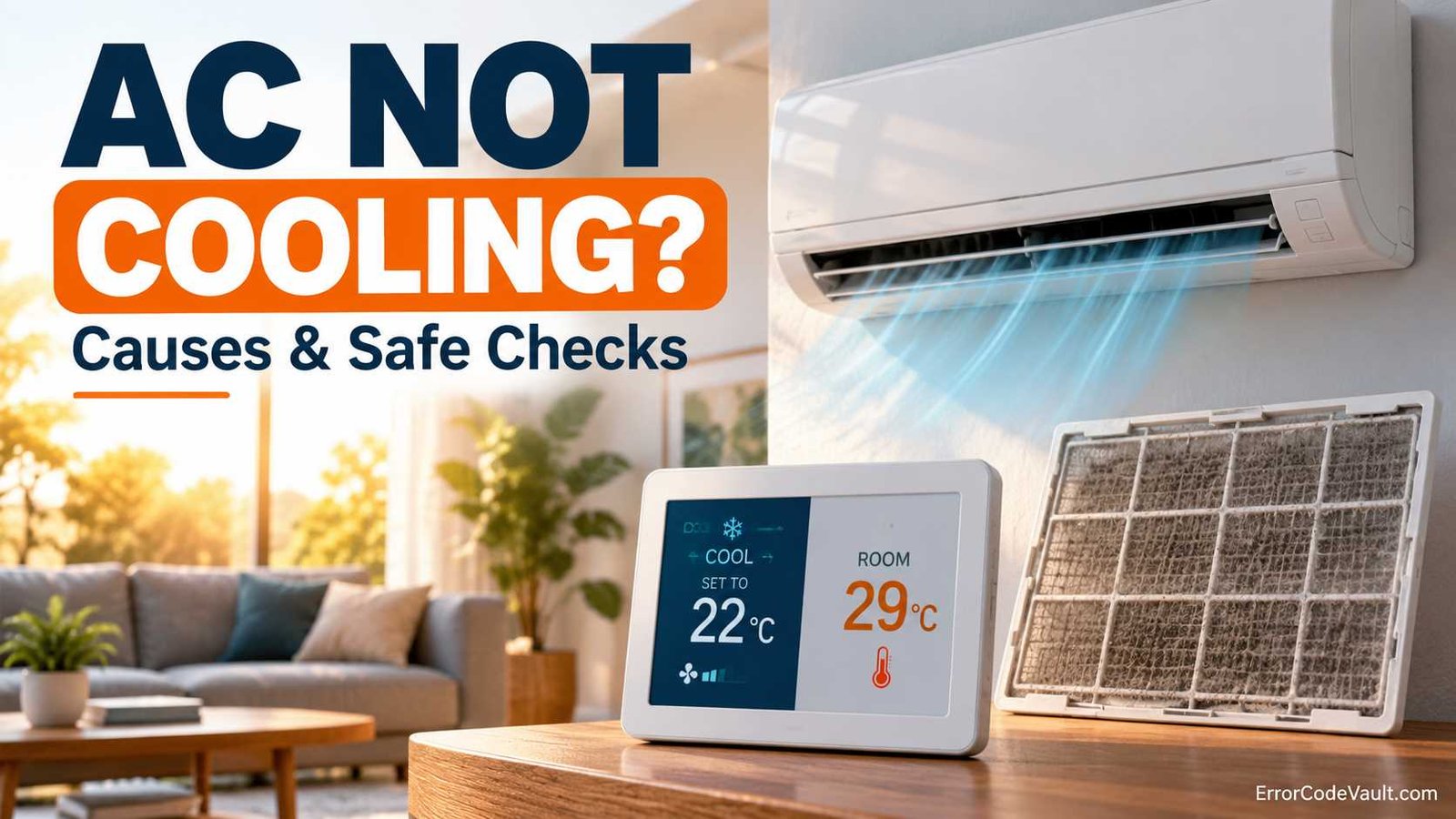
 If you are asking, “Why is my AC not cooling?”, start by finding out whether it is blowing air at all, blowing air that is not cold, or delivering cool air without lowering the room temperature. Those symptoms call for different checks. An incorrect thermostat setting, dirty filter or blocked airflow may be simple to correct; a frozen coil, failed outdoor component or refrigerant problem needs more care.
Stop cooling and seek professional help if you see ice on refrigerant tubing, smell burning, hear electrical arcing or find water close to electrical equipment. Do not remove electrical covers, touch capacitors or disconnect refrigerant lines.
First, Identify What Your AC Is Doing
Stand by a supply vent on a central system, or the discharge grille on a room air conditioner. Is there a normal stream of air? Does it feel cooler than the room? Then check whether the room temperature is gradually falling. Use a separate thermometer when possible instead of relying only on how the air feels against your hand.
- No airflow: check the thermostat or unit power, operating mode and accessible filter; a fan or control fault is also possible.
- Airflow but no cold air: check that cooling is actually selected and whether the outdoor system is operating, if applicable.
- Cool air but the room stays hot: consider blocked airflow, open doors or windows, strong sun, excessive cooling demand or inadequate equipment performance.
Five Checks You Can Make Without Opening the AC
- Set the right mode. Select COOL and set the temperature below the current room temperature. FAN mode circulates air without necessarily cooling it.
- Check the fan setting. On many central systems, ON runs the blower between cooling cycles. AUTO can make it easier to tell when cooling is being requested.
- Inspect the user-accessible filter. Turn the equipment off and follow the manual to clean or replace a dirty filter with the correct size and type. Restricted airflow reduces cooling and can contribute to freezing.
- Clear vents and grilles. Move furniture, rugs and curtains away from returns and supply openings. Do not close multiple vents to redirect airflow.
- Look at outdoor ventilation. For a central split system, check from a safe distance that leaves or vegetation are not crowding the condenser. Do not reach through the fan grille or remove covers.
After correcting an obvious setting or blockage, allow the system’s normal start delay and watch for a temperature change. Repeatedly lowering the thermostat does not make a properly operating air conditioner cool faster.
Why Is My AC Blowing Air but Not Cold Air?
An indoor blower can operate even if the equipment that removes heat is not running. With a central split AC, listen and look from a safe position to see whether the outdoor unit appears active during a call for cooling. A spinning outdoor fan does not, by itself, confirm that the compressor is working.
If the outdoor unit is silent, the problem could involve a power interruption, a control lockout or an electrical component. You can note whether a clearly labeled household breaker appears tripped, but do not repeatedly reset it. A breaker that trips again requires a qualified technician. Never open an outdoor disconnect enclosure or test a live circuit.
For a window or portable AC, check the unit’s own COOL mode and installation instructions instead. A portable air conditioner’s exhaust hose must vent correctly outdoors; central-system condenser checks do not apply to every room unit.
Could a Dirty Filter or Frozen Evaporator Coil Be the Cause?
Air must move across the indoor evaporator coil to carry heat to the refrigerant. A clogged filter or obstructed return can reduce that airflow. The result may be weak air at the vents, poor cooling and sometimes ice on the coil or refrigerant line.
If you can see frost on an exposed refrigerant tube or other accessible area, switch cooling OFF. Allow the ice to thaw without scraping it, pouring hot water on it or applying a heat gun. Changing a dirty filter may address one airflow cause, but freezing can also indicate a blower or refrigerant fault. If ice reappears, leave cooling off and arrange professional diagnosis.
Why Does the AC Run but the Room Stay Warm?
When the supply air is cool but the room barely changes, check the heat entering the space. Open windows, afternoon sun, cooking appliances and poorly insulated rooms can overwhelm the available cooling. Close outside doors and windows, shade direct sunlight and compare temperatures over time.
If one room is hot while others cool, look for an obstructed grille and consider duct distribution, leakage or thermostat location on a central system. If every room stays warm despite noticeable cooling at the registers, a technician can measure system airflow and heat removal and assess whether the equipment is properly sized for the building. Long operation on a very hot afternoon is not, by itself, proof of failure.
Use These Symptoms to Decide What Happens Next
| Symptom | Possible reason | Safe next action |
|---|---|---|
| No air comes from the vents | Wrong setting, power or indoor fan issue | Check mode, display and filter; seek service if airflow does not return |
| Air comes out but feels warm | Fan-only operation or cooling equipment not starting | Confirm COOL and observe outdoor-unit activity where applicable |
| Airflow is noticeably weak | Clogged filter or restricted airflow | Check accessible filter and unobstructed grilles |
| Frost appears on exposed tubing | Frozen coil from airflow or refrigerant problems | Turn cooling off and arrange diagnosis if the cause is not obvious |
| One room stays much hotter | Uneven airflow, sun or duct problems | Check register and window exposure; assess ductwork if persistent |
| Breaker repeatedly trips | Possible electrical fault | Leave equipment off and call a qualified professional |
Does Low Refrigerant Make an AC Stop Cooling?
It can, but a warm room does not prove the system needs refrigerant. A properly sealed air conditioner does not routinely use up its refrigerant. A leak or incorrect charge may reduce cooling and contribute to coil icing; other electrical and airflow faults can look similar.
Do not attach gauges, use recharge cans or open the refrigerant circuit. A qualified HVAC technician should find the underlying problem, address any leak and handle refrigerant according to local rules. Capacitors, contactors and compressors likewise require professional electrical testing rather than guessed replacement.
Should You Reset the AC?
Correct the mode and temperature settings first, then allow the manufacturer’s compressor-protection delay. A model-approved control reset can address some temporary control issues, but it cannot clear a physical obstruction or repair a failed part. Avoid repeated breaker cycling, especially after a trip. If there is an error code, record it exactly before following your model’s instructions.
When to Call an HVAC Technician
Request service if the unit still produces warm air after the thermostat, filter and ventilation checks; the outdoor system fails to start; ice forms; airflow remains weak; or cooling is inadequate in normal conditions. Stop use immediately for burning odors, sparking, damaged wiring or unsafe water near electrical parts.
Before the visit, note whether air is absent, warm or cool, the thermostat mode and setpoint, measured room temperature, filter condition, visible frost, any error message and whether the outdoor unit appears to operate. These observations are more useful than assuming the compressor or refrigerant is at fault.
Begin with settings and clear airflow, use the symptom to narrow the problem, and stop where diagnosis requires electrical or refrigerant work. That is the safest way to find out why the AC is not cooling without turning an ordinary repair into a larger problem.

Ahmad Raza is the website administrator and content operations manager at Error Code Vault. With 11 years of experience in technical publishing, he manages site accuracy, author verification, source quality, updates, user feedback, and editorial compliance.