
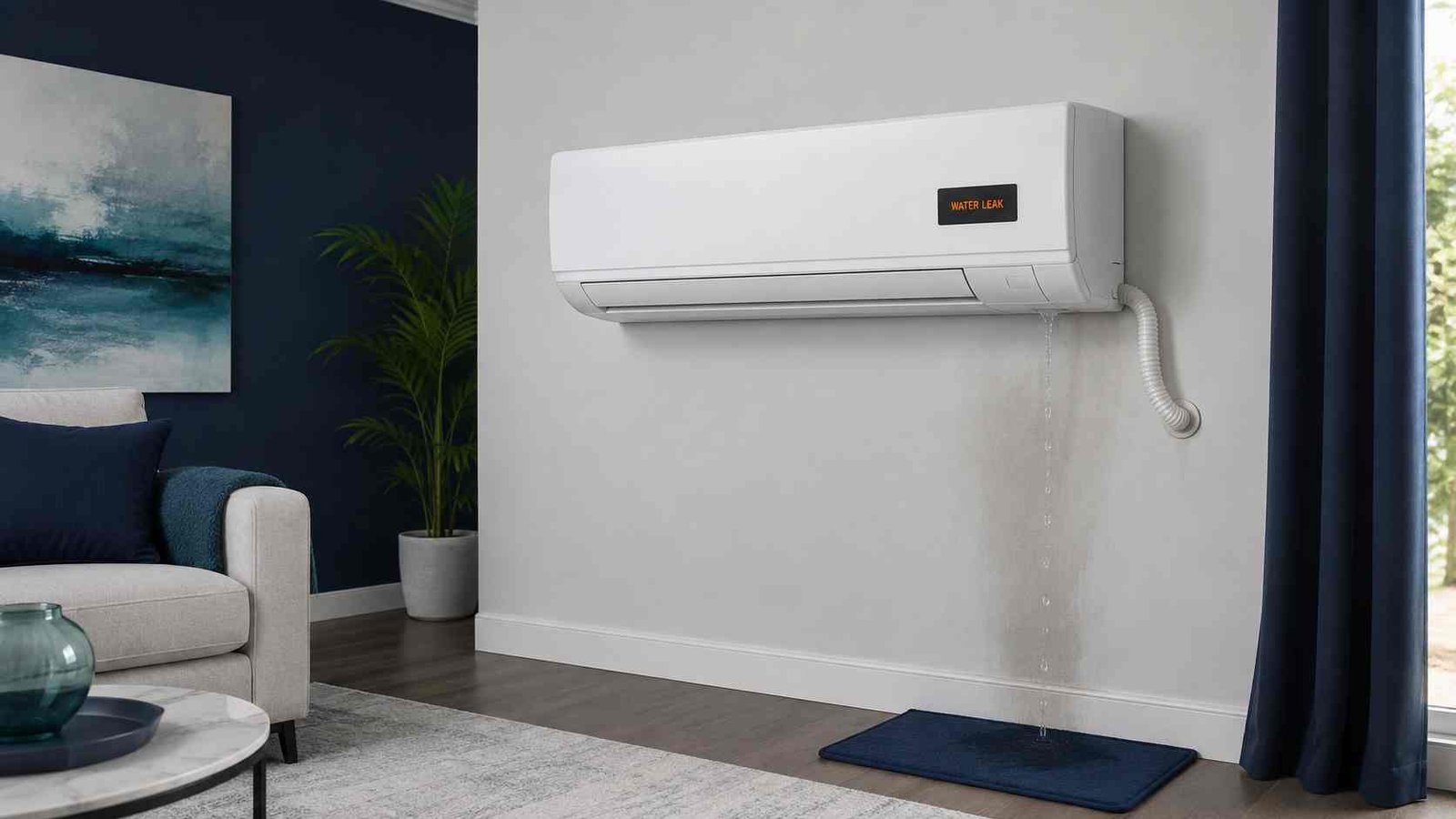
 A split AC indoor unit leaking water usually has a condensate drainage or airflow problem. The most common causes are a blocked or poorly routed drain hose, dirty air filters, a frozen indoor coil, or an installation fault.
Turn the air conditioner off if water is running down the wall, reaching electrical equipment, or pooling on the floor. Your safest first checks are to inspect the removable filters and look at the accessible end of the outdoor drain hose. Do not remove the indoor casing, push tools into hidden drainage pipes, or attempt refrigerant repairs.
Small droplets on the louvers during very humid weather may be surface condensation. A steady drip from inside or behind the unit, however, needs investigation.
| Item | Details |
|---|---|
| Problem | Water dripping or running from a wall-mounted split AC indoor unit |
| Most likely cause | Blocked or restricted condensate drain |
| Other common causes | Dirty filter, frozen coil, poor drain slope, loose hose, installation fault |
| Safe first check | Turn the unit off, inspect the filters and observe the outdoor drain outlet |
| Repair difficulty | Easy for filter cleaning; moderate to advanced for drainage and installation faults |
| Can the AC still be used? | Not while it is actively leaking indoors or water is near electrical equipment |
| Professional help needed | When leakage is heavy, recurring, linked to icing, or started after installation or servicing |
During cooling or dry mode, moisture from the room air condenses on the cold indoor heat exchanger. That water should collect in a drain pan and leave the building through a condensate hose. Water flowing from the designated outdoor drain outlet during cooling is therefore normally expected.
Safety warning: Switch the air conditioner off if water is reaching a socket, power cable, extension lead, appliance, or electrical part. Do not touch wet electrical equipment. Isolate the affected circuit only when you can do so safely from a dry location.
Is It Normal Condensation or an Actual Leak?
Not every visible drop means that the drain pan is overflowing. First identify where the water is appearing.
Normal water from the outdoor drain
A functioning split AC removes humidity while cooling. The resulting condensate usually leaves through a small drain hose outside the building. The amount varies with room humidity, temperature, operating mode, and how long the system runs.
Water from the intended outdoor drain outlet is usually normal. Water dripping inside the room is not.
Surface droplets on the louvers
A few droplets may form on the air outlet, casing, or directional blades when cold surfaces meet warm, humid room air. This is more likely when:
- Outdoor or indoor humidity is very high
- Doors or windows are open
- The selected temperature is unusually low
- The fan is running slowly
- The airflow is directed toward a nearby obstruction
Samsung and LG describe this type of surface condensation as possible in humid conditions. Raising the set temperature slightly, using medium or high fan speed, and reducing humid outdoor-air entry may help when there is no internal overflow.
Signs of an actual indoor leak
Treat the problem as a fault when:
- Water runs from behind or underneath the casing
- A steady stream comes from one end of the unit
- The wall below the air conditioner becomes wet
- Water sprays from the outlet with the airflow
- The drain hose is not releasing water during extended cooling
- Ice is visible behind the filters
- The unit leaks again soon after being restarted
Common Causes of a Split AC Indoor Unit Leaking Water
| Cause | What may be happening | Safe homeowner action |
|---|---|---|
| Blocked drain hose | Dust, slime or debris prevents condensate from leaving | Observe the accessible outdoor hose end; arrange cleaning if flow is restricted |
| Poor drain-hose routing | A bend, upward section or submerged end causes water to back up | Check visible sections without moving fixed pipework |
| Dirty filters | Restricted airflow may increase condensation or contribute to coil icing | Clean removable filters according to the manual |
| Frozen indoor coil | Ice melts and releases more water than the drainage system can handle | Turn cooling off and arrange service if icing returns |
| Installation fault | The unit or drain may not have the correct position or fall | Contact the installer |
| Loose drain connection | Water escapes before entering the drain hose | Professional inspection is normally required |
| Damaged drain pan | A crack or displaced pan allows water to escape | Technician-level repair |
| Pipe insulation problem | Moisture forms on cold refrigerant piping | Installer or technician inspection |
| Rainwater entry | Water enters through an inadequately sealed wall opening | Have the pipe entry and exterior sealing checked |
| Condensate pump fault | A fitted pump cannot remove the collected water | Contact the installer or pump service provider |
1. Blocked condensate drain
A blocked drainpipe is one of the most common explanations for indoor leakage. Dust, biological growth, insects or other debris can restrict the line. Condensate then backs up into the drain pan until it spills through the indoor casing.
Fujitsu and Mitsubishi Heavy Industries both identify blocked drainage as a leading cause of water leaking from an indoor unit.
The blockage may be near the outdoor hose end, inside the indoor drainage channel, or in a concealed section of pipe. Seeing a little water outside does not prove that the entire line is clear. A partial restriction can still cause overflow when the AC produces condensate faster than the pipe can carry it away.
2. Bent, raised or submerged drain hose
Most wall-mounted split systems depend on gravity to carry condensate outdoors. A kink, sag, upward section, or compressed hose can hold water and reduce drainage.
The outdoor end should not be submerged in standing water because this can interfere with discharge or allow water to move back toward the unit. Samsung’s support guidance specifically recommends keeping the drain hose directed downward, straight, and out of water.
Do not pull, cut or reroute fixed pipework yourself. Drain alignment is part of the installation and may require the indoor unit to be repositioned.
3. Dirty air filters
Dirty filters restrict the amount of air moving across the indoor heat exchanger. Daikin states that dirty indoor filters can contribute to condensate leaking from the air outlet. Fujitsu also lists clogged filters as a leading factor in dripping problems.
Clean only the filters designed for routine homeowner removal. Follow the model’s user manual because filter construction and cleaning methods vary.
In general:
- Turn the unit off.
- Open only the normal filter-access panel.
- Remove the washable filters carefully.
- Remove loose dust or wash them as directed by the manufacturer.
- Let washed filters dry fully in the shade.
- Reinstall them in the correct position.
Do not operate the air conditioner without its filters.
4. Frozen indoor coil
Restricted airflow can cause the indoor coil to become excessively cold. Condensed moisture may then freeze instead of falling normally into the drain pan. When the ice melts, the sudden volume of water can overflow or miss the drainage channel.
Fujitsu identifies restricted airflow and frozen coils as a possible reason for indoor dripping. LG similarly explains that slow or blocked airflow can cause frost behind the front grille.
Possible signs include:
- Visible frost behind the filters
- Weak airflow
- Reduced cooling
- Water appearing after the unit is switched off
- Repeated cycles of icing and dripping
Turn cooling off and allow the ice to melt naturally. Protect the wall and floor while it melts. Do not chip ice from the coil, pour hot water into the unit, or use a hair dryer.
If icing returns after the filters are clean, the system needs professional diagnosis. Possible causes extend beyond filter condition and may involve the blower, coil condition, temperature sensing or refrigerant circuit.
5. Indoor unit or drain installed incorrectly
A newly installed unit that starts leaking immediately may not be draining correctly. The indoor head may be improperly positioned, the drain connection may be loose, or the pipe may lack continuous downward fall.
Samsung advises checking that the indoor unit is correctly positioned and that the drain hose slopes downward. Mitsubishi Heavy Industries installation documentation also warns that incorrect drainage can cause water leakage.
Contact the original installer when the problem begins:
- Immediately after installation
- After the unit was relocated
- After wall renovation
- After refrigerant piping or drain routing was changed
Installation-related leakage is not something that should require repeated homeowner drain clearing.
6. Loose or damaged drain connection
The drain hose connects to the indoor drain pan. If this connection becomes loose, damaged or displaced, water may escape inside the casing even when the outdoor end appears clear.
The connection is usually behind the indoor unit’s outer cover. Accessing it may expose electrical wiring and fragile components, so this is normally a technician-level inspection.
7. Cracked or displaced drain pan
The drain pan sits beneath the indoor heat exchanger and catches condensation. A damaged, distorted or incorrectly seated pan may leak before water reaches the drain hose.
This problem is less common than a blockage but becomes more likely when:
- Water leaks even though drainage outside appears strong
- The unit was recently dismantled for deep cleaning
- Leakage comes consistently from the centre or opposite side of the drain
- The indoor unit has suffered impact or movement
Pan inspection often requires significant disassembly. Stop at the removable filters and arrange professional service.
8. Damaged or missing pipe insulation
Cold refrigerant pipes are normally insulated to prevent condensation. If insulation is missing, compressed, split or poorly joined, moisture can form on the pipe surface and run back toward the indoor unit or wall.
This may look like a blocked drain even though the drain pan is working normally. An HVAC technician or installer should inspect and restore the insulation using material suitable for the system.
9. Rainwater entering through the wall opening
An indoor unit can sometimes leak during heavy rain even while it is switched off. In that case, the water may be entering around the pipe opening rather than coming from AC condensate.
LG explains that rainwater can travel indoors through the wall penetration when connecting pipes or exterior sealing are not arranged correctly.
Clues include:
- Leakage happens only during rain
- The AC is off when water appears
- Dampness develops around the wall opening
- The outdoor unit or pipework is installed on a roof
- The system was recently installed or relocated
Ask the installer to inspect the exterior pipe routing, weather seal and wall penetration.
10. Condensate pump failure
Some installations cannot rely entirely on gravity and use a separate condensate pump. If the pump loses power, becomes blocked or fails, the water level may rise until the indoor unit or pump reservoir leaks.
Not every split system has a pump. Do not assume one is present unless it is visible or documented by the installer. Pump diagnosis and replacement should be handled by the installer or a qualified HVAC service provider.
What to Do Immediately
- Turn the air conditioner off. Use the remote or normal control first.
- Protect the area below it. Move furniture, electronics and valuables. Place an absorbent towel or shallow container under the drip without blocking the air outlet.
- Keep clear of wet electrical equipment. Do not unplug a wet plug, touch a wet socket or operate switches with wet hands.
- Allow residual water to drain. Some dripping may continue briefly after shutdown because water remains inside the pan or melting ice is present.
- Photograph the leak location. A clear image or short video can help the installer identify whether water is coming from the casing, louver, pipe opening or one side of the unit.
Safe Step-by-Step Troubleshooting
Step 1: Identify exactly where the water appears
Check whether it is coming from:
- The louver or air outlet
- The bottom edge of the casing
- One end of the indoor unit
- Behind the unit
- The wall opening where pipes exit
- An external condensate pump
The location helps separate surface condensation, drainage overflow, pipe sweating and rainwater entry.
Step 2: Observe the outdoor drain outlet
Locate the condensate hose only when it is safely accessible from ground level.
During normal cooling in humid conditions, you would generally expect some condensate discharge. No flow during extended cooling may suggest a blockage, poor routing or a disconnected hose. Weak or intermittent flow may indicate a partial restriction.
Do not climb onto a roof or ladder to reach pipework.
Step 3: Inspect the visible hose position
Look for:
- A flattened or sharply bent section
- An upward loop
- A hose end pressed against soil
- Insects, mud or visible material at the opening
- The end sitting in a bucket, drain or standing water
- A loose exterior connection
Do not insert wire, screwdrivers or rigid rods into the hose. They can puncture the drain or push debris farther inside.
Step 4: Check and clean the filters
Clean the removable filters according to the model manual. Daikin recommends regular filter maintenance because obstruction reduces airflow and can contribute to poor performance and leakage.
If the filters are damaged, replace them with the correct type for the model rather than running the AC without them.
Step 5: Look for icing and weak airflow
Do not remove the coil cover. Look only through the normal filter opening.
If frost is visible:
- Keep cooling switched off
- Allow the ice to melt naturally
- Expect additional dripping while it melts
- Do not restart until the unit is dry
- Arrange service if the ice returns
Step 6: Consider recent work
Think about what changed before the leak began:
- New installation
- Unit relocation
- Deep cleaning
- Painting or drilling near the unit
- Drain-hose alteration
- Roofing or exterior wall work
- Heavy rain
A leak that starts immediately after professional work should be reported to the service provider.
Step 7: Test cautiously
A brief test may be reasonable only when:
- No water has reached electrical equipment
- The filters are clean and dry
- No ice is visible
- The external hose is not obviously bent or submerged
- The previous leak was minor
- The area around the unit is dry
Run the unit on a moderate cooling setting with medium or high fan speed and watch it closely. Switch it off immediately if water returns.
What If the Drain Pipe Is Clear but the AC Still Leaks?
A drain can appear clear without carrying water at the required rate. Possible explanations include:
- A partial blockage inside a concealed section
- A problem in the indoor drainage channel
- Water missing the pan because of dirt or unit alignment
- A loose connection between the pan and hose
- A damaged drain pan
- Condensation forming on uninsulated piping
- Coil icing caused by an airflow or refrigeration problem
- Water entering through the wall penetration
This is the point where repeated external drain cleaning becomes less useful. A technician may need to inspect the indoor drainage path, mounting position, coil, fan and pipe insulation.
Why Is the Split AC Leaking After Cleaning?
Leakage after cleaning does not necessarily mean the unit is still dirty. It may indicate that:
- Debris moved into the drain outlet
- The drain connection was disturbed
- The pan was not refitted correctly
- The unit shifted on its mounting plate
- Cleaning liquid remains inside
- Chemical residue or foam is interfering with drainage
- A pre-existing crack became visible after cleaning
Daikin warns against using unsuitable commercial cleaning agents inside an air conditioner because they can damage internal materials and contribute to water leakage.
Contact the company that performed the service. Avoid removing the casing to inspect its work.
Symptom Guide
| Symptom | More likely explanation |
|---|---|
| Water from one end | Drain blockage, incorrect slope or unit alignment |
| Water spraying from louvers | Heavy condensation, dirty blower, frozen coil or internal overflow |
| Ice followed by dripping | Restricted airflow or a technician-level cooling fault |
| Leak with weak cooling | Frozen coil, dirty filter, blower problem or refrigeration fault |
| Leak only during humid weather | Surface condensation or drainage system near its capacity |
| Leak only during rain | Water entering through the wall or pipe opening |
| Leak after installation | Drain connection, slope, mounting or sealing problem |
| Leak after deep cleaning | Displaced hose, pan issue, remaining blockage or cleaning residue |
| Drain flows outside but unit leaks | Partial blockage, pan damage, alignment issue or pipe condensation |
| Leak while AC is switched off | Melting ice, remaining pan water or rainwater entry |
Repairs Homeowners Should Not Attempt
Stop troubleshooting before any task involving:
- Removing the indoor-unit casing
- Disconnecting internal drain joints
- Removing the blower wheel or drain pan
- Opening electrical compartments
- Live-voltage testing
- Refrigerant pressure testing
- Refrigerant charging or leak repair
- Cutting fixed pipework
- Pressurising a hidden drain
- Applying internal chemical cleaners
- Bypassing a float switch or condensate-pump alarm
Water leakage can have several causes that look similar from outside. Internal inspection should be performed by someone qualified to work on the system and permitted to handle refrigerants under local rules.
When to Call an HVAC Technician
Arrange professional service when:
- Water is near electrical parts or a wall socket
- Leakage is heavy or recurring
- The filters are clean but the leak continues
- Ice returns after thawing
- Airflow or cooling is weak
- The drain hose is concealed inside a wall
- Water leaks from behind the unit
- The outdoor drain flows but water still enters the room
- The unit leaked immediately after installation
- Leakage started after deep cleaning or relocation
- The drain pan, pump or pipe insulation may be damaged
- The system displays an error code or warning light
- There is an unusual electrical smell, buzzing sound or breaker trip
Mitsubishi Heavy Industries notes that indoor leakage can result from blocked drainage, installation problems or refrigeration-system faults. Panasonic similarly states that an indoor leak may be related to installation, the main unit or the drain hose.
How to Prevent Future Water Leaks
Clean the filters regularly
Follow the interval in the user manual. Homes with pets, construction dust, smoke or heavy AC use may need more frequent inspection.
Keep the outdoor drain end clear
Make sure the accessible end is not covered by soil, leaves or standing water. Do not seal or cap it.
Use sensible cooling settings
During very humid weather, avoid combining an extremely low temperature with the lowest fan speed. Keep doors and windows closed while cooling.
Arrange periodic professional maintenance
A technician can inspect parts that are not safely accessible to the homeowner, including:
- Drain pan and internal channel
- Concealed drainpipe
- Blower wheel
- Indoor coil
- Pipe insulation
- Mounting position
- Condensate pump where fitted
- Refrigeration performance
Correct installation faults properly
A drain that repeatedly blocks, backs up or loses its slope may require rerouting. Repeated temporary clearing will not correct poor installation.
Avoid unapproved cleaning products
Do not spray household disinfectant, bleach, strong detergent, fragrance or general-purpose coil cleaner into the indoor unit. Use only maintenance methods and products approved for the model.
Editorial and Source Note
This article was prepared by Emily Carter, Error Code Vault’s Australia and New Zealand appliance safety contributor. It uses official manufacturer support pages and installation guidance to separate basic homeowner checks from work requiring a qualified HVAC professional.
Error Code Vault is an independent information website. It is not affiliated with Daikin, Samsung, Fujitsu, LG, Panasonic, Mitsubishi Heavy Industries, Carrier or other manufacturers mentioned on this page. Model construction and maintenance procedures vary, so the appliance manual and local manufacturer support remain the primary references.
Frequently Asked Questions
Can I keep using a split AC that is leaking water?
Do not continue using it while water is actively leaking indoors, especially when the wall, socket, cable or electrical equipment is wet. Turn it off and identify whether the issue is minor surface condensation or an internal drainage leak.
Can a dirty filter cause an indoor AC unit to leak?
Yes. A dirty filter restricts airflow and can contribute to excessive condensation or indoor-coil icing. Daikin, Fujitsu and LG all identify restricted airflow or dirty filters as possible contributors to dripping or frost.
Why is my AC leaking when the drain hose is clear?
The line may be only partially clear. Other possibilities include a loose drain connection, damaged pan, incorrect unit alignment, missing pipe insulation, coil icing, or water entering through the wall opening.
Why does the indoor unit leak only at night?
Night-time humidity may be higher, while the room temperature and fan speed may be lower. These conditions can increase surface condensation or expose a drainage restriction that is able to cope only with smaller amounts of water.
Can low refrigerant make a split AC leak water?
A refrigeration fault may cause abnormal coil icing, followed by dripping when the ice melts. Water leakage alone does not confirm low refrigerant. Refrigerant diagnosis and handling must be left to a qualified professional.
Why is water coming from the AC louvers?
Water at the louvers can be caused by surface condensation, restricted airflow, internal overflow, dirt on the blower, or melting ice. Switch the unit off if the flow is more than a few surface droplets or returns repeatedly.
Should water come out of the outdoor drain pipe?
Yes, during cooling or dry operation, condensate collected inside the indoor unit normally leaves through the drain hose. The amount depends on humidity and operating conditions.
Why did my split AC start leaking after installation?
The drain hose may lack the correct downward slope, the indoor unit may not be positioned correctly, or the drain connection or wall opening may need correction. Contact the original installer rather than opening or adjusting the unit yourself.

Emily Carter is an Australian home-appliance safety editor with 9 years of experience researching washers, air conditioners, refrigerators, and coffee machines. She checks troubleshooting steps for accuracy, regional model differences, and homeowner safety before publication.