
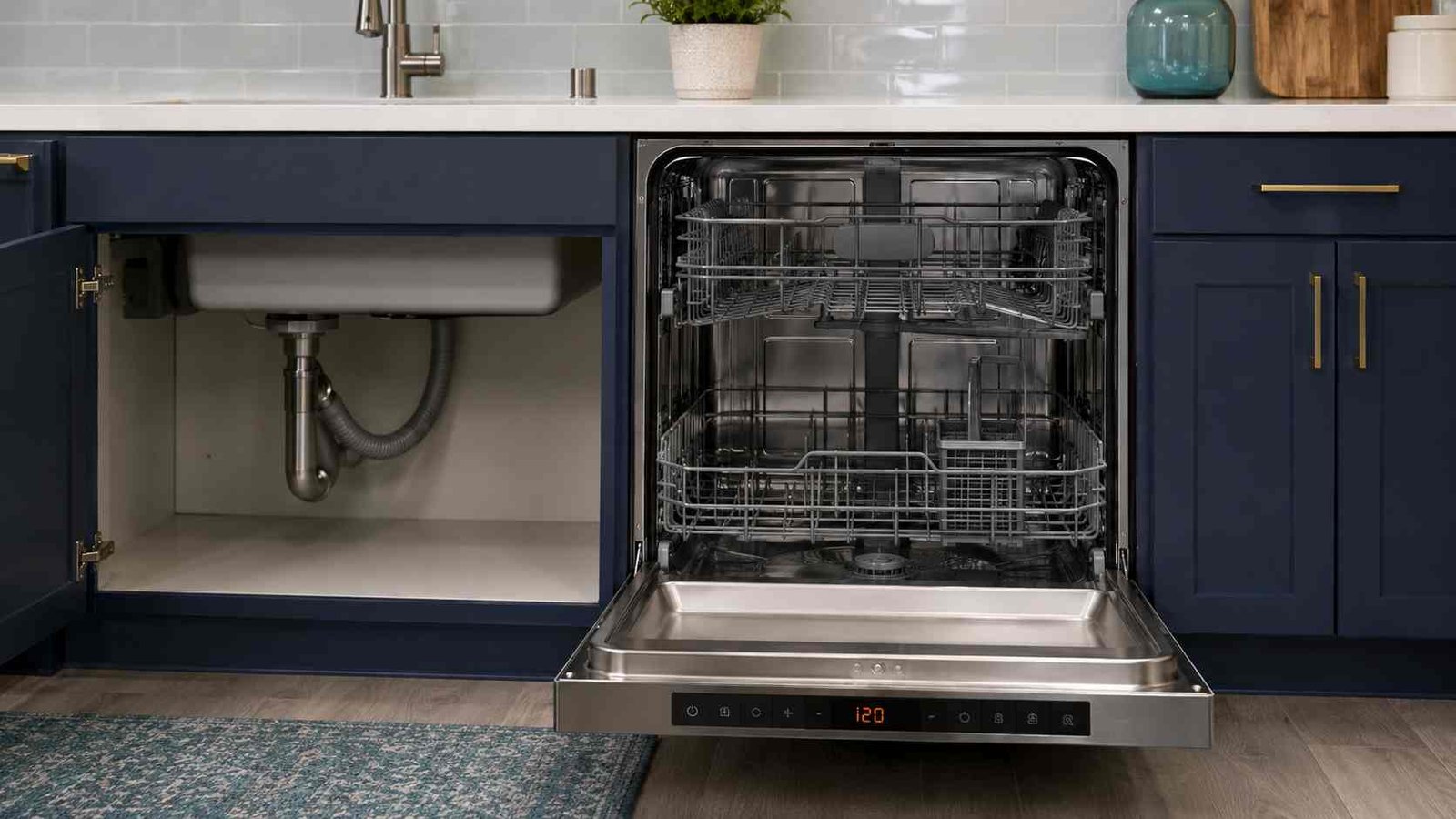
 The Frigidaire dishwasher i20 error means the appliance did not drain properly or did not remove all the water within the expected part of the cycle. The first safe checks are the dishwasher filter, garbage disposer connection, countertop air gap, and visible drain hose.
A reset may clear the display, but it will not remove food debris, straighten a pinched hose, or open a blocked drain connection. Do not continue running the dishwasher if water is leaking onto the floor, there is an electrical smell, the breaker trips, or a large amount of dirty water remains inside.
Frigidaire’s official guidance identifies incomplete draining as the confirmed meaning of i20. It recommends checking the disposer knockout plug, drain-hose condition and height, and the glass trap or filter before arranging service.
Frigidaire i20
| Item | Details |
|---|---|
| Error code | i20 |
| Brand | Frigidaire |
| Appliance | Dishwasher |
| Confirmed meaning | The dishwasher did not drain properly or completely |
| Most common area to check | Filter and external drain path |
| Safe first action | Cancel the cycle and inspect for an obvious blockage |
| Reset method | Press Cancel or disconnect power for three minutes |
| Can it still be used? | Not until normal draining is restored |
| Repair difficulty | Easy for basic external checks; advanced if internal diagnosis is needed |
| Professional help | Required if the code returns after the drain path is confirmed clear |
What Does i20 Mean on a Frigidaire Dishwasher?
The i20 code is a drain-performance error. The dishwasher expected the water level to fall during the drain phase, but the machine detected that draining was incomplete or improper.
This does not automatically mean the drain pump has failed. In many cases, water cannot leave the appliance because of a restriction elsewhere in the drainage path.
Frigidaire tells owners to check:
- Whether a garbage disposer knockout plug was removed
- Whether the drain hose is blocked
- Whether the hose is pinched or restricted
- Whether the hose is installed at the correct height
- Whether the glass trap, filters, and accessible sump area contain food debris
The exact filter design and button labels can differ by model, so use the owner’s manual for your dishwasher when removing or reinstalling washable parts.
Common Symptoms of an i20 Error
An i20 code may appear with one or more of these symptoms:
- The wash cycle stops before completion
- Dirty water remains around or above the filter
- The dishwasher repeatedly tries to drain
- A humming or pumping sound continues longer than expected
- The code returns shortly after a reset
- Dishes remain dirty because the cycle did not finish
- Water backs up after a new garbage disposer was installed
- The machine drains slowly rather than failing completely
A small amount of water below the filter area may be normal on some dishwashers. Frigidaire advises checking the drainage system when water rises enough to cover the filter screen or clearly remains in the tub after the cycle.
Most Common Causes
1. Food debris in the filter or glass trap
Food particles, labels, seeds, fragments of glass, and other debris can restrict water flow into the drain system.
Frigidaire specifically lists a dirty glass trap or filter as an i20 check. The filter must also be reinstalled correctly after cleaning.
2. Blocked or kinked drain hose
A hose can become pinched behind the dishwasher or restricted where it passes through the cabinet. Grease and food residue can also build up inside the hose.
The hose may look normal under the sink while still being compressed behind the appliance.
3. Clogged sink or garbage disposer connection
The dishwasher normally drains into a sink drain or garbage disposer connection. A blockage at that connection can prevent water from leaving the machine.
Running the disposer may clear loose material, but disconnect power to the disposer before inspecting its inlet or attempting any physical cleaning.
4. Garbage disposer knockout plug still installed
A new garbage disposer has a sealed dishwasher inlet. The installer must remove the internal knockout plug before connecting the dishwasher hose.
If the plug remains in place, the dishwasher has no open path into the disposer. This is one of Frigidaire’s main checks for a newly installed dishwasher or a problem that began after disposer replacement.
5. Dirty countertop air gap
Some installations use a small air-gap fitting mounted beside the kitchen faucet. Food debris can collect inside it and restrict drainage.
Frigidaire recommends removing the air-gap cover and checking that the fitting is clean when one is installed.
6. Incorrect drain-hose routing
Frigidaire’s North American guidance calls for the drain hose to reach a minimum height of approximately 32 inches from the floor. This raised routing helps prevent wastewater from flowing back toward the dishwasher.
Installation requirements can vary by model and local plumbing rules. Follow the installation document supplied with the appliance rather than using a universal hose arrangement.
7. Possible internal drainage or sensing fault
When the complete external drain path is clear, further diagnosis may be required.
Depending on the model, a technician may inspect areas such as:
- The drain pump
- The pump impeller
- A drain check valve
- Water-level or pressure-sensing components
- The sensor channel
- Wiring connections
- The electronic control
These are possible diagnostic areas, not parts that should be replaced based on the i20 code alone. A third-party repair guide for a selected Frigidaire Gallery dishwasher links recurring i20 errors to contamination in a pressure-sensing channel, but it also notes that model construction can differ.
Before You Start Troubleshooting
Take these precautions first:
- Press Cancel and allow the dishwasher to attempt its normal drain routine.
- Switch off the circuit breaker or unplug the dishwasher before moving it or touching concealed components.
- Let hot water cool before placing your hands near the filter.
- Wear protective gloves because broken glass may be hidden in cloudy water.
- Do not open electrical housings or perform live-voltage testing.
- Stop immediately if water is leaking beneath the appliance.
You can remove standing water with a cup, sponge, or wet vacuum after disconnecting power. Do not tip the dishwasher to empty it, as water may reach electrical components or the base pan.
How to Troubleshoot a Frigidaire Dishwasher i20 Error
Work through the checks in order. This reduces the risk of replacing a part when the actual cause is an external restriction.
Step 1: Confirm that the cycle has finished
Make sure the cycle is not paused and the door has not been opened before the drain phase completed.
Press Cancel once. Many Frigidaire dishwashers begin a drain routine when the current cycle is cancelled. Listen for water entering the sink drain or garbage disposer.
If the dishwasher drains normally during cancellation, the code may have resulted from an intermittent restriction. Continue with the filter and hose checks before running another full load.
Step 2: Check the kitchen sink and disposer
Run water into the sink and confirm that it drains freely.
When a garbage disposer is installed:
- Run it briefly to clear loose food
- Check whether the i20 problem began after the disposer was replaced
- Confirm that the dishwasher inlet was opened by removing the knockout plug
- Look for a restriction where the dishwasher hose connects
Do not place your hand inside a disposer. Disconnect its power before inspecting the connection.
Step 3: Clean the countertop air gap
When an air gap is present:
- Remove its decorative outer cover.
- Lift or unscrew the inner cap if the design allows.
- Remove visible food residue.
- Rinse the removable cap.
- Reinstall the parts securely.
Water or debris emerging from the air gap during draining often indicates a restriction between the air gap and the sink or disposer.
Step 4: Inspect the visible drain hose
Look under the sink for:
- Sharp bends
- Flattened areas
- Pinching against the cabinet
- A loose or sagging hose
- Grease near the sink connection
- An incorrectly positioned high loop
Do not pull the built-in dishwasher out unless its power and water supply have been safely isolated. A concealed kink behind the unit is a suitable reason to call the original installer or an appliance technician.
Step 5: Remove and clean the filter
The filter arrangement varies, but the basic process is usually:
- Disconnect power.
- Remove the lower dish rack.
- Locate the filter or glass trap at the bottom.
- Follow the model manual to unlock and lift it out.
- Empty loose debris into a bin.
- Rinse the filter under running water.
- Use a soft brush for stubborn residue.
- Reinstall and lock the filter correctly.
Do not force a filter that does not turn or lift easily. The release method differs between models.
Frigidaire recommends regular filter care and notes that a clogged or incorrectly installed filter can contribute to poor drainage.
Step 6: Check the visible sump area
With the filter removed, inspect only the area that is safely visible and accessible.
Look for:
- Broken glass
- Bones
- Paper labels
- Seeds
- Pieces of plastic
- Heavy grease or food buildup
Do not remove pump covers, wiring, screws, or internal housings unless the owner’s manual specifically identifies them as user-serviceable.
Step 7: Reassemble and run a drain test
Reinstall every filter and cover exactly as instructed. Restore power and press Cancel to start a drain routine.
Listen for these signs:
- Normal pump sound with water leaving: The restriction may have been cleared.
- Pump hums but little water leaves: A hose, connection, pump, or impeller problem may remain.
- No drain-pump sound: Professional electrical or control diagnosis may be needed.
- Pump runs continuously: Stop the test and arrange service if the behaviour continues after a reset.
Step 8: Run a short empty cycle
If the dishwasher drains successfully, run a short empty cycle without detergent.
Watch the final drain. Do not immediately load the machine with dishes, because another incomplete cycle could leave contaminated water trapped inside.
How to Reset the Frigidaire i20 Code
Frigidaire provides three general reset options:
- Press or hold the Cancel button.
- Switch the dishwasher circuit breaker off.
- Unplug the dishwasher for approximately three minutes.
After restoring power, select a short cycle and monitor the first drain.
Button names differ. Your control panel may use Cancel, Start/Cancel, or a similar label. Follow the model manual if it gives a different procedure.
Why does i20 return after a reset?
A reset clears the current alarm or restarts the control. It does not:
- Remove debris
- Open a sealed disposer inlet
- Repair a damaged pump
- Straighten a hidden hose
- Correct improper installation
- Clean an internal sensor channel
When the code returns, stop repeatedly resetting the appliance and inspect the complete drain path.
Frigidaire i20 Error but the Filter Is Clean
A clean filter rules out only one possible restriction.
Next, check:
- The sink drains normally.
- The garbage disposer is clear.
- The disposer knockout plug was removed.
- The air gap is clean.
- The drain hose is not kinked under the sink.
- The hose reaches the required installation height.
- The drain connection is not blocked with grease.
- The filter is correctly locked in place.
If all these checks pass and i20 returns, the problem may be inside the dishwasher. Professional testing may be needed to distinguish a weak drain pump from a blocked internal channel, sensing problem, check-valve issue, wiring fault, or control problem.
Do not order a pressure sensor or drain pump only because another owner reported success with that part. Verify the full model number and obtain a model-specific diagnosis first.
i20 Versus i40
Frigidaire lists both codes as drainage-related, but they are not defined in exactly the same way.
| Code | Frigidaire meaning | Main checks |
|---|---|---|
| i20 | Unit did not drain completely or properly | Drain hose, disposer connection, installation height, filter and sump |
| i40 | Clogged filter or sump | Glass trap, filter and food buildup in the sump |
Symptoms can overlap because a clogged filter may ultimately prevent complete draining. Still, the article or repair record should use the code actually shown on the display.
Can You Keep Using the Dishwasher?
Do not continue normal use until the dishwasher can complete a drain without showing i20.
Repeated operation can:
- Leave dirty water around dishes
- Cause unpleasant odours
- Allow debris to collect in the filter area
- Lead to water backing up from the sink connection
- Turn a minor restriction into a complete blockage
Stop using the dishwasher immediately when:
- Water leaks onto the floor
- The breaker trips
- You smell burning or overheated insulation
- The pump makes grinding noises
- The dishwasher repeatedly fills without draining
- Water reaches electrical parts beneath the machine
Model and Regional Differences
Frigidaire’s i20 guidance is primarily aimed at North American dishwashers sold in the United States and Canada. The US and Canadian support pages provide the same basic meaning and checks.
Some dishwashers from related Electrolux-group brands use a similar i20 drainage code in other markets. However, this does not mean their filter design, button sequence, voltage, hose routing, or parts are interchangeable with Frigidaire models.
Always confirm:
- The full model number
- The product serial number
- The country of sale
- The owner’s manual
- The installation guide
- The exact code shown
The model label is commonly located along the dishwasher door or tub frame, but its position varies.
When to Call a Technician
Arrange professional service when:
- The i20 error returns after all safe drain-path checks
- The dishwasher makes no drain-pump sound
- The pump hums but cannot move water
- The pump runs continuously
- The hose is concealed or requires removing the dishwasher
- Water leaks beneath the unit
- Electrical parts need testing
- An internal pressure or water-level system may be involved
- The code occurs intermittently with no visible blockage
Frigidaire recommends contacting support or scheduling service when its normal not-draining checks do not resolve the problem.
Frequently Asked Questions
What does i20 mean on a Frigidaire dishwasher?
It means the dishwasher did not drain properly or completely. Check the filter, drain hose, sink or disposer connection, air gap, and hose routing first.
How do I clear an i20 code?
Correct the drainage problem, then press Cancel. Frigidaire also allows a power reset by switching off the breaker or unplugging the dishwasher for approximately three minutes.
Why does i20 return when the filter is clean?
The restriction may be in the drain hose, air gap, sink connection, garbage disposer, or concealed hose routing. On selected models, professional diagnosis may also identify an internal pump or water-level sensing problem.
Can a garbage disposer cause the i20 error?
Yes. A blocked disposer, clogged dishwasher inlet, or knockout plug left inside a newly installed disposer can prevent the dishwasher from draining.
Does i20 always mean the drain pump is faulty?
No. Frigidaire’s first checks focus on external restrictions and installation conditions. The pump is only one possible technician-level cause after the full drain path has been checked.
Is some water in the bottom normal?
A small amount below the filter may be normal. Water covering the filter screen or remaining visibly in the tub after the cycle suggests a drainage issue.
Can I use drain cleaner in the dishwasher?
No. Do not pour chemical sink or drain cleaner into the dishwasher. It can damage appliance materials, create hazardous fumes, and expose anyone servicing the machine to corrosive chemicals.
Should I replace the pressure sensor for an i20 code?
Not without model-specific diagnosis. Pressure-sensing contamination has been reported on selected Gallery models, but the same code can result from a simple hose or disposer restriction.

Daniel Brooks is a US-based appliance troubleshooting researcher with 12 years of experience studying washer, dryer, refrigerator, and dishwasher faults. He reviews manufacturer manuals and converts technical error codes into safe, practical guidance for homeowners.