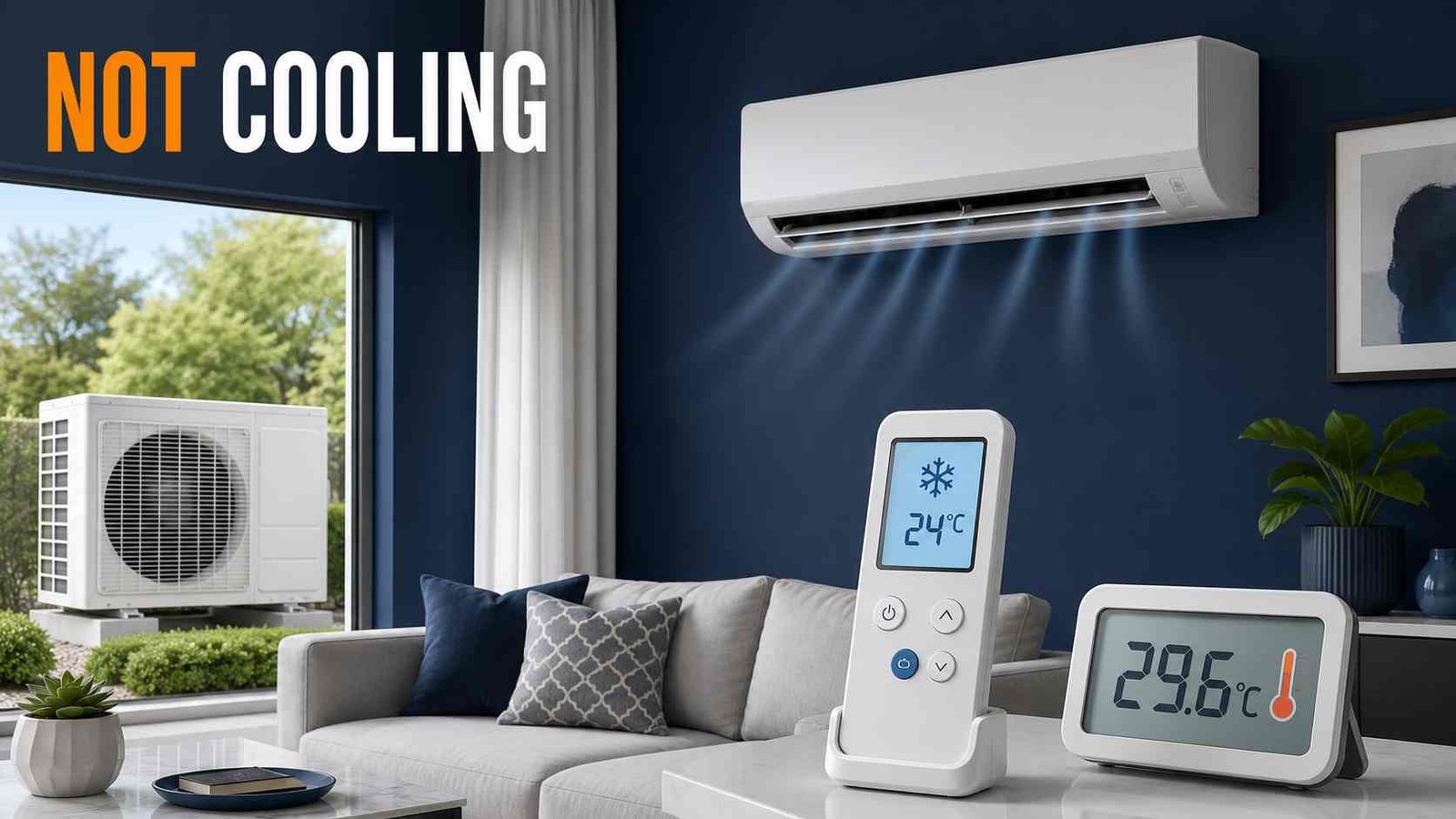
 An air conditioner that runs but does not cool usually has an incorrect operating setting, restricted airflow, a blocked outdoor unit or a problem that prevents the refrigerant system from removing heat. Start by confirming that the unit is in Cool mode, the target temperature is below the room temperature and the filter is clean.
You should stop the system if you see ice, smell burning, hear an abnormal mechanical noise, notice water reaching electrical parts or find that a breaker keeps tripping. Refrigerant leaks, compressor faults, internal wiring and sealed-system repairs are not safe homeowner jobs.
This guide covers central air conditioners, ducted systems, split and mini-split units, window air conditioners and portable AC units.
Air Conditioner Runs but Does Not Cool
| Item | Details |
|---|---|
| Problem | The air conditioner operates, but the room temperature does not fall |
| Error code | Usually none; some models may display a separate fault code |
| Most common causes | Incorrect mode, dirty filter, restricted airflow or blocked outdoor unit |
| Other possible causes | Frozen coil, faulty fan, thermostat problem, refrigerant leak or compressor fault |
| Safe first check | Select Cool mode, lower the set temperature and inspect the filter |
| Can it still be used? | Only briefly while checking basic settings and airflow |
| Stop using it when | There is ice, a burning smell, electrical tripping, leaking water or abnormal noise |
| Repair difficulty | Basic checks are easy; sealed-system and electrical faults require professional service |
What Does “Running but Not Cooling” Mean?
The phrase can describe several different situations:
- The indoor fan runs, but the air coming from the vents is warm.
- The unit blows slightly cool air, but the room does not become comfortable.
- The indoor unit operates while the outdoor unit remains off.
- The system cools at night but cannot keep up during the hottest part of the day.
- One room or zone cools normally while another remains warm.
The indoor blower can operate even when the compressor or outdoor heat-rejection system is not working. This is why hearing the fan does not confirm that the complete cooling cycle is operating.
A short restart delay can also be normal. Some air conditioners intentionally delay compressor operation for about three minutes after being stopped, restarted or switched between operating modes. This protects the compressor and should not be mistaken for an immediate failure.
Most Common Reasons an Air Conditioner Runs but Does Not Cool
| Possible cause | What you may notice | Safe homeowner action |
|---|---|---|
| Wrong operating mode | Fan runs but air is not cold | Select Cool rather than Fan, Dry, Heat or ventilation mode |
| Temperature set too high | Unit runs gently or cycles without strong cooling | Set the target below the current room temperature |
| Fan set to On | Blower runs between cooling cycles | Select Auto where appropriate |
| Dirty air filter | Weak airflow, long running time or icing | Clean or replace the filter according to the manual |
| Blocked vents or intake | Some rooms receive little air | Open vents and remove objects blocking airflow |
| Outdoor unit obstructed | Weak cooling, especially in hot weather | Remove loose leaves and visible obstructions without opening the cabinet |
| Frozen evaporator coil | Ice on tubing, weak airflow or water after thawing | Turn cooling off and arrange service if ice returns |
| Portable exhaust problem | Unit blows cool air but room stays hot | Check the hose, window kit and hot-air outlet |
| Excessive room heat load | Cooling improves at night | Close windows, curtains and reduce indoor heat sources |
| Refrigerant or compressor fault | Airflow is normal but air remains warm | Stop troubleshooting and contact a qualified technician |
Safe Troubleshooting Steps
1. Confirm the Air Conditioner Is in Cool Mode
Check the controller, wall thermostat or remote display.
Select:
- Cool or the snowflake symbol
- A temperature lower than the current room temperature
- Auto fan where that option is available
Do not rely only on the sound of the fan. Fan-only mode circulates room air without actively cooling it. Dry, dehumidification, air-purification, economy and AI modes may also produce gentler cooling than normal Cool mode. LG specifically notes that dehumidification, air-purification and power-saving modes may not feel as cold as standard cooling operation.
After changing the setting, allow several minutes for the compressor-protection delay to finish.
2. Check Whether the Set Temperature Is Realistic
Set the target temperature below the actual room temperature. A unit set close to the current temperature may reduce its compressor speed or operate with light airflow because it believes the room is already comfortable.
Avoid repeatedly changing the temperature or switching the unit on and off. Frequent restarting does not make the system cool faster and may keep restarting its built-in protection delay.
3. Close Doors and Windows
Close exterior doors and windows while testing the system.
Also check for:
- Strong direct sunlight
- Uncovered west-facing windows
- Cooking appliances
- Clothes dryers
- Multiple computers or other heat-producing equipment
- Large numbers of people in a small room
An air conditioner removes heat from the room. If heat enters faster than the unit can remove it, the system may run continuously without reaching the set temperature.
For window air conditioners, inspect the window installation and side seals. Gaps can allow cooled air to escape and hot outdoor air to enter. The US Department of Energy includes window seals, thermostat settings, filters, drainage and outdoor-unit condition among the basic items to check when cooling performance is poor.
4. Inspect the Air Filter
Turn the air conditioner off before removing the filter.
A dirty filter restricts airflow through the indoor coil. This reduces cooling performance and can contribute to coil icing. Carrier identifies a clogged filter as a frequent cause of an air conditioner running without providing adequate cooling.
Follow the model’s instructions to:
- Remove the filter.
- Vacuum, wash or replace it as directed.
- Let a washable filter dry completely.
- Reinstall it in the correct direction.
- Never operate the unit without its required filter.
Filter design and cleaning intervals vary. Daikin, for example, recommends checking and cleaning filters regularly and advises following the manual for the correct washing method.
A clean-looking filter can still be restricted by fine dust, pet hair or grease. Replace disposable filters rather than washing them unless the manufacturer specifically identifies them as washable.
5. Check the Indoor Airflow Path
Make sure air can move freely into and out of the system.
For central or ducted systems, check:
- Supply registers are open.
- Return grilles are not covered.
- Furniture is not blocking vents.
- Rugs, curtains or boxes are not obstructing returns.
- Airflow is reasonably similar at several vents.
For split and mini-split systems, check:
- The top or front intake is unobstructed.
- The discharge louvres are open.
- Curtains are not being pulled against the intake.
- Furniture is not directly blocking the airflow.
Daikin and Fujitsu troubleshooting guidance both identify dirty filters and blocked indoor or outdoor air openings as causes of poor cooling.
Do not insert fingers, brushes or tools through an operating grille.
6. Look for Ice or Frost
Check only the visible areas around the indoor unit, pipe connections and insulated refrigerant lines.
Possible signs of freezing include:
- Frost on a refrigerant pipe
- Ice around the indoor coil area
- Very weak airflow
- Water appearing after the unit is turned off
- Cooling that becomes weaker the longer the unit runs
A frozen coil can result from restricted airflow, a dirty coil, a blower problem or low refrigerant. Turn cooling off if ice is visible. Do not chip, scrape or heat the ice.
Carrier recommends shutting the system down when an evaporator coil is frozen because continued operation may cause additional damage. Refrigerant and internal coil diagnosis should be left to a professional.
Cleaning the filter may correct an airflow restriction, but recurring ice means the underlying fault has not been resolved.
7. Visually Check the Outdoor Unit
For a central, ducted, split or mini-split system, the outdoor unit must release the heat removed from indoors.
While the system is calling for cooling, observe the unit from a safe distance. Depending on the model and operating conditions, you may hear the compressor and see the fan operating. Inverter systems can change speed, and the outdoor fan may not run continuously in every operating condition.
Check for:
- Leaves or grass packed around the coil
- Plastic bags or covers blocking airflow
- Plants growing against the cabinet
- Objects placed on or beside the unit
- A closed ventilation grille in an enclosed outdoor-unit area
Remove only loose external debris that can be reached safely. Turn the system off first, and do not remove covers, reach through the fan grille, bend coil fins or spray electrical compartments.
A blocked or dirty outdoor condenser can reduce cooling and place extra load on the compressor.
If the indoor fan runs but the outdoor unit remains completely inactive after the normal delay, professional diagnosis is usually required.
8. Check Portable Air Conditioner Venting
A portable air conditioner must discharge collected heat outside through its exhaust hose. If that heat remains in the room, the appliance may blow cool air at the front while the overall room temperature stays high.
Check that:
- The exhaust hose is attached at both ends.
- The hose is not crushed, sharply bent or blocked.
- The window kit is closed and sealed.
- Hot exhaust air is not returning through a gap.
- The rear intake has adequate clearance.
- The condensate tank does not need draining.
- The room is within the cooling-area guidance for the model.
Keep the exhaust hose arranged as described in the manual. Extending it with an unsuitable hose can increase heat transfer back into the room and restrict exhaust airflow.
9. Check a Window Air Conditioner’s Installation
For a window or through-wall unit:
- Confirm that the rear section is not blocked.
- Check that curtains do not cover the front intake.
- Make sure the side panels and window opening are sealed.
- Clean the filter.
- Confirm that the unit is installed in the correct orientation.
- Check whether water or an error indicator suggests a drainage problem.
Do not drill new drain holes or change the installation angle unless the owner’s manual specifically instructs you to do so.
10. Consider Room Size and Extreme Weather
A correctly operating air conditioner can still struggle when:
- The room is larger than the unit’s rated application.
- The ceiling is unusually high.
- The room receives strong direct sun.
- Insulation is poor.
- Doors are opened frequently.
- A portable unit is installed in a room with a high heat load.
- Outdoor temperatures are unusually severe.
Carrier notes that an undersized system may run continuously and still fail to maintain the required indoor temperature, especially as outdoor temperatures rise.
Poor sizing should be assessed by an installer rather than guessed from floor area alone. Climate, glazing, insulation, ceiling height and internal heat sources all affect the cooling load.
Should You Reset the Air Conditioner?
There is no universal reset procedure for every air conditioner.
A power cycle may clear a temporary control problem, but it will not repair a dirty coil, refrigerant leak, failed fan, faulty capacitor or compressor problem.
Use this approach:
- Turn the unit off using its normal controls.
- Wait for the fans and moving parts to stop.
- Check the owner’s manual for the approved restart or power-cycle procedure.
- Use only the dedicated appliance isolator, plug or breaker identified in the manual.
- Never switch off the property’s main breaker as a substitute for an AC reset.
- Restart the system and allow time for the compressor-protection delay.
Daikin’s troubleshooting guidance shows that reset timing and breaker instructions can be model- and fault-specific. It also advises contacting service if a warning lamp returns after power is restored.
Do not repeatedly reset a unit that displays an error code, flashes a warning light or trips an electrical protection device.
What to Do When the Basic Checks Do Not Work
Arrange professional service when:
- Airflow is strong but the air remains warm.
- The outdoor unit does not start.
- Ice returns after the filter has been cleaned.
- The system cools briefly and then stops cooling.
- A warning light or error code returns.
- The breaker or safety switch trips.
- Water is leaking near electrical parts.
- The system produces a burning smell.
- There is a new grinding, rattling or harsh buzzing noise.
- Cooling performance has gradually declined.
- The system requires frequent refrigerant charging.
- The unit runs continuously but cannot maintain temperature.
Continuing to run an air conditioner that is not cooling can place additional strain on the compressor and other components.
Possible Parts or Systems a Technician May Check
The symptom does not identify one specific failed part. A technician may need to test several areas.
| Component or system | Possible effect |
|---|---|
| Thermostat or temperature sensor | Incorrect temperature reading or no cooling command |
| Indoor blower motor | Low airflow across the evaporator coil |
| Blower capacitor or control | Fan starts slowly, stops or runs incorrectly |
| Outdoor condenser fan | Heat cannot be released effectively |
| Contactor, relay or power control | Outdoor system does not start |
| Control board | Incorrect commands or communication failure |
| Evaporator or condenser coil | Reduced heat transfer due to dirt, damage or icing |
| Refrigerant circuit | Low charge, leak, restriction or metering-device problem |
| Compressor | Refrigerant does not circulate correctly |
| Ductwork or zone damper | Cooled air is lost or sent to the wrong area |
| Portable exhaust assembly | Hot air returns to the room |
Capacitors can retain electrical charge after power is removed. Do not open the cabinet or attempt electrical testing.
Refrigerant and Electrical Safety
Do not attempt to:
- Add refrigerant
- Release refrigerant
- Open service valves
- Repair refrigerant pipes
- Bypass a pressure or temperature switch
- Test live voltage
- Replace a capacitor
- Work on compressor terminals
- Repair internal wiring
Refrigerant work is regulated in many countries. In the United States, EPA Section 608 rules govern the handling and recycling of refrigerants in stationary air-conditioning equipment.
The United Kingdom requires relevant qualifications for installation, servicing, maintenance, leak checking, gas recovery and decommissioning of stationary refrigeration and air-conditioning systems containing F-gases.
Australia requires appropriate licensing for work that involves handling scheduled refrigerant or components where refrigerant could be released. New Zealand also requires relevant refrigerant charging and recovery training or certification.
Ireland operates personnel and company certification requirements for relevant F-gas work on stationary refrigeration, air-conditioning and heat-pump equipment.
Use an appropriately qualified or licensed contractor for your location.
Stop the Air Conditioner Immediately If You Notice These Signs
Safety warning: Stop operation and disconnect the unit using the approved isolator, plug or dedicated breaker if there is a burning smell, smoke, sparking, repeated breaker tripping or a serious abnormal noise. Keep clear of the appliance and arrange qualified service.
Daikin advises stopping operation and disconnecting power when a burnt odour, abnormal noise or tripping protection device is present.
Do not use a household cleaning spray inside the unit. Some manufacturers warn that unsuitable chemical cleaners can damage internal materials and contribute to water leaks.
Frequently Asked Questions
Why is my AC fan running but the air is not cold?
The indoor blower can run even if the compressor, outdoor fan or refrigerant circuit is not operating correctly. First confirm Cool mode, lower the set temperature, inspect the filter and check whether the outdoor unit starts after the normal delay.
Can a dirty air filter stop an air conditioner from cooling?
Yes. A heavily restricted filter reduces airflow, weakens cooling and may contribute to evaporator-coil icing. Clean or replace it using the instructions for your model.
Should I turn off an air conditioner that is running but not cooling?
Turn it off if the basic setting and filter checks do not restore cooling, particularly if you see ice or the outdoor unit is not operating. Continuing to run a malfunctioning system may increase component strain.
Why does my AC cool at night but not during the day?
The daytime cooling load may exceed the unit’s available capacity because of direct sunlight, high outdoor temperature, poor insulation, open doors, cooking or an undersized system. A dirty condenser can also perform worse during hot weather.
Does low refrigerant mean the AC only needs topping up?
Not necessarily. Low refrigerant may indicate leakage or another sealed-system problem. The system should be inspected rather than repeatedly recharged without identifying the cause.
Why does my portable AC blow cold air but not cool the room?
The exhaust hose may be disconnected, blocked or leaking hot air back into the room. An unsuitable room size, open window gap, dirty filter or high heat load can produce the same symptom. Portable units must vent collected heat outside.
Will resetting the air conditioner restore cooling?
A reset may clear a temporary control fault, but it cannot correct restricted airflow, ice, a refrigerant leak, an electrical failure or a damaged compressor. Follow only the reset procedure published for the exact model.
Is a quiet outdoor unit always faulty?
No. Inverter systems can reduce compressor and fan speed as the cooling demand changes. However, if the room is warm, the thermostat is requesting cooling and the outdoor unit never starts after the normal protection delay, arrange service.

Emily Carter is an Australian home-appliance safety editor with 9 years of experience researching washers, air conditioners, refrigerators, and coffee machines. She checks troubleshooting steps for accuracy, regional model differences, and homeowner safety before publication.