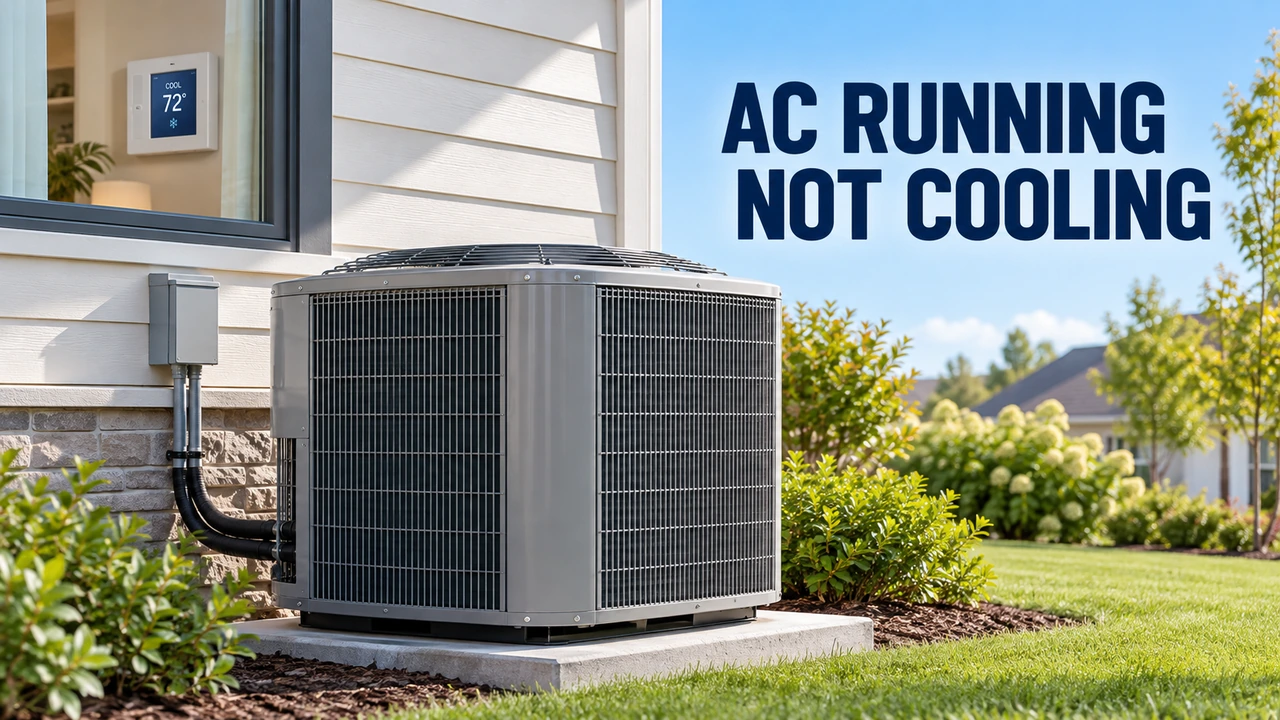
 If your AC is running but not cooling, first check the thermostat mode, indoor air filter and airflow at the supply vents. Then look from a safe distance to see whether the outdoor unit is operating. A running indoor fan does not necessarily mean the air conditioner is actually removing heat: the fan can circulate room-temperature air while the cooling equipment is off or malfunctioning.
Turn the system off and arrange professional help if you smell burning, hear abnormal electrical buzzing, see ice on refrigerant tubing, or find water close to electrical equipment. Do not open electrical cabinets, touch capacitors or refrigerant lines, or attempt to add refrigerant.
Start With the Thermostat and Airflow
- Select COOL. Set the desired temperature a few degrees below the measured room temperature. If the thermostat is set to HEAT, OFF or FAN ONLY, the system may move air without cooling.
- Choose AUTO for the fan. With the fan set to ON, the indoor blower can run between cooling cycles. AUTO usually makes it easier to tell whether a cooling call is active; the exact behavior depends on the system.
- Check an accessible air filter. Switch the system off before following the manufacturer’s filter-replacement instructions. A heavily clogged filter can reduce airflow and contribute to evaporator icing. Use the correct filter size and type.
- Open and uncover vents. Make sure furniture, curtains and rugs are not obstructing return or supply grilles. Do not close multiple supply registers to force colder air into one room.
- Give the thermostat time to respond. Many systems include a short compressor-protection delay after a setting change. Watch for normal cooling rather than repeatedly lowering the setpoint.
If you use a window or portable AC rather than a central split system, confirm that it is in cooling mode, that its washable filter is clean, and that its exhaust or outdoor airflow path is unobstructed. A portable unit’s exhaust hose must be fitted as its manual specifies; do not apply central-system checks to a different appliance type.
AC Blowing Air but Not Cold: Is the Outdoor Unit Running?
On a conventional central split air conditioner, the indoor blower and outdoor condenser have separate jobs. The indoor blower distributes air through the home, while the refrigerant circuit moves heat outdoors. If only the indoor blower operates, air at the vents may feel no cooler than the room.
From the ground and without removing any grille or cover, observe whether the outdoor unit appears to be running during an active cooling call. Do not reach toward its fan or assume that an outdoor fan spinning proves the compressor is healthy. Some systems have variable-speed operation or controls that change fan behavior.
If the outdoor unit is silent while the thermostat calls for cooling, the issue could involve power, a protection lockout, controls or a failed component. Check only the homeowner-accessible thermostat settings and any clearly labeled breaker status. A breaker that trips again should be left off and assessed by a qualified professional; do not keep resetting it.
Check for a Dirty Filter, Blocked Condenser or Frozen Coil
Dirty indoor filter and weak airflow
A blocked return filter reduces the volume of air moving across the indoor coil. You might notice weaker airflow at several vents, unusually long run times or a coil that begins to ice. Replace or clean a user-serviceable filter according to the manual. If air stays weak with a clean filter and open grilles, a duct or blower problem may need professional diagnosis.
Debris around the outdoor condenser
Leaves, grass clippings and vegetation can obstruct the outdoor coil’s airflow. Remove loose debris from the surrounding ground and keep the manufacturer’s recommended clearance around the cabinet. For coil cleaning, follow the exact equipment instructions or arrange a service visit. Do not direct high-pressure water at fins, remove guards, or put hands near a moving fan.
Ice on a refrigerant line or indoor coil
Visible frost or ice on the larger insulated refrigerant line, or unusually little airflow during cooling, may mean the indoor evaporator is freezing. Low airflow and refrigerant-related faults are among several possible causes. Switch cooling off rather than continuing to run a frozen system, and contact an HVAC technician. Do not scrape the ice, apply heat or open the indoor coil housing.
What Your AC Symptoms May Mean
| What you notice | Possible explanation | Next safe action |
|---|---|---|
| Indoor fan runs, air feels room-temperature | Fan-only setting or cooling system not operating | Check COOL mode, setpoint and outdoor-unit activity |
| Weak airflow from several vents | Dirty filter, blocked return or blower/duct issue | Check accessible filter and grilles |
| Ice visible on tubing | Frozen evaporator related to airflow or refrigerant problems | Turn cooling off and arrange service |
| Outdoor unit is not operating | Power, control or outdoor-component fault | Check thermostat and breaker status safely; seek service |
| Outdoor unit runs but cooling is poor | Dirty coil, refrigerant fault, load or equipment issue | Clear surrounding debris; request diagnosis if unchanged |
| Cooling is reasonable at night but poor in afternoon | High heat load, insulation, airflow or capacity limitations | Reduce solar gain and document temperatures for an HVAC assessment |
Why the Air Conditioner Runs Constantly but the House Stays Warm
A working AC can run for long periods during exceptionally hot or humid conditions. The important question is whether it is removing heat and steadily reducing indoor temperature. Close windows and exterior doors, shade sun-exposed windows and avoid unnecessary indoor heat sources while checking performance.
If the system never approaches the set temperature despite a clean filter and clear condenser airflow, the home may have excessive heat gain, duct leakage, incorrect equipment sizing or a cooling-system fault. Replacing the thermostat or compressor without measurements is not a sound diagnosis. An HVAC professional can assess airflow, refrigerant performance and the building’s cooling load.
Could Low Refrigerant Be the Reason?
Yes, a refrigerant leak or incorrect charge can reduce cooling, but warm supply air alone does not prove refrigerant is low. Air conditioners do not normally consume refrigerant during operation. A technician should locate and address any leak and then evaluate the charge using manufacturer procedures and applicable regulations. Do not use a consumer recharge kit or disconnect refrigerant tubing.
A malfunctioning capacitor, contactor, compressor, expansion device or control can produce similar symptoms on some systems. These parts involve stored electrical energy, high voltage or pressurized refrigerant and should not be tested or replaced as a homeowner experiment.
Should You Reset an AC That Is Running but Not Cooling?
First correct an obvious thermostat setting and allow any built-in restart delay. Do not repeatedly cycle the breaker or disconnect switch to force cooling. If a breaker has tripped, especially more than once, stop and contact a professional. A reset will not clean a clogged filter, thaw a coil safely, seal a refrigerant leak or repair electrical damage.
When to Call an HVAC Technician
Book service if the air remains warm after checking cooling mode, filter and visible airflow; if the outdoor unit does not start; if you see ice; if a breaker repeatedly trips; or if the system makes unusual buzzing or grinding sounds. Stop operation immediately for burning odors, sparking or water threatening electrical components.
Before the visit, record the equipment brand and model, thermostat mode and setpoint, approximate room temperature, airflow strength, whether the outdoor unit appears active, and any visible ice or error message. These observations help the technician separate airflow, controls and cooling-circuit problems without guessing at parts.
Start with the controls and clean airflow paths. If the unit still runs without cooling, avoid internal electrical or refrigerant work and have the fault diagnosed professionally.

Ahmad Raza is the website administrator and content operations manager at Error Code Vault. With 11 years of experience in technical publishing, he manages site accuracy, author verification, source quality, updates, user feedback, and editorial compliance.