
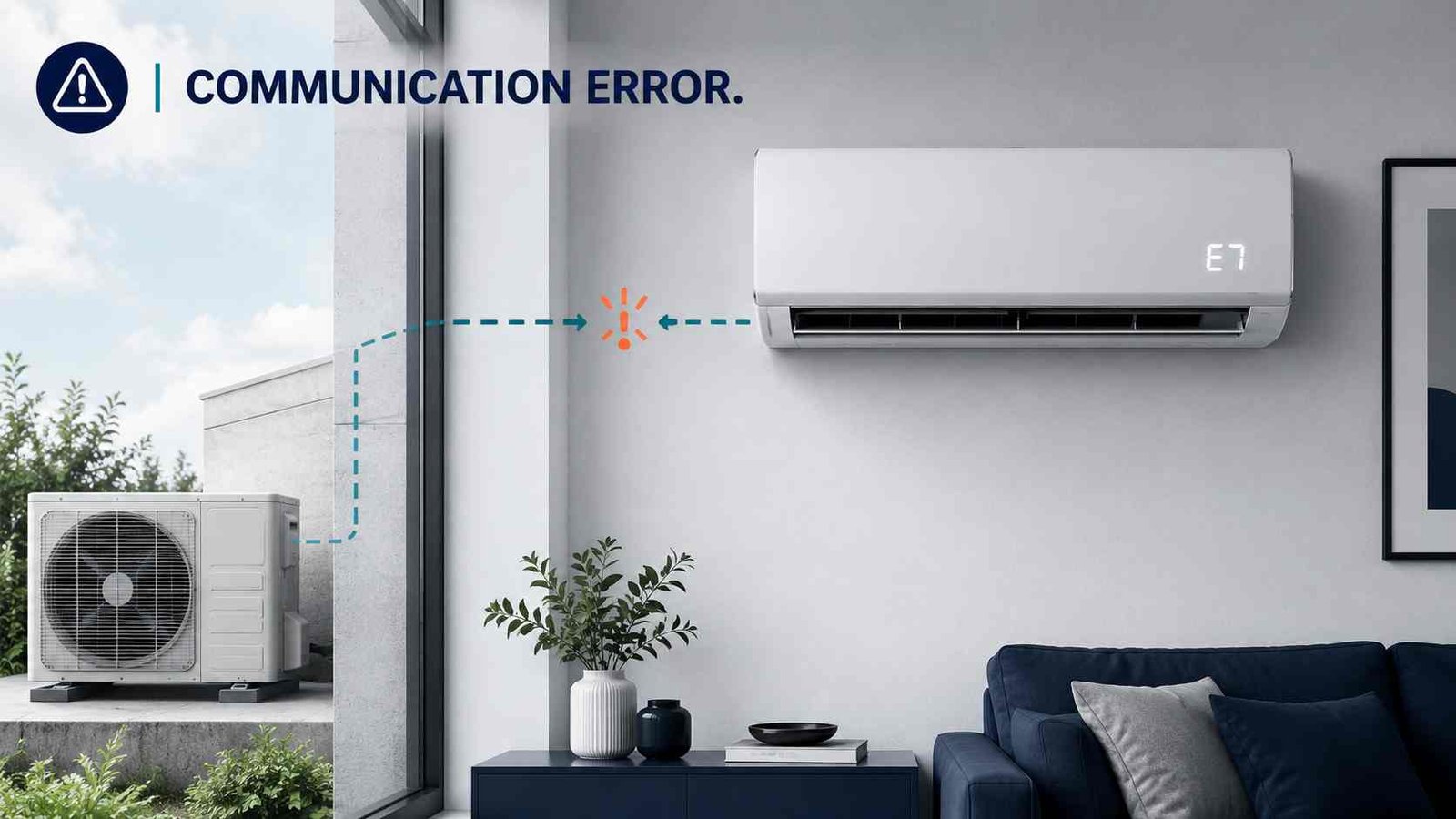
 The Haier Air Conditioner E7 error usually means the indoor and outdoor units have lost communication. Common causes include a disconnected or damaged communication cable, incorrect terminal connections, loss of power to the outdoor unit, or a failed indoor or outdoor control board.
Turn the air conditioner off and check the exact model number before attempting a reset. Do not remove either unit’s electrical cover or touch the connecting terminals. Haier’s service information treats E7 as a technician-level fault on many ductless systems.
There is also an important model difference: one official Haier regional support page defines E7 as compressor discharge-temperature protection. Because Haier uses different code systems across some products and markets, the manual for your exact model takes priority.
Quick Answer
| Item | Details |
|---|---|
| Error code | E7 |
| Brand | Haier |
| Appliance | Usually a split, mini-split or ductless air conditioner |
| Most common meaning | Communication fault between indoor and outdoor units |
| Common causes | Communication wiring, terminal connection, indoor PCB, outdoor PCB or outdoor power problem |
| Safe first action | Turn the system off, record the model number and check the accessible breaker or isolator |
| Repair difficulty | Usually professional diagnosis |
| Can the AC still be used? | Do not continue using it if E7 returns |
| When to call for service | When the code returns after one controlled restart or appears with electrical, heat or outdoor-unit symptoms |
What Does E7 Mean on a Haier Air Conditioner?
On many Haier wall-mounted split and ductless air conditioners, E7 indicates a communication failure between the indoor unit and the outdoor unit.
The indoor unit sends operating commands and temperature information to the outdoor unit. The outdoor unit then controls components such as the compressor, outdoor fan and refrigerant-flow system. If this data connection is interrupted, the units cannot coordinate safely and the controller may stop operation and display E7.
Haier India lists three likely causes:
- Disconnected communication wiring
- A failed indoor PCB
- A failed outdoor PCB
The same support page advises arranging service when the code appears.
Haier’s North American Arctic Next Gen service manual also defines E7, accompanied by 15 flashes on the outdoor board’s LED1, as a loss of communication between the indoor and outdoor units.
Check the Air Conditioner Type First
Do not assume every Haier product uses the same E7 definition.
Split or mini-split air conditioner
This guide primarily applies to systems with:
- A wall-mounted indoor unit
- A separate outdoor condenser
- Refrigerant pipes and electrical wiring between the units
Communication failure is the most widely documented E7 meaning for this appliance type.
Portable air conditioner
Haier’s current US portable-air-conditioner code lists include E1, E2, E4, FL and several older-model codes, but they do not list E7. If a portable unit shows E7, use its exact model manual rather than applying the split-system explanation automatically.
Window or through-the-wall air conditioner
Haier US does not publish one complete universal code table for window and wall units. Its support guidance says displayed fault codes require diagnosis by a trained service technician.
Multi-zone system
A multi-zone system may have several indoor units connected to one outdoor unit. Record which indoor unit shows E7 and whether other zones still operate. The fault may involve the affected unit, shared communication wiring or the outdoor controller.
Important Model and Regional Difference
Although communication failure is the most common documented meaning, E7 is not universal across every Haier air conditioner.
A current Haier Philippines support page defines E7 as compressor discharge-temperature protection and directs the user to unplug the unit and arrange service. Another official Haier Philippines error table defines E7 as indoor-to-outdoor communication failure.
This conflict is why you should verify:
- The indoor-unit model number
- The outdoor-unit model number
- The country where the system was sold
- Whether the code appears on the indoor display, wired controller or outdoor board
- The definition in the model’s own manual
Model warning: Do not order a control board, communication cable, fan motor or compressor-related part based only on the characters E7.
Common Causes of the Haier E7 Error
1. Disconnected communication wiring
A conductor may have come loose at the indoor or outdoor terminal block. This can happen after installation, maintenance, vibration or accidental cable movement.
Haier specifically identifies disconnected communication wiring as a cause of E7.
2. Damaged or incorrectly installed cable
Haier’s North American installation documentation warns that communication problems and E7 may result from:
- Incorrect wire type or size
- Solid-core wire where the model requires stranded cable
- Midline splices
- Poor terminal connections
- Indoor and outdoor wires connected to different terminal positions
These checks require access to mains-voltage terminals and should be handled by an installer or qualified HVAC technician.
3. Outdoor unit has lost power
The indoor display may still operate even when the outdoor unit is not receiving the correct supply on some system designs.
Possible reasons include:
- A tripped circuit breaker
- An outdoor isolator switched off
- A failed disconnect or fuse
- Damaged supply wiring
- An outdoor control-board power fault
A homeowner may check the normal position of an accessible breaker or isolator. Internal voltage testing is not a homeowner procedure.
4. Indoor control board failure
The indoor PCB receives commands from the remote, monitors sensors and sends information to the outdoor unit. If the board cannot create or process the communication signal, E7 may appear.
A failed indoor PCB is one of Haier’s officially listed possible causes.
5. Outdoor control board failure
The outdoor PCB must receive and respond to commands from the indoor unit. Damage caused by heat, moisture, component failure or an electrical event may stop that response.
Haier lists the outdoor PCB as another possible cause.
6. Outdoor inverter module or fan-related fault on selected models
On the Arctic Next Gen models covered by Haier’s service flowchart, technician diagnosis may continue from the communication circuit to the outdoor PCB, inverter power module or outdoor fan motor.
This is model-specific. It does not mean every Haier E7 error requires one of those parts.
7. Installation or recent repair problem
E7 appearing soon after installation, board replacement, cable work or professional cleaning raises the possibility of:
- Incorrect terminal order
- A loose connector
- An unsuitable cable
- A wire damaged during refitting
- Incorrect replacement-board configuration
Tell the installer when the code first appeared and what work was recently completed.
Safe Checks You Can Perform
Keep the checks external. Do not open electrical compartments.
Step 1: Record the complete code
Take a clear photo of the display. Confirm whether it shows:
- E7 continuously
- E7 only during startup
- E7 after several minutes
- E7 with another code
- A flashing-light pattern rather than a digital code
These details help distinguish an immediate communication loss from a fault that develops after the outdoor system begins operating.
Step 2: Find both model numbers
The indoor and outdoor units normally have separate model numbers.
Look for rating labels:
- On the side or underside of the indoor unit
- Behind an accessible front filter cover, where the user manual permits
- On the outer casing of the outdoor unit
- On the invoice, installation documents or warranty registration
Do not remove a screwed electrical panel to find a label.
Step 3: Turn the system off
Switch the air conditioner off using its normal control.
If it is safe and accessible, isolate the system at its dedicated breaker or external isolator. Do not touch damaged switches, wet equipment or exposed wiring.
Step 4: Check the accessible power controls
Look for:
- A tripped air-conditioner breaker
- An outdoor isolator left off after maintenance
- A recent household power failure
- Another electrical circuit that has also stopped working
Reset a breaker only once and only when there are no signs of burning, water entry or damaged wiring.
Step 5: Inspect from a safe distance
Without opening the units, check for:
- Storm or impact damage
- A visibly cut or crushed interconnecting cable
- Heavy water exposure
- Pest damage near accessible cable routes
- Debris completely blocking the outdoor unit
- A burning smell or unusual electrical noise
Step 6: Perform one controlled restart
After the system has been safely isolated and the display has gone dark, restore power once and start it normally.
Observe:
- Whether E7 appears immediately
- Whether the indoor fan starts
- Whether the outdoor unit starts after its normal delay
- Whether the code returns after several minutes
If E7 returns, stop using the system and arrange service.
Can You Reset the Haier E7 Error?
There is no verified universal Haier button sequence for clearing E7.
Some Haier regional support pages tell users to unplug or turn off the appliance and contact service. North American ductless guidance describes E and F codes as information for a qualified service professional.
A one-time power cycle may clear a temporary interruption caused by a short power disturbance or controller lock-up. It will not repair:
- A broken communication wire
- An incorrect terminal connection
- A failed PCB
- A damaged inverter module
- A genuine compressor-temperature protection problem
Do not repeatedly cycle the breaker in an attempt to force the air conditioner to run.
Simple Troubleshooting Flow
- Confirm that the appliance is a split or ductless system.
- Record the indoor and outdoor model numbers.
- Photograph the E7 display.
- Switch the system off.
- Check the accessible breaker and outdoor isolator.
- Look for external damage, water entry or burning smells.
- Restore power once.
- Watch whether the code returns.
- Leave the unit off and contact service if E7 reappears.
What a Technician May Check
Professional diagnosis may include:
- Correct supply voltage to the indoor and outdoor units
- Terminal order at both ends of the interconnecting cable
- Cable continuity and insulation condition
- Whether the cable type matches the model requirements
- Communication-signal behaviour
- Indoor PCB operation
- Outdoor PCB operation
- Outdoor inverter-module power and communication
- Outdoor fan control on applicable models
- Replacement-board settings and model compatibility
Haier’s service flowchart includes live AC and DC measurements, board LEDs and component isolation. These procedures involve potentially dangerous voltage and are not suitable for an untrained homeowner.
Possible Parts Involved
| Part or area | Why it may cause E7 | Who should check it? |
|---|---|---|
| Interconnecting cable | Open, damaged, spliced or unsuitable cable interrupts communication | Qualified installer or technician |
| Terminal block | Loose, burnt or incorrectly matched connections | Qualified electrician or HVAC technician |
| Indoor PCB | Does not send or process communication data | Technician |
| Outdoor PCB | Does not receive or answer the indoor signal | Technician |
| Inverter power module | Prevents outdoor electronics from starting correctly on selected models | Technician |
| Outdoor fan motor or circuit | Included in the diagnostic path of certain model families | Technician |
| Outdoor power supply | Outdoor unit cannot respond without correct power | Electrician or HVAC technician |
A diagnostic result should identify the failed circuit before a part is replaced. E7 alone does not prove that either PCB is defective.
Does E7 Mean Low Refrigerant?
Usually, no.
In Haier’s commonly published split-system error table:
- E7 is indoor-to-outdoor communication failure
- F13 is lack of refrigerant
- F4 is compressor discharge-temperature protection
- F8 is an outdoor DC fan malfunction
This means E7 should not automatically be diagnosed as a refrigerant leak or low-pressure problem.
The exception is that one regional Haier page assigns compressor discharge-temperature protection to E7. Check the exact model documentation before ruling in or ruling out a temperature-related fault.
Is It Safe to Keep Using the Air Conditioner?
Do not continue operating the system when E7 returns after a controlled restart.
A communication fault means the indoor and outdoor controls may not be exchanging the information required for normal operation. The system may already be stopping itself to protect components.
Leave the unit off and seek service immediately if:
- The breaker trips
- You smell burning
- The outdoor unit repeatedly clicks or attempts to start
- Wiring appears damaged
- Water has entered either unit
- The code appeared after a storm or electrical surge
- The outdoor unit becomes unusually hot
- The model manual identifies E7 as compressor-temperature protection
When to Call a Technician
Arrange professional service when:
- E7 returns after one power cycle
- The outdoor unit remains completely inactive
- The fault appeared after installation or maintenance
- One zone fails on a multi-zone system
- The breaker or isolator will not stay on
- The system is still under warranty
- You cannot confirm the E7 definition for the model
- The code is accompanied by noise, heat, smell or visible damage
For recently installed systems, contact the original installer first. Wiring selection and terminal arrangement are part of installation, and Haier’s documentation links installation errors directly with E7 communication problems.
Information to Give the Service Provider
Prepare the following before calling:
- Indoor-unit model number
- Outdoor-unit model number
- Serial number
- Photo of the E7 display
- Any outdoor LED flash pattern visible without opening the unit
- Whether the indoor fan runs
- Whether the outdoor fan or compressor starts
- How quickly E7 appears
- Recent power outage, storm, cleaning or repair history
- Installation date and warranty documents
This information can reduce unnecessary repeat visits and helps the technician locate the correct service documentation.
Frequently Asked Questions
How do I clear E7 on a Haier air conditioner?
Turn the system off and perform one controlled power cycle using its normal breaker or isolator, provided there is no electrical damage, water exposure or burning smell. If E7 returns, the underlying communication or protection fault has not been resolved.
Why does my Haier AC show E7 after a power outage?
A power interruption may temporarily disrupt communication or damage a sensitive control component. One restart may clear a temporary fault. A recurring E7 requires professional diagnosis of the power supply, wiring and control boards.
Can a loose wire cause the Haier E7 error?
Yes. Haier identifies disconnected communication wiring as a possible cause. Installation documentation also warns that poor terminal connections, midline splices and incorrect cable can cause E7.
Does E7 mean the outdoor PCB is faulty?
It can, but the code does not prove the board has failed. The communication cable, terminal connections, indoor PCB, outdoor power supply and other model-specific outdoor components must be checked first.
Can the indoor unit run while E7 is displayed?
The indoor fan or display may still operate because the indoor unit and outdoor unit perform different functions. That does not mean the complete system is working safely. Stop using it if E7 remains or returns.
Can cleaning the air conditioner cause E7?
Cleaning should not normally cause E7. However, the timing may be relevant if water reached electrical parts, a connector was disturbed, or the interconnecting cable was moved during professional service.
Is Haier E7 a refrigerant-leak code?
Not on the commonly published Haier split-system table, where refrigerant shortage is listed separately as F13. Because code definitions can vary, confirm the manual for your exact model.
Can I replace the PCB myself?
No. Board diagnosis involves mains electricity, stored DC voltage, model-specific settings and confirmation that the wiring or another component did not cause the failure. PCB replacement should be completed by a qualified professional.

Emily Carter is an Australian home-appliance safety editor with 9 years of experience researching washers, air conditioners, refrigerators, and coffee machines. She checks troubleshooting steps for accuracy, regional model differences, and homeowner safety before publication.