
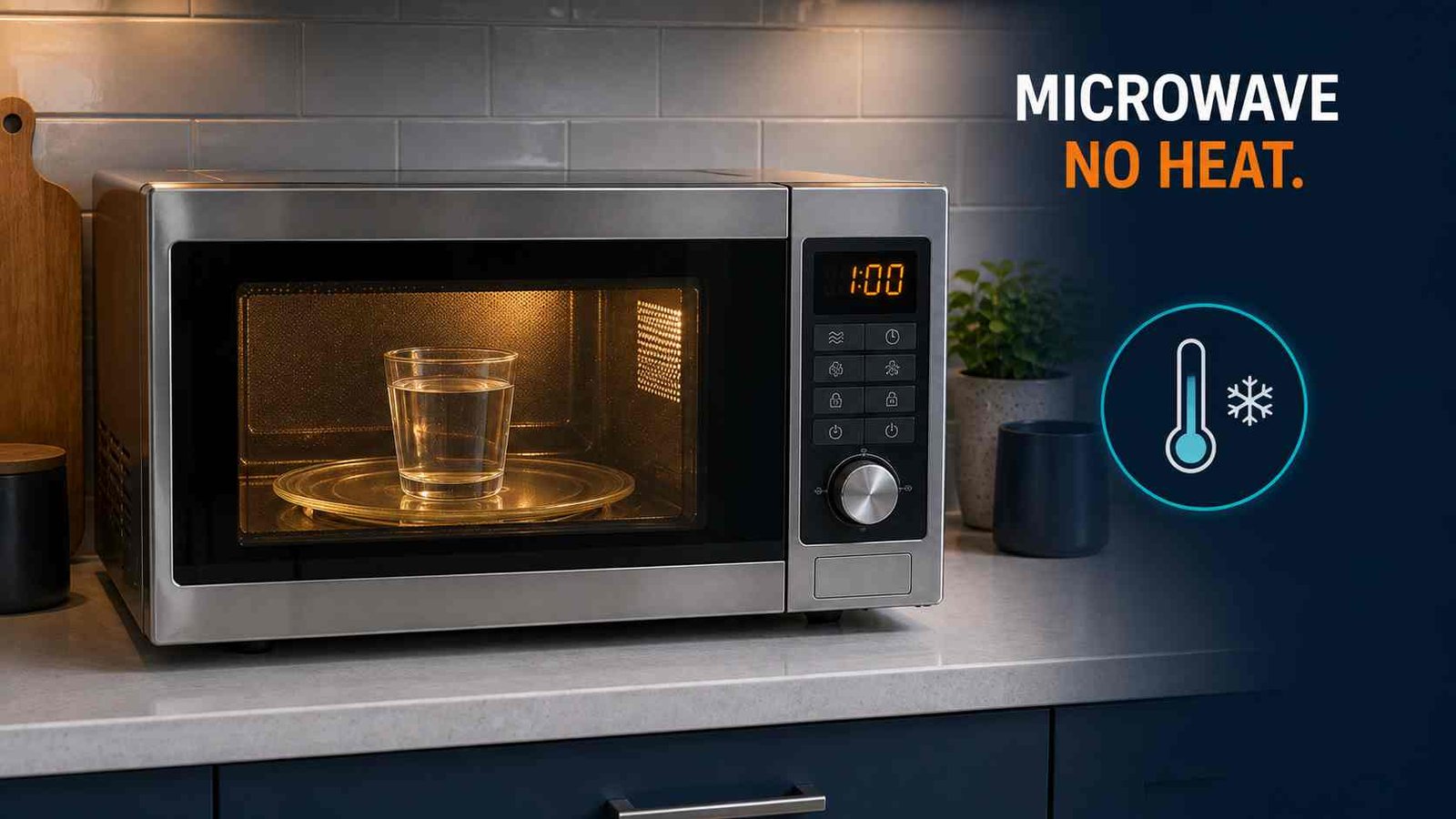
 A microwave that runs but does not heat may still light up, count down, operate its fan, and rotate the turntable. Those functions do not confirm that the microwave-heating system is working.
Start by checking whether you selected a real cooking cycle rather than the kitchen timer, whether Demo mode is active, whether the power level is too low, and whether the door closes completely. A short water-heating test can then confirm whether the appliance is producing heat.
Stop using the microwave immediately if its door, hinges, latch, or seals are damaged, if it operates with the door open, or if you notice sparks, smoke, burning smells, repeated breaker trips, or an unusually hot plug or socket. Do not remove the outer cabinet. A microwave can retain a dangerous electrical charge after it has been unplugged. er
| Question | Answer |
|---|---|
| What does the symptom mean? | The controls and motor systems are operating, but microwave energy may not be reaching the food. |
| Is this an error code? | No. It is a symptom that can occur with many brands and models. |
| Most common simple causes | Kitchen Timer selected, Demo mode enabled, low cooking power, incomplete door closure, or a model-specific setting. |
| Safe first check | Cancel the cycle, choose timed cooking at full power, close the door firmly, and test one cup of water. |
| Can the microwave still be used? | Only for a brief controlled test when there are no damage or electrical-warning signs. Do not keep running repeated cycles if it produces no heat. |
| Possible internal causes | Door-interlock fault, magnetron failure, high-voltage diode fault, or another problem in the heating or control system. |
| Repair difficulty | Professional diagnosis is required once external checks fail. |
| When should you stop? | Stop for door damage, open-door operation, smoke, arcing, burning smells, abnormal heat, breaker trips, or persistent no-heat operation. |
What It Means When a Microwave Runs Without Heating
A microwave contains several systems that can operate independently. The display, lamp, cooling fan, turntable motor, control board, door-safety system, and microwave-generating components do not all perform the same job.
That is why the following may still happen during a no-heat fault:
- The display counts down.
- The cavity light comes on.
- The turntable rotates.
- The fan makes its normal sound.
- The cycle finishes and beeps.
The magnetron is the component that produces microwave energy used to heat food. In Demo mode, manufacturers can intentionally disable the magnetron while allowing the display, fan, light, and turntable to operate. A similar outward symptom can occur when an internal heating component has failed. s different from weak heating
First decide which symptom you have:
No heat: A cup of cool water shows no noticeable temperature rise after a correct test cycle.
Weak heat: The water becomes warmer, but heating takes longer than expected.
Weak heating can be influenced by the selected power level, food quantity, cookware, ventilation, repeated cooking cycles, or model-specific power management. Complete lack of heat after the basic checks is more likely to require service.
Samsung notes that very small food quantities can produce different sensor-cooking results. LG also explains that selected models may temporarily reduce microwave output during repeated use to protect against overheating. the Microwave Immediately in These Situations
Do not continue testing when the appliance shows a possible electrical, fire, or door-safety problem.
The door is bent, warped, loose, or damaged
Do not use a microwave if the door does not close firmly or if its hinges, latch, seals, or surrounding surfaces are damaged. The FDA advises contacting the manufacturer when these parts are damaged or the door does not open and close correctly. es with the door open
Normal microwave ovens use independent interlock systems designed to stop microwave generation when the door is released or opened. If the appliance continues operating with the door open, discontinue use immediately and disconnect it from power where this can be done safely. parks, smoke, or scorch marks
A small spark caused by unsuitable metal cookware is different from unexplained repeated arcing. Stop if arcing continues after the unsuitable item has been removed, or if you see smoke, blackened areas, melted components, or burning damage.
The plug or socket is unusually hot
Burn marks, buzzing or crackling from the electrical connection, repeated blown fuses, breaker trips, or a plug or socket that feels unusually hot require immediate disconnection and professional assessment. Electrical Safety First advises users not to ignore these signs. a strong electrical-burning smell or abnormal noise
A changed electrical hum, harsh buzzing, repeated clicking, burning smell, or sudden shutdown may indicate an internal fault. These signs cannot identify the failed part reliably, but they are enough reason to stop.
Safety warning: Do not remove the microwave cabinet, control panel, rear cover, or built-in trim to look for the fault. Do not test door switches, capacitors, diodes, transformers, inverter boards, fuses, or internal wiring. GE states that the high-voltage capacitor can retain a dangerous charge after the microwave has been unplugged and that specialised equipment is needed for diagnosis. s to Perform Before Arranging Repair
Only continue when the door and electrical connection appear undamaged and there has been no smoke, arcing, overheating, or breaker activity.
1. Cancel the current programme
Press Stop, Cancel, or Clear, depending on the control panel. Wait for the microwave to return to its normal clock or standby display.
Then choose a straightforward timed microwave cycle rather than a sensor, defrost, grill, convection, combination, delayed-start, or automatic programme.
2. Make sure you did not select the Kitchen Timer
The Kitchen Timer counts down without starting a cooking cycle. GE and Samsung both list accidental timer selection as a basic cause of a microwave appearing to run without heating. ls such as:
- Timer
- Kitchen Timer
- Clock/Timer
- Minute Timer
Cancel it and select Cook Time, Microwave, Time Cook, or the equivalent control for your model.
3. Check for Demo or Showroom mode
Demo mode is one of the clearest explanations when the timer, lamp, fan, and turntable work but the food remains cold. The mode is designed to demonstrate the controls without activating the magnetron. cations include:
- “Demo” on the display
- A “d” symbol
- “dOn”
- A cycle that counts down unusually quickly
- Normal-looking operation with no heat
Do not use a generic button sequence from another model. Demo-mode procedures differ between brands and sometimes between product series from the same brand. Use the model number to find the correct owner’s manual.
4. Select full microwave power
Choose 100% power, often shown as:
- High
- P10
- Power 10
- 100%
- Maximum
A lower power setting normally cycles or reduces the heating output. It can make the microwave seem weak, especially during a short test. Whirlpool, KitchenAid, and Panasonic all recommend checking the power setting before assuming an internal failure. t the door area without dismantling anything
Open the door and look for:
- Food debris around the door edge
- Packaging material or a shipping spacer
- An item preventing full closure
- A visibly loose or damaged latch
- A bent or misaligned door
- Damage around the sealing surfaces
Clean ordinary food residue with a soft damp cloth and mild detergent. Do not use abrasive pads on the door or sealing surfaces.
Close the door firmly without slamming it. Samsung and Haier advise confirming full door closure because the safety mechanism must engage before heating can begin. lift, push, or pull the door into a particular position to make the microwave heat. Heating only when pressure is applied to the door suggests a latch or interlock problem that requires service.
6. Check ventilation and installation clearance
Make sure external vents are not covered by containers, cloths, paper, grease buildup, or surrounding cabinetry.
Countertop microwave clearance requirements vary by model. Over-the-range units must also be installed and vented according to their installation instructions. Samsung notes that insufficient clearance can contribute to weak heating or no heating. nstalled microwave, also check that:
- All shipping materials were removed.
- The door closes completely.
- The unit is connected to the intended household supply.
- Installation matches the manufacturer’s instructions.
Do not remove a built-in or over-the-range microwave yourself merely to inspect its wiring or connections.
7. Perform one controlled water-heating test
A water test provides a clearer result than testing a small amount of food.
For Whirlpool’s published test:
- Place one cup, approximately 250 mL, of cool water in a microwave-safe cup.
- Put it on the turntable.
- Select one minute at High or 100% microwave power.
- Start the cycle.
- Check whether the water has a noticeable temperature rise. ions vary. Panasonic, for example, advises heating a cup of water for one to two minutes in its general troubleshooting guidance. Follow your model’s manual when its instructions differ. removing the cup. Do not exceed the recommended time or repeat long water-heating cycles. Water can become superheated and erupt when the cup is moved or another substance is added. The FDA advises following the manufacturer’s heating-time limits. he result:**
| Test result | What it suggests | Next action |
|---|---|---|
| Water becomes clearly hot | The microwave is producing heat | Review the original food, quantity, cookware, programme, and power setting |
| Water becomes slightly warm | Heating may be weak | Confirm full power, ventilation, and manual instructions; arrange service if weak heating continues |
| Water remains cold | Demo mode, door detection, or an internal heating fault may be present | Perform one model-appropriate reset, then arrange service if no heat remains |
| Microwave sparks, smells, trips power, or makes abnormal sounds | Possible safety or electrical fault | Stop immediately and disconnect power safely |
Do not run the microwave empty. Some manufacturers specifically warn against empty operation because it may damage the appliance. ing the Microwave Restore Heating?
A reset may clear a temporary control problem, but it cannot repair a failed magnetron, door switch, diode, inverter, or another damaged component.
Most microwaves do not have one universal reset button. Published procedures differ:
- Haier advises unplugging selected microwaves for 30 seconds.
- KitchenAid describes a one-minute power disconnection for its models.
- Panasonic’s general troubleshooting page suggests unplugging for five minutes when the Stop/Reset control does not resolve the issue. approach:
- Cancel the cycle.
- Switch off and unplug a countertop microwave if its plug is easily and safely accessible.
- For a fixed or over-the-range model, use the approved isolation method stated in its manual.
- Leave it disconnected for the period recommended by the manufacturer.
- Restore power.
- Set the clock if required.
- Perform one controlled water test.
Do not repeatedly reset a microwave that trips its breaker or fuse. Whirlpool advises against continuing to operate a microwave when the circuit protection trips again after resetting. nternal Causes When the Microwave Still Does Not Heat
The following components are possible causes, not confirmed diagnoses. The exact design depends on the model.
| Possible component | Its role | Possible symptom | Homeowner repair? |
|---|---|---|---|
| Door-interlock switch or latch system | Confirms that the door is safely closed | Runs incorrectly, refuses to heat, behaves differently when the door is moved | No |
| Magnetron | Produces microwave energy | Normal-looking cycle with no heat; sometimes abnormal humming or a blown fuse | No |
| High-voltage diode | Supports the electrical supply to the magnetron on conventional designs | No heat or abnormal electrical sound | No |
| Capacitor or high-voltage power system | Stores and manages high-voltage energy | No heat, electrical noise, shutdown, or protection-device failure | No |
| Transformer or inverter system | Provides model-specific power for microwave generation | No heat, intermittent heat, or model-specific service code | No |
| Thermal protector or internal fuse | Opens the circuit during an abnormal electrical or temperature condition | Heating stops, unit shuts down, or selected functions fail | No |
| Control board or relay | Sends power and commands to the heating system | Cycle appears normal but heating is not activated | No |
Whirlpool and KitchenAid identify the magnetron, high-voltage diode, and door switch as possible no-heat causes. Panasonic identifies codes such as H97 and H98 on selected models as service issues rather than user-correctable operating errors. must identify the actual cause using the correct service information and safety equipment. Replacing a guessed part can leave the original fault unresolved and may interfere with the door-safety or high-voltage systems.
What Different Symptoms May Suggest
The fan and turntable work, but the water stays cold
First rule out Demo mode, timer mode, low power, and incomplete door closure. If these checks are correct, an internal heating-system fault becomes more likely.
It makes a louder hum than before
A changed hum can accompany several electrical or mechanical problems. It does not confirm that the magnetron is defective. Stop the test if the sound is harsh, accompanied by a burning smell, or followed by a breaker trip.
It heats only sometimes
Intermittent heating may involve the door-latch system, control system, thermal protection, or high-voltage section. Do not keep opening and slamming the door to make it work.
It heats briefly and then stops
Check ventilation and allow the appliance to cool. If the symptom repeatedly returns during ordinary use, arrange service. Do not bypass any thermal protection device.
Grill or convection works, but microwave mode does not
A combination microwave uses separate heating methods. The grill or convection heater may work even when microwave generation has failed. Test only the microwave mode according to the owner’s manual.
It has not heated since installation
Check for Demo mode, shipping material, door closure, ventilation clearance, and correct installation. If those checks are satisfactory, contact the installer or manufacturer rather than removing the appliance.
Why the Microwave Cabinet Must Remain Closed
Unplugging a microwave removes incoming power, but it does not automatically make every internal component safe. The high-voltage capacitor may retain a hazardous charge.
Internal diagnosis can also involve:
- High-voltage measurements
- Door-interlock testing
- Live operating tests
- Model-specific service procedures
- Post-repair safety verification
- Leakage testing where required
GE gives no do-it-yourself microwave-repair advice because of the retained high voltage, electronic complexity, and specialised diagnostic equipment. oundary includes seemingly simple internal jobs. Do not open the cabinet to replace an internal fuse or door switch.
Model and Regional Differences
The symptom can occur in countertop, built-in, drawer, over-the-range, inverter, and combination microwaves, but the procedures are not universal.
Reset times vary
A 30-second reset may be published for one brand while another recommends one or five minutes. Follow the manual for the exact model rather than increasing the disconnection time repeatedly.
Demo-mode controls vary
Do not assume a Samsung, Whirlpool, Panasonic, or other manufacturer’s button sequence applies to a different model. Even models within one brand can use different menus.
Inverter models use a different power design
Some microwaves use an inverter-based power system rather than a conventional transformer-based design. The homeowner symptom can be identical, but the diagnostic method and replacement parts differ.
Error codes are model-specific
The phrase “runs but does not heat” is not a universal error code. Selected Panasonic models may show codes such as H97 or H98 for a service-level problem, but those meanings should not be applied to other brands. l connections differ by country
Do not modify a plug, fuse, socket, circuit, or fixed connection to make the microwave operate. In the UK and Ireland, avoid overloading extension leads or connecting one extension lead to another. Electrical Safety First warns that overloaded sockets and leads can create an overheating and fire risk. Repair or Replace the Microwave?
There is no single answer based only on the no-heat symptom.
Consider these points:
Check the warranty first
Find the model and serial number, purchase date, receipt, and warranty terms. Some warranties provide different coverage periods for labour, general parts, and selected components.
Do not open the appliance before checking the warranty. Unauthorised work may affect coverage.
Consider the microwave type
A basic countertop microwave is easier to replace than a built-in, drawer, convection, or over-the-range model. Installed appliances may also involve trim kits, ventilation, cabinetry, and removal costs.
Consider its age and overall condition
Replacement may be more practical when the microwave is old and also has:
- A damaged or corroded cavity
- A deteriorated door
- Unreliable controls
- Multiple previous failures
- Unavailable parts
- Significant cosmetic or structural damage
Compare the quotation with replacement cost
Obtain a diagnosis before deciding. Do not assume the magnetron is faulty based only on the symptom.
A professional quotation should identify:
- The confirmed failed component
- Labour and parts cost
- Warranty on the repair
- Any installation or removal work
- Whether other damage was found
Replace an unsafe appliance
A microwave with serious door, cavity, structural, or electrical damage should not be kept in service merely because it still turns on.
When to Contact a Technician
Arrange manufacturer-authorised or appropriately qualified microwave service when:
- Demo mode and timer mode have been ruled out.
- Full power is selected.
- The door closes correctly and is undamaged.
- One controlled water test produces no heat.
- A model-appropriate reset does not help.
- Heating is intermittent.
- An error code returns.
- The microwave makes a new abnormal sound.
- An internal component would need testing.
- The appliance is built in or installed over a range.
- The door, latch, hinges, or seals appear damaged.
Contact an electrician rather than an appliance technician when the main concern is a damaged, loose, scorched, or overheating household socket or fixed electrical supply.
Information to Collect Before Booking Service
Have the following details ready:
- Full model number
- Serial number
- Approximate purchase date
- Microwave type
- Error code or display message
- Whether Demo mode was checked
- Water-test duration and result
- Whether the fan, light, and turntable operate
- Any unusual sound, smell, arcing, or breaker activity
- Whether the problem started after installation, a power interruption, or another event
Avoid reporting only that the microwave is “not working.” The specific statement “the display, fan, light, and turntable work, but 250 mL of water remains cold after one minute at full microwave power” gives the service provider a clearer starting point.
Frequently Asked Questions
Why does my microwave run normally but not heat food?
Possible operating causes include Kitchen Timer selection, Demo mode, a low power level, or incomplete door closure. If those checks are correct and a controlled water test produces no heat, an internal heating or safety-system fault may require professional service. rntable spin when the magnetron is faulty?
Yes. The turntable, fan, light, display, and magnetron are not the same component. Demo mode intentionally allows several visible functions to operate while the magnetron remains off. A failed internal heating component can create a similar symptom. rowave have a reset button?
Most models do not have one universal dedicated reset button. Some use Stop/Reset, while others require a brief power disconnection. The recommended time varies by brand and model. to keep using a microwave that does not heat?
Do not continue ordinary use when it consistently produces no heat. One short, controlled test may be reasonable when the appliance has no door damage, arcing, smoke, burning smell, overheating, or breaker problem. Stop after the fault is confirmed and arrange service.
Can I replace the microwave fuse myself?
Not when the fuse is inside the cabinet. Internal microwave work can expose you to stored high voltage even after the appliance is unplugged. A blown fuse can also be the result of another fault, so replacing it without diagnosis may not solve the problem. nasonic H97 or H98 codes mean?
On selected Panasonic microwave models, H97 or H98 indicates a service issue. Disconnect and reset the appliance only as directed by the relevant manual, then contact an authorised service centre if the code remains. Do not apply these code meanings to other brands. y microwave heat slowly rather than not at all?
Check the power level, food quantity, cookware, ventilation clearance, and whether the appliance has been used repeatedly. Some models temporarily reduce output during continuous operation to control temperature. eating microwave worth repairing?
That depends on the confirmed fault, appliance age, microwave type, warranty coverage, general condition, installation requirements, parts availability, and repair quotation. Obtain a diagnosis before assuming that the magnetron needs replacement.
Daniel Brooks is a US-based appliance troubleshooting researcher with 12 years of experience studying washer, dryer, refrigerator, and dishwasher faults. He reviews manufacturer manuals and converts technical error codes into safe, practical guidance for homeowners.