
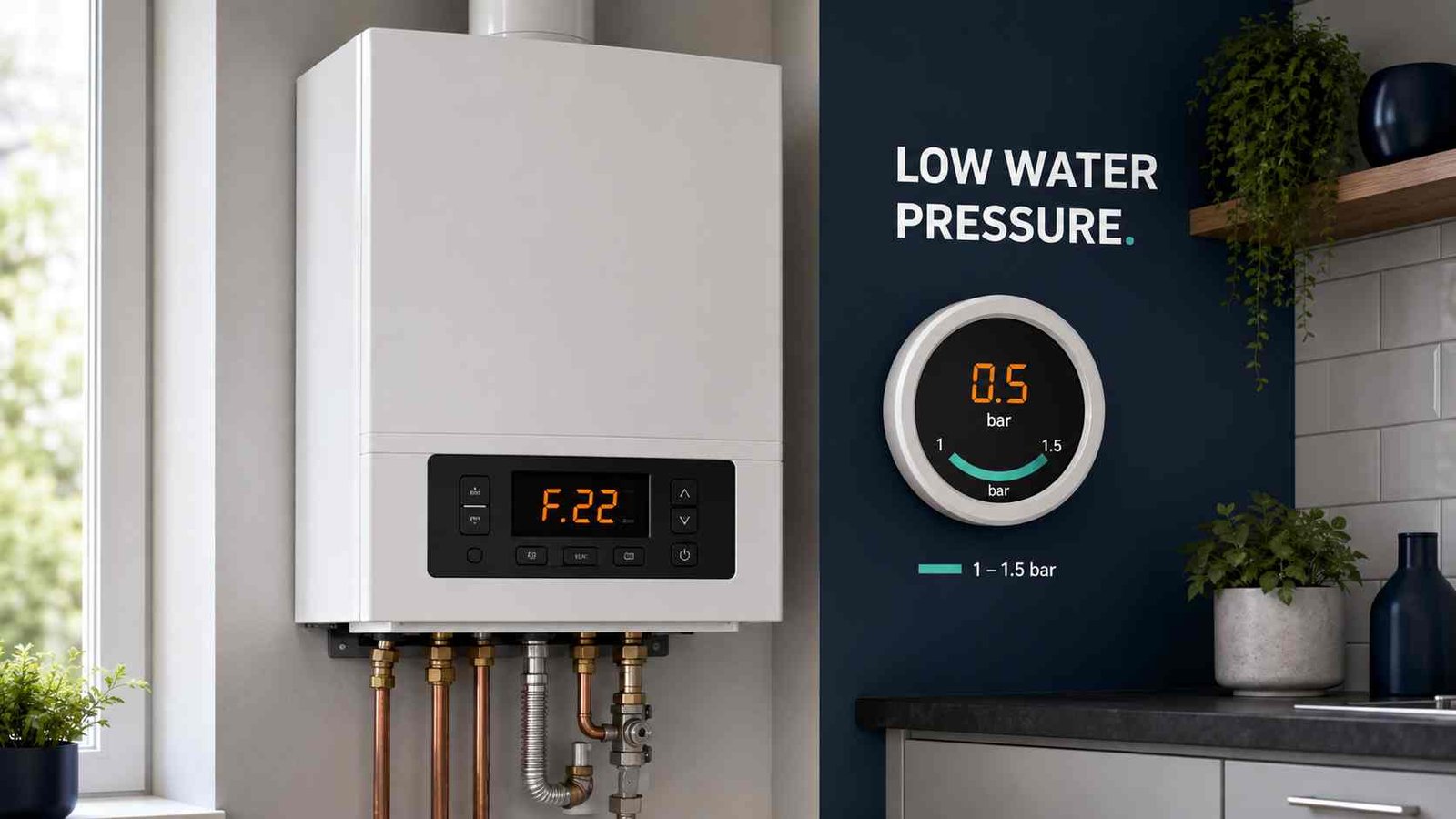
 The Vaillant boiler F22 fault code means the boiler has detected low water pressure in the heating system. On many models, the boiler shuts down to protect itself, leaving you without central heating and possibly without hot water.
Your first safe check is the pressure reading on the boiler’s display or pressure gauge. Vaillant commonly recommends about 1 to 1.5 bar when the system is cold, although the exact acceptable range varies by model. If the pressure is below 1 bar and you know how to use the boiler’s filling device, you may be able to repressurise it safely.
Do not remove the boiler casing. If the pressure is already normal, water is leaking, or F22 returns after topping up, the boiler needs professional diagnosis.
Vaillant F22 quick answer
| Item | Explanation |
|---|---|
| Fault code | F.22 or F22 |
| Meaning | Low water pressure in the heating system |
| Appliance | Vaillant gas boiler |
| Usual symptom | Boiler shuts down, with no heating and possibly no hot water |
| Safe first check | Read the pressure while the heating system is cold |
| Typical cold target | Around 1 to 1.5 bar, subject to the model manual |
| Possible homeowner action | Repressurise through the approved filling device |
| Professional help needed | If pressure is normal, falls again, or an internal fault is suspected |
| Can the boiler be used? | It will normally remain shut down until safe pressure is restored |
Vaillant lists low system pressure as the main meaning of F22. Selected ecoTEC and ecoFIT manuals show that some boilers switch off once pressure falls below approximately 0.5 bar.
What does F22 mean on a Vaillant boiler?
F22 is a protective low-water-pressure fault.
A sealed central-heating system needs enough water pressure to circulate water through the boiler, pipework and radiators. When the pressure falls below the boiler’s operating limit, the controls stop the appliance rather than allowing it to continue under unsuitable conditions.
The display may alternate between F.22 and the current pressure reading. The boiler may show these symptoms:
- Radiators remain cold.
- Hot water is unavailable on a combi boiler.
- The boiler does not fire.
- The pressure gauge reads below its normal area.
- A pressure figure such as 0.5 bar or lower appears on the display.
Official ecoTEC pro and ecoFIT sustain instructions state that the boiler switches off below approximately 0.5 bar and displays F22 alongside the pressure reading.
What pressure should a Vaillant boiler have?
For many household Vaillant systems, aim for approximately 1 to 1.5 bar while the boiler and radiators are cold. Vaillant uses this range in its general homeowner guidance.
Some official model manuals describe a wider permitted cold range of 1 to 2 bar. Newer ecoTEC plus instructions recommend at least 1 bar and identify approximately 1.5 bar as a useful standard value for many installations. Taller properties may require a different setting determined by the installer.
Here’s what matters:
- Follow the pressure range shown in your own boiler manual.
- Check pressure when the system is cold.
- Do not keep adding water once the correct pressure has been reached.
- Never use another Vaillant model’s filling instructions without checking that the controls match yours.
Pressure readings at a glance
| Cold pressure reading | What it usually means | Recommended action |
|---|---|---|
| Below 0.5 bar | Boiler may shut down with F22 | Repressurise only if the manual allows and no leak is present |
| 0.5 to 0.8 bar | Pressure is still too low on many models | Top up before normal operation |
| Around 1 to 1.5 bar | Typical homeowner target | Normally suitable for many systems |
| 1 to 2 bar | Permitted cold range in selected manuals | Confirm against the model manual |
| Pressure already above 1 bar with F22 | The reading and fault do not agree | Contact an engineer rather than adding more water |
Vaillant specifically advises professional help when F22 appears but the system pressure is already above 1 bar, because the fault may involve a sensor, pump, wiring or expansion vessel rather than a simple shortage of water.
Common causes of the Vaillant F22 fault
1. Normal gradual pressure loss
A heating system can lose a small amount of pressure over time. If the pressure has dropped slowly and there are no signs of a leak, a one-time top-up may restore operation.
Frequent repressurising is not normal. A system that repeatedly loses pressure needs inspection.
2. Radiators were recently bled
Bleeding a radiator releases trapped air, but it can also release some water and lower the overall system pressure. F22 may appear if the pressure was not checked and restored afterward. Vaillant recommends checking for approximately 1 to 1.5 bar when the heating system is cold after bleeding radiators.
3. A leak in the heating system
Water may be escaping from:
- Radiator valves
- Pipe joints
- Towel rails
- Visible heating pipework
- Components underneath the boiler
- Hidden pipework beneath floors or inside walls
Look for drips, damp patches, rust marks, flaking paint or staining near radiators and pipe connections. Do not dismantle joints or remove the boiler casing to search for an internal leak.
4. Filling valve or filling loop problem
A filling device that was not closed correctly may cause pressure problems. A damaged filling loop can also leak or fail to add water properly.
The arrangement differs between installations. Some boilers use an external flexible loop, some have an integrated filling device, and some older systems use a filling key or another installer-provided arrangement.
5. Faulty water-pressure sensor
The pressure sensor may report an incorrect reading. This becomes more likely when the gauge shows a normal pressure but the boiler continues to display F22.
Sensor testing or replacement requires professional diagnosis.
6. Expansion vessel fault
The expansion vessel controls pressure changes as the heating water warms and cools. If it loses its air charge or develops an internal fault, pressure may rise excessively while heating and then fall too low when the system cools.
Expansion-vessel testing involves internal boiler work and is not a homeowner repair.
7. Pump, wiring or circulation fault
Vaillant also lists pump problems and loose, disconnected or faulty wiring among possible F22 causes. Pump-related F22 guidance may be particularly relevant to open-vented systems. These checks require a competent engineer.
Safe checks before repressurising the boiler
Complete these checks before opening any filling valve:
- Let the heating system cool.
Pressure rises as heating water becomes hot, so a cold reading gives a clearer starting point. - Read the current pressure.
Use the physical gauge or digital pressure display. Check the manual if you do not know how to display the pressure. - Look for visible water leaks.
Check around radiators, exposed pipe joints and underneath the boiler without removing any panels. - Confirm that F22 really matches low pressure.
If the gauge already reads above 1 bar, do not add water simply because F22 is showing. - Identify the correct filling device.
Never turn an unknown valve. Compare the controls with the diagrams in the exact operating instructions for your model. - Stop if anything is unclear.
Asking an installer to identify the filling controls is safer than guessing.
How to repressurise a Vaillant boiler safely
The following is general guidance. The number, position and operating direction of the filling valves vary, so your boiler manual takes priority.
Step 1: Switch the boiler off
Turn the appliance off using its normal control and allow the system to cool. Vaillant advises starting with the boiler turned off before repressurising.
Step 2: Find the filling device
Common arrangements include:
- An external silver braided filling loop
- An integrated filling connection beneath the boiler
- Two small filling valves
- A filling key on selected installations
- A separate filling point installed elsewhere on the system
Do not assume that every valve underneath the boiler belongs to the filling loop.
Step 3: Open the filling valve slowly
Operate the filling device exactly as described in the manual. Open it slowly so the pressure does not rise too quickly.
You will usually hear water entering the heating circuit.
Step 4: Watch the pressure continuously
Stop filling at the pressure recommended for your model. For many domestic installations, this will be approximately 1 to 1.5 bar while cold.
Avoid filling to the top of a wide permitted range unless your installer has specifically set a higher cold pressure.
Step 5: Close every filling valve completely
Close the filling controls in the order given in the manual. Confirm that water has stopped entering the system.
On removable filling-loop arrangements, follow the manufacturer’s instructions about whether the connection should be detached after filling.
Step 6: Check for leaks
Look around the filling connection, visible pipework and underneath the boiler. Stop using the filling device if water appears.
Step 7: Turn the boiler back on
Some Vaillant boilers remove the F22 message automatically after sufficient pressure has been restored. Selected manuals state that the fault display can disappear automatically after approximately 20 seconds.
If F22 remains, use the model-specific reset instructions.
How to reset a Vaillant boiler after F22
Do not reset the boiler before correcting the low pressure. A reset does not add water or repair a leak.
After restoring the correct pressure:
- Close the filling valves fully.
- Switch the boiler on.
- Wait briefly to see whether F22 clears automatically.
- If it remains, locate the reset or fault-clearance control described in the manual.
- Use the reset control only for the stated time.
- Check whether heating and hot-water operation return.
Vaillant’s general guidance describes holding the reset control for approximately three seconds, but it also warns that instructions can differ by model. Some operating manuals use different fault-clearance timings, so the exact manual should always take priority.
Repeated resetting is not a repair. If F22 returns, stop resetting and find the cause.
What if F22 appears when the pressure is normal?
If the gauge or digital display shows more than 1 bar but the boiler still reports F22, do not add more water.
Possible causes include:
- Incorrect pressure-sensor reading
- Faulty pressure sensor
- Loose or damaged sensor wiring
- Pump or circulation problem
- Expansion-vessel fault
- Internal blockage or hydraulic problem
Vaillant treats this as an engineer-level fault and warns homeowners not to open the boiler casing.
An engineer may compare the displayed reading with the actual system pressure, inspect electrical connections and evaluate the hydraulic components. These are not safe DIY checks.
What if the pressure falls again after topping up?
Monitor the cold pressure over the next few hours and days.
A small one-time adjustment may be harmless, particularly after radiator bleeding. Pressure that falls repeatedly indicates an unresolved problem.
Check for:
- Damp radiator valves
- Drips from exposed pipe joints
- Water underneath the boiler
- Discoloured walls, ceilings or skirting boards
- An outside discharge pipe that regularly releases water
- A large difference between cold and hot pressure
If the pressure drops immediately after the filling valve is closed, Vaillant advises against repeatedly repressurising. A significant leak or pressure-relief problem may be present.
Continually adding fresh water can also dilute corrosion inhibitor in the heating circuit. The long-term solution is to locate and repair the pressure loss.
Parts an engineer may inspect
The F22 code does not identify one guaranteed failed part. Depending on the pressure reading and system behaviour, an engineer may inspect:
| Component | Why it may be checked |
|---|---|
| Water-pressure sensor | May report low pressure incorrectly |
| Sensor wiring and connectors | Can interrupt or distort the pressure signal |
| Expansion vessel | May cause major pressure changes between hot and cold |
| Pressure-relief valve | May allow heating water to escape |
| Circulation pump | May contribute to selected F22 conditions |
| Filling valve or loop | May leak or fail to close correctly |
| Heating pipework and radiators | May contain visible or hidden leaks |
Do not purchase a part based on F22 alone. The underlying cause should be confirmed first.
Vaillant models that may show F22
Official Vaillant documentation uses F22 on several boiler families, including selected:
- ecoTEC pro boilers
- ecoTEC plus boilers
- ecoTEC exclusive boilers
- ecoFIT sustain boilers
For example, official ecoTEC pro 24 and 28 operating instructions describe F22 as low filling pressure, while ecoFIT sustain instructions also show an F22 shutdown below approximately 0.5 bar.
This is not a complete compatibility list. Older boilers, region-specific products and newer control platforms may use different displays or filling methods.
Find the identification label without removing the sealed boiler casing, then use the exact operating manual for that model.
When to call a heating engineer
Arrange professional help when:
- F22 remains with pressure above 1 bar.
- The pressure falls again after repressurising.
- Water is leaking from inside or underneath the boiler.
- You cannot identify the correct filling controls.
- The gauge does not move while filling.
- Pressure rises too quickly or becomes excessive.
- The boiler makes unusual mechanical noises.
- F22 repeatedly returns after a reset.
- A sensor, pump, expansion vessel or internal valve may be faulty.
- The boiler casing would need to be removed.
In the UK, work involving the gas appliance or its functional casing should be handled by a suitably qualified Gas Safe registered engineer. Gas Safe Register explains that consumers may perform tasks specifically intended for users in the manufacturer’s instructions, but they should not disturb gas components or remove an integral combustion casing.
Safety warning: Do not remove the boiler casing, test internal wiring, interfere with the gas supply, bypass safety controls or attempt internal pump, sensor or expansion-vessel repairs.
Frequently asked questions
Is Vaillant F22 always caused by low pressure?
F22 means the boiler has detected a low-pressure condition, but the actual cause may not be a simple shortage of water. If the displayed pressure is already normal, a pressure sensor, wiring connection, pump or expansion-vessel problem may be involved.
What pressure clears F22 on a Vaillant boiler?
Many household systems are normally filled to approximately 1 to 1.5 bar while cold. Selected manuals show that the F22 display clears after sufficient pressure is restored, with some models requiring at least about 1.1 bar before the low-pressure indication fully stops flashing. Always use the target in your own manual.
Can I use the boiler while F22 is showing?
The boiler will usually shut down and prevent normal heating operation. This is a protective response, so do not try to bypass it. Restore pressure correctly or arrange professional diagnosis.
Can I clear F22 by pressing reset?
A reset alone will not correct low water pressure. Restore the correct pressure first. The code may then clear automatically, or the boiler may require a model-specific reset.
Why does F22 return every few days?
Repeated F22 faults normally mean the system is continuing to lose pressure or the pressure is being measured incorrectly. Possible causes include radiator or pipe leaks, an internal leak, a pressure-relief issue, an expansion-vessel fault or a defective pressure sensor.
Can bleeding radiators cause F22?
Yes. Bleeding releases air and sometimes water from the heating system. If the system pressure is not checked afterward, it may fall far enough to trigger F22.
Why does the boiler show F22 even though it reads 1.5 bar?
The displayed pressure may be inaccurate, or the pressure sensor and its electrical connection may be faulty. Do not add more water. Vaillant recommends engineer attention when F22 is present above 1 bar.
How often should I need to repressurise my Vaillant boiler?
An occasional top-up may be needed after radiator bleeding or gradual pressure loss. Regular or frequent repressurising indicates a leak or component fault and should be investigated rather than managed through repeated filling.

Oliver Grant is a UK appliance diagnostics writer with 10 years of experience covering washing machines, boilers, dishwashers, and tumble dryers. He specializes in fault-code interpretation, model-specific checks, and clear guidance based on official technical documentation.
2 thoughts on “Vaillant Boiler F22 Fault Code: Low Water Pressure Explained”