
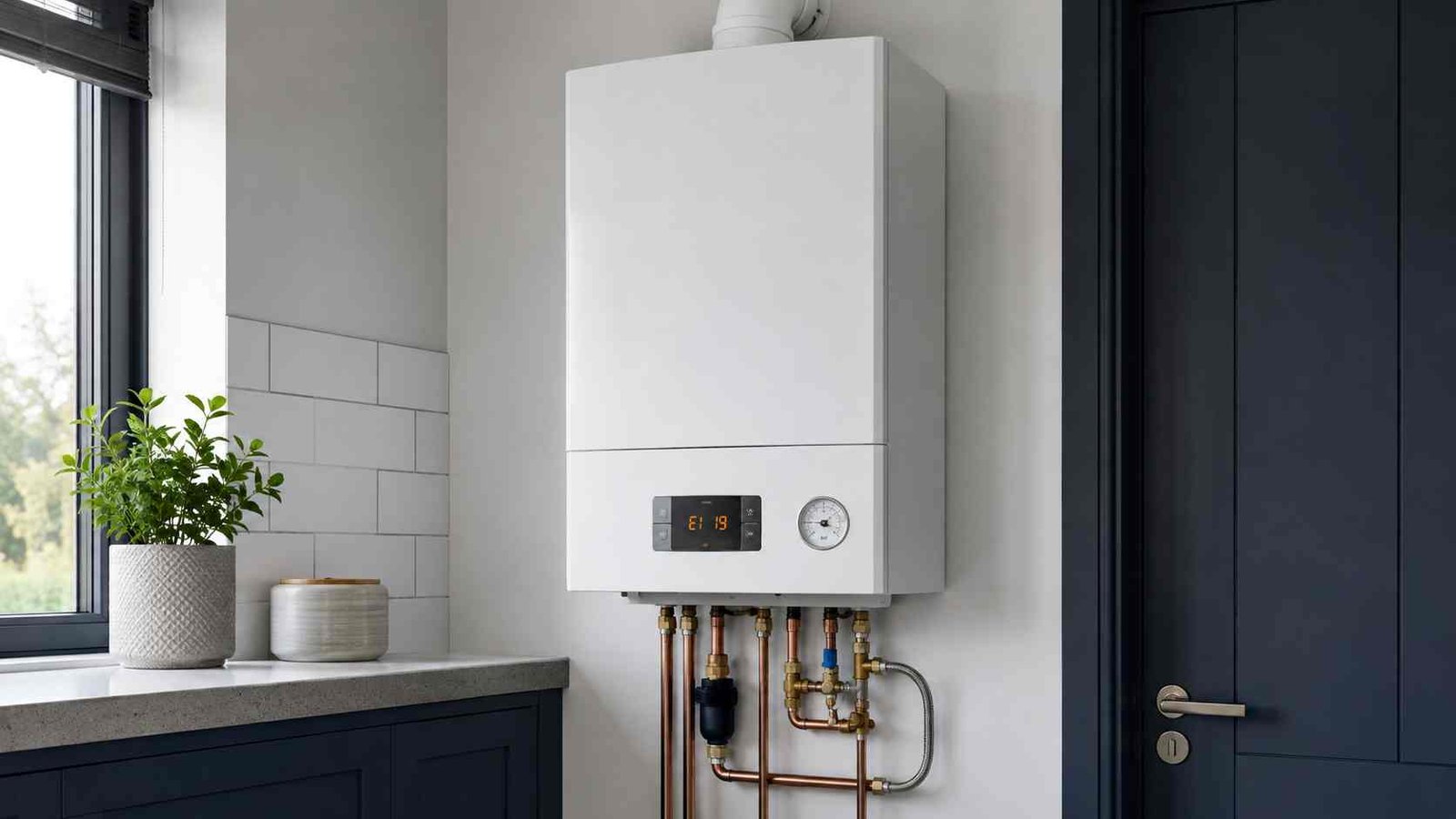
A Baxi Boiler E1 Error Code is often not a complete fault code. On boilers with limited displays, the screen may show E1 first and then two more digits. For example, alternating E1 and 33 means the full code is E133, while E1 followed by 18 forms E118.
This distinction matters because E118 indicates low water pressure on several Baxi ranges, while E133 is associated with a gas supply, ignition or flame-related fault. Before topping up the pressure or resetting the boiler, watch the display through several cycles and record every digit.
Do not remove the boiler casing or attempt work involving gas, combustion components, internal wiring or safety controls. Stop using the appliance and seek professional help if you smell gas, suspect carbon monoxide, see water leaking from the boiler or cannot identify the complete code.
Baxi E1 Error Code
| Item | Details |
|---|---|
| Brand | Baxi |
| Appliance | Gas boiler |
| Display | E1 followed by additional digits |
| Is E1 a complete code? | Usually not on displays that alternate code sections |
| Common complete codes | E110, E118, E125, E128 and E133 |
| Common low-pressure code | E118 on several established Baxi ranges |
| Safe first check | Record the full code and look at the pressure gauge |
| Normal pressure | Generally 1.0 to 2.0 bar |
| Can the boiler be used? | Not while it is locked out or repeatedly showing a safety fault |
| Homeowner difficulty | Easy for external checks; internal diagnosis requires an engineer |
| Professional help | Required for recurring pressure loss, ignition faults, leaks and internal component testing |
Baxi’s current fault-code information lists E118 as water pressure below 0.5 bar on several Platinum, Duo-tec, Megaflo, EcoBlue, Assure, 600 and 800 boiler ranges. However, other E1-series codes have completely different meanings.
What Does E1 Mean on a Baxi Boiler?
There is no single fault meaning that applies to every Baxi boiler displaying E1.
On some control panels, the display does not have enough space to show the entire three-digit fault continuously. It therefore alternates between two sections. Baxi confirms that an E133 fault may appear as E1 followed by 33.
Watch the screen for at least several seconds and write the sequence exactly as it appears.
Examples include:
| Display sequence | Complete code | Possible meaning |
|---|---|---|
| E1, then 10 | E110 | Maximum temperature or safety thermostat fault |
| E1, then 18 | E118 | Water pressure below 0.5 bar |
| E1, then 25 | E125 | Water-circulation fault |
| E1, then 28 | E128 | Repeated flame-loss safety fault |
| E1, then 33 | E133 | Gas supply, ignition or flame-related fault |
These meanings apply only to Baxi ranges covered by the corresponding official fault table. Always compare the code with the user guide for the exact boiler model.
Common Baxi Fault Codes Beginning With E1
E110: Maximum Temperature or Safety Thermostat Fault
Baxi describes E110 as either the boiler’s maximum temperature being exceeded too quickly or the safety thermostat operating. Possible underlying conditions include trapped air, restricted circulation or a pump problem.
Do not repeatedly reset an E110 fault. The boiler may have stopped to protect itself from overheating. A Gas Safe registered engineer may need to assess the pump, system circulation, sensors and other internal components.
E118: Low Water Pressure
E118 means the boiler has detected water pressure below 0.5 bar on the ranges covered by Baxi’s current table. This is the E1-series fault most likely to be resolved through a homeowner-level pressure check.
The gauge will usually be below 1 bar. Common reasons include:
- Air released from radiators
- A small leak in a radiator, valve or heating pipe
- Water discharged through the pressure-relief pipe
- An expansion-vessel problem
- A pressure sensor or gauge issue
You may repressurise the system when your model instructions allow it. However, pressure that drops repeatedly indicates an unresolved fault rather than a normal need for regular topping up.
E125: Water-Circulation Fault
E125 indicates a water-circulation problem. It does not simply mean that the system needs more water.
Possible causes may include trapped air, poor circulation, a restricted system or a pump-related issue. Internal testing and pump diagnosis should be left to a qualified engineer.
E128 or E129: Repeated Flame Loss
Baxi associates E128 with frequent flame loss. E129 is also a flame-loss safety fault occurring under more specific operating conditions.
These codes involve the boiler’s combustion and flame-monitoring system. Do not open the casing or attempt to clean, adjust or bypass ignition components. Arrange professional diagnosis.
E133: Gas Supply, Ignition or Flame Fault
E133 is commonly associated with a gas supply or ignition-related failure. Baxi’s reset guide also notes that E133 can involve the gas supply, ignition or flame, or a blocked condensate route.
In freezing weather, an external condensate pipe may freeze and cause the boiler to shut down. Baxi specifically states that the display can alternate between E1 and 33.
Do not assume E133 is a low-pressure fault. Adding water will not fix an ignition or condensate problem when the pressure is already normal.
Check These Things Before Resetting the Boiler
1. Record the Complete Fault Code
Watch the display until the sequence repeats.
Write down:
- Every letter and number
- Whether dots appear between numbers
- Any flame, pressure or warning symbol
- The exact boiler model
- The pressure shown on the gauge
A photo or short video of the display can help an engineer identify the code later.
2. Check the Boiler Pressure
Baxi states that normal operating pressure is generally between 1.0 and 2.0 bar. If it drops below 1.0 bar, the system may need repressurising. Pressure normally rises slightly while the heating is operating.
Use the boiler’s user guide when it gives a more specific cold-pressure target.
| Gauge reading | Recommended response |
|---|---|
| Below 0.5 bar | The boiler may lock out with a low-pressure code |
| Below 1.0 bar | Repressurising may be needed |
| 1.0 to 2.0 bar | Generally within Baxi’s stated operating range |
| Above the recommended range | Do not add more water |
| Pressure rises sharply when heating | Arrange an engineer inspection |
| Pressure drops again after topping up | Check for leaks and arrange diagnosis |
3. Look for Visible Water Leaks
Check accessible areas without removing any covers:
- Radiator valves
- Heating pipes
- Joints beneath radiators
- The floor below the boiler
- Visible external discharge pipework
- Damp marks, corrosion or staining
Baxi identifies system leaks as a common reason for low pressure. Small leaks may evaporate on hot pipework before forming an obvious puddle.
Do not attempt to tighten internal boiler connections.
4. Consider a Frozen Condensate Pipe
This is mainly relevant during freezing weather, especially when the full code is E133, E28 or E04.10 and the boiler is making gurgling noises.
The condensate pipe is usually a plastic pipe running from the boiler to a drain. An external section may freeze in cold conditions.
Baxi recommends warming the exposed frozen section with:
- A hot-water bottle
- A microwaveable heat pack
- Warm water poured gently from a suitable container
Do not use boiling water, a naked flame, a blowtorch or an electrical heat gun. Switch the boiler and its electrical supply off before following the manufacturer’s thawing guidance.
5. Stop if You Smell Gas
Do not reset the boiler, operate electrical switches or use a flame.
Baxi advises opening doors and windows, turning off the gas at the meter when safe to do so and calling the UK National Gas Emergency Service on 0800 111 999.
Carbon monoxide cannot be seen, smelled or tasted. Possible symptoms include headache, dizziness, nausea, breathlessness, collapse and loss of consciousness. Leave the property and seek urgent help if carbon monoxide is suspected.
How to Repressurise a Baxi Boiler With a Low-Pressure Code
Only repressurise the boiler when:
- The complete code or gauge confirms low pressure
- The user guide permits homeowner repressurising
- You can confidently identify the correct filling arrangement
- There is no significant visible leak
- The pressure is below the recommended range
Baxi boilers may have different filling arrangements, including an external braided filling loop, a built-in filling link or another model-specific control. Do not follow a generic valve sequence when your boiler looks different.
Safe Repressurising Process
- Find the model instructions.
Check the boiler user guide before touching the filling controls. - Read the current pressure.
Confirm that it is genuinely below the recommended range. - Identify the approved filling control.
Do not operate an unidentified valve. - Allow water into the system slowly.
Watch the gauge continuously. - Stop at the pressure stated in the manual.
Baxi’s general guidance places normal operating pressure between 1.0 and 2.0 bar. - Close the filling control completely.
Leaving it partly open can cause pressure to continue rising. - Check for leaks.
Inspect the accessible filling connection, pipes and radiator valves. - Reset the boiler only when appropriate.
Use the control-panel procedure for your exact model.
Contact a Gas Safe registered engineer or Baxi support when you cannot identify the filling arrangement or do not feel confident operating it. Baxi states that repressurising can normally be completed by a homeowner but recommends professional help when the user cannot manage it safely.
Warning: Do not add water when the gauge is already within or above the normal range. The E1 display may belong to a circulation, overheating, ignition or flame-related fault instead.
What if the Pressure Is Normal?
If the gauge is between approximately 1.0 and 2.0 bar, do not assume that adding more water will clear the fault.
Instead:
- Record the complete code.
- Check the exact model number.
- Compare the code with the model’s user guide.
- Check for a frozen external condensate pipe during severe cold.
- Perform one model-approved reset after external checks.
- Arrange professional diagnosis if the fault returns.
A normal analogue pressure reading does not rule out a faulty pressure sensor, circulation problem or other internal fault. These require instrument testing and should not be diagnosed by removing the casing.
Why the E1 Fault Returns After Repressurising
A boiler should not require frequent topping up. If pressure falls again, possible causes include the following.
Leak in the Heating System
Inspect accessible radiators, valves and pipes for staining, corrosion or dampness. A concealed leak may require professional investigation.
Air Released From the System
Bleeding radiators lowers system pressure because air leaves the circuit. The system may need topping up afterwards. Repeated air buildup can point to another system issue.
Expansion-Vessel Problem
The expansion vessel controls pressure changes as heating water warms and cools. Baxi states that recharging or replacing it is a job for a qualified Gas Safe registered engineer.
Pressure-Relief Valve Leak
The pressure-relief valve may discharge water if system pressure becomes excessive. Debris or damage can then prevent it from sealing correctly. Baxi advises professional cleaning or replacement when this valve is leaking.
Pressure Sensor Fault
The boiler may report low pressure even when the mechanical gauge appears normal. A qualified engineer can compare sensor readings and test the relevant circuit.
Filling Control Left Open
If the filling link has not been closed completely, pressure may rise rather than fall. Shut the approved filling control as instructed in the user guide and seek help if the pressure continues increasing.
How to Reset a Baxi Boiler
The reset method depends on the control panel.
Dedicated Reset Button
Press the reset button until the red lockout light goes out. If lockout occurs repeatedly, Baxi advises contacting an installer or service engineer.
Boiler Thermostat Control Knob
On compatible models, turn the temperature control knob fully anticlockwise and hold it until the red lockout light goes out. Return the control to the required setting afterwards.
ON/OFF/Selector Switch
Turn the selector to the R, or reset, position. Hold it for at least five seconds and release it. The display should return to the current boiler temperature if the reset is successful.
Do not guess the procedure when your controls differ. Check the model guide.
A reset clears a lockout command. It does not repair a leak, failed pump, gas-supply problem, sensor fault or blocked internal component. Frequent resetting may hide a developing problem and delay proper diagnosis.
Newer Baxi Boilers May Use Different Code Formats
Recent Baxi Combi 2 and System 2 ranges can use longer codes rather than older three-digit E-codes.
Examples from Baxi’s current table include:
| Newer code | Baxi description |
|---|---|
| A.02.06 | Low system pressure in the heating circuit |
| H.02.07 | Permanent low pressure in the heating circuit |
| E.01.17 | Permanent no-water-circulation condition |
| H.01.18 | Temporary no-water-circulation condition |
| E.04.10 | Burner failed to ignite after four attempts |
| E.01.04 | Flame loss detected five times within 24 hours |
These codes are listed for Baxi 200, 400, 600 and 800 Combi 2 models and selected System 2 and Assure 500 ranges. The dots and final digits are important. An E.01 code does not automatically mean the same thing as an older display flashing E1.
Possible Parts an Engineer May Test
The complete code determines which components require testing.
| Full code or symptom | Components an engineer may assess |
|---|---|
| E110 overheating | Pump, circulation, temperature sensors, safety thermostat |
| E118 low pressure | System leaks, pressure sensor, expansion vessel, relief valve |
| E125 circulation fault | Pump, system restriction, sensors, trapped air |
| E128 or E129 | Ignition and flame-monitoring system |
| E133 | Gas supply, ignition electrodes, flame sensing, condensate route |
| E160 | Fan and related electrical controls |
| Pressure normal but low-pressure fault remains | Pressure sensor, wiring and control electronics |
This table does not confirm that any listed part is faulty. Proper diagnosis requires model-specific testing by an appropriately qualified engineer.
When to Call a Gas Safe Registered Engineer
Stop homeowner troubleshooting and arrange professional help when:
- The complete code is not a straightforward low-pressure warning
- Pressure is already normal
- Pressure falls repeatedly after topping up
- Water is leaking from the boiler
- Pressure rises sharply when heating starts
- The boiler makes unusual banging, boiling or grinding noises
- E110, E125, E128, E129, E133 or E160 remains after safe checks
- A condensate pipe is clear but the boiler still will not ignite
- The boiler casing would need to be removed
- You cannot identify the filling or reset controls
- The fault returns after an appropriate reset
- Gas or carbon monoxide is suspected
In the UK, gas, combustion and sealed-casing boiler work must be handled by an appropriately qualified Gas Safe registered engineer.
Can You Continue Using a Baxi Boiler Showing E1?
A boiler that has locked out has stopped because its controls detected an unsafe or abnormal condition. Do not bypass the lockout or repeatedly reset it.
A confirmed low-pressure condition may be corrected by repressurising when the manual permits it. Other E1-series faults may involve overheating, circulation, ignition, gas supply or flame monitoring and require professional investigation.
Switch the boiler off and obtain urgent advice when there is a gas smell, carbon monoxide alarm, visible boiler leak, burning smell, electrical damage or unusual combustion-related noise.
Frequently Asked Questions
Does E1 always mean low pressure on a Baxi boiler?
No. E1 may be only the first part of a three-digit code. E118 is a low-pressure code on several Baxi ranges, but E110, E125 and E133 have different meanings. Record the complete sequence before taking action.
Why does my Baxi boiler flash E1 and then 33?
The complete code is E133. Baxi associates E133 with a gas supply, ignition or flame-related fault. In freezing conditions, a blocked condensate pipe may also be involved.
What pressure should a Baxi boiler show?
Baxi states that normal operating pressure is generally between 1.0 and 2.0 bar. The pressure may rise slightly while the boiler is heating. Check the exact user guide for the model-specific target.
Why is the E1 fault still showing after I topped up the pressure?
The full code may not be a low-pressure fault, the reset may still be required, or there may be a pressure-sensor, leak or circulation problem. Do not continue adding water when the gauge is already normal.
Why does my boiler pressure keep dropping?
Possible causes include air leaving the system, a pipe or radiator leak, an expansion-vessel problem or a leaking pressure-relief valve. Baxi advises an engineer inspection when pressure falls frequently.
Can I reset the boiler several times?
Repeated lockout indicates an unresolved fault. Baxi advises contacting an installer or service engineer when lockout occurs frequently.
Can I thaw a frozen condensate pipe myself?
An accessible external pipe may be warmed using a hot-water bottle, heat pack or warm water after switching off the boiler and electrical supply. Do not use boiling water or an open flame. Seek professional help when the pipe is inaccessible or the boiler does not restart.
Is an E1 fault dangerous?
The letters E1 alone do not identify the level of risk. Some complete codes indicate low pressure, while others involve overheating, ignition, flame loss or gas supply. Treat a recurring lockout seriously and stop immediately if gas or carbon monoxide is suspected.

Oliver Grant is a UK appliance diagnostics writer with 10 years of experience covering washing machines, boilers, dishwashers, and tumble dryers. He specializes in fault-code interpretation, model-specific checks, and clear guidance based on official technical documentation.