
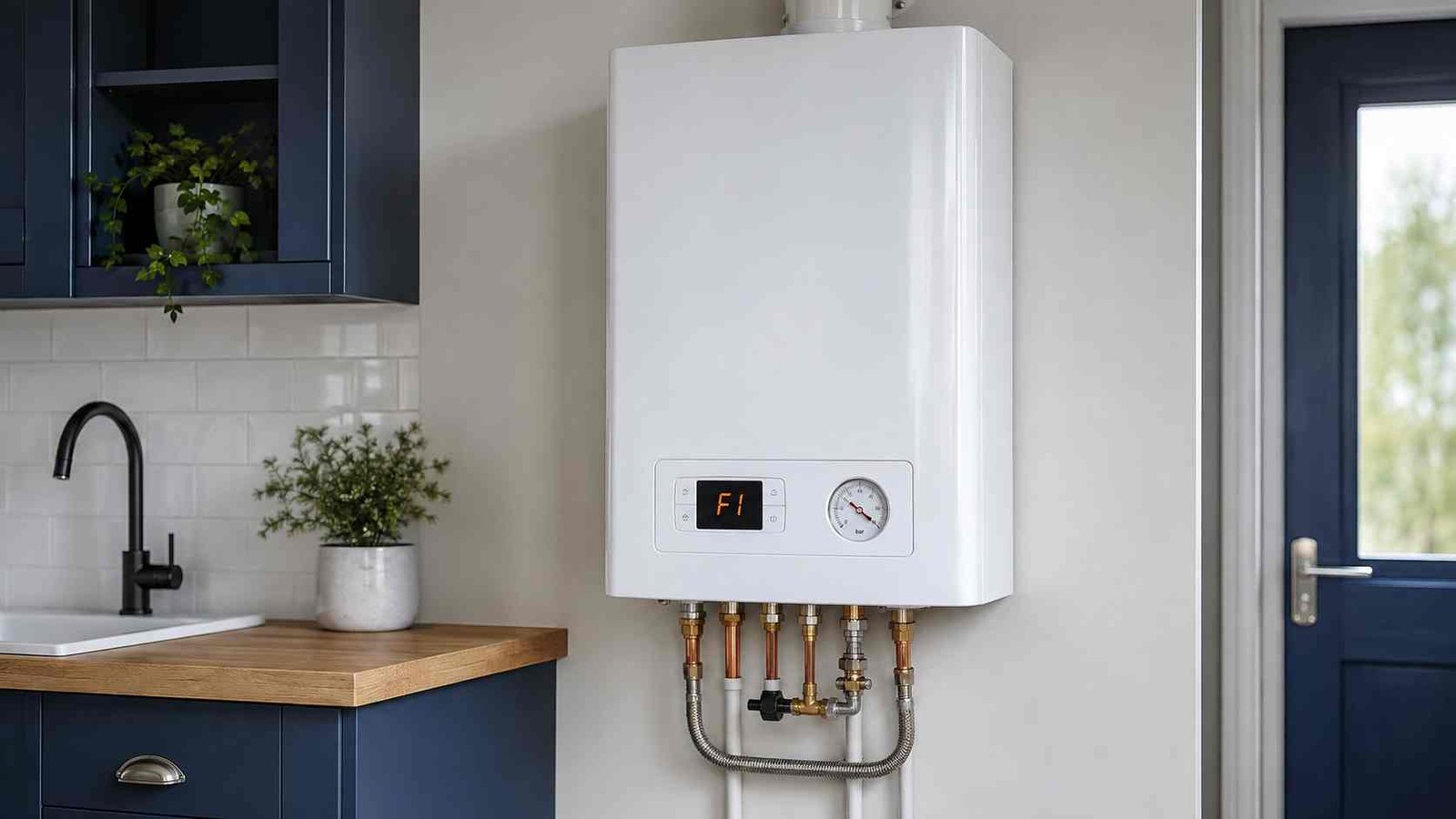
 The Ideal boiler F1 fault code usually means the central-heating system has low water pressure. On supported Ideal Logic boilers, the first safe check is the pressure gauge. Ideal generally advises checking whether the pressure is between 1 and 1.5 bar, although the exact refill instruction can vary by model.
If the pressure is low, you may be able to repressurise the system using the filling loop described in your boiler’s user manual. Keep the boiler off and allow the system to cool before filling. Do not open unidentified valves or remove the boiler casing.
Call a qualified heating engineer if the pressure keeps falling, F1 remains after the correct pressure is restored, water is leaking, or you cannot identify the filling controls safely.
Ideal Boiler F1 Fault Code:
| Item | Details |
|---|---|
| Fault code | F1, or F01 on selected displays |
| Meaning | Low central-heating system water pressure |
| Brand | Ideal Heating |
| Commonly affected range | Ideal Logic and related boiler families |
| Normal first check | Read the boiler pressure gauge |
| Typical cold filling target | Usually 1 to 1.5 bar; check the exact model manual |
| Safe first action | Repressurise only when the filling controls are clearly identified |
| Reset required? | On some models; follow the display or user manual |
| Can the boiler operate? | It may stop operating when pressure falls below its minimum threshold |
| Professional help needed? | Yes, if pressure loss returns, the gauge is normal but F1 remains, or an internal check is required |
Ideal’s Logic Combi guidance identifies F1 as low water pressure and tells the user to check for 1 to 1.5 bar. A Logic System2 manual uses the longer F01 format for the same fault.
What Does F1 Mean on an Ideal Boiler?
F1 indicates that the boiler has detected insufficient water pressure in the sealed central-heating circuit.
The boiler needs adequate system pressure to circulate heated water through the radiators and associated pipework. When the pressure becomes too low, supported models may stop operating instead of continuing under unsuitable conditions.
Ideal’s official Logic Combi troubleshooting page describes F1 as low water pressure. It recommends checking whether the gauge is between 1 and 1.5 bar and repressurising according to the user manual when necessary.
Why the boiler may stop
The exact shutdown point is model-dependent.
For example:
- The Logic MAX Combi2 manual states that the boiler will not operate if pressure falls below 0.3 bar.
- The Logic System2 manual also gives a 0.3-bar minimum under this condition.
- The Vogue MAX Combi Ireland manual gives a 0.5-bar minimum.
This is why one pressure threshold should not be presented as universal across every Ideal boiler. Follow the manual belonging to the exact model installed in your property.
F1, F01 and Low Water Pressure Displays
Ideal has used different control panels across its boiler ranges.
| Display | Likely meaning on supported models | What to do |
|---|---|---|
| F1 | Low water pressure | Check the pressure gauge |
| F01 | Low water pressure | Check for approximately 1 to 1.5 bar |
| Low Water Pressure | Written version of the same condition | Follow the instructions shown on the display |
| Pressure normal but fault remains | The basic low-pressure correction has not cleared the fault | Contact Ideal or a qualified engineer |
Older Logic displays may alternate between the letter F and the number 1, while some later controls show F01 or a written “Low Water Pressure” message. The correct response must be based on the model manual rather than the display style alone.
Which Ideal Boilers Use the F1 Code?
Official Ideal material confirms low-pressure fault guidance across several Logic boiler families, including:
- Ideal Logic Combi 24, 30 and 35
- Ideal Logic System models
- Ideal Logic MAX and Logic MAX Combi models
- Selected Logic Plus and Logic Code products
- Later models using F01 or written fault descriptions
Not every Ideal boiler uses the exact two-character F1 display. Check the model name on the boiler or its documentation before following a reset or filling sequence.
Check the Boiler Pressure Gauge First
Locate the pressure gauge without removing the sealed boiler casing. Depending on the model, it may be visible on the front panel, behind a user-accessible drop-down flap or on the control display.
Check the reading while the heating system is cool.
Gauge below 1 bar
A reading below 1 bar suggests the system may need repressurising. Ideal commonly specifies a filling range of 1 to 1.5 bar, though selected System boiler instructions say to restore the pressure to 1 bar before restarting.
Gauge between 1 and 1.5 bar
The pressure is within the range quoted in several Ideal guides. Do not add more water merely because F1 is visible.
When the pressure is already correct but the fault remains:
- Confirm that you are reading the correct gauge.
- Make sure any filling valves you previously opened are fully closed.
- Follow the model’s restart instruction once, if directed.
- Contact Ideal or a qualified heating engineer if the code returns.
The official user guidance directs owners to professional support when correct repressurising does not restore operation.
Gauge above the recommended range
Do not continue adding water. Close the filling valves immediately.
Pressure normally rises somewhat as the system heats, so the filling target should be checked with the boiler off and the system cool. If you have significantly overfilled the system and do not know how to correct it safely, contact an engineer rather than opening random valves or releasing water from the boiler.
How to Clear an Ideal Boiler F1 Fault Safely
The following is a general process. It does not replace the instructions for your exact model.
1. Turn the boiler off and let it cool
Ideal’s newer low-pressure messages instruct users to fill the system with the boiler off and the system cold. This gives a more reliable pressure reading and reduces the risk of contact with hot pipework.
2. Find the correct user manual
Identify the full boiler model before touching the filling controls. Filling arrangements vary and may include:
- A removable flexible filling loop
- An integrated filling link
- One or two operating handles
- Model-specific valve positions
Do not rely only on valve colour. Ideal manuals show different colours and layouts between product families.
3. Confirm that the filling loop is secure
Where the manual uses a removable filling loop, make sure it is attached exactly as illustrated before opening the controls.
Stop if:
- The hose or connection is damaged
- You see an active leak
- The layout does not match the manual
- You cannot identify which controls operate the filling loop
4. Add water slowly
Open the filling controls gradually while watching the pressure gauge continuously. You may hear water entering the system.
Stop when the gauge reaches the pressure stated in the model manual. For many Ideal boilers, this is between 1 and 1.5 bar when cold. The Logic MAX Combi2 manual specifically instructs the user to fill gradually and stop within that range.
5. Close every filling control
Return all operated valves or handles to the fully closed position.
Leaving a filling valve partly open can allow pressure to continue rising. On models with a removable filling loop, disconnect and refit the cap or plug only when the user manual specifically instructs you to do so.
6. Restart only as directed
Some Ideal controls require the user to press Restart after repressurising. Others provide instructions on the screen.
The Logic System2 manual tells the user to repressurise to 1 bar, close the filling-loop tap and press Restart. The Logic MAX Combi2 guide says to press Restart when directed by the listed fault message.
Do not repeatedly press the reset button. If the fault returns, further diagnosis is needed.
7. Check the result
Confirm that:
- The fault message has cleared
- The boiler responds to a heating demand
- Hot water is available where applicable
- The pressure stays stable
- No water is leaking from accessible pipework or radiators
Recheck the gauge later after the system has cooled.
Why Did the Boiler Pressure Drop?
A small loss after bleeding radiators
After radiators have been bled, the system pressure may need checking and restoring. Ideal’s low-pressure fault guidance tells users to bleed the radiators and then refill the system to the stated pressure where required.
One correction after radiator bleeding may be normal. Regular pressure loss is not.
A leak in the heating system
Ideal states that pressure falling below the original installation pressure and continuing to fall may indicate a water leak.
Check only visible, accessible areas such as:
- Radiator valves
- Exposed pipe joints
- The area beneath the boiler
- Towel radiators
- Visible filling-loop connections
Do not remove the boiler casing to search for a leak.
Recent heating-system work
Pressure can be affected after a radiator, valve or other part of the heating circuit has been drained or changed. Ask the person who completed the work whether the system was refilled and checked afterward.
A fault that requires internal diagnosis
When the gauge is within the correct range but F1 or F01 remains, the user manuals do not provide an internal homeowner repair. Possible diagnosis may involve the boiler’s pressure-detection system, wiring or another internal component, but the exact cause cannot be confirmed from the display alone.
That work requires the sealed casing to remain closed and should be left to an appropriately qualified engineer.
What to Do When F1 Returns After Repressurising
An F1 code that returns soon after topping up should not be treated as a repeated reset problem.
| What happens | What it may indicate | Recommended action |
|---|---|---|
| Pressure falls below 1 bar again | Ongoing water loss | Check visible areas and call an engineer |
| F1 remains at normal pressure | Fault not resolved by filling | Contact Ideal or an engineer |
| Pressure continues climbing | Filling control may not be fully closed or system requires assessment | Close filling controls and get advice |
| Water appears beneath the boiler | Possible internal or external leak | Stop using the boiler and arrange inspection |
| You need to top up frequently | Recurring system problem | Do not rely on repeated refilling |
| F1 appeared after bleeding radiators | System may need one controlled refill | Restore pressure according to the manual |
Ideal specifically advises contacting a Gas Safe registered engineer, or an RGI in Ireland, when the system cannot be repressurised or pressure continues to fall after filling.
Possible Parts and Professional Checks
F1 does not identify one failed replacement part. It identifies a low-pressure condition detected by the boiler.
A heating engineer may need to determine:
- Whether the system is genuinely losing water
- Whether a radiator, valve or pipe joint is leaking
- Whether the filling arrangement closes correctly
- Whether the pressure reading is accurate
- Whether pressure-detection components are operating correctly
- Whether an internal boiler leak is present
Do not order a pressure-related part based only on the F1 code. The engineer will need the exact boiler model, serial information and test results before identifying the correct component.
When to Call a Heating Engineer
Arrange professional help when:
- The pressure falls again after filling
- You need to top up the boiler regularly
- F1 remains when the gauge is between 1 and 1.5 bar
- The pressure gauge does not move while filling
- The pressure rises too high
- Water is leaking from beneath the boiler
- You cannot identify the correct filling loop
- The boiler repeatedly shuts down
- The fault requires casing removal or internal testing
In Great Britain, gas-boiler servicing and repairs should be carried out by a suitably qualified Gas Safe registered engineer. In the Republic of Ireland, work on domestic gas installations must be handled by a Registered Gas Installer.
Safety warning: Do not remove the boiler casing, bypass a safety device, test live wiring, adjust internal gas components or operate valves you cannot identify. Ideal’s manuals state that the appliance must not be used without the casing correctly fitted and that sealed components must not be tampered with.
If you smell gas in Great Britain, avoid flames and electrical switches, leave the affected area and call the National Gas Emergency Service on 0800 111 999. In the Republic of Ireland, call Gas Networks Ireland on 1800 20 50 50.
Frequently Asked Questions
What does F1 mean on an Ideal boiler?
On supported Ideal Logic boilers, F1 means low central-heating system water pressure. Check the pressure gauge before trying a reset.
What pressure should my Ideal boiler show?
Several Ideal guides specify approximately 1 to 1.5 bar, particularly when the system is cold. Selected System boiler instructions tell the user to refill to 1 bar. The model manual takes priority.
How do I reset an Ideal boiler after an F1 fault?
Restore the correct pressure first. Close the filling controls, then press Restart only if the model manual or display instructs you to do so. Resetting before correcting low pressure is unlikely to clear the cause.
Why is F1 still showing when the pressure is normal?
The basic pressure correction has not resolved the fault, or the displayed pressure may not reflect what the boiler’s controls are detecting. Do not remove the casing. Contact Ideal if the boiler is covered or arrange professional diagnosis.
Why does the F1 code keep coming back?
Repeated F1 faults usually mean the pressure is falling again or the fault has not been properly resolved. Ideal advises professional help when pressure continues to drop after repressurising.
Can I use the boiler while F1 is displayed?
The boiler may stop operating when pressure is below its permitted minimum. Do not try to force operation through repeated resets. Correct the pressure safely or arrange an engineer.
Is it safe to repressurise an Ideal boiler myself?
It may be a permitted user task when the exact filling arrangement is clearly shown in the model’s user guide and you feel confident following it. Stop if the controls are unclear, damaged or leaking.
Does every Ideal boiler show F1 for low pressure?
No. Some displays use F01, while newer controls may show the words Low Water Pressure. Always verify the code in the manual for the exact boiler.

Oliver Grant is a UK appliance diagnostics writer with 10 years of experience covering washing machines, boilers, dishwashers, and tumble dryers. He specializes in fault-code interpretation, model-specific checks, and clear guidance based on official technical documentation.