
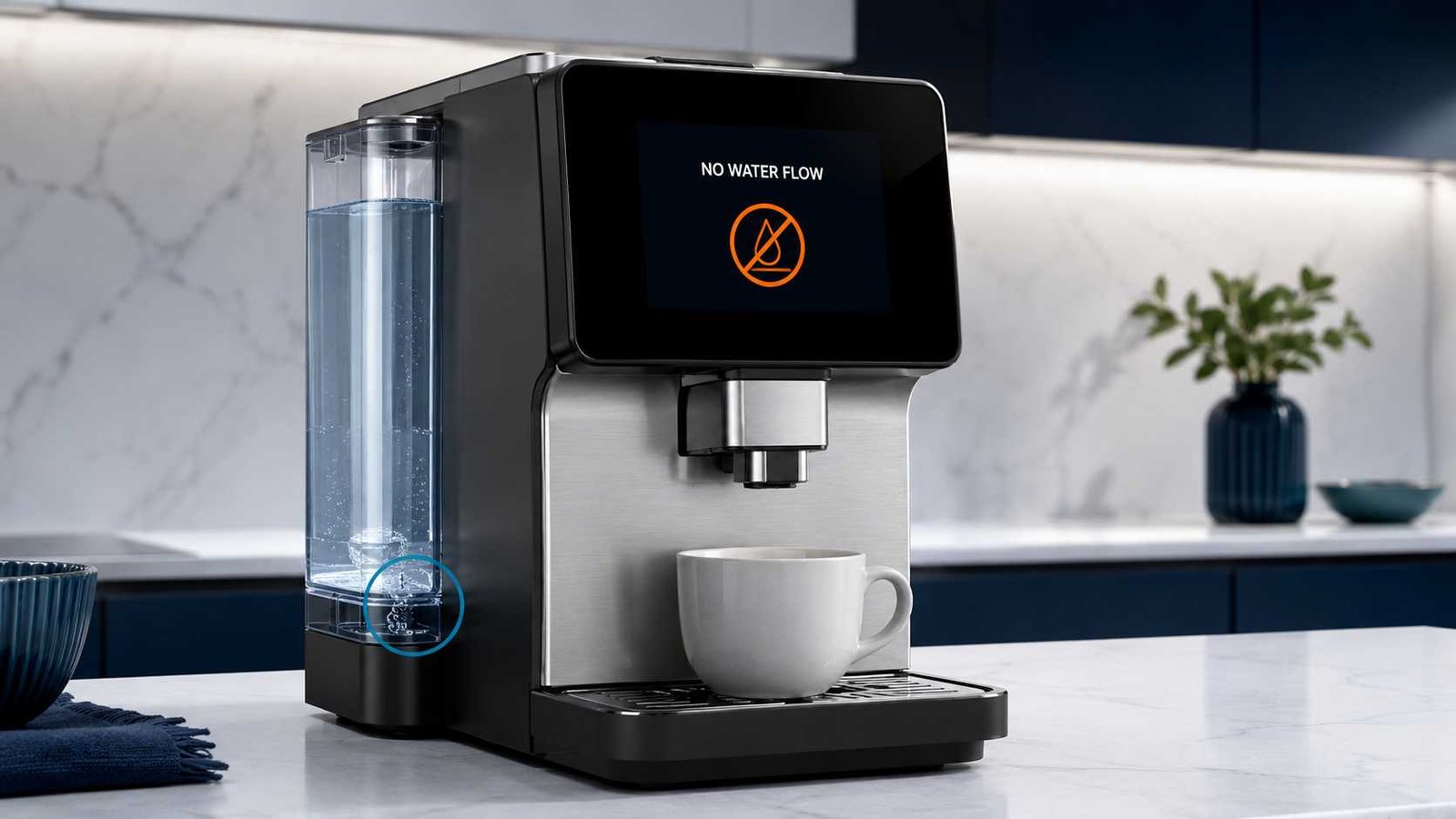
 A coffee machine that is not pumping water usually has an empty or incorrectly fitted reservoir, trapped air in the water circuit, a blocked water filter, limescale buildup, or an obstruction in the coffee outlet. A failed pump is possible, but it should not be the first conclusion.
Start by filling and firmly reseating the water tank. Remove the capsule or portafilter and test whether the machine can dispense plain hot water. This helps show whether the problem affects the whole water circuit or only the coffee-brewing path.
Stop using the machine if it leaks internally, smells burnt, becomes unusually hot, trips the electrical supply, or makes harsh electrical noises. Do not open the casing or test internal wiring, pumps, heaters, or valves yourself.
Coffee Machine Not Pumping Water
| Item | Details |
|---|---|
| Problem | Coffee machine powers on but does not move water normally |
| Appliances affected | Pump espresso, capsule, automatic bean-to-cup and built-in coffee machines |
| Most likely causes | Tank seating, trapped air, blocked filter, limescale or clogged outlet |
| First safe check | Fill and firmly refit the water reservoir |
| Useful test | Run plain water without coffee, a capsule or portafilter |
| Repair difficulty | Usually easy when caused by the tank, filter or airlock |
| Can it still be used? | Only if it operates normally and has no leaks, overheating or electrical symptoms |
| Professional help | Needed when safe cleaning, priming and approved descaling do not restore flow |
Philips identifies an incorrectly inserted water tank and trapped air as two common reasons an espresso machine cannot draw water. De’Longhi also links loud pump buzzing on selected machines to air in the hydraulic system.
Identify Where the Water Flow Stops
The location of the blockage is often more useful than the sound of the pump.
| Symptom | What it may indicate |
|---|---|
| No water from any outlet | Tank connection, filter, airlock, scale, pump or upstream restriction |
| Water from steam wand but not group head | Blocked brew path, group outlet, basket or brew valve |
| Water flows without portafilter | Fine coffee, excessive dose or blocked filter basket |
| Loud buzzing with no flow | Trapped air, dry water circuit or restricted inlet |
| Weak flow that became worse gradually | Limescale or a developing obstruction |
| No pump sound when brew starts | Control, sensor, switch, wiring or pump-power issue |
| Flow stopped after descaling | Airlock, incomplete rinse stage or loosened mineral deposits |
No Water Comes From Any Outlet
If nothing comes from the coffee outlet, hot-water spout or steam wand, begin at the water supply side.
Check that:
- The tank contains fresh water.
- The tank is pushed completely into position.
- Nothing is trapped beneath or behind the reservoir.
- The tank filter is fitted correctly.
- The machine has not recently run with an empty reservoir.
Philips notes that a front-mounted tank may need to be pushed fully backwards, while dirt, particles or coffee beans under a top-mounted tank can interfere with its connection.
Water Comes From the Steam Wand but Not the Group Head
This usually means the machine can draw and heat water, so a completely failed pump becomes less likely.
The problem may instead be in the brew path, including:
- A clogged filter basket
- A blocked portafilter outlet
- Coffee ground too finely
- Too much coffee in the basket
- A dirty group head
- A restricted brew valve
Remove the portafilter and briefly test the group head according to the user manual. Do not place your hands beneath the outlet because the water may be very hot.
Water Flows Without the Portafilter
When the group head produces a normal stream without the portafilter, the water circuit is probably functioning. The resistance is more likely being created by the coffee or removable brewing parts.
Philips lists a clogged filter basket, blocked portafilter spouts, an excessively fine grind and too much coffee as possible reasons a manual espresso machine produces little or no coffee.
Try:
- Cleaning the filter basket.
- Cleaning the portafilter outlet.
- Using a slightly coarser grind.
- Reducing the coffee dose.
- Avoiding excessive tamping pressure.
Change one setting at a time so you can identify what restores normal flow.
The Pump Buzzes Loudly but No Water Moves
A loud buzzing pump often means the pump is operating but cannot draw water.
This frequently happens when:
- The reservoir ran empty.
- The machine is new.
- It has not been used for a long period.
- A water filter was recently changed.
- Air entered the circuit during cleaning or descaling.
De’Longhi advises priming selected pump espresso machines through the steam or frothing outlet when air is trapped. The exact method varies, so follow the instructions for your model rather than using a universal button sequence.
The Machine Is Silent When Brewing Starts
Silence is different from a buzzing pump.
First confirm that:
- The machine has finished heating.
- The water tank and drip tray are correctly installed.
- The brew head or service door is closed.
- No empty-tank, descale or warning indicator is active.
- The appliance has not entered standby mode.
A simple power cycle may help if the controls are temporarily unresponsive. Turn the machine off normally, unplug it, wait about one minute, reconnect it and try again.
If the display responds but the pump remains silent, an internal control, sensor, pump or electrical problem may require professional diagnosis.
Common Causes of a Coffee Machine Not Pumping Water
1. The Water Tank Is Empty or Incorrectly Seated
A reservoir can appear to be installed while its outlet valve is not fully engaged.
Remove it, refill it with fresh water and reinstall it firmly. Do not exceed the marked maximum level. De’Longhi’s model-specific guidance also starts by confirming that the reservoir contains enough fresh water.
Inspect the tank area for:
- Coffee beans
- Loose grounds
- Packaging material
- Scale deposits
- A folded seal
- A misaligned tank lid
Do not force the tank into position. If it no longer fits correctly, check for a warped tank, damaged valve or displaced seal.
2. Air Is Trapped in the Water Circuit
An airlock prevents the pump from drawing a continuous column of water.
Philips recommends temporarily removing the water filter on affected automatic machines, refilling the reservoir and dispensing several cups through the hot-water function. Nespresso also states that air bubbles can develop after the tank runs empty or after a long period of non-use.
Typical signs include:
- Loud buzzing
- Water arriving in short bursts
- A few drops followed by nothing
- Flow returning briefly after the tank is moved
- The problem beginning after the tank ran dry
3. The Water Filter Is Blocking Flow
Reservoir filters must be prepared, installed and replaced according to the manufacturer’s instructions.
A dry filter can trap air. An old filter can also become restrictive.
For Philips AquaClean filters, the manufacturer advises shaking the filter, holding it upside down under water until air bubbles stop, and then reinstalling it. Philips also warns that a filter used beyond the recommended period may become clogged.
As a diagnostic test, remove the filter only when the manual allows it. If water flow returns without the filter, replace or correctly prepare the filter rather than continuing to use a restricted one.
4. Limescale Is Restricting the Water Path
Minerals left by hard water can collect in the inlet, internal tubing, thermoblock, boiler or outlet passages.
A gradual reduction in water flow is more suggestive of scale than a sudden complete stop. Bosch specifically identifies hard-water buildup as a likely reason some coffee machines stop pumping and recommends running the model’s descaling programme. Breville also advises descaling when water flow becomes weak or absent.
Use only:
- The descaler recommended by the manufacturer
- The quantity specified in the manual
- The correct descale mode for the model
- The full fresh-water rinse procedure afterwards
Do not assume vinegar is safe. Some manufacturers do not recommend it because concentration, odour, residue and compatibility can vary.
5. The Hot-Water or Steam Outlet Is Clogged
Scale or dried milk can block a removable frothing nozzle or hot-water outlet.
Allow the machine to cool before removing any user-serviceable outer nozzle. Clean only the parts the manual identifies as removable.
Philips advises checking selected classic frothing spouts for visible white scale deposits when hot water cannot pass.
Do not insert a sharp object into an internal pipe, valve or pressurised passage.
6. The Filter Basket or Portafilter Is Blocked
Coffee oils and fine grounds can close the small holes in a pressurised or non-pressurised basket.
Test with a second clean basket where available. If the replacement basket works, clean the original according to the manual.
A basket blockage is particularly likely when:
- Water flows from the group head without the portafilter.
- The pump becomes quieter or strained after locking in the portafilter.
- Coffee only drips from one side.
- The problem began after changing beans or grinder settings.
7. The Coffee Is Too Fine or the Basket Is Overfilled
Very fine grounds create strong resistance. Excess coffee can also press against the shower screen and prevent normal extraction.
De’Longhi and Philips both document fine coffee or excessive dosing as possible reasons water cannot pass through the coffee bed on selected espresso machines.
Use a coarser grind and a normal dose. Do not keep increasing pump time against a completely blocked coffee puck.
8. The Brew Group or Dispensing Spout Is Dirty
Automatic bean-to-cup machines may stop dispensing when the removable brew group or coffee outlet becomes clogged.
Philips recommends rinsing the removable brew group on applicable models and cleaning blocked dispensing spouts. The removal method is model-specific and should only be used when the user manual identifies the brew group as homeowner-removable.
Never remove a brew group while the machine is operating or completing an automatic cycle.
9. An Internal Part Has Failed
When all safe checks fail, possible technician-level causes include:
- A weak or seized pump
- A faulty tank inlet valve
- A blocked flowmeter
- A restricted solenoid or diverter valve
- A blocked thermoblock or boiler passage
- A loose or split internal hose
- A pump-control or sensor fault
- A control-board problem
These possibilities cannot be confirmed from the symptom alone. The machine normally requires model-specific testing and disassembly by a qualified repair provider.
How to Troubleshoot a Coffee Machine That Is Not Pumping Water
Step 1: Switch Off and Inspect the Machine
Turn the machine off, unplug it and allow hot parts to cool.
Stop immediately if you notice:
- Water beneath or inside the casing
- A burning smell
- Smoke
- Sparking
- Repeated breaker or fuse operation
- Unusual heat around the plug or cord
Step 2: Refill and Refit the Water Tank
Remove the reservoir and fill it with fresh water.
Check the tank valve and installation area for visible dirt or obstruction. Reinstall the tank evenly and press it into its normal operating position.
Do not press the tank valve manually unless the user manual instructs you to do so.
Step 3: Remove Coffee From the Test
Remove the capsule, pod or portafilter.
Place a sufficiently large container under the outlet and try to dispense plain water. This separates a machine water-flow problem from a coffee, capsule or basket restriction.
Step 4: Test the Available Outlets
Where the machine has more than one outlet, compare:
- Group head
- Hot-water spout
- Steam wand
- Coffee dispensing nozzle
If one outlet works, concentrate on the blocked path rather than assuming the pump has failed.
Step 5: Check the Water Filter
Remove the tank filter temporarily only when the manufacturer permits operation without it.
Refill the tank and test again. If flow returns, correctly prepare or replace the filter before normal use.
Step 6: Prime the Water Circuit
Priming methods differ by brand and model.
Philips and Saeco Automatic Machines
On affected Philips machines, the official procedure involves switching off the machine, removing the tank filter, refilling the reservoir, switching the machine on and dispensing two or three cups through the hot-water function.
De’Longhi Pump Espresso Machines
Selected De’Longhi pump machines can be primed by placing a cup under the traditional frother and opening the steam valve until water begins to flow. Do not apply this method to a model without the same controls.
Nespresso Original Machines
Nespresso advises ejecting the capsule and filling the reservoir. On Original machines with only a coffee outlet, repeated Lungo cycles may release the airlock. Models with both coffee and hot-water or steam outlets may require alternating between the two functions.
Nespresso Vertuo Machines
Vertuo operating and cleaning sequences vary by model. Use the machine-assistance page or model manual rather than applying an Original-line Lungo procedure to a Vertuo machine. Nespresso’s current support information directs owners to model-specific assistance for Vertuo troubleshooting.
Breville and Sage Machines
Breville recommends filling and correctly seating the reservoir, then dispensing hot water until a consistent stream is achieved when air is trapped in the circuit. Machines from the same product family may be sold as Sage in the UK and parts of Europe.
Step 7: Clean the User-Serviceable Brewing Parts
Clean the parts your manual identifies as removable:
- Filter basket
- Portafilter
- Coffee outlet
- Outer steam nozzle
- Capsule holder
- Removable brew group
- Drip tray and grounds container
Use the supplied cleaning tool where applicable. Do not enlarge holes with an oversized pin or drill bit.
Step 8: Descale the Machine
Run the official descaling programme when:
- Water flow weakened gradually.
- The descale indicator is active.
- Scale is visible around an outlet.
- The machine has been used with hard water.
- Priming and tank checks did not solve the problem.
If the machine cannot move any water at all, repeatedly starting descale cycles may not help because the solution cannot circulate. Stop and arrange service if the approved priming procedure cannot establish flow.
Step 9: Complete the Rinse Cycle
Do not stop after the descaling solution has passed through.
Refill the tank with fresh water and complete every rinse stage required by the manual. An incomplete programme may leave the machine waiting for more water or another rinse cycle.
Step 10: Try a Basic Power Cycle
A power cycle can clear a temporary electronic state, but it cannot remove scale or a physical blockage.
Turn the machine off normally, unplug it for about one minute and reconnect it. Avoid using undocumented factory-reset or diagnostic button combinations.
Coffee Machine Not Pumping Water After Descaling
A machine that loses flow during or immediately after descaling may have:
- Drawn air when the tank became empty
- Paused before completing the rinse stage
- A tank that was not fully reinstalled
- A water filter refitted incorrectly
- Loosened scale restricting a narrow passage
- An existing pump or valve problem that became more noticeable
Use this order:
- Remove the descaling mixture.
- Rinse and fill the tank with fresh water.
- Refit the reservoir firmly.
- Remove or prepare the tank filter as the manual directs.
- Run the approved priming or hot-water procedure.
- Resume the correct rinse stage if the display requests it.
Do not keep adding descaler. More chemical solution will not fix an airlock or failed pump.
Does the Coffee Machine Need a New Pump?
Not necessarily.
Pump noise does not prove that the pump is healthy, but it also does not prove that the pump has failed. A functioning pump can sound loud when it is drawing air or working against a blockage.
Professional pump diagnosis becomes more reasonable when:
- The tank and inlet are correctly fitted.
- The filter has been ruled out.
- Approved priming does not restore water.
- No outlet produces normal flow.
- Descaling cannot circulate.
- The pump sounds weak, irregular or mechanically harsh.
- The problem repeatedly returns.
- Water is leaking inside the casing.
The technician may need to test water delivery, pump output, valves, sensors and the internal hydraulic circuit.
What Not to Do
Safety warning: Coffee machines combine mains electricity, hot water, steam and pressurised components. Internal repairs can create shock, burn and leakage risks.
Do not:
- Open the casing.
- Test live electrical voltage.
- Bypass a tank, door, temperature or pressure sensor.
- Run the pump dry repeatedly.
- Force wire or tools into internal tubing.
- Remove hoses from a hot or pressurised machine.
- Use an unapproved chemical cleaner.
- Mix different descaling products.
- Perform an undocumented reset sequence.
- Continue operating a leaking or overheating machine.
When to Contact a Technician
Arrange professional service when:
- No water flows after the approved tank, filter and priming checks.
- The machine leaks internally.
- The pump remains silent despite normal controls and indicators.
- A burning smell, smoke or sparking appears.
- The machine repeatedly trips the electrical supply.
- Water reaches one circuit but not another after removable parts are cleaned.
- The problem returns immediately after descaling.
- An error message remains after the manual’s procedure.
- The machine is under warranty and opening it could affect coverage.
Bosch and Philips both direct users to customer support when manufacturer-approved troubleshooting does not resolve the water-flow problem.
How to Prevent Future Water-Flow Problems
Keep the reservoir above its minimum operating level and avoid allowing the machine to run dry.
Refit the tank carefully after every refill. Prepare replacement filters as instructed and replace them at the recommended interval.
Clean removable baskets, outlets and milk-system parts before residue hardens. Run the manufacturer’s descaling programme when the machine requests it or at the interval stated in the manual.
Using the correct grind and dose also reduces unnecessary pressure in manual espresso machines.
Frequently Asked Questions
Why is my coffee machine making noise but not pumping water?
A loud buzzing noise commonly occurs when air is trapped in the circuit or the pump cannot draw water from the tank. Refit the reservoir, check the filter and use the model’s approved priming procedure.
How do I remove an airlock from a coffee machine?
Fill and correctly install the tank, remove or prepare the water filter as instructed, and run the approved hot-water or priming function until a steady stream appears. The exact procedure varies among Philips, De’Longhi, Nespresso, Breville and other brands.
Will descaling fix a coffee machine that is not pumping?
It may help when mineral buildup is restricting the water path. Descaling will not correct an incorrectly seated tank, trapped air, clogged filter, failed pump or electrical fault. Bosch and Breville both identify scale as a possible cause of reduced or absent flow.
Why does water flow without the portafilter but not with it?
The basket may be blocked, the coffee may be ground too finely, or the basket may contain too much coffee. Clean the basket and try a coarser grind with a normal dose.
Can a water filter stop a coffee machine from pumping?
Yes. A dry, air-filled, incorrectly installed or clogged filter can restrict the tank supply. Prepare or replace it according to the manufacturer’s instructions.
Why did my coffee machine stop pumping after the tank ran empty?
The pump may have drawn air into the circuit. Refill and reseat the tank, then follow the model-specific priming procedure. Nespresso and Philips both identify an empty tank as a common trigger for trapped air.
Should I keep running the pump until water appears?
Use only the duration and method stated by the manufacturer. Do not run a dry, overheating or harsh-sounding pump continuously. Stop when the approved procedure fails and arrange service.
Is resetting the coffee machine likely to restore water flow?
A power cycle may clear a temporary control problem, but it will not remove limescale, release every airlock or clear a physical blockage. Avoid undocumented factory-reset combinations.

Emily Carter is an Australian home-appliance safety editor with 9 years of experience researching washers, air conditioners, refrigerators, and coffee machines. She checks troubleshooting steps for accuracy, regional model differences, and homeowner safety before publication.