
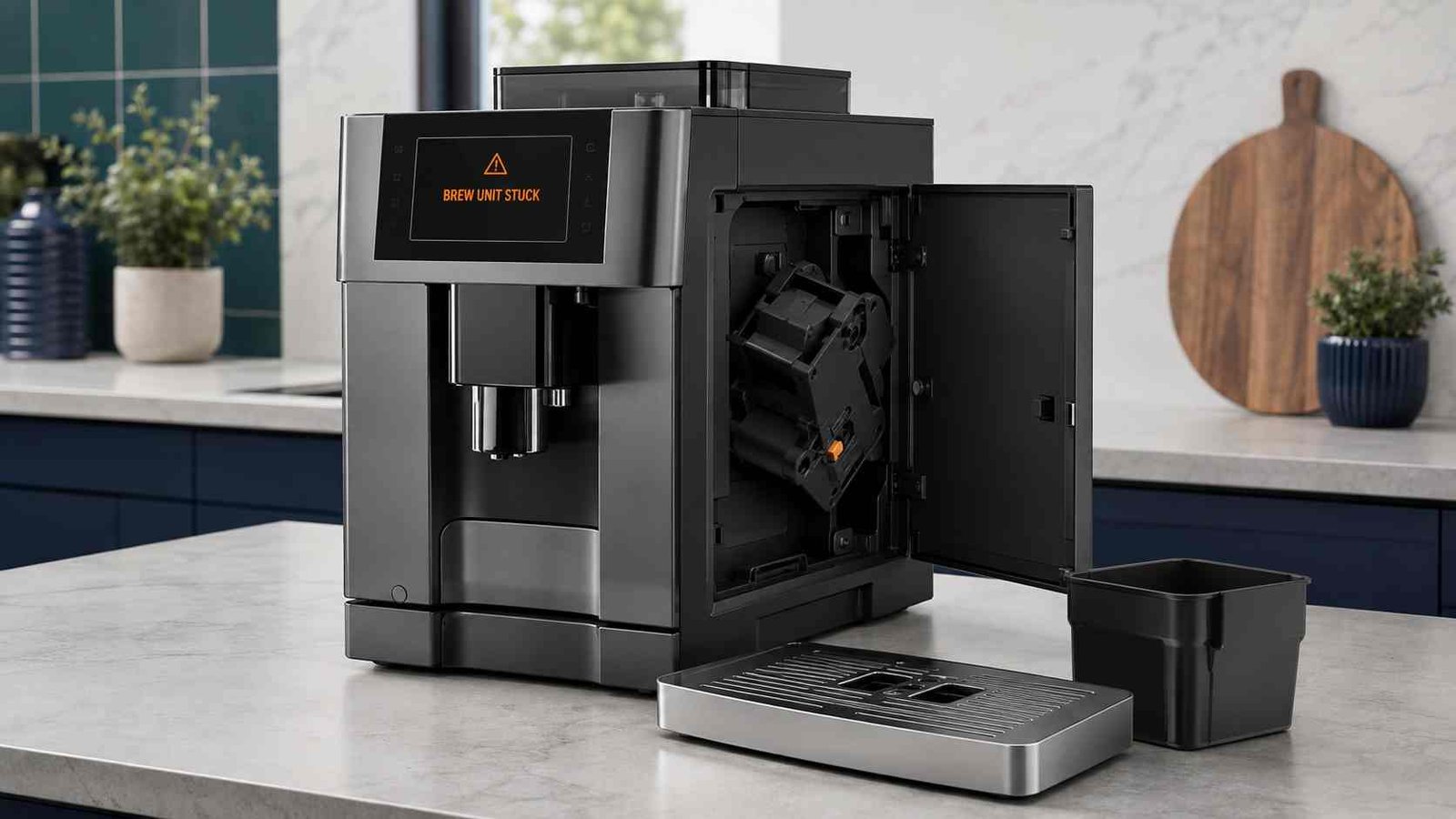
A coffee machine brew unit is usually stuck because the internal drive stopped outside its normal removal position. This can happen after opening the service door during operation, interrupting a cleaning cycle, disconnecting power too early, or removing the drip tray before the machine completed its shutdown sequence.
Start by putting the water tank, drip tray, and grounds container back into place. Close the service door, operate the machine with its normal power button, and let it complete a full startup and shutdown without interruption. Do not force the brew unit, locking handle, release tabs, or internal gears.
Stop using the machine if you hear grinding or repeated clicking, see broken plastic, notice a leak, or smell overheating.
| Item | Guidance |
|---|---|
| Appliance type | Fully automatic or bean-to-cup coffee machine |
| Main symptom | Brew unit will not come out, move, or go back in |
| Most likely cause | Internal drive is outside the removal position |
| Safe first check | Reassemble the machine and complete a normal startup and shutdown |
| Other possible causes | Active descaling cycle, coffee residue, stiffness, incorrect alignment, or damaged locking parts |
| Repair difficulty | Usually easy when caused by positioning; professional repair may be needed if the drive remains jammed |
| Can you keep using it? | Not recommended if the unit is misaligned, the tray will not fit, or the machine makes abnormal noises |
| Main warning | Never pull, twist, or lever the brew unit out with force |
What a Stuck Brew Unit Usually Means
The brew unit is the mechanism that receives ground coffee, compresses it, passes hot water through it, and moves the used coffee puck into the grounds container.
Manufacturers may call it a:
- Brew unit
- Brew group
- Brewing unit
- Infuser
When it becomes stuck, the unit itself is not necessarily broken. More often, the machine’s drive has stopped before returning the mechanism to its neutral or home position.
Philips identifies an incorrect neutral gear position as a main reason its brew group cannot be removed. De’Longhi similarly advises allowing the powered shutdown process to finish before trying to extract the infuser. Siemens and Miele documentation also connects removal problems with an incorrect drive position.
Common reasons the brew unit becomes stuck
| Possible cause | What you may notice | Safe response |
|---|---|---|
| Shutdown was interrupted | Unit stopped too high, low, or forward | Complete a normal power cycle |
| Service door opened during operation | Brew unit is visibly outside its usual position | Close the door and let the machine initialise |
| Descaling programme is active | Machine shows a descaling prompt | Finish the programme |
| Drip tray removed too early | Tray or grounds container will not slide back in | Reassemble without forcing and restart |
| Heavy coffee residue | Unit feels sticky or difficult to move | Clean it after normal removal becomes possible |
| Brew unit is dry or stiff | Movement is tight during normal handling | Use only the lubricant approved for that model |
| Mechanical fault | Grinding, repeated clicking, or no drive movement | Stop and arrange professional service |
Before Trying to Remove the Brew Unit
Let the machine finish what it is doing
Wait until brewing, rinsing, cleaning, or descaling has completely stopped. Do not open the service door while the internal mechanism is moving.
Philips states that its brew group cannot be removed while the machine is in descaling mode. The descaling programme must be completed first.
Use the normal power button
Do not start by pulling the plug from the wall. Many automatic machines reposition the brew unit during their powered shutdown sequence.
De’Longhi specifically advises switching the machine off with its power button, allowing the process to finish, and not forcing an infuser that still cannot be removed.
Keep your hands away from moving parts
Do not reach deeply into the machine while it is powered. After shutting it down, wait until all motor, rinsing, and mechanical sounds have stopped.
Never use tools to lever it out
Screwdrivers, pliers, knives, and other tools can crack the brew-unit housing, release mechanism, rails, or internal drive coupling. A unit that requires significant force is probably not in the correct removal position.
Safe First Reset for a Brew Unit That Will Not Come Out
The following sequence is suitable as a general first check, but your model manual takes priority.
- Stop pulling the brew unit.
Release any pressure on the handle, tabs, or locking lever. - Check for an active programme.
Finish descaling, rinsing, cleaning, or any process shown on the display. - Put the removable containers back.
Reinstall the water tank, drip tray, and coffee grounds container where the model requires them. - Close the service door completely.
The machine may not reposition the drive while the door is open. - Switch the machine on using its normal power control.
Allow it to initialise fully. Do not open the door or remove the tray during this process. - Switch it off using the same power control.
Wait until rinsing and mechanical sounds have completely stopped. - Open the access door and try the normal release procedure.
Press only the designated release button or move the approved locking handle.
Philips gives a similar sequence: reinstall the water tank, tray, and grounds container, close the door, switch the machine off, wait until it becomes quiet, restart it, and wait until it is ready before attempting removal again. (Philips USA)
Stop if the release still needs force. Repeating the correct reset once is reasonable. Repeatedly switching the machine on and off while it clicks, grinds, or stalls may make an existing mechanical problem worse.
Brand-Specific Checks
Philips and Saeco Brew Group Stuck
On supported Philips machines:
- Refit the water tank, drip tray, and grounds container.
- Close the service door.
- Switch the machine off with the ON/OFF button.
- Wait until all sounds stop, which Philips says can take approximately 15 to 20 seconds.
- Switch the machine back on.
- Wait until it is fully ready.
- Open the service door.
- Hold the marked PUSH release and pull the brew group toward you.
Do not open the service door or remove containers while the machine is initialising. Complete an active descaling cycle before trying to remove the group.
Philips brew group will not go back in
Leave the brew group outside the machine. Refit the other removable components, close the service door, and let the machine complete its positioning sequence. The exact insertion position of the brew group varies, so use the diagrams in the model manual before reinserting it.
De’Longhi Infuser Stuck
De’Longhi commonly calls the brew unit an infuser.
If it cannot be removed:
- Close the machine and reinstall anything removed.
- Switch the machine off with its front power button.
- Allow the complete shutdown and rinse process to finish.
- Wait until the machine becomes silent.
- Try the normal infuser removal procedure.
The location can differ by product family. It may be accessible from the front, side, or behind the water tank. De’Longhi warns against forcing the infuser when it remains stuck.
Do not confuse the main power button with a rear master switch where both are present. The machine normally needs to complete its electronic shutdown before the brew drive reaches the extraction position.
Siemens Brewing Unit Cannot Be Removed
Siemens instructions vary by product series.
For example, EQ.500 documentation says the brewing unit may be outside its removal position and advises switching the appliance back on. Siemens EQ.3/EQ300 support gives the same general cause.
Some Siemens displays may also report that the brewing unit is heavily soiled or cannot be removed. In that situation, do not attempt cleaning until the unit can be released normally.
Because EQ.3, EQ.500, EQ.6, EQ700, and EQ.9 machines do not all use an identical access or locking arrangement, follow the manual for the exact series.
Bosch Brewing Unit Stuck
Bosch removable brewing units may use a red locking lever. For supported models, Bosch instructs users to switch the appliance off, remove the tray and grounds container, move the red lever, and carefully remove the brewing unit by its handle.
When the lever or unit will not move normally:
- Reinstall the removable components
- Close the access door
- Run a normal startup and shutdown
- Try again only after the machine is quiet
Do not copy the red-lever procedure onto a Bosch model with a different brewing system.
Miele Brew Unit Cannot Be Removed
Miele documentation states that removal difficulty can mean the brew-unit drive is not in the correct position.
For applicable models, Miele advises returning the brew-unit handle to its starting position if necessary, closing the appliance door, switching the machine off, waiting approximately one minute, and switching it back on so the drive can initialise.
Miele also warns that changing the handle position after removing the brew unit may prevent reinsertion. The exact handle movements and removal direction vary between models.
JURA Machines Are Different
Do not try to apply removable-brew-group instructions to a JURA machine.
JURA describes its brewing units as maintenance-free units cleaned through integrated rinsing and cleaning programmes. Routine user removal is not part of the normal maintenance process.
If a JURA machine shows a brewing-system fault, follow the display and official service guidance rather than opening the casing.
Brew Unit Is Stuck During Descaling
An active descaling programme may intentionally prevent access to the brew unit.
Do not:
- Unplug the machine to interrupt descaling
- Force the service door
- Remove parts while pumps or valves are operating
- Try to bypass a container or door sensor
Finish the programme using the required water, descaler, and rinsing stages. If the cycle is frozen rather than merely unfinished, follow the model-specific recovery procedure or contact the manufacturer.
Philips directly confirms that brew-group removal is unavailable during descaling on supported models.
What to Do When the Brew Unit Will Not Go Back In
A brew unit that was removed successfully may not fit back if:
- Its handle or locking mechanism was moved while outside the machine
- The machine’s internal drive changed position
- The unit is not aligned with its guide rails
- The drip tray or grounds container is obstructing the compartment
- Coffee residue is packed around the rails or drive opening
Safe reinsertion process
- Do not push harder when resistance begins.
- Remove the unit and inspect it for obvious coffee buildup.
- Check that its handle, arrows, or reference marks match the manual.
- Make sure the machine’s internal compartment is clear.
- On models that support it, leave the brew unit out, reinstall the other components, close the door, and let the machine initialise.
- Switch the machine off normally.
- Reinsert the unit only when the manual’s alignment points match.
Philips provides an official drive-positioning sequence for a brew group that cannot be inserted. Miele also states that closing the door and allowing the drive to initialise may return it to its correct starting position.
Drip Tray or Grounds Container Will Not Fit
The tray may be blocked because the brew unit stopped too low or too far forward.
Do not push the tray against the brew mechanism. Instead:
- Remove the tray again.
- Clear loose, dry coffee grounds from accessible areas.
- Check that the brew unit is not leaning into the tray path.
- Follow the model’s power-reset sequence.
- Reinsert the tray only when it slides without unusual resistance.
A tray that remains blocked after the machine has attempted to initialise may indicate a drive-position problem requiring service.
Cleaning a Dirty or Stiff Brew Unit
Only clean the unit after it can be removed normally.
For many removable brew groups:
- Switch the machine off and let it become quiet.
- Remove the unit according to the manual.
- Rinse away loose coffee residue with lukewarm or warm water.
- Allow the unit to air-dry.
- Clean accessible dry grounds from the compartment with a soft brush or cloth.
- Reinstall the unit when its alignment marks are correct.
Bosch instructs users to rinse the brewing unit under warm running water and warns against dish detergent, acidic or vinegar-based cleaners, and dishwasher cleaning.
Miele similarly states that cleaning agents can damage the lubricated moving components and recommends hand-cleaning the brew unit with warm water.
Should you lubricate the brew unit?
Only lubricate it when the manufacturer calls for lubrication, and use the specified food-safe product.
Philips advises applying a thin layer of its approved grease to designated areas such as the piston, lower shaft, and side rails. These locations and products should not be assumed to apply to other brands.
Do not use:
- Cooking oil
- Petroleum jelly
- Automotive grease
- Spray lubricant
- General-purpose household oil
- An unidentified silicone product
What Not to Do
- Do not force the brew unit out.
- Do not pull it with pliers.
- Do not turn internal drive gears by hand.
- Do not bypass door, tray, or container switches.
- Do not operate the machine with fingers inside the service compartment.
- Do not remove exterior or service covers.
- Do not wash the unit in a dishwasher unless the exact manual permits it.
- Do not use vinegar or detergent on lubricated mechanisms unless instructed.
- Do not keep restarting a machine that makes loud grinding noises.
When the Basic Reset Does Not Work
Arrange manufacturer support or qualified repair when:
- The brew unit remains stuck after the correct positioning sequence
- The machine repeatedly stops outside its home position
- The motor clicks or grinds without moving the unit
- A locking handle, tab, or rail is cracked
- The tray cannot be reinstalled
- A positioning or brew-unit error returns after cleaning
- Water is leaking into the service compartment
- There is a burning smell or unusual heat
- The machine trips the electrical supply
- The brew unit is not designed for user removal
The official sources consistently connect this symptom with drive positioning. From that, a technician may need to inspect the drive mechanism, coupling, locking system, or position-detection components. The exact diagnosis and parts depend on the model and should not be guessed without testing.
Can You Continue Using the Coffee Machine?
Do not continue normal use when the brew unit:
- Cannot complete its movement
- Prevents the service door from closing
- Blocks the drip tray
- Makes grinding or repeated clicking sounds
- Causes a recurring warning
- Appears cracked or misaligned
A machine that still makes coffee may nevertheless be unable to park the brew unit correctly. Continuing to run it could increase residue buildup or place more strain on the drive. This is a precautionary recommendation rather than a universal manufacturer diagnosis.
Frequently Asked Questions
Why is my coffee machine brew unit stuck?
The most common reason is that the internal drive stopped outside its normal removal position. Interrupted shutdown, opening the door during operation, an active maintenance programme, heavy residue, or a mechanical fault may cause it.
Can I pull a stuck brew group out with force?
No. Forcing it can damage the release tabs, handle, rails, housing, or drive coupling. Reassemble the machine and let it complete its normal positioning sequence first.
Should the coffee machine be on or off when removing the brew unit?
For most removable systems, the machine should be switched off using its normal power control and allowed to complete shutdown before removal. Follow your model manual because the access sequence varies.
Why is the brew group stuck after a power cut?
A power interruption can stop the internal mechanism before it reaches its home position. Restore power, reinstall the required containers, close the door, and allow a full startup and shutdown.
Can I remove the brew unit during descaling?
Not on machines that lock the unit during descaling. Philips specifically states that the descaling process must be completed before the brew group can be removed.
Why will the brew unit not go back into the machine?
The unit or internal drive may be in the wrong position. The handle may also have moved while the unit was outside the machine. Do not force it. Reset the drive using the model-specific procedure and check the alignment marks.
Can I wash the brew unit with detergent?
Not unless the manual explicitly permits it. Bosch and Miele warn against detergent or cleaning agents on their removable brewing units because these products can affect the mechanism and its lubrication.
Does every automatic coffee machine have a removable brew unit?
No. JURA describes its brewing unit as a maintenance-free internal system cleaned through automatic programmes. It is not intended for routine user removal.

Emily Carter is an Australian home-appliance safety editor with 9 years of experience researching washers, air conditioners, refrigerators, and coffee machines. She checks troubleshooting steps for accuracy, regional model differences, and homeowner safety before publication.