
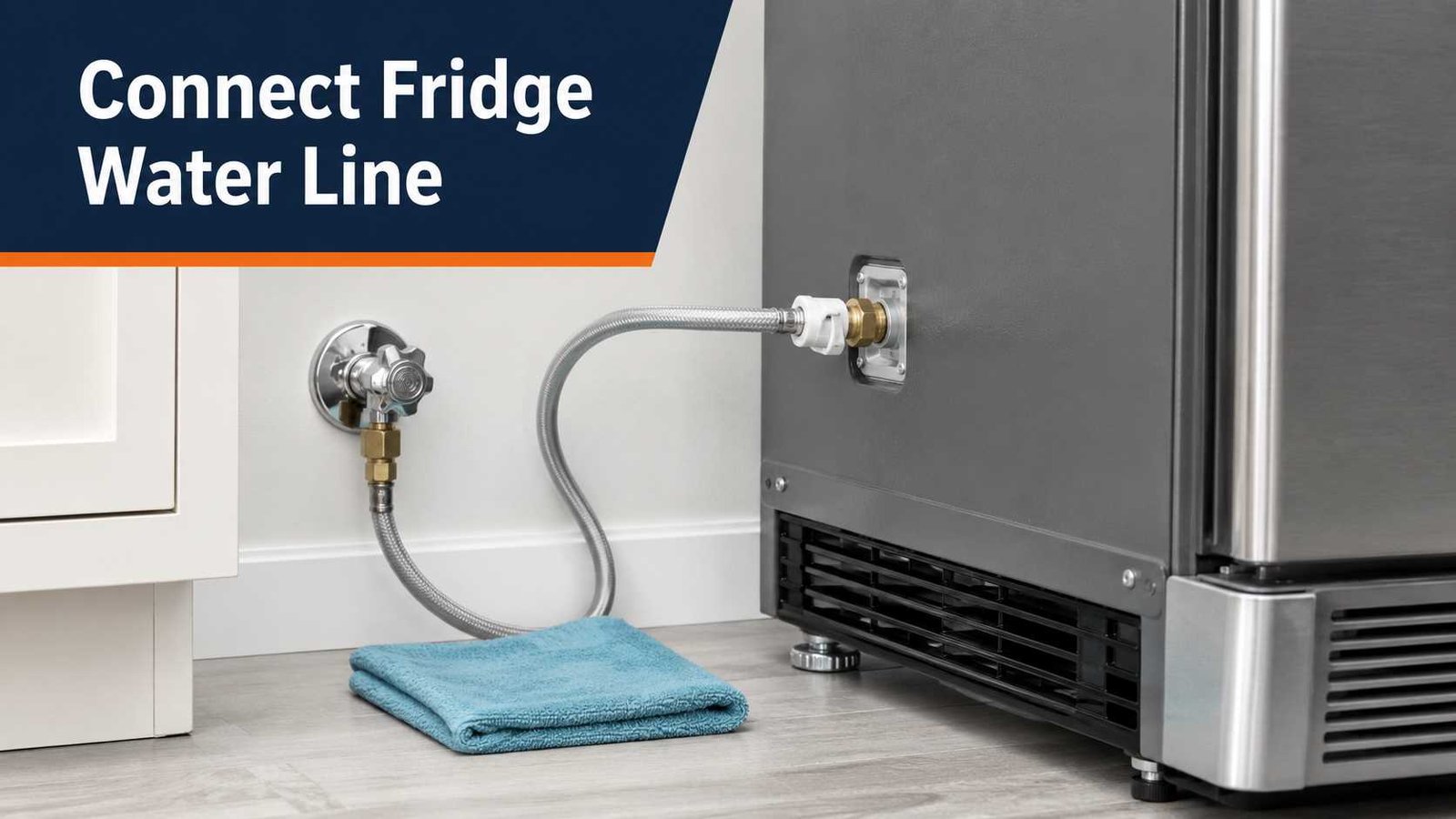
 To connect a water hose to a refrigerator, first confirm that the refrigerator is designed for a plumbed water supply and identify the connection specified in its installation manual. Most North American refrigerators that use a water dispenser or automatic ice maker connect to a cold-water shutoff through a small refrigerator-rated supply tube rather than an ordinary household or garden hose.
On many Whirlpool models, the connection uses 1/4-inch (6.35 mm) outside-diameter soft copper or PEX tubing. Other brands and regions can use different hoses, couplers or adaptors, so do not buy fittings based only on a generic installation guide.
Before making the connection, unplug the refrigerator and shut off the water supply. If you discover damaged plumbing, an unsuitable valve, or a connection you cannot make leak-free, stop and contact a qualified plumber or appliance professional.
Refrigerator Water Line Setup at a Glance
| Item | General guidance |
|---|---|
| Water source | Cold, potable household water |
| Typical North American tubing | 1/4-inch copper or PEX on many models |
| Refrigerator connection | Usually at the rear of the appliance |
| First safety step | Unplug refrigerator and shut off water |
| Difficulty | Usually straightforward if a suitable shutoff already exists |
| After connection | Open water supply and inspect every joint for leaks |
| Important precaution | Do not kink or pinch the line behind the refrigerator |
| Professional help | Recommended when new household plumbing or difficult routing is required |
Whirlpool specifies a cold-water supply and 1/4-inch copper or PEX tubing for applicable refrigerators, while Samsung documents its own fitting arrangements and advises checking the model-specific installation instructions.
What Type of Water Hose Does a Refrigerator Need?
The phrase refrigerator water hose is commonly used in searches, but the actual part is normally called a water supply line, water supply tubing, or ice maker water line.
Do not connect an ordinary garden hose.
The correct line must be suitable for potable water and compatible with the refrigerator’s inlet fitting.
1/4-Inch Copper or PEX
For many refrigerators sold in the United States and Canada, 1/4-inch tubing is common.
Whirlpool specifies 1/4-inch (6.35 mm) outside-diameter soft copper or PEX tubing between the household shutoff and refrigerator on supported models.
Samsung US recommends a refrigerator water-line installation kit containing 1/4-inch copper tubing, a compression nut and a ferrule for its applicable installations. Samsung also documents a different arrangement when compatible plastic tubing is used.
That does not mean every refrigerator uses the same tubing.
Manufacturer-Supplied Hoses and Adaptors
Some refrigerators sold outside North America use a supplied flexible hose, push-fit coupler, filter assembly or tap adaptor rather than the North American-style copper compression connection.
For example, Beko’s guidance for applicable refrigerators describes a standard 1/2-inch valve connector at the cold-water mains, with the refrigerator hose connected through its specified adaptor system.
Here’s what matters: match the water line to your refrigerator manual, not to another refrigerator that looks similar.
Where Do You Hook Up a Fridge Water Line?
A plumbed refrigerator normally has two ends to consider:
Cold household water supply → shutoff valve → refrigerator water line → refrigerator water inlet
Household Water Connection
The household end connects to an accessible cold-water supply through an appropriate shutoff valve.
Samsung UK specifically says a mains-connected refrigerator should receive cold, potable water and warns that a hot-water connection can cause the system to malfunction.
Refrigerator Connection
The appliance end is normally located toward the rear of the refrigerator. Whirlpool’s general installation procedure directs the supply tube to the water-line inlet at the back of the refrigerator cabinet.
The exact inlet can look different between models. You may find:
- A threaded compression fitting
- A short factory-installed plastic tube
- A push-fit connector
- A hose coupler
- An external water-filter connection
Do not force a fitting that does not match.
Does Every Fridge With a Water Dispenser Need a Water Line?
No.
Some refrigerators have non-plumbed water dispensers supplied from an internal refillable tank. Haier Australia, for example, currently sells refrigerators with non-plumbed dispensers as well as models with plumbed water and ice systems.
Check whether your refrigerator is described as plumbed or non-plumbed before installing a supply line.
What You Need Before Connecting the Refrigerator
For a straightforward installation where a suitable shutoff valve already exists, you may need:
- Refrigerator-compatible potable-water tubing or hose
- Correct compression nut, ferrule or manufacturer-specified connector
- Adjustable wrench if required by the fitting
- Small bucket
- Dry towel
- Access to the cold-water shutoff
- Refrigerator installation manual
Do not automatically buy a generic compression kit. Your refrigerator may use a different connection.
How to Connect a Water Hose to a Refrigerator
The following procedure describes the general arrangement used by many plumbed refrigerators. Your owner’s or installation manual takes priority whenever its instructions differ.
Step 1: Check the Refrigerator Manual
Find the installation instructions using the model number.
Confirm:
- Whether the refrigerator requires plumbing
- Required tubing or hose type
- Connector size
- Water-pressure requirements
- Filter arrangement
- Whether additional supplied fittings are required
Whirlpool explicitly advises users to consult their model-specific instructions because installation requirements can differ between refrigerators.
Step 2: Unplug the Refrigerator
Disconnect the appliance from its electrical supply before working behind it.
Whirlpool’s installation guidance instructs users to unplug the refrigerator before beginning the water-supply connection.
Step 3: Shut Off the Cold-Water Supply
Close the shutoff controlling the refrigerator line.
If the line is supplied from plumbing beneath a sink, verify which valve or branch supplies the refrigerator before disconnecting anything.
Have a towel or small container ready for residual water.
Step 4: Connect the Supply Line to the Shutoff Valve
How this connection is made depends on the valve and tubing system.
On a typical compatible copper compression arrangement, the tubing is inserted fully into the outlet and secured with the specified compression hardware. Whirlpool and Samsung both document compression-style installations on applicable North American models.
Do not assume this method applies to push-fit, manufacturer-supplied hose or regional adaptor systems.
Step 5: Flush a Newly Installed Supply Line
Before connecting the free end to the refrigerator, place it into a bucket or sink if the manufacturer calls for flushing.
Whirlpool recommends opening the water supply and flushing a newly installed tube until the water runs clear before completing the refrigerator connection.
Turn the supply off again before making the final connection.
Step 6: Connect the Line to the Refrigerator
Locate the refrigerator’s water inlet.
Insert or attach the supply line according to the manufacturer’s fitting design.
For Samsung’s documented 1/4-inch compression arrangement, copper tubing uses a ferrule while compatible plastic tubing uses its specified molded end. Samsung specifically warns that excessive tightening can cause leakage.
Do not keep tightening a leaking fitting indefinitely. If the correct components will not seal, shut off the supply and investigate the fitting rather than using excessive force.
Step 7: Leave a Service Loop
Do not pull the tubing tight between the wall and refrigerator.
Leave enough relaxed tubing for the appliance to be pulled forward for cleaning or service.
Whirlpool recommends a coil or service loop and warns that a kinked or pinched water line can reduce water flow.
Avoid sharp bends.
Step 8: Turn the Water Back On
Slowly reopen the household shutoff valve.
Watch the connection at:
- The household valve
- Any inline connector or filter
- The refrigerator inlet
Step 9: Check Carefully for Leaks
Wipe each connection dry and inspect it.
If droplets appear:
- Shut the water off.
- Confirm that the tubing is fully inserted.
- Check that the correct ferrule, molded end or connector is being used.
- Retighten only as directed by the manufacturer.
- Reopen the water and inspect again.
Samsung and Whirlpool both tell users to check the completed installation for leaks.
If the leak continues, stop using the water connection.
Step 10: Flush the Refrigerator Water System
New tubing, filters and refrigerator water passages may contain air or installation residue.
Follow the refrigerator manual’s flushing procedure before drinking the water.
The required volume is not universal. For example, Samsung US specifies one gallon for the applicable installation described in its support guide, while Samsung UK gives broader instructions to run several litres or several minutes on applicable models.
Use your model’s instructions rather than a generic flushing quantity.
How to Install a New Water Line for a Refrigerator
There is an important difference between connecting a refrigerator and installing new household plumbing.
If a Refrigerator Shutoff Already Exists
This is normally the simpler situation.
You mainly need to:
- Verify the valve is suitable.
- Obtain the correct refrigerator-rated line.
- Connect both ends.
- Flush the line.
- Check for leaks.
If There Is No Water Supply Behind the Fridge
A new branch may need to be created from a suitable cold-water pipe.
That can involve plumbing fittings, pipe modification and routing the line through cabinetry, floors or walls.
Whirlpool says a basic hookup can be manageable for some homeowners but recommends professional assistance when a line must travel long distances, pass through floors or walls, or the plumbing becomes complicated.
Be Careful With Self-Piercing Saddle Valves
Older refrigerator installations sometimes use self-piercing saddle valves.
GE Appliances says self-tapping or self-piercing valves are not recommended because their small opening can restrict water flow to the ice maker. Whirlpool likewise advises against piercing-type or undersized saddle valves and tells users to check local plumbing requirements.
If you need to modify the home’s plumbing, this is a good point to involve a qualified plumber.
How to Install a Compression Fitting on a Refrigerator Water Line
There is no single compression-fitting procedure that covers every refrigerator.
For a typical copper arrangement documented by Samsung:
- Slide the correct compression nut onto the tubing.
- Add the ferrule.
- Fully seat the tube in the fitting.
- Tighten the compression nut securely.
- Turn the water on.
- Check the fitting for leaks.
Samsung’s compatible plastic arrangement uses a molded end rather than the copper ferrule arrangement, which demonstrates why parts should not be mixed between tubing types.
Never add random washers, ferrules or sealants unless the manufacturer’s instructions specify them.
Is It Easy to Install a Fridge Water Line?
It can be.
If there is already an accessible cold-water shutoff behind or near the refrigerator and you have the correct hose and fittings, connecting the refrigerator is usually a relatively straightforward installation.
The job becomes more complicated when:
- No refrigerator shutoff exists
- New household plumbing is needed
- The line must pass through a wall or floor
- The valve is damaged or corroded
- You cannot identify the fitting
- Water continues to leak after correct assembly
Whirlpool makes the same general distinction between a basic connection and more complicated plumbing routes that may justify professional help.
Common Refrigerator Water-Line Connection Mistakes
Connecting to Hot Water
Use a cold potable-water source unless your model specifically states otherwise. Samsung UK warns that connection to hot water can cause malfunction.
Using the Wrong Tubing
A hose that physically fits is not automatically suitable.
Confirm potable-water compatibility, diameter and connector requirements.
Overtightening the Fitting
More force does not necessarily create a better seal. Samsung specifically warns that overtightening its documented compression fitting can cause a leak.
Leaving the Tubing Too Short
The refrigerator needs enough slack to move forward without pulling on the connection.
Kinking the Line
A kink can restrict water flow. Whirlpool recommends a relaxed service loop and warns against pushing the refrigerator so far back that the tube becomes pinched.
Forgetting to Open the Shutoff Valve
If the refrigerator is connected but produces no water, confirm that the household valve is fully open.
Ignoring Small Leaks
A slow drip behind a refrigerator can remain unnoticed. Inspect the connections before pushing the appliance fully back.
Refrigerator Connected but No Water Comes Out
If the dispenser does not work after installation, start with the simplest external checks:
- Confirm the water valve is open.
- Make sure the hose is not kinked.
- Inspect visible connections.
- Confirm the refrigerator filter is correctly installed if required.
- Check that the supply line was flushed.
- Confirm that the line is connected to the correct inlet.
- Check the model manual for its required water pressure.
Samsung UK identifies closed valves, low pressure, kinked or blocked hoses and filter restrictions as possible causes of poor water flow.
Special Samsung RS27T and RS22T Note
Samsung documents two water lines on RS27T and RS22T refrigerators. If the two lines are cross-connected, the ice and water functions can operate incorrectly.
Do not apply that configuration to other Samsung models unless their manual shows the same arrangement.
What If the New Refrigerator Water Connection Leaks?
Turn the water supply off first.
Then inspect only the accessible external connection.
Look for:
- Tubing not fully seated
- Wrong fitting
- Damaged tube
- Cracked hose
- Incorrect ferrule or molded-end arrangement
- Loose connector
- Excessively kinked tubing
Whirlpool specifically recommends inspecting accessible connections and checking the line for cracks, damage and kinks.
If the correct connection still leaks, leave the water shut off and arrange professional repair.
When Should You Call a Plumber or Appliance Professional?
Professional assistance makes sense when:
- There is no suitable refrigerator shutoff valve
- Household plumbing must be modified
- The supply pipe is corroded or damaged
- The line must be routed through floors or walls
- The correct connection cannot be identified
- You cannot stop a leak
- Local plumbing rules require professional installation
- The refrigerator manual specifies an installation method beyond your experience
Do not attempt hidden pipe modifications simply to complete an appliance hookup.
Refrigerator Water Line Safety Checklist
- Confirm the refrigerator is a plumbed model.
- Read the model-specific installation instructions.
- Use a cold, potable water source.
- Use refrigerator-rated tubing or the manufacturer-specified hose.
- Unplug the refrigerator before working behind it.
- Shut off the household water before connecting tubing.
- Use the correct fittings for the tubing type.
- Do not overtighten compression fittings.
- Leave a relaxed service loop behind the refrigerator.
- Keep the line free of kinks and sharp bends.
- Open the water and inspect every connection for leaks.
- Flush the line according to the refrigerator manual.
- Stop and call a professional if household plumbing needs work you cannot safely complete.
Frequently Asked Questions
How do I connect a water hose to a fridge?
Connect an approved refrigerator water-supply line between an accessible cold-water shutoff and the refrigerator’s water inlet. Shut off the water and unplug the refrigerator first, use the fittings specified for your model, then reopen the supply and check carefully for leaks.
Where do I hook up a fridge water line?
One end connects to the household cold-water supply through an appropriate shutoff valve. The other normally connects to a water inlet or factory-installed tube at the rear of the refrigerator. The exact fitting varies by model.
How do I install a new water line for a refrigerator?
If a refrigerator shutoff already exists, you generally need only the correct supply tube and fittings. If no suitable water connection exists and household pipes must be modified, check local requirements and consider using a qualified plumber.
Is it easy to install a fridge water line?
Connecting to an existing, accessible valve can be relatively straightforward. Running a completely new line through cabinets, floors or walls is more complicated and may be better handled professionally.
What size water line does a refrigerator use?
Many North American refrigerators use 1/4-inch tubing, and Whirlpool specifies 1/4-inch outside-diameter copper or PEX for applicable models. However, sizes and connector systems differ, especially across brands and countries. Check your refrigerator manual before purchasing tubing.
Does a refrigerator water line connect to hot or cold water?
Use a cold potable-water supply unless the manufacturer’s instructions explicitly state otherwise. Samsung UK warns that connecting a refrigerator water system to hot water can cause malfunction.
Can I reuse my old refrigerator water line?
Do not assume an existing line should automatically be reused. Inspect it for kinks, cracks, damage and fitting compatibility. Whirlpool recommends checking supply tubing for damage, while Samsung notes that compatible connection hardware depends on the tubing design.
Why is my refrigerator water line leaking after installation?
Common external issues include a tube that is not fully seated, incompatible fittings, damaged tubing or an improperly tightened connection. Samsung warns that overtightening its compression connection can itself cause leakage. Shut the water off until the connection can be made leak-free.
Daniel Brooks is a US-based appliance troubleshooting researcher with 12 years of experience studying washer, dryer, refrigerator, and dishwasher faults. He reviews manufacturer manuals and converts technical error codes into safe, practical guidance for homeowners.