
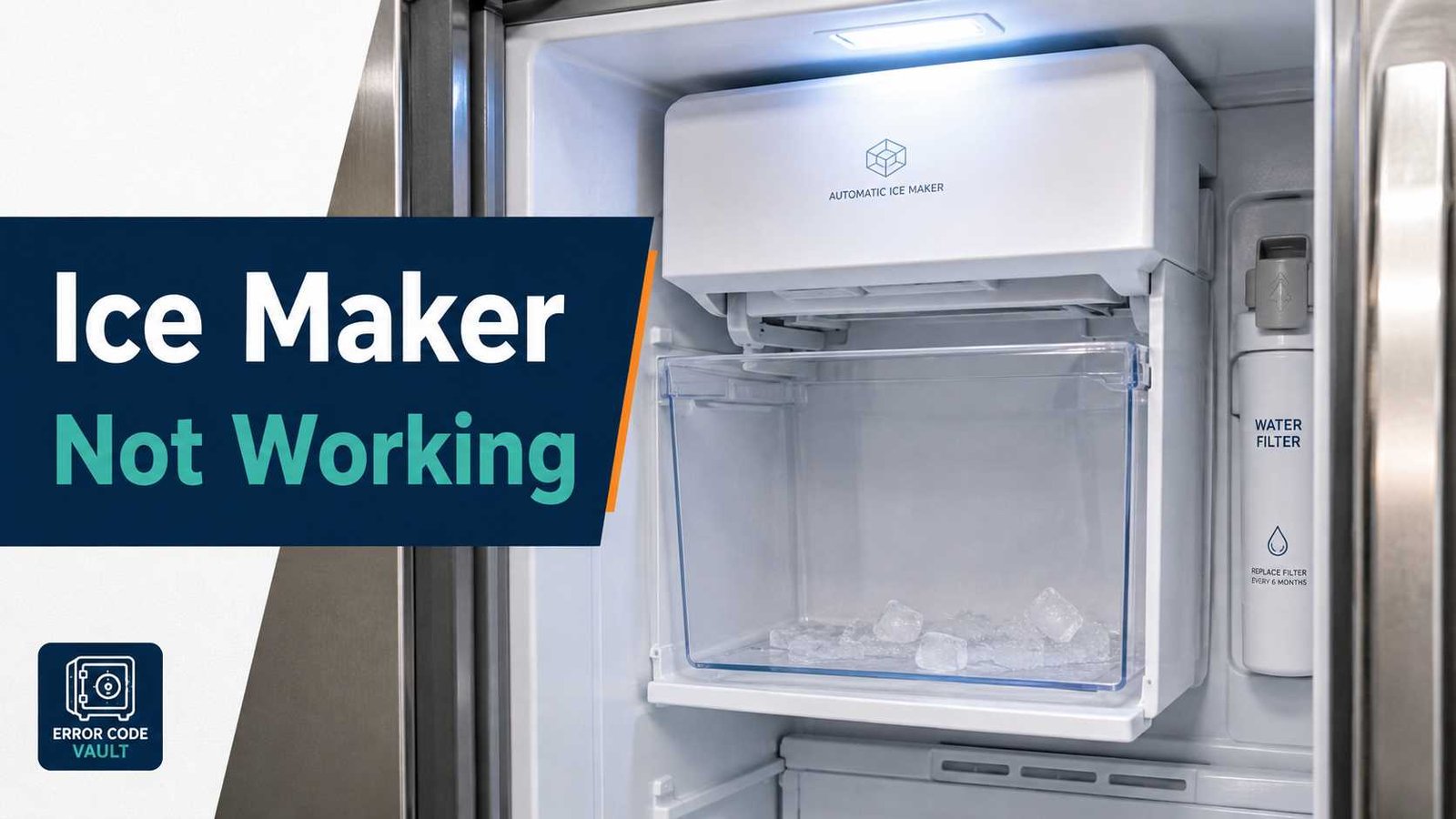
 If your Whirlpool refrigerator ice maker is broken or has suddenly stopped making ice, do not assume the complete ice-maker assembly needs replacement. Whirlpool identifies restricted water supply, incorrect freezer temperature, an accidentally switched-off ice maker, and water-filter problems among the main causes of no ice.
Start by checking whether the ice maker is turned on, whether the refrigerator still dispenses water, and whether the water line is open and free of kinks. The freezer should also be cold enough for normal ice production.
If you find leaking water, damaged wiring, a burning smell, or repeated electrical problems, stop troubleshooting and arrange professional service.
Quick answer: A Whirlpool refrigerator that suddenly stops making ice often has a water-flow, filter, temperature, or control-setting problem. Check these before paying to replace the ice maker.
Whirlpool Ice Maker Troubleshooting at a Glance
| What to check | What you may find | Safe homeowner check? |
|---|---|---|
| Ice maker setting | Ice maker accidentally turned off | Yes |
| Water shutoff valve | Valve closed or partly closed | Yes |
| Supply tubing | Kinked or pinched line | Yes |
| Water dispenser | Weak or no water flow | Yes |
| Water filter | Clogged or incorrectly installed | Yes |
| Freezer temperature | Freezer too warm | Yes |
| Ice bin/chute | Ice jam or dispenser problem | Yes |
| Frozen internal fill tube | Water cannot reach ice mold | Limited |
| Water inlet valve | Valve may have failed | Technician recommended |
| Wiring/control system | Electrical or sensor problem | Technician |
| Ice-maker assembly | Internal mechanism may have failed | Model dependent |
Why Is My Whirlpool Refrigerator Suddenly Not Making Ice?
Whirlpool’s current troubleshooting guidance places four issues near the top of the list: restricted water supply, freezer temperature, the ice maker being turned off, and water-filter problems.
That means an empty ice bin does not automatically prove the ice maker itself is defective.
Work through the checks below in order. The first few take little time and can rule out problems that do not require appliance disassembly.
1. Make Sure the Ice Maker Is Turned On
This sounds obvious, but it is one of Whirlpool’s first recommended checks.
Depending on the refrigerator, ice production may be controlled by:
- A mechanical shutoff arm
- A physical ON/OFF switch
- An electronic refrigerator control
- A menu option on the dispenser panel
On selected Whirlpool models, a control arm senses the level of ice in the bin. If the arm is in the OFF position, loose, or damaged, ice production can stop.
Do not copy a switch position or button sequence from a different Whirlpool refrigerator. Find your complete model number and use the corresponding owner’s manual.
2. Check Whether Water Is Reaching the Refrigerator
An automatic ice maker cannot work without an adequate water supply.
Make sure:
- The refrigerator is connected to the household cold-water supply.
- The shutoff valve is fully open.
- The water line has not been crushed behind the refrigerator.
- There are no obvious kinks in the tubing.
- The line was not accidentally disturbed when the appliance was moved.
Whirlpool specifically warns that pushing the refrigerator too far back can pinch its water line.
Does the water dispenser still work?
This is a useful clue.
If both the water dispenser and ice maker have weak or no water, investigate the household water supply, shutoff valve, filter, supply tubing, and water pressure first.
If water dispenses normally but no ice is produced, the problem may be farther downstream in the ice-making system. Possible areas include the fill circuit, ice-maker controls, internal fill tube, inlet-valve circuit, or ice-maker mechanism.
It is still not enough information to declare a particular part defective.
3. Check the Refrigerator Water Filter
A clogged filter can reduce water flow enough to slow or stop ice production.
Whirlpool recommends replacing its refrigerator water filter approximately every six months, when the filter indicator signals replacement, or as needed, depending on usage and water conditions.
Signs that water flow may be restricted include:
- Slow water dispensing
- Small ice cubes
- Hollow cubes
- Reduced ice production
- No ice
Whirlpool confirms that low water pressure can produce small or irregular cubes and slow or no ice production.
Ice maker stopped after changing the filter?
Check the filter installation.
Whirlpool says an incorrectly installed filter may restrict or stop water flow and may also cause leakage around the filter housing.
Make sure the replacement filter is correctly seated according to the instructions for your refrigerator.
4. Check the Freezer Temperature
An ice maker needs a properly cooled freezer to operate normally.
Current Whirlpool troubleshooting guidance recommends a freezer temperature around 0°F (-18°C), while one Whirlpool Product Help ice-maker page gives an operating range of approximately 0–5°F (-17 to -15°C) for optimal ice production.
The practical rule is simple: use the temperature recommended in your specific refrigerator manual.
If the freezer is too warm, you may see:
- Very slow ice production
- Small cubes
- No new cubes
- Partially frozen water
If you change the temperature setting, do not expect an immediate result. The compartment needs time to stabilize.
5. Check Water Pressure and Flow
Poor water pressure can affect both the dispenser and ice maker.
Whirlpool’s current Product Help guidance says most refrigerators with water and ice features operate with household pressure of approximately 30–120 psi (207–827 kPa) at the refrigerator connection, with performance typically optimal around 40–80 psi.
Possible signs of low pressure include:
- Slow dispenser flow
- Slow filling
- Small ice cubes
- Hollow or irregular cubes
- Low ice production
- No ice production
A reverse-osmosis system can also reduce pressure reaching the refrigerator. Whirlpool advises checking the RO filters and system when water flow becomes inadequate.
A qualified plumber can measure household water pressure if you suspect a supply problem.
6. Reset the Whirlpool Ice Maker
A reset may help when the problem is a temporary control issue, but there is no single reset method that should be assumed for every Whirlpool refrigerator.
Whirlpool advises checking the manual for the reset control. Where a dedicated reset is not available, current Whirlpool Product Help guidance recommends a refrigerator power cycle:
- Unplug the refrigerator.
- Leave it disconnected for about one minute.
- Plug it back in.
- Allow time for the appliance and ice maker to resume normal operation.
Whirlpool notes that it may take a couple of hours before you can judge whether ice production has resumed.
A reset will not fix a closed water valve, blocked filter, frozen water tube, defective valve, or mechanically failed ice maker.
Whirlpool Ice Maker Not Making Ice but Water Dispenser Works
This symptom helps narrow the search.
If water comes from the dispenser normally but the ice bin stays empty, check:
- Ice maker ON/OFF setting
- Freezer temperature
- Whether the ice maker contains water or ice
- Mechanical control arm, if fitted
- Signs of a frozen fill tube
- Model-specific controls
A defective water inlet valve is another possibility. Whirlpool explains that the valve opens to feed water into the ice-making system and can become a cause once filter condition and water supply have been checked.
Diagnosis of the valve or internal electrical circuit should be left to a qualified appliance technician.
What If the Ice Maker Has Water but Will Not Dump Ice?
This is different from an ice maker that never receives water.
If frozen cubes remain in the ice mold but never reach the bin, possible causes include a temporary control problem or a fault in the ice-making mechanism.
Try the model-approved reset first.
If cubes repeatedly remain in the mold after the freezer temperature has been confirmed, the ice maker may require professional diagnosis.
Avoid trying to energize the motor manually, bypass sensors, jump electrical terminals, or apply live voltage to test it.
Ice Maker Makes Ice but Will Not Dispense It
If your ice bin already contains ice, the ice maker itself may be working perfectly well.
Whirlpool treats making ice and dispensing ice as separate troubleshooting situations. On side-by-side models, the company recommends checking the refrigerator doors, dispenser lock, dispenser paddle, ice clumping, dispenser chute, and ice-bin installation.
Check for clumped ice
Ice can freeze into a large mass inside the bin, particularly when it is not used regularly.
Remove loose clumps if they can be cleared safely. A badly frozen bin may need to be removed and allowed to defrost.
Check the dispenser chute
Look for cubes blocking the chute.
Do not attack a solid blockage with sharp metal tools. Whirlpool recommends allowing stubborn chute ice to melt rather than chipping at components that can be damaged.
Check the dispenser lock
If the refrigerator has a Control Lock or Dispenser Lock function, make sure it is not enabled.
Common Whirlpool Ice Maker Problems
| Problem | Typical symptom | First check |
|---|---|---|
| Ice maker turned off | No ice | ON/OFF setting |
| Water valve closed | No ice and possibly no water | Household shutoff valve |
| Kinked water line | Weak flow or no ice | Tubing behind refrigerator |
| Clogged filter | Slow water, small cubes, low ice | Filter condition |
| Incorrect filter installation | Low/no water after filter change | Filter seating |
| Freezer too warm | Slow or no ice | Freezer temperature |
| Low water pressure | Small/hollow cubes | Water flow |
| Control arm problem | Ice production stops | Arm position |
| Frozen fill tube | Ice mold stays dry | Professional diagnosis may be needed |
| Failed inlet valve | No fill despite normal supply | Technician diagnosis |
| Ice-maker failure | No harvest/fill after basic checks | Model-specific service |
| Ice chute blocked | Ice exists but will not dispense | Chute/bin |
Whirlpool lists filters, water valves and lines, compartment temperature, control arms, bins, and frozen inlet tubes among common ice-maker problem areas.
What If None of the Basic Checks Work?
Before arranging service, collect a few details. They can make diagnosis easier:
- Full refrigerator model number
- Serial number
- Current freezer temperature
- Whether the water dispenser works normally
- Approximate age of the water filter
- Whether the ice mold is dry, contains water, or contains frozen cubes
- Whether the ice maker makes unusual noises
- Whether the problem started after moving the refrigerator
- Whether it started after changing a filter
- Whether there is any water leakage
The model number matters because Whirlpool uses several refrigerator layouts and ice-maker systems.
Could the Whirlpool Ice Maker Itself Be Broken?
Yes, but it should normally become a stronger suspect after the basic operating conditions have been verified.
Whirlpool’s own troubleshooting material recommends checking water supply, filter condition, freezer temperature, control-arm position, and related issues before concluding that the ice-making mechanism needs service.
Possible component-level faults can involve:
- Ice-maker assembly
- Water inlet valve
- Control arm or sensor
- Fill system
- Internal wiring
- Electronic controls
- Dispenser components
Which components exist and how they are diagnosed varies by refrigerator model.
How Much Does It Cost to Replace an Ice Maker in a Whirlpool Refrigerator?
There is no single Whirlpool replacement price.
As of 2026, Angi reports general ice-maker repair costs ranging roughly from $75 to $660, depending on the repair, brand, accessibility, and failed component. A separate Angi guide places complete ice-maker replacement around $260–$450 in typical situations.
ConsumerAffairs estimates refrigerator ice-maker repairs at roughly $200–$350.
These figures are U.S. consumer-market estimates, not Whirlpool prices.
Actual Whirlpool cost depends on:
- Refrigerator model
- Ice-maker design
- Failed component
- Parts price
- Local labor rates
- Service-call charges
- Warranty coverage
- Whether the problem is actually in the ice maker
Replacement assemblies themselves vary significantly by model. Current parts listings, for example, show some Whirlpool-compatible assemblies around the $90 range and others around $160 before labor.
That is why replacing the entire ice maker before checking water supply and temperature can be an expensive mistake.
U.S. Owners of Certain 2018–2021 Side-by-Side Refrigerators
There is an additional issue worth knowing about in 2026.
A U.S. class-action settlement concerns certain Whirlpool-manufactured side-by-side refrigerators made between 2018 and 2021. The lawsuit alleged that a door wire harness could fail and affect in-door functions such as the ice maker, ice dispenser, water dispenser, or control panel. Whirlpool agreed to the settlement without this being a finding that every refrigerator has the alleged problem.
The official settlement site currently lists a Final Approval Order and Judgment and a November 2, 2026 deadline for certain past wire-harness claims.
Do not assume your refrigerator qualifies simply because the ice maker has stopped.
Eligibility depends on the exact model and serial number and should be checked through the official Whirlpool Refrigerator Settlement process.
Is It Safe to Use the Refrigerator With a Broken Ice Maker?
If refrigeration is operating normally and the only issue is that the ice maker does not produce ice, the refrigerator itself may still be usable.
However, stop using the ice/water system and arrange service if you notice:
- Active water leakage
- Exposed or damaged wiring
- Burning smell
- Repeated breaker or electrical tripping
- Significant melting or loss of freezer cooling
- Water reaching electrical components
Do not bypass safety controls or perform live-voltage testing to diagnose an ice maker.
When Should You Call a Technician?
Professional diagnosis makes sense when:
- The water supply and filter are normal but the ice maker remains dry
- Ice freezes in the mold but repeatedly fails to eject
- The fill tube repeatedly freezes
- The inlet valve is suspected
- Internal wiring appears damaged
- Water leaks inside the refrigerator
- The ice maker repeatedly fails after a model-approved reset
- A sensor, control board, motor, or wiring problem is suspected
Whirlpool itself recommends professional help when basic ice-maker troubleshooting does not resolve the problem.
The goal is not to replace the most expensive part first. It is to identify whether the failure is in the water supply, temperature conditions, ice-making mechanism, or dispenser system.
Frequently Asked Questions
How do I fix a broken Whirlpool ice maker?
Start with the ice-maker ON setting, water shutoff valve, supply line, water filter, freezer temperature, and water-dispenser flow. Then use the reset procedure approved for your model. If these checks are normal and the ice maker still does not fill or harvest ice, professional diagnosis may be needed.
Why did my Whirlpool refrigerator suddenly stop making ice?
Common causes include restricted water flow, a clogged or incorrectly installed filter, incorrect freezer temperature, an ice maker that has been switched off, or a component-level failure.
Can a Whirlpool water filter stop the ice maker?
Yes. Whirlpool says a clogged or improperly installed filter can reduce water flow to both the dispenser and ice maker, potentially causing low or no ice production.
Why does my Whirlpool water dispenser work but the ice maker does not?
Normal water dispensing makes a total household water-supply failure less likely. Check the ice-maker setting, freezer temperature, fill system, and model-specific ice-maker controls next. Component testing may require a technician.
How do I reset a Whirlpool refrigerator ice maker?
Follow your refrigerator manual because reset controls vary by model. Whirlpool’s general Product Help guidance says that where no dedicated reset button is available, unplugging the refrigerator for about one minute and reconnecting power can be used as a power cycle.
How much does a Whirlpool ice maker cost to replace?
Current U.S. consumer guides commonly place complete ice-maker replacement in the several-hundred-dollar range, with one Angi estimate around $260–$450. The actual price depends heavily on the Whirlpool model, part required, labor rate, and whether the ice maker itself is actually defective.
Can low water pressure cause a Whirlpool refrigerator to stop making ice?
Yes. Whirlpool says inadequate water pressure can cause slow dispensing, small or irregular cubes, slow ice production, or no ice production. Most Whirlpool refrigerators with water and ice functions are specified for about 30–120 psi at the refrigerator connection, although model instructions take priority.
Should I replace the whole ice maker if it is not making ice?
Not immediately. Verify the water supply, filter, temperature and ice-maker controls first. A complete assembly replacement will not solve a closed water valve, kinked tubing, low pressure or clogged filter.
Daniel Brooks is a US-based appliance troubleshooting researcher with 12 years of experience studying washer, dryer, refrigerator, and dishwasher faults. He reviews manufacturer manuals and converts technical error codes into safe, practical guidance for homeowners.