
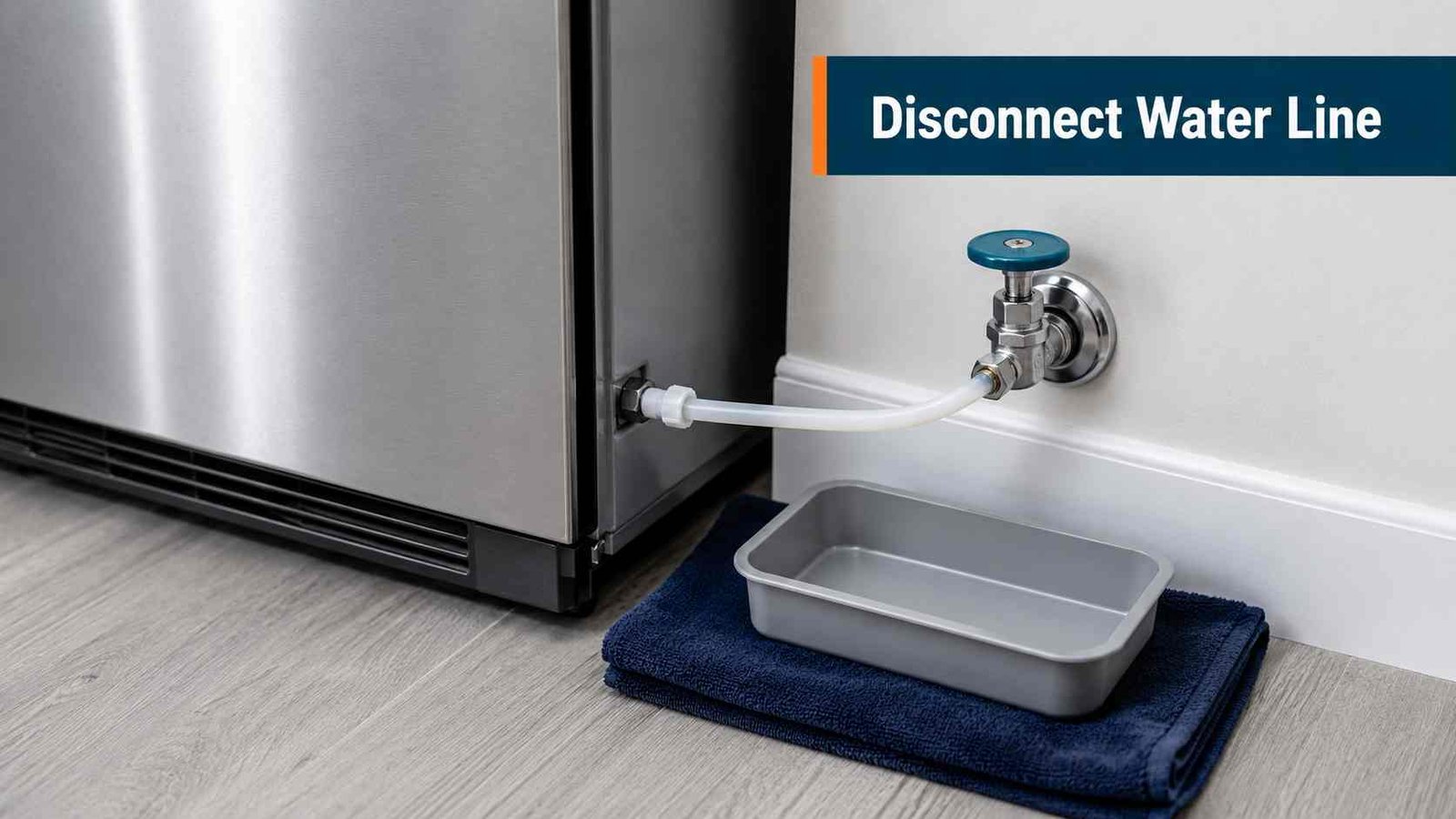
 To unhook a refrigerator water line, first shut off the cold-water supply feeding the refrigerator, confirm the water has stopped, unplug the fridge, and place a towel or shallow container beneath the connection. Then disconnect the tubing according to the fitting type.
A threaded compression connection normally releases by loosening its compression nut. A push-fit or quick-connect fitting usually requires pressing its release collar while pulling the tube straight out. The exact connection varies by refrigerator model, so do not force a fitting that does not match these descriptions.
Manufacturer moving instructions specifically call for shutting off the water supply before disconnecting the line from the refrigerator.
| Item | What to Do |
|---|---|
| First step | Turn off the refrigerator water supply |
| Power | Unplug the refrigerator |
| Water remaining in line | A small amount may remain |
| Common fittings | Compression nut or push-fit connector |
| Basic tools | Towel, shallow bowl, suitable wrench if needed |
| Main risk | Water leakage or damaging the fitting |
| Difficulty | Usually easy to moderate |
| Professional help | Recommended for a leaking valve, damaged plumbing, or unfamiliar connection |
Important: Do not loosen the refrigerator connection while the water supply is still pressurized. If the shutoff valve will not completely stop the water, stop and deal with the valve problem first.
What You Need Before Disconnecting the Line
For most refrigerators, you only need a few basic items:
- A towel
- A shallow bowl or small container
- An adjustable wrench if your refrigerator uses a threaded compression fitting
- The refrigerator’s installation manual if the connection is unfamiliar
Avoid cutting the tube simply to remove the refrigerator. Cutting may make the existing supply line unusable for the replacement refrigerator and can create another potential leak point.
Step 1: Find the Refrigerator Water Shutoff Valve
Your first job is to stop water from reaching the refrigerator.
Trace the water tube from the back of the appliance toward the household supply. The dedicated shutoff valve may be directly behind the refrigerator, inside a nearby cabinet, beneath the kitchen sink, in a basement, or in a crawl space.
GE Appliances specifically notes that refrigerator shutoff valves are commonly found under the kitchen sink, in the basement or crawl space, or in a cabinet next to the refrigerator.
Turn the valve completely to the OFF position.
A quarter-turn valve normally closes when its handle is turned perpendicular to the pipe. Older multi-turn valves may require several clockwise turns.
What If There Is No Refrigerator Shutoff Valve?
Do not start loosening the refrigerator connection while water is still reaching it.
If there is no dedicated refrigerator valve, you may need to shut off the appropriate household cold-water branch or the home’s main water supply before proceeding.
If you cannot confidently identify the correct valve, having a plumber handle the shutoff is safer than experimenting with unfamiliar household plumbing.
Step 2: Make Sure the Water Is Actually Off
Closing a valve does not always mean it has successfully stopped the water. Older shutoff valves can fail internally.
If your refrigerator has a working water dispenser, you can briefly operate it after closing the supply valve to check whether normal water flow has stopped. A little residual water may still come through.
If water continues flowing normally, do not disconnect the line.
Instead, recheck the shutoff valve or shut off the upstream water supply.
Once you are satisfied that the water supply has stopped, proceed to the refrigerator.
Step 3: Unplug the Refrigerator
Disconnect the refrigerator from the electrical outlet before working behind it.
If you need to pull the refrigerator forward, do it slowly. Do not move it farther than the available water line allows while the tubing is still attached.
Samsung’s refrigerator setup guidance also recommends preparing towels and a bowl when disconnecting a rear water line because some water can remain in the tubing.
Protect delicate flooring if necessary and avoid placing excessive tension on the tube.
Step 4: Find the Water Connection
Look near the lower rear portion of the refrigerator.
GE notes that the refrigerator’s water inlet valve is commonly located toward the bottom rear of the appliance, although its exact side and position vary by model.
Follow the household supply tube until you reach the refrigerator connection.
Place your towel and bowl underneath it before loosening anything.
You will usually see one of the following arrangements.
Compression-Nut Connection
A compression fitting has a threaded metal or plastic nut securing the supply tube to the refrigerator connection.
This style is common on refrigerators using copper or suitable plastic/PEX supply tubing. Whirlpool-family documentation, for example, specifies 1/4-inch (6.35 mm) outside-diameter copper or PEX tubing on applicable models.
LG and Samsung also document compression connections on selected refrigerators.
Push-Fit or Quick-Connect Connection
A push-fit connector holds the tube internally and releases it through a collar, collet, or coupler.
For example, Samsung documents selected refrigerator connections where the user presses and holds the coupler while pulling the water hose free. Samsung warns against using excessive force because the coupler can break.
Manufacturer-Specific Connection
Some refrigerators use a connector, locking clip, molded hose end, filter connection, or coupler specific to that product.
If you cannot clearly identify the fitting, check the installation manual using the refrigerator’s exact model number rather than pulling harder.
Step 5: How to Disconnect a Compression Water Line
Once the supply is definitely off and the refrigerator is unplugged:
- Put the bowl directly beneath the fitting.
- Locate the compression nut where the supply tube meets the refrigerator.
- Support the refrigerator-side fitting so it does not twist.
- Turn the compression nut counterclockwise with a suitable wrench.
- Continue loosening it until the tube can be separated.
- Pull the supply line away gently.
- Allow remaining water to drain into the bowl.
Do not squeeze, sharply bend, or twist copper tubing.
Whirlpool’s installation instructions show this type of connection being secured with a nut and specifically caution against over-tightening during installation.
LG similarly uses a compression nut and ferrule on applicable refrigerator water connections.
The same principle works in reverse for disconnection, but exact fittings vary.
Step 6: How to Disconnect a Push-Fit Water Line
Do not treat a push-fit fitting like a threaded nut.
First look for a small locking clip. If one is present and the manufacturer’s instructions show that it is removable, remove it before attempting to release the tubing.
For a typical appliance quick connector:
- Make sure the supply is off.
- Place a towel beneath the fitting.
- Push the tubing slightly toward the connector to remove tension.
- Press the connector’s release collar or coupler inward.
- Keep the collar depressed.
- Pull the tubing straight out without twisting aggressively.
Samsung describes a comparable method on selected refrigerators, where the coupler is pressed while the hose is detached.
However, not every push-fit plumbing product releases by hand. Some purpose-built push-to-connect fittings require the manufacturer’s disconnect clip or tool. SharkBite, for example, instructs users to engage the release collar with an approved disconnect tool rather than pulling against the fitting.
That is why identifying the actual connector matters.
What If the Refrigerator Water Line Will Not Come Off?
If the line feels stuck, do not simply pull harder.
Check these points first:
Make Sure the Water Is Off
A pressurized line should not be disconnected.
Look for a Locking Clip
Some quick connectors use a small retaining clip that prevents accidental release.
Push Before Pulling
Certain quick-connect fittings release more easily when the tube is pushed slightly inward first, the collar is depressed, and then the tube is pulled straight out.
For push-to-connect plumbing fittings, SharkBite specifically warns that pulling before releasing the collar can make removal more difficult because the internal gripping teeth bite more firmly into the pipe.
Do Not Crush the Connector With Pliers
Do not squeeze a plastic release collar with ordinary pliers unless the manufacturer specifically tells you to use them.
Damaging the fitting may turn a simple refrigerator move into a plumbing repair.
Check the Model Manual
A connector that looks unusual may have a model-specific release method.
Stop if the fitting appears damaged, badly corroded, inaccessible, or connected directly to fixed household plumbing.
What Should You Do With the Water Line After Disconnecting It?
What happens next depends on why you removed the refrigerator.
If You Are Installing Another Refrigerator
Keep the shutoff valve closed until the replacement refrigerator is ready to connect.
Inspect the existing tubing and fittings first. Do not reuse tubing that is kinked, cracked, badly corroded, crushed, or otherwise damaged.
Manufacturers may specify particular tubing or new hose components for their refrigerators, so follow the installation instructions supplied with the replacement appliance.
If the Refrigerator Is Temporarily Disconnected
Leave the dedicated shutoff valve completely closed.
Position the loose tubing so it cannot be stepped on, crushed, or accidentally pulled.
If You Are Permanently Removing the Water Connection
Simply leaving an old tube loose behind a wall or cabinet is not a good permanent plumbing solution.
Have the unused branch properly terminated when required. Local plumbing requirements vary, so permanent modification of household pipework is an appropriate job for a qualified plumber when you are unsure.
Can You Use a Refrigerator Without the Water Line?
For a refrigerator whose cooling system is independent of its external water supply, disconnecting the household water line prevents water-dependent features such as the dispenser and automatic ice production from operating.
If the refrigerator will remain in use without water, turn off the automatic ice maker according to the model’s instructions.
Whirlpool notes that ice-maker controls differ by model. Some use a wire shutoff arm, some a physical switch, and others a control-panel setting.
KitchenAid’s moving guidance similarly instructs users to turn off the ice maker after shutting off and disconnecting its water supply.
Do not assume your model uses the same control sequence as another refrigerator.
Plumbed vs Non-Plumbed Refrigerators
Not every refrigerator with a water dispenser connects to household plumbing.
A plumbed refrigerator takes water from a fixed household cold-water supply.
A non-plumbed refrigerator may instead have a refillable internal water tank.
For example, Samsung Australia provides separate instructions for refrigerators that obtain dispenser water from an internal tank.
If your refrigerator uses a refillable tank, there may be no household water line to unhook.
When Should You Call a Plumber or Appliance Professional?
Stop the DIY process if:
- The refrigerator shutoff valve does not stop the water.
- The valve begins leaking when you operate it.
- Fixed household plumbing needs to be altered.
- Copper tubing is badly kinked or corroded.
- A connector breaks.
- You cannot identify how the fitting releases.
- Water continues leaking after the supply is supposedly off.
- The refrigerator’s manufacturer requires professional installation for the applicable connection.
GE advises contacting a plumber when a leak appears to originate from the household copper water line rather than the refrigerator itself.
Safety Checklist
Before moving the refrigerator away from its final position, confirm:
- Water supply valve is fully closed.
- Water flow has stopped.
- Refrigerator is unplugged.
- Water tube is completely disconnected.
- No fitting is actively leaking.
- Loose tubing is protected.
- Ice maker is turned off if the refrigerator will operate without water.
Frequently Asked Questions
Do I have to turn off the water before disconnecting a refrigerator?
Yes. Shut off the water supply feeding the refrigerator before loosening or releasing the connection. Manufacturer moving instructions specifically include shutting off the water before disconnecting the refrigerator line.
Where is the refrigerator water shutoff valve?
Common locations include behind the refrigerator, under the kitchen sink, inside a nearby cabinet, in a basement, or in a crawl space. GE lists several of these locations in its refrigerator support guidance.
Why did water come out after I turned the valve off?
Some water can remain inside the refrigerator tubing after the supply is closed. That is why placing a towel and bowl beneath the connector before disconnecting it is useful. Samsung’s refrigerator setup instructions similarly tell users to prepare for remaining water when the line is disconnected.
How do I disconnect a refrigerator quick-connect water line?
On many appliance quick connectors, you push the tubing slightly inward, depress the release collar or coupler, and then pull the tube straight out. However, connector designs vary. Samsung’s selected refrigerator couplers use a press-and-release method, while some aftermarket plumbing fittings require a dedicated disconnect tool.
Can I use the refrigerator after disconnecting the water line?
On refrigerators where cooling operates independently of the water system, food-storage cooling can continue, but the water dispenser and automatic ice-making functions will not have a water supply. Turn the ice maker off according to the instructions for your exact model.
Can I just cut the refrigerator water line?
Cutting the line is generally unnecessary for ordinary refrigerator removal and may prevent easy reuse. Disconnect it at its intended fitting instead. If fixed plumbing needs to be removed or permanently terminated, consider using a plumber.
What if my refrigerator does not have a dedicated water shutoff valve?
Do not disconnect the tube while it is live. Shut off the correct upstream or main household water supply, or have a plumber install or service an accessible shutoff valve.
Do all refrigerators use a 1/4-inch water line?
No. A 1/4-inch (6.35 mm) outside-diameter supply line is specified for many North American Whirlpool-family models, but tubing, connector and installation requirements vary by refrigerator and region. Check the installation instructions for the exact model.

Daniel Brooks is a US-based appliance troubleshooting researcher with 12 years of experience studying washer, dryer, refrigerator, and dishwasher faults. He reviews manufacturer manuals and converts technical error codes into safe, practical guidance for homeowners.