
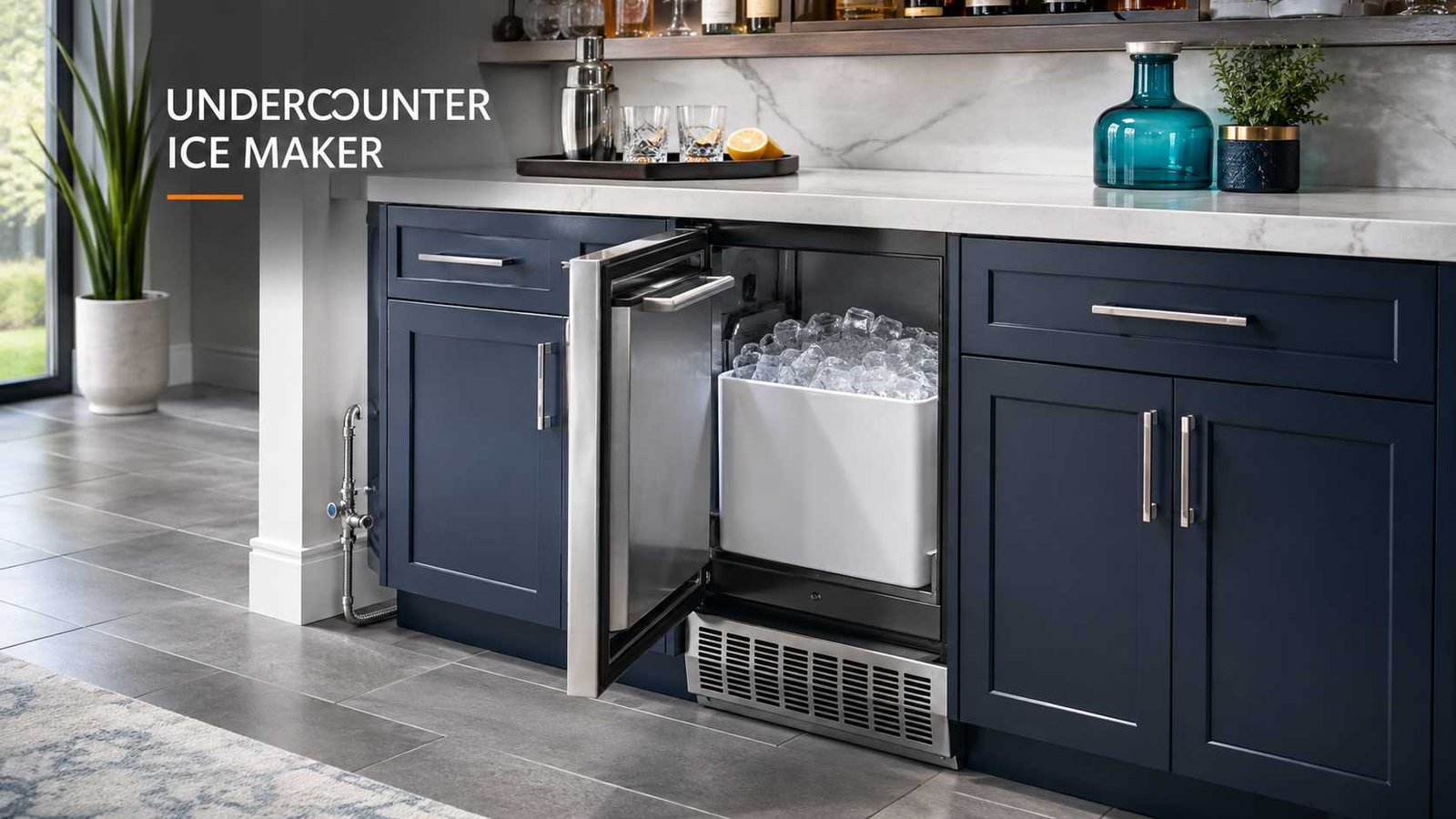
 A built-in undercounter ice maker is a dedicated ice-making appliance designed to fit beneath a kitchen, bar, or entertainment-area counter. Unlike the small ice maker inside a refrigerator, these machines can produce and store much larger quantities of ice and may offer clear cubes, nugget ice, or other specialized shapes.
The important part is installation. Most true undercounter machines need a potable water supply, electrical connection, adequate ventilation, and a suitable drain. Many also have non-refrigerated storage bins, so a small amount of ice melting is normal rather than a sign that the appliance is broken.
Before buying one, check the drain arrangement first. A machine that fits perfectly in your cabinetry may still be unsuitable if its water, drainage, electrical, or ventilation requirements cannot be met safely.
Built-In Undercounter Ice Maker at a Glance
| Feature | What to Expect |
|---|---|
| Installation | Under a counter or between cabinets |
| Common residential width | Around 15 inches on many models |
| Water supply | Usually required |
| Drain | Commonly required |
| Drain options | Gravity drain or drain pump |
| Ice styles | Clear cubes, nugget ice and model-specific shapes |
| Storage | Often an insulated bin rather than a freezer |
| Current premium US price examples | Roughly $2,900 to more than $6,000 |
| Maintenance | Regular cleaning and descaling |
| Best for | Frequent ice users, entertaining, bars and large households |
| Main drawback | Purchase price plus plumbing, drainage and maintenance |
A current KitchenAid 15-inch panel-ready model, for example, holds up to 25 pounds of ice and is designed for flush installation into surrounding cabinetry.
What Is a Built-In Undercounter Ice Maker?
A built-in undercounter ice maker is a dedicated appliance that produces ice independently of your refrigerator.
It normally sits at roughly dishwasher or base-cabinet height. Many residential models are narrow enough to fit into a 15-inch cabinet opening, although dimensions differ between products.
KitchenAid describes undercounter ice makers as appliances designed to fit below a counter or alongside cabinetry. Some models also support panel-ready doors, allowing a cabinet panel to be fitted to the front for a more integrated appearance.
What does built-in actually mean?
Built-in means more than simply being small enough to slide under a countertop.
A model approved for built-in installation must be able to operate safely with the clearances and ventilation arrangement specified by its manufacturer. Many undercounter models draw or exhaust air through the front of the appliance.
Blocking that ventilation can reduce performance and may cause overheating.
Never assume that a portable or freestanding ice maker can be enclosed inside cabinetry merely because its dimensions fit the available space.
Built-in vs countertop ice maker
A countertop ice maker is normally:
- Smaller
- Portable
- Filled manually or supplied by a reservoir
- Easier to install
- Less expensive
- Lower in storage capacity
Some countertop machines do not need a permanent water line at all. GE, for example, states that its Opal countertop nugget machines use an internal reservoir and do not require a water connection.
A built-in machine is better suited to permanent installation and higher ice demand.
How Does an Undercounter Ice Maker Work?
The exact process depends on the type of ice being produced.
Clear ice makers
In a clear-ice system, water may continuously circulate over a cold freezing surface.
GE explains that on its clear-ice system, water circulates over a freezing plate. As ice forms, minerals are rejected into the remaining water. Mineral-containing water is then drained and fresh water enters for another cycle.
This controlled freezing process helps produce clearer ice than the cloudy cubes commonly formed in a conventional household freezer.
Once the slab or cubes reach the correct stage, the machine releases the ice into its storage bin and continues producing ice until the bin-control system indicates that enough is present.
Nugget ice makers
Nugget ice has a softer, chewable texture.
GE describes nugget ice as being made from compacted ice flakes, while Hoshizaki uses an auger-based process in its nugget-ice equipment.
Do not assume that every nugget machine works identically. Ice-making mechanisms differ by manufacturer and product series.
Why Does Ice Melt in an Undercounter Ice Maker?
This surprises many first-time owners.
The storage bin in many dedicated ice makers is not a refrigerated freezer compartment.
KitchenAid specifically states that the ice bin in applicable models is not refrigerated and that some melting will occur. The amount of melting increases as room temperature rises.
That does not necessarily mean the machine is failing.
Instead, the appliance continually makes fresh ice while melted water leaves through the drainage system.
This also explains why drainage is such an important part of installation.
If you rarely use the ice, partially melted cubes can also freeze together or form clumps. Warm room conditions may both increase melting and reduce ice production. KitchenAid notes that production can fall when room temperature exceeds about 90°F or 32°C on applicable machines.
Does an Undercounter Ice Maker Need a Drain?
Most traditional residential undercounter ice makers require a drainage arrangement.
The exact setup depends on the model.
There are two main systems.
Gravity drain
A gravity drain allows wastewater to flow downward naturally.
This works when an approved drain is available in the correct position below the ice machine.
Scotsman recommends gravity drainage when a suitable drain is nearby and lower than the appliance.
Advantages include:
- Fewer mechanical components
- No drain-pump motor
- Potentially less pump-related noise
- Simpler operation when the plumbing layout allows it
The downside is placement. Gravity cannot push water uphill.
Drain pump
A drain pump mechanically moves wastewater away from the machine.
This can be useful where the available household drain is higher or farther from the ice maker. Scotsman notes that a pump becomes appropriate when gravity alone cannot move the wastewater to the available drain.
Some machines include the pump from the factory. Others offer one as an optional accessory.
For example, GE lists optional drain-pump kits for selected 15-inch ice makers.
Which drain type is better?
Neither is universally better.
Choose based on the plumbing arrangement specified in the appliance installation instructions.
If a proper lower drain is available, gravity drainage may be sufficient. If wastewater must travel upward or to a location that gravity cannot reliably reach, a compatible pump model may be necessary.
A plumber can help determine whether the proposed drain arrangement complies with local requirements.
Does an Undercounter Ice Maker Need a Water Line?
A permanently installed ice maker normally needs a suitable potable cold-water supply.
Whirlpool notes that undercounter models may require a designated water line as well as proper drainage, electrical supply, and ventilation.
Before purchase, check:
- Water connection size specified by the manufacturer
- Permitted water-pressure range
- Location of the shutoff valve
- Filter requirements
- Distance from the appliance
- Local plumbing requirements
Do not assume the water connection for your refrigerator can automatically be split and used for another appliance. Whether that is appropriate depends on the plumbing layout, available flow, fittings, manufacturer instructions, and local code.
How Much Does an Undercounter Ice Maker Cost?
Built-in residential ice makers can be expensive.
As checked on August 12, 2026, KitchenAid lists its 15-inch panel-ready KUIX515SPA at $2,900 on its US website. It includes a drain pump and a 25-pound storage bin.
At the luxury end, Sub-Zero lists its 15-inch panel-ready DEU1550IP at $6,290 MSRP. The model has a 25-pound storage capacity and uses a 115 VAC, 60 Hz supply in its North American specification.
These examples show why a realistic budget for a premium residential built-in machine can be several thousand US dollars.
Prices change frequently and vary by market, dealer, finish, promotions, and model.
The appliance price is not the whole cost
Depending on your kitchen, you may also need to budget for:
- Water-line installation
- Drain installation
- Drain pump or pump kit
- Electrical work
- Cabinet alterations
- Custom panel and handle
- Water filters
- Ice-machine cleaner
- Periodic servicing
A panel-ready appliance can also require a separately supplied cabinet panel and hardware.
For that reason, compare the total installed cost, not just the advertised machine price.
Is an Undercounter Ice Maker Worth It?
It can be, but only for the right household.
It may be worth buying if:
- You regularly entertain large groups.
- Your refrigerator cannot keep up with ice demand.
- You use ice every day.
- You want clear cocktail-style cubes or nugget ice.
- You have a home bar or entertainment room.
- You have suitable water, drainage and electrical connections.
- You value having a large supply ready without filling trays.
KitchenAid markets undercounter machines specifically around their higher ice capacity compared with smaller countertop units, making them more suitable for parties and frequent use.
It may not be worth it if:
- You only use a small amount of ice.
- Your refrigerator already produces enough.
- Cabinet space is limited.
- Installing drainage would be difficult or expensive.
- You want a maintenance-free appliance.
- Machine noise would bother you.
- A $400–$600 countertop machine already meets your needs.
The last point matters. A current GE Opal countertop nugget machine is listed around $549 in the US, illustrating how large the price gap can be between a countertop appliance and a premium built-in model.
Clear Ice vs Nugget Ice
Ice type should be decided before choosing the machine.
Clear ice
Clear cubes tend to be harder and visually cleaner.
They are particularly attractive for:
- Cocktails
- Spirits
- Soft drinks
- Home bars
- Entertaining
Clear-ice machines commonly circulate water over a freezing surface and remove mineral-rich water during the cycle.
Nugget ice
Nugget ice is softer and more chewable.
It works well for:
- Sodas
- Lemonade
- Smoothies
- Iced tea
- People who prefer softer ice
GE describes nugget ice as compacted ice flakes.
One type is not objectively better. Choose the texture you are most likely to use.
How Much Ice Do You Actually Need?
Do not confuse daily production with storage capacity.
A machine might produce far more ice in 24 hours than it can hold at one time.
For example, a bin capacity of 25 pounds means the machine can store roughly that amount under specified conditions. It does not necessarily describe how much the machine can produce over an entire day. KitchenAid’s current 15-inch model lists a 25-pound storage capacity.
Production ratings can also change with operating conditions.
Hoshizaki’s Australian counter-fit machine illustrates this clearly: its published daily production varies according to ambient-air and incoming-water temperatures.
When comparing machines, check both:
Daily production: How quickly the appliance can make ice.
Storage capacity: How much finished ice can be held at one time.
A high daily production figure is less useful if your household does not consume enough ice to justify it.
Check These Requirements Before Buying
A built-in ice machine should be treated as a small plumbing appliance, not simply another cabinet insert.
Before ordering one, check the following.
1. Cabinet opening
Compare the manufacturer’s required cutout dimensions with the actual opening.
A nominal 15-inch appliance does not mean every 15-inch opening is automatically suitable.
2. Drain location
Determine whether the machine requires:
- Gravity drainage
- An internal pump
- An optional external or internal pump kit
This should be decided before cabinetry is finished.
3. Water connection
Confirm that an accessible potable water supply and shutoff can be provided.
4. Electrical supply
Use the voltage, frequency and circuit requirements specified for the exact regional model.
5. Ventilation
Do not cover intake or exhaust openings.
Whirlpool specifically identifies unobstructed front ventilation as a consideration for undercounter models.
6. Door swing
Check hinge orientation and clearance from adjoining cabinet doors, walls and handles.
7. Indoor or outdoor rating
Never assume a residential indoor machine can be installed on a patio or outdoor kitchen.
Only use a model in outdoor conditions when the manufacturer specifically approves it for that use.
Regional Differences Matter
An appliance available in one country should not automatically be imported into another.
United States and Canada
North American residential machines commonly use 115–120V, 60Hz electrical systems.
For example, the current Sub-Zero DEU1550IP specification lists:
- 115 VAC
- 60 Hz
- Dedicated 15-amp circuit
Australia and New Zealand
Australian products may use 220–240V, 50Hz supplies.
Hoshizaki Australia’s current counter-fit machine, for example, specifies 220–240V, 50Hz.
United Kingdom and Ireland
Search terminology often shifts toward undercounter ice machine, self-contained ice machine, or under-counter ice maker.
More importantly, buyers need equipment intended for local 220–240V electrical systems and local plumbing requirements rather than a North American 115V model.
Always verify the specification sheet for the exact product sold in your country.
Are Undercounter Ice Makers Noisy?
They can be more noticeable than a passive refrigerator ice bin.
Normal operating sounds may come from:
- Compressor operation
- Condenser fan
- Water circulation
- Ice dropping into the bin
- Drain pump operation
Pump-equipped machines may produce an additional pumping sound as meltwater is removed.
If the machine will be installed near a bedroom, quiet sitting area, or open-plan living room, noise deserves consideration before purchase.
An abnormal grinding, repeated clicking, severe vibration, or unexpectedly loud pump noise should be checked against the manufacturer troubleshooting information for the specific model.
Cleaning and Maintenance
Dedicated ice machines require regular cleaning.
Minerals from incoming water can accumulate inside the water system and freezing components. The amount of scale depends partly on local water conditions.
KitchenAid’s current machines include a cleaning cycle, and the company directs owners to use the procedure specified for their appliance.
Maintenance may include:
- Emptying and cleaning the storage bin
- Running the manufacturer’s cleaning cycle
- Using an approved ice-machine cleaner
- Replacing applicable water filters
- Checking that the drain remains clear
- Keeping ventilation openings unobstructed
Do not use household chemicals inside the ice-making system unless the manufacturer specifically approves them.
Common Problems After Installation
A correctly installed machine can still develop normal appliance faults over time.
Ice maker not producing ice
Possible causes can include water-supply problems, operating temperature, controls, drainage issues, or a machine-specific fault.
Ice maker not draining
A kinked, blocked, improperly routed, or incorrectly installed drain can interfere with operation. Whirlpool notes that drain-hose problems can affect ice production on applicable machines.
Ice melting or clumping
Some melting is normal where the bin is not refrigerated. Warm room conditions and infrequent ice use can increase clumping.
Low ice production
Ambient temperature and incoming water temperature can affect output. Published production figures should therefore be treated as ratings under specified conditions rather than guaranteed production in every kitchen.
Water leaking around the machine
Stop using the appliance if water is escaping onto the floor or into cabinetry.
Turn off the water supply when it can be done safely and arrange inspection. Do not continue operating a leaking appliance near electrical connections.
When Should You Use Professional Installation?
Professional installation is sensible when the project requires:
- A new household water line
- A new drain connection
- Modification of fixed plumbing
- New electrical wiring or receptacles
- Cabinet alteration
- A drain pump installation
- Uncertainty about local plumbing or electrical requirements
The machine itself may look straightforward, but water, wastewater and electricity are all present in a confined cabinet space.
Do not modify internal wiring, bypass safety devices, or improvise drainage arrangements to make an unsuitable installation work.
Frequently Asked Questions
Is an undercounter ice maker worth it?
It can be worth the cost for a household that uses a lot of ice, entertains frequently, or specifically wants clear or nugget ice. For occasional ice use, a refrigerator ice maker or countertop machine is usually cheaper and simpler.
How much does an undercounter ice maker cost?
Premium residential built-in models currently range from roughly $3,000 into the $6,000-plus range in the US based on examples from KitchenAid and Sub-Zero checked on August 12, 2026. Installation, plumbing, cabinetry and accessories can add to the total cost.
What is a built-in under-cabinet ice maker?
It is a dedicated ice-making appliance designed for installation beneath a countertop or between lower cabinets. Unlike a countertop machine, it is intended to become a permanent part of the kitchen or bar area.
How does an undercounter ice maker work?
The process depends on the ice type. Clear-ice models may circulate water over a freezing plate and drain away mineral-rich water between cycles. Nugget machines create softer ice using a different process, commonly involving flakes or an auger system.
Does every undercounter ice maker need a drain?
Many traditional built-in machines do, but requirements vary. Some use gravity drainage, while others include or accept a drain pump. Always check the installation manual for the exact model before buying.
Does an undercounter ice maker keep ice frozen?
Not necessarily. KitchenAid confirms that the bins in applicable dedicated ice makers are not refrigerated, so some stored ice naturally melts and drains away.
Can I put a freestanding ice maker inside a cabinet?
Only if the manufacturer specifically approves built-in installation. Enclosing a unit that requires open-air ventilation can cause operating problems or overheating.
Is a drain pump better than a gravity drain?
Not automatically. Gravity drainage is appropriate when a suitable lower drain is available. A pump is useful when wastewater must be moved to a higher or more distant drain.

Daniel Brooks is a US-based appliance troubleshooting researcher with 12 years of experience studying washer, dryer, refrigerator, and dishwasher faults. He reviews manufacturer manuals and converts technical error codes into safe, practical guidance for homeowners.