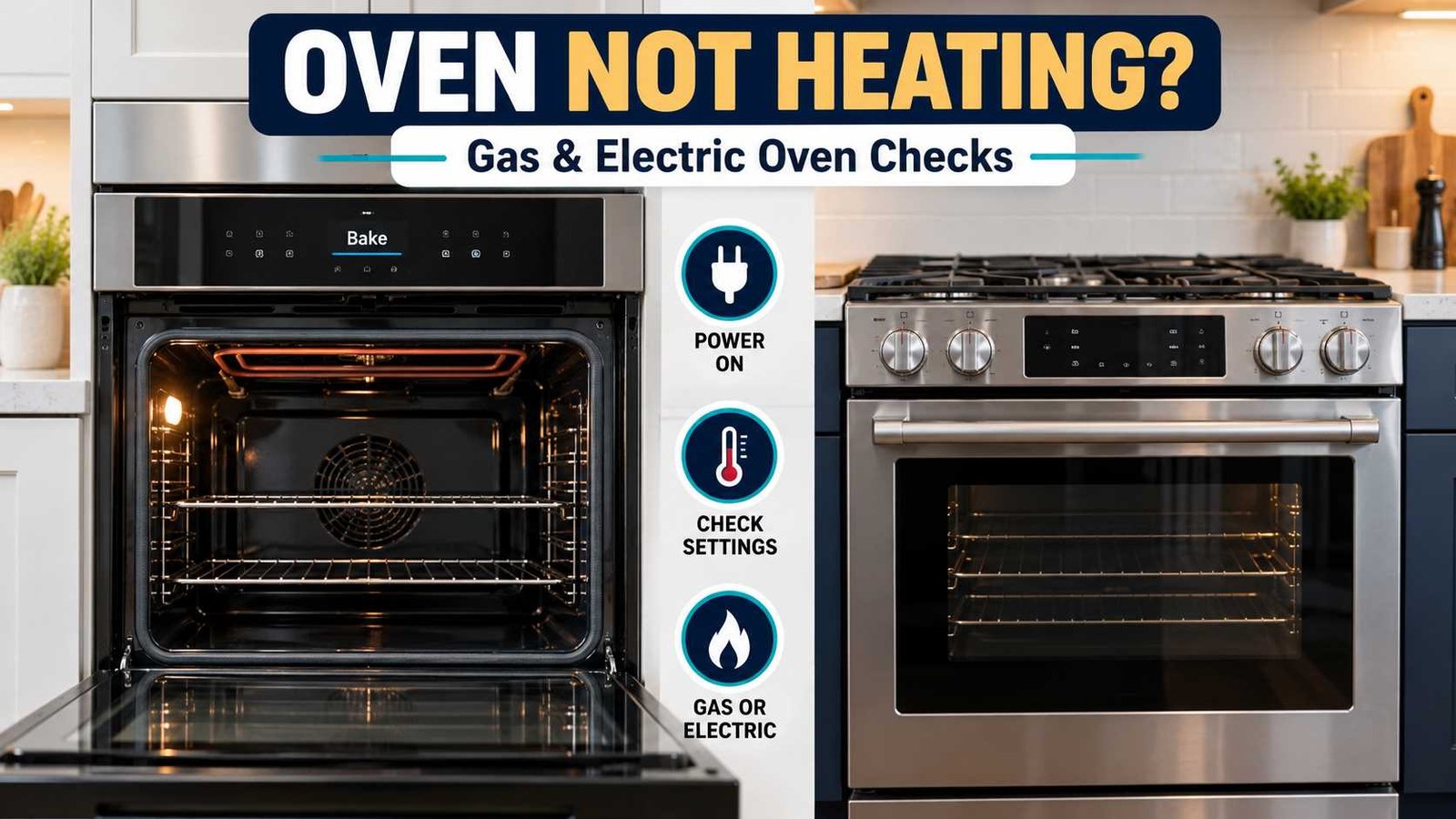
 If your oven will not heat, first confirm that Bake is selected, the temperature is set and the cooking programme has actually started. A delayed start, control lock or demonstration mode can prevent heating even when the clock and display work. If the settings are correct, the next step depends on whether you have a gas or electric oven and whether it is completely cold or merely struggling to reach temperature.
Stop using the oven if you smell gas, see sparking or a visibly damaged element, notice smoke or scorching, or experience repeated electrical trips. Do not attempt live electrical testing, manually ignite a modern gas burner or bypass an oven safety device. If gas is suspected, leave the area without operating switches and contact your gas emergency provider from outside.
Which oven-not-heating symptom do you have?
| What happens | First useful check | What it may suggest |
|---|---|---|
| Display works but oven stays cold | Bake setting, delayed start and demo mode | Control setting or heating-system fault |
| Oven and display have no power | Household electrical supply | Power interruption or appliance fault |
| Broil works but Bake does not | Record the failed cooking mode | Bake-specific element, ignition or control issue |
| Oven warms but never reaches the set temperature | Preheat time, door closure and temperature behaviour | Heating, sensor or calibration issue |
| Gas cooktop works, but oven stays cold | Oven mode and installation history | Oven ignition or model-specific gas-supply issue |
| Fault code or repeated shutdown | Exact code and model manual | Condition requiring model-specific diagnosis |
1. Check the cooking mode and control settings
Select Bake and an appropriate cooking temperature, then follow the model’s Start or confirmation step. Some ovens appear ready on the display but do not heat until Start is pressed. Cancel any programmed Delay Start and check for Control Lock, Demo, Showroom or Sabbath mode where your manual says those features affect operation. The cancellation sequence varies by manufacturer; do not use a button combination intended for a different model.
Check that the door closes fully and that nothing blocks the gasket or latch. Certain ovens suspend an element when the door is open, especially in Broil mode. If knobs were removed for cleaning, make sure they were returned to their correct positions.
2. Distinguish a power problem from a heating problem
A blank display or completely unresponsive oven may have lost power. Check the household breaker or fuse only from a safe, dry location. If a breaker has tripped, do not repeatedly reset it; repeated trips or damaged wiring require an electrician or appliance technician. A wall oven or range that is hardwired should not be pulled out to inspect its terminals.
Electric ranges can sometimes have working lights or surface controls while the oven does not heat. In North America, many electric ranges need a suitable 240-volt supply for heating, while control circuits can operate differently. In the UK, Ireland, Australia and New Zealand, supply and installation arrangements differ. A professional should confirm the required supply against the rating label and installation guide; the user should not measure live voltage.
3. Electric oven will not heat: what might have failed?
Bake element or hidden heating element
A failed bake element is one possible explanation when an electric oven powers on but does not heat properly. Some models have an exposed element at the bottom of the cavity, while others conceal it under the oven floor. With the oven switched off and completely cool, look only at visible surfaces for damage such as blistering, a split or burn marks. Do not lift a concealed oven floor or touch electrical connections.
Do not rely on the element glowing red: certain elements are concealed, and electronic controls may cycle elements in ways that are not obvious to the user. A technician can check the appropriate part and control circuit using the correct service documentation.
Broil element, temperature sensor or control fault
An oven that broils but does not bake gives a useful clue, but it does not prove the bake element alone is defective. A failed broil element can also impair particular cooking modes. The temperature sensor, thermal protection and electronic control can cause inaccurate temperatures or prevent heating. Diagnosing them generally involves disassembly or electrical measurements and is not a homeowner check.
4. Gas oven will not heat: check the symptom, not the burner
Gas ovens may use a hot-surface igniter, electronic spark ignition or, on some older units, a standing pilot. If a gas cooktop still lights but the oven does not, that does not confirm the oven burner has gas or that its ignition system is healthy. GE’s guidance notes that certain newly installed ranges can have an oven-side regulator setting issue while the surface burners continue working. Such a problem belongs with the installer or qualified gas technician.
A weak igniter, faulty ignition control or gas safety component can leave an oven cold even when the display operates. Do not remove the oven base to watch an igniter, manually light a sealed burner, adjust a regulator, loosen the gas connector or test burner wiring. Gas-appliance diagnosis is model-specific and requires appropriate qualifications.
5. What if the oven heats, but not enough?
Some complaints described as no heat are actually slow preheating or inaccurate oven temperature. Check whether the appliance is still preheating, whether the door closes correctly and whether the selected mode is designed for conventional baking or convection. Avoid opening the door repeatedly while checking. Preheat times vary with cavity size, starting temperature, selected temperature and model.
For food that cooks unevenly, consider rack position, cookware and overcrowding before requesting calibration. If the oven repeatedly underheats after following the manual’s operating guidance, record the discrepancy and request a professional temperature-performance check. One inexpensive oven thermometer reading is not enough to identify a failed sensor, particularly during normal temperature cycling.
6. If Bake works but Broil does not, or the reverse
Test only the functions the owner’s manual permits, and stop if there is sparking, smoke or a gas smell. Note which mode fails, whether preheat ever completes and whether an error appears. Different modes may use different elements, burners and control logic. A working Broil mode does not prove every part of the Bake circuit is sound, nor does working Bake rule out a broil-side problem.
7. Check the model number before replacing any part
Find the full model number on the appliance rating label, commonly near the oven door frame, storage drawer or another location identified in the manual. Look up its heating type, fault-code definitions and operating instructions. An element, igniter, sensor or control board that fits one model may be incompatible with a visually similar oven. Do not buy parts solely because a general troubleshooting page calls them common failures.
When should you call for repair?
- Seek urgent help: gas odor, smoke, sparking, scorching, a suspected fire or unsafe electrical conditions. In a fire, follow local emergency guidance and do not reopen a closed oven door to investigate flames.
- Arrange qualified appliance service: the correct controls are set and the oven still stays cold; Bake or Broil repeatedly fails; a fault code returns; or the temperature remains unreliable.
- Contact the installer: the oven has never heated properly since installation, relocation or fuel conversion.
- Use an electrician or qualified gas technician: suspected supply wiring, gas regulator, connector or burner-system faults.
When booking, provide the model number, fuel type, the exact symptom, the selected cooking mode and any displayed code. That information helps separate operating settings from a heating-component failure without risky trial-and-error repairs.
Keep the oven working reliably
Keep the door gasket clean, remove food residue once the cavity is cool and follow the manufacturer’s guidance for self-cleaning and ventilation. Avoid covering oven vents or the cavity floor with foil unless the manual explicitly permits it. Most importantly, distinguish an oven that will not start from one that powers on but cannot produce heat. The first calls for settings and supply checks; the second may require a properly diagnosed element, ignition or control repair.

Daniel Brooks is a US-based appliance troubleshooting researcher with 12 years of experience studying washer, dryer, refrigerator, and dishwasher faults. He reviews manufacturer manuals and converts technical error codes into safe, practical guidance for homeowners.