
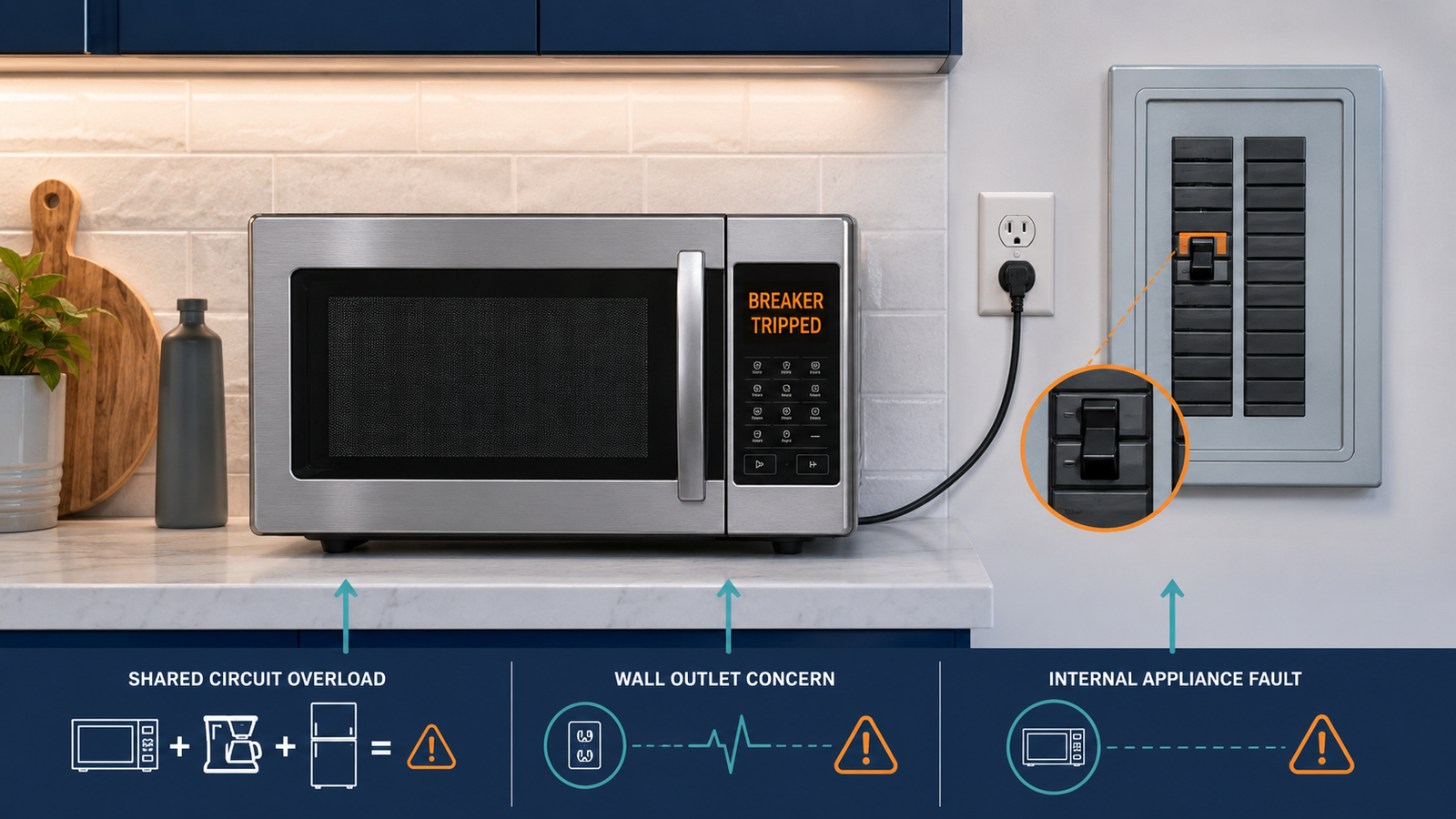
 When a microwave trips the circuit breaker, the problem may be an overloaded circuit, an unsuitable power connection, a damaged outlet, a wiring fault, or an internal microwave failure. The exact cause cannot be identified from the trip alone.
Unplug the microwave and check its plug, power cord, and wall outlet for heat, discolouration, cracking, or a burning smell. When there is no visible damage, the breaker may be reset once after other appliances on the circuit have been switched off.
Do not continue testing the microwave if the breaker trips again. GE and Whirlpool both advise disconnecting the appliance and arranging service after a repeated trip. Never remove the microwave’s outer cover because dangerous voltage may remain inside even after it has been unplugged. er
| Item | What you need to know |
|---|---|
| Problem | Microwave trips a breaker, fuse, GFCI, AFCI, RCD, or safety switch |
| Most likely cause | Circuit overload, incorrect supply, outlet problem, wiring fault, or internal microwave fault |
| Safe first step | Unplug the microwave and inspect the plug, cord, and outlet externally |
| Can you reset the breaker? | Once, provided there is no smoke, heat, damage, crackling, or burning smell |
| Can you keep using the microwave? | No, not if the protective device trips again |
| Homeowner repair level | External checks only |
| Internal repair difficulty | High and potentially dangerous |
| Who may be needed? | Appliance technician, licensed electrician, manufacturer, or landlord |
| Important warning | Do not open the microwave cabinet or touch internal components |
Why Does a Microwave Trip the Circuit Breaker?
A circuit breaker disconnects power when it detects more current than the circuit is designed to carry or a short-circuit condition. Other protective devices respond to different electrical problems.
For example:
- A standard breaker or fuse mainly protects wiring from excessive current and short circuits.
- A GFCI or RCD detects current leaking away from its intended path.
- An AFCI detects electrical patterns associated with arcing.
- An Australian safety switch generally refers to an RCD or combined protective device.
The device that trips can provide useful information, but it does not prove which component has failed. A microwave that trips a standard breaker may be overloading the circuit or developing an internal short. A GFCI, RCD, or safety-switch trip may point toward current leakage, but professional testing is still required. the Microwave Immediately If You Notice These Signs
Do not reset the breaker or reconnect the microwave when you notice:
- Smoke or visible sparks
- A burning or hot-plastic smell
- A melted, cracked, or discoloured plug
- Scorching around the wall outlet
- Buzzing, crackling, or fizzing from the plug or socket
- A power cord that feels unusually hot
- Bare, cut, or frayed wires
- An electric shock or tingling sensation
- A damaged microwave door, latch, or outer cabinet
- A breaker that trips repeatedly
Electrical Safety First advises users not to ignore burn marks, hot plugs or sockets, arcing sounds, blown fuses, or tripping breakers. WorkSafe New Zealand gives similar advice for damaged cords, scorching, smoke, sparks, hot spots, and repeated breaker trips. Disconnect the appliance and have it assessed by a qualified person. high-voltage warning:** Do not remove the outer cabinet. A microwave contains high-voltage circuitry, and its capacitor may retain a dangerous charge after the power cord has been unplugged. Special equipment and training may be required for diagnosis. ly When the Breaker Trips
The timing of the trip can help a technician narrow the investigation. It should not be treated as a confirmed diagnosis.
| When the trip occurs | Possible fault area | Safe next action |
|---|---|---|
| Immediately after plugging it in | Power cord, line filter, internal wiring, outlet, or supply fault | Unplug it and arrange inspection |
| When Start is pressed | Heating circuit, power-control circuit, interlock system, or overloaded supply | Stop after one repeated trip |
| Several seconds into heating | Component failing under load, overheating connection, or weak circuit protection | Disconnect and book diagnosis |
| When the door opens or closes | Door-latch or safety-interlock area | Stop using it; do not adjust switches |
| Only when another appliance is running | Shared-circuit overload | Turn off other loads and confirm circuit requirements |
| At random points during cooking | Loose connection, intermittent component fault, heat-related fault, or circuit problem | Stop using it until inspected |
| GFCI, RCD, or safety switch trips | Possible current leakage or protection-device compatibility issue | Disconnect and seek qualified testing |
Breaker trips immediately when the microwave is plugged in
A trip before any cooking command suggests that the fault is present as soon as mains power enters the appliance. Possible areas include the power cord, plug, line filter, control power supply, internal wiring, or the wall circuit.
Do not keep plugging the microwave back in. An electrician may need to inspect the outlet and circuit, while an appliance technician may need to examine the microwave.
Breaker trips when Start is pressed
Pressing Start activates the microwave’s higher-power heating systems. The display and light can work normally because they use much less power than the heating circuit.
A trip at this point can indicate:
- A circuit that cannot support the microwave’s load
- Another high-power appliance sharing the circuit
- A fault in the microwave’s high-voltage or inverter system
- A control or wiring fault
- A problem in the door-interlock system
The timing narrows the investigation, but internal electrical testing is needed before naming a specific part.
Breaker trips after a few seconds
A delayed trip may occur when a component begins drawing abnormal current under load or when a poor electrical connection heats up. It can also happen when a circuit is already close to its limit.
Do not repeatedly run short cooking tests. Repeated trips can stress the plug, socket, breaker, wiring, and microwave.
Breaker trips when the door opens or closes
Microwave doors use safety-interlock mechanisms that prevent operation with the door open. A breaker trip linked to door movement requires professional attention.
Do not slam the door, adjust the latch hooks, tape the door closed, or attempt to reposition or bypass an interlock switch. Panasonic specifically warns against adjustments or repairs to the door, control-panel frame, and safety-interlock switches. rips only when other appliances are running
The microwave may be sharing a circuit with a kettle, toaster, coffee maker, air fryer, refrigerator, dishwasher, or another high-demand appliance. Their combined demand may exceed the circuit’s capacity.
This is more likely when:
- Kitchen lights dim when the microwave starts
- The trip happens only at busy cooking times
- Another appliance stops at the same moment
- The microwave is connected through a power board or extension lead
- The problem stops when other appliances are turned off
The long-term answer is not simply to avoid using everything at once. Check the microwave’s installation instructions and have an electrician confirm whether the circuit is suitable.
Common Causes of a Microwave Tripping the Breaker
1. Too many appliances on the same circuit
A microwave can use a substantial amount of electrical power while heating. When several appliances share the same branch circuit, their combined demand may trip the breaker.
WorkSafe New Zealand recommends limiting the number of appliances connected to one outlet to avoid circuit overload. ect or non-dedicated electrical supply
Electrical requirements differ by brand, model, country, and installation type. Always check the rating label, owner’s manual, and installation instructions.
For its North American countertop and over-the-range microwaves, GE specifies a 120-volt, properly grounded individual branch circuit protected by a 15- or 20-amp breaker or time-delay fuse. GE states that its over-the-range models should be on a dedicated circuit. These figures should not be applied automatically to models sold in other countries. ion cord, adaptor, or overloaded power board
A microwave should normally be connected directly to a suitable grounded wall outlet. An underrated extension lead can overheat, reduce voltage at the appliance, or contribute to breaker operation.
GE strongly recommends against using an extension cord with a microwave and advises using a properly grounded dedicated outlet. Some individual manuals may describe minimum extension-cord requirements, but direct wall connection remains the safer standard approach. a grounding pin or use an adaptor to make an incompatible plug fit.
4. Damaged power cord, plug, or wall outlet
A loose connection can generate heat and electrical arcing. Check only what is visible without dismantling the outlet or microwave.
Stop using the appliance if you find:
- Loose plug contact
- Melted plastic
- Brown or black marks
- Cracked insulation
- Exposed conductors
- Heat at the plug or outlet
- Buzzing or crackling
A damaged wall outlet or household wiring requires an electrician. A damaged microwave cord normally requires an authorised or qualified appliance repairer.
5. Weak, damaged, or unsuitable breaker
Circuit breakers can deteriorate or develop poor connections. However, replacing the breaker should not be the first assumption simply because it trips.
A licensed electrician must confirm:
- The breaker type and rating
- Circuit conductor size
- Connection condition
- Measured appliance load
- Whether other outlets share the circuit
- Whether an AFCI, GFCI, RCD, or combined device is involved
Never install a higher-rated breaker to stop the tripping. The circuit wiring may not be designed for it.
6. Household wiring or grounding fault
Loose connections, damaged cables, poor grounding, or an unsuitable outlet may cause the breaker or another protective device to operate.
When a breaker continues to trip after appliances have been unplugged, WorkSafe New Zealand advises calling a licensed electrician. AFCI, RCD, or safety-switch operation
These devices are not identical to standard overload breakers.
GE explains that a GFCI responds to excessive current leakage to ground, while an AFCI responds to electrical patterns that resemble arcing. If one continues to trip after resetting, service is recommended. government electrical-safety guidance distinguishes circuit breakers, which protect wiring from overloads and short circuits, from RCD safety switches, which help protect people from electric shock. al microwave fault
Possible technician-level fault areas include:
- Door-interlock switches or latch mechanism
- Power cord or internal wiring
- Electrical noise or line filter
- Control-board relay
- High-voltage capacitor
- High-voltage diode
- Magnetron
- High-voltage transformer
- Inverter power board on applicable models
This list does not mean that one of these parts is definitely defective. Microwave designs vary, and the parts must be tested using the correct model documentation and professional procedures.
Safe Checks You Can Perform
Keep every microwave panel closed during these checks.
Step 1: Unplug the microwave
Switch the microwave off and remove its plug from the wall outlet when it is safely accessible.
For a built-in, drawer, or over-the-range model with an inaccessible plug, turn off its identified circuit at the electrical panel. Do not remove an installed microwave to reach wiring.
Step 2: Look, listen, and smell
Inspect the visible cord, plug, wall outlet, and microwave exterior.
Stop immediately if you find heat, scorch marks, damaged insulation, smoke, unusual smells, or electrical sounds. Do not reconnect the microwave.
Step 3: Check whether other appliances lost power
Identify which lights and outlets stopped working when the breaker tripped. This can help show whether the microwave shares a circuit with other kitchen appliances.
Do not open the electrical panel beyond operating the normal breaker handle.
Step 4: Remove other loads
Switch off and unplug other appliances supplied by the same circuit where practical.
This check is intended only to identify a possible overload. It does not prove that the wiring or microwave is safe.
Step 5: Remove extension leads and adaptors
Connect the microwave only to the permanent wall outlet specified by its instructions. Do not test it through an extension lead, multi-plug adaptor, travel adaptor, or power board.
Step 6: Check the model’s requirements
Find the model number and review the owner’s manual or installation instructions for:
- Required voltage and frequency
- Grounding or earthing requirements
- Required circuit rating
- Dedicated-circuit instructions
- Restrictions on extension leads
- Installation requirements
Do not assume that specifications from another microwave apply to yours.
Step 7: Reset the breaker once
Only proceed when there is no smoke, heat, burning smell, visible damage, or electrical shock.
Move a standard tripped breaker fully to Off and then back to On. Some breakers appear to be on even though the handle is sitting between positions.
Step 8: Stop if it trips again
GE advises trying the microwave once after resetting the breaker and unplugging it for service if the breaker trips again. Whirlpool also says not to continue trying to operate a microwave after the breaker or fuse trips again. m repeated tests with different cooking times, foods, power levels, or outlets.
What Not to Do
Never:
- Reset the breaker repeatedly
- Hold a breaker in the On position
- Replace a fuse with a higher rating
- Install a larger breaker without an electrician’s assessment
- Move the microwave to an unverified circuit as repeated testing
- Use an extension lead to bypass the original outlet
- Remove the microwave’s cabinet
- Touch internal wiring
- Test or discharge the high-voltage capacitor
- Bypass or adjust door-interlock switches
- Operate a microwave with a damaged door or latch
- Attempt live-voltage measurements
GE does not provide do-it-yourself microwave repair instructions because of retained high voltage, complex circuitry, and the special equipment needed for diagnosis. blem the Microwave or the House Wiring?
The following signs can help decide who should investigate first.
| Observation | More likely direction |
|---|---|
| Only the microwave causes the trip | Microwave fault or microwave-specific load issue |
| Several appliances cause the same circuit to trip | Circuit, breaker, outlet, or wiring problem |
| Microwave trips only with other appliances running | Shared-circuit overload |
| Breaker trips while the microwave is unplugged | Household electrical problem |
| Plug or wall outlet is hot or discoloured | Outlet, connection, cord, or supply fault |
| Microwave trips on another professionally verified suitable circuit | Microwave fault becomes more likely |
| GFCI, RCD, or safety switch trips | Current leakage or protective-device issue requires testing |
| Microwave works until Start is pressed | Fault appears when the heating load is activated |
A small lamp or low-power appliance working in the same outlet does not fully prove that the circuit can safely supply a microwave. That is a practical inference from the microwave’s much higher operating demand. An electrician can perform a proper outlet, grounding, wiring, voltage, and load assessment. essional Should You Call?
Call an appliance technician when:
- The breaker trips only when the microwave is connected or started
- The trip is linked to opening or closing the door
- The microwave hums, smells abnormal, or stops during heating
- The circuit has been checked and confirmed suitable
- The manufacturer recommends appliance service
- The microwave is built in or over the range
Call a licensed electrician when:
- Several appliances trip the same circuit
- The breaker trips while the microwave is unplugged
- The wall outlet is loose, hot, damaged, or discoloured
- The property has old wiring or an old fuse box
- The microwave shares a circuit that may be overloaded
- A GFCI, AFCI, RCD, or safety switch repeatedly trips
- You are unsure whether the outlet is grounded or correctly rated
Contact the manufacturer or retailer when:
- The microwave is still under warranty
- The problem began soon after installation
- The appliance may be subject to a safety recall
- An authorised service provider is required
- The owner’s manual gives model-specific instructions
Contact the landlord or property manager when:
- You rent the property
- The fixed outlet, circuit, or switchboard may be faulty
- The microwave was supplied with the rental
- A built-in appliance cannot be disconnected safely
Regional Electrical Terms and Differences
United States and Canada
Common terms include circuit breaker, fuse, GFCI, and AFCI. Many North American household microwaves operate on 120-volt grounded circuits, but the required breaker rating and dedicated-circuit instructions must come from the specific manual.
United Kingdom and Ireland
Readers may describe the microwave as tripping the consumer unit, MCB, RCBO, or RCD, or blowing the plug fuse. Do not replace a plug fuse with a higher rating unless the manufacturer’s instructions specify that rating.
Electrical Safety First recommends unplugging a microwave and contacting the retailer, manufacturer, or qualified technician when there are burn marks, arcing sounds, heat, blown fuses, or circuit-breaker trips. and New Zealand
The protective device may be called a circuit breaker, RCD, or safety switch. WorkSafe New Zealand advises immediately disconnecting an appliance that repeatedly trips a breaker and having it repaired by a qualified person or replacing it. crowave with the correct local plug, voltage rating, and installation arrangement.
Should You Repair or Replace the Microwave?
Repair may make sense when:
- The microwave is relatively new
- It is under warranty
- It is a built-in, drawer, or over-the-range model
- The appliance is otherwise in good condition
- The required part remains available
- The repair estimate is reasonable compared with replacement
Replacement may be more practical when:
- The microwave is old or heavily worn
- The door, cabinet, and control system have several problems
- There is severe heat or electrical damage
- Parts are unavailable
- The repair estimate approaches the cost of a suitable replacement
- The model has an unresolved safety recall
- A countertop model can be replaced more economically
Do not base the decision only on one suspected part. Ask for a written diagnosis and estimate before approving a repair.
Frequently Asked Questions
Is it safe to use a microwave that has tripped the breaker once?
Inspect the plug, cord, outlet, and microwave exterior before doing anything else. When there is no heat, damage, smoke, arcing sound, or burning smell, the breaker may be reset once. Stop using the microwave if it trips again. the microwave clock work until I press Start?
The clock and control panel require much less power than the heating system. Pressing Start activates higher-power components, which may expose an overloaded circuit or internal fault.
Does a microwave need a dedicated circuit?
It depends on the model and local electrical requirements. GE specifies an individual grounded circuit for its North American countertop and over-the-range models and states that its over-the-range microwaves should be on a dedicated circuit. Check your own installation instructions. tension cord cause a microwave to trip the breaker?
An unsuitable or underrated extension lead can contribute to voltage drop, overheating, poor connections, and circuit problems. Connect the microwave directly to a suitable grounded wall outlet whenever its instructions require this. lty door switch trip the breaker?
A fault in the door-interlock area is one possible technician-level cause, especially when the trip occurs as the door opens, closes, or Start is pressed. Timing alone does not confirm a failed switch. Do not adjust or bypass the interlocks. magnetron trip a circuit breaker?
A magnetron or another part of the microwave’s high-voltage system may cause abnormal current under load. However, a magnetron cannot be diagnosed safely from the symptom alone. Professional testing is required.
Should I replace the circuit breaker with a larger one?
No. A larger breaker may allow more current through wiring that was not designed for it, increasing the risk of overheating or fire. Only a licensed electrician should determine the correct circuit and breaker rating.
Should I call an electrician or a microwave repair technician?
Call an electrician when multiple appliances affect the circuit, the outlet is damaged, or the breaker trips without the microwave connected. Call an appliance technician when the electrical supply is suitable but the microwave repeatedly causes the trip.
Daniel Brooks is a US-based appliance troubleshooting researcher with 12 years of experience studying washer, dryer, refrigerator, and dishwasher faults. He reviews manufacturer manuals and converts technical error codes into safe, practical guidance for homeowners.