
An oven that turns on but does not heat may have a simple setting problem, an interrupted power supply, a failed electric heating element, a weak ga
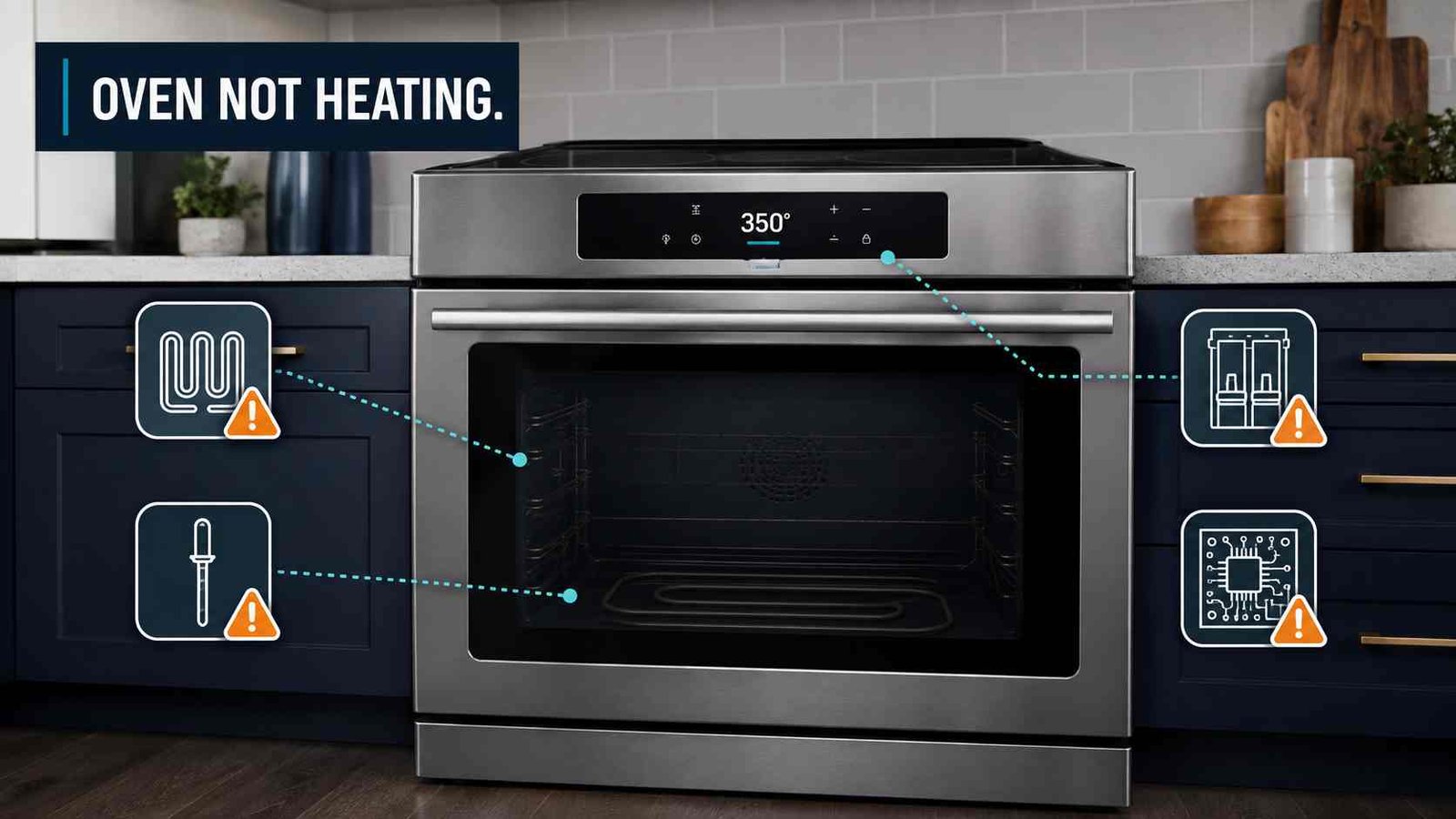
s igniter, or an internal control fault. Start by confirming the cooking mode and temperature, cancelling any delayed program, checking the clock, and looking for Demo or Control Lock mode.
Stop using the oven if you smell gas, see a damaged or sparking element, notice scorching around the plug or cooker switch, or the appliance repeatedly trips a breaker, fuse, or RCD. These symptoms require professional attention rather than repeated resets.
The correct diagnosis depends on whether the oven is completely cold, heats only in certain modes, or heats but cannot reach the selected temperature.
| Item | Details |
|---|---|
| Problem | Oven powers on but does not heat normally |
| Appliance types | Electric, gas, convection, built-in, freestanding and double ovens |
| Most common cause categories | Incorrect setting, power problem, failed element, gas igniter, sensor or control fault |
| Safe first check | Confirm the mode, temperature, clock, timer, lock and Demo settings |
| Can the oven still be used? | Not when there is gas odour, electrical damage, sparking or repeated circuit tripping |
| Typical repair difficulty | Simple setting checks are easy; internal electrical and gas diagnosis requires a professional |
| Who may be needed? | Appliance technician, electrician or licensed gas professional |
Why an Oven Can Turn On Without Producing Heat
An illuminated display does not prove that every heating circuit is working.
On an electric range, the display, clock, light or cooktop may work while the oven remains cold. Possible reasons include a failed bake element, an incomplete electrical connection, a control problem or a fault affecting only the oven circuit.
GE notes that full-size electric ranges require the correct electrical supply for their heating systems. Its troubleshooting guidance recommends checking the breakers and having loose, burned or incorrect supply connections assessed by an installer or electrician.
A gas oven can also have working surface burners but a cold oven. The oven uses its own igniter, burner and controls, so an oven ignition fault may not affect the cooktop.
Identify the Exact Heating Symptom
Before checking parts, determine what the oven is actually doing.
| Symptom | More likely cause category |
|---|---|
| Display is completely blank | Household power, breaker, fuse, outlet, cooker switch or installation |
| Display works but oven is completely cold | Settings, Demo mode, element, igniter, power connection or control |
| Broil or Grill works but Bake does not | Bake element, lower burner ignition or associated control circuit |
| Bake works but Broil or Grill does not | Upper element or its control circuit |
| Fan operates but cavity remains cold | Convection element, power supply or control fault |
| Oven heats slowly | Supply issue, failing element, door seal, sensor, airflow or normal preheat behaviour |
| Oven reaches the wrong temperature | Sensor position, calibration, thermostat or control fault |
| One cavity of a double oven works | Fault isolated to the non-working cavity or its controls |
| Breaker trips as heating starts | Element, wiring, connection or other electrical fault |
This symptom-first approach helps narrow the problem without opening the appliance or testing live circuits.
Safe Checks to Perform First
1. Confirm the Cooking Mode
Select a normal cooking mode such as Bake, Conventional or Fan Bake, then choose a temperature and press Start if the control requires it.
Do not judge the oven using a mode that may not preheat in the usual way. Air Fry, Keep Warm, Proof, Eco and automatic programs can behave differently from standard Bake.
2. Check the Temperature Setting
Make sure the selected temperature is high enough to produce noticeable heat.
A setting entered incorrectly, displayed in an unfamiliar temperature unit, or left at a low warming temperature can appear to be a heating failure.
3. Set the Clock After a Power Cut
Some electronic ovens will not heat while the clock is flashing or remains unset after a power interruption. Bosch and AEG support guidance both identify an unset clock as a possible reason an oven will not operate.
Set the time using the instructions for your exact model. Button sequences vary.
4. Cancel Delayed or Automatic Cooking
Check for words or symbols such as:
- Delay
- Start Time
- End
- Duration
- Auto
- Timer
A delayed-start or automatic program can make the controls appear normal while preventing immediate heating. Whirlpool and AEG list programmed cooking settings among the checks for an oven that is powered but not heating.
Press Cancel, return the oven to its normal clock display, and select Bake again.
5. Check Control Lock or Child Lock
Control Lock may prevent the keypad or oven functions from starting.
The unlocking method is model-specific. Some models use a dedicated Lock key, while others require a combination of controls. Consult the owner’s manual instead of trying random button combinations.
6. Look for Demo Mode
Demo or showroom mode allows the control panel to operate without energising the heating system.
Depending on the brand, the display may show:
- Demo
- DEMO
- d
- tESt
- tE 5t
- A showroom message
Maytag explains that Demo mode permits control functions to be demonstrated without turning on the oven. Samsung similarly states that an oven in Demo mode will not heat, although a gas cooktop may still ignite.
Use the model’s manual to deactivate it. There is no universal Demo-mode sequence.
7. Close the Door Fully
Check that cookware, foil, a misaligned rack or accumulated debris is not preventing the door from closing.
On selected ovens and cooking modes, the heating system may respond differently when the door is open. Whirlpool advises checking that the door is fully closed when troubleshooting both electric and gas models.
Do not force a locked door.
8. Check the Household Electrical Supply
Look at the breaker panel, fuse box or consumer unit.
A breaker can appear to be on while sitting between its normal On and Off positions. Switch it fully off and then back on once.
For UK and Irish installations, check whether a fuse or RCD has operated. For built-in ovens, also check the accessible cooker isolation switch.
Do not continue resetting the circuit when it trips again. Repeated tripping indicates a fault that needs professional diagnosis.
Power-Supply Problems
A new or recently moved oven deserves special attention.
An incorrect power connection may allow lights and controls to operate while preventing the heating components from receiving the required supply. Samsung uses the message bAd LinE on selected ranges to identify an improper power connection and recommends checking the installation instructions or using a professional installer.
Possible power-related situations include:
- A tripped breaker or RCD
- A blown household fuse
- An incorrect new installation
- A loose or damaged power connection
- A burned plug, outlet or cooker switch
- Insufficient circuit capacity
- A hardwired connection fault
- A supply interruption affecting only part of the appliance
Do not pull out a heavy range to inspect wiring, especially when it has a gas connection or anti-tip bracket. Electrical connection checks belong to an electrician or qualified installer.
Stop using the oven if the plug, outlet or switch feels unusually hot, shows burn marks, makes buzzing or crackling sounds, or repeatedly blows a fuse. Electrical Safety First advises disconnecting the appliance and contacting the manufacturer or a qualified repair professional.
Electric Oven Heating-Element Causes
Electric ovens may use separate elements for Bake, Broil or Grill, and convection cooking.
Failed Bake Element
The bake element is normally the main heat source during baking. It may be visible on the oven floor or concealed below an internal panel.
A visible element may show:
- A crack or complete break
- A blistered section
- A burned spot
- Unusual deformation
- Sparking during operation
GE recommends switching off the circuit and unplugging the range before inspecting an exposed bake element for cracks or breaks.
A concealed element cannot be assessed safely by appearance from inside the cavity. Do not remove oven panels merely to find it.
Failed Broil or Grill Element
When Bake works but Broil or Grill does not, the upper element or its circuit may have failed.
The opposite symptom is also useful: if the upper element heats but normal Bake leaves the oven cold, the lower element or associated control circuit becomes more likely.
Failed Convection Element
Many true-convection ovens have a circular heating element around or behind the fan.
The fan can continue to run even when that element has failed. A spinning fan therefore does not confirm that convection heat is being produced.
Other ovens use the fan to circulate heat from the normal bake and broil elements. The design varies, so check the manual before assuming the appliance has a separate convection element.
An Element Does Not Always Glow Continuously
Some elements cycle on and off during cooking, and some concealed elements cannot be seen. Whirlpool states that cycling is normal during oven operation. A lack of constant red glow is therefore not enough by itself to prove failure.
A completely cold oven, visible element damage or failure in one specific mode provides stronger diagnostic evidence.
Gas Oven Ignition and Supply Causes
Gas-oven diagnosis requires stricter limits because the appliance combines gas, combustion and electrical ignition.
Weak or Failed Igniter
Many gas ovens use a glow-bar igniter. The igniter must heat and draw the correct current before the gas safety valve opens.
A weak igniter may glow but still fail to open the valve reliably. The result may be:
- No flame
- Very slow ignition
- Intermittent heating
- Failure to maintain temperature
GE advises checking whether the oven igniter glows when Bake is selected. If no glow appears, possible causes include the igniter, oven controls or other electrical components.
Observation through the normal oven opening may be reasonable when the manual permits it. Do not touch, remove, clean aggressively or electrically test the igniter.
Gas Supply Interruption
Confirm only that other gas appliances or the cooktop behave normally and that no emergency gas shutoff has been triggered.
Do not loosen fittings or search for a leak yourself. Valve, regulator and supply diagnosis requires a licensed gas professional.
Gas Odour or Delayed Ignition
A gas smell, small explosion-like sound, flash, or long delay before burner ignition is not a normal no-heat symptom.
Gas safety warning: Do not operate flames, electrical switches or devices near a suspected gas leak. Ventilate and leave the area when safe, then contact the local gas emergency service or supplier from a safe location. Energy Safe Victoria and Gas Networks Ireland provide this same core emergency advice.
Do not continue trying to light the oven.
Temperature Sensor, Thermostat and Calibration Causes
Sensor and calibration problems usually cause inaccurate heating rather than a completely cold oven.
Temperature Sensor Position
Some electric ovens have a slim metal temperature probe visible inside the rear of the cavity.
Check whether it appears:
- Severely bent
- Touching the oven wall
- Loose
- Physically damaged
Do not remove, straighten forcefully or test it electrically.
Faulty Sensor or Thermostat
A failed sensor, thermostat or control circuit may cause:
- Underheating
- Overheating
- Long preheat times
- Unstable temperature
- Unexpected cycling
- A temperature-related error code
Whirlpool includes an incorrectly positioned temperature sensor among the possible reasons an oven does not heat as expected.
Calibration Is Not a No-Heat Repair
Calibration changes how the control interprets the selected temperature. It may help when food consistently cooks too quickly or too slowly, but it will not repair an oven that stays completely cold.
Whirlpool advises using the model-specific calibration procedure only after determining that an adjustment is needed.
Control Board and Internal Control Causes
When settings, power and visible components do not explain the problem, the fault may be internal.
Possible causes include:
- Electronic control board
- Heating relay
- Selector or function switch
- Mechanical thermostat
- Thermal protection device
- Door switch or latch circuit
- Damaged internal connector
- Burned or broken wiring
These are possible causes, not conclusions that can be reached from the symptom alone.
A technician may need wiring diagrams, resistance measurements and live-voltage tests to isolate the fault. Homeowners should not perform those procedures.
What Different Symptoms Usually Suggest
Oven Light and Display Work, but There Is No Heat
First check Demo mode, Delay Start, Control Lock and the selected cooking mode.
If all settings are correct, likely categories include:
- Incorrect or incomplete power supply
- Failed element
- Failed gas igniter
- Control-board or relay fault
Stovetop Works, but the Oven Is Cold
For an electric range, the oven may have a failed element or separate control problem.
For a gas range, a working cooktop does not rule out a failed oven igniter. Whirlpool specifically identifies the igniter as a possible reason the gas stovetop works while the oven does not.
Broil Works, but Bake Does Not
This usually directs attention toward the bake heating system.
On an electric oven, that may include the lower bake element or its relay and wiring. On a gas oven, it may involve the bake igniter, burner or related control circuit.
Fan Runs, but the Oven Remains Cold
Possible causes include:
- Demo mode
- Failed convection element
- Loss of heating power
- Failed relay or control
- Incorrect cooking function
The cooling fan may also run independently of the cooking heat. Do not assume every fan sound comes from the convection system.
Oven Stopped After a Power Cut
Set the clock, cancel automatic cooking and check for Demo mode.
A model-specific power reset may also help when the controls have stopped responding. Whirlpool and Maytag commonly advise turning the circuit off for approximately one minute before restoring it, but the model manual should take priority.
Oven Stopped After Self-Cleaning
Allow the oven to cool completely. Check whether the door remains locked or a cleaning status remains on the display.
If power was interrupted during cleaning, some Whirlpool and Maytag models allow a latch reset by cancelling the cleaning cycle or briefly switching off the circuit. If the latch remains stuck after cooling, service is recommended.
Do not force the door or remove panels.
Breaker Trips When Heating Starts
Stop resetting the breaker.
A heating element, internal wire, terminal, connection or another electrical component may be shorting when energised. This symptom requires an appliance technician or electrician.
Can You Reset an Oven That Is Not Heating?
A reset may clear a temporary control problem, but it cannot repair a burned element, failed igniter, damaged wire or defective power connection.
A general safe reset is:
- Cancel the current cooking cycle.
- Record or photograph any error code.
- Turn the oven off.
- Switch off its breaker or approved isolation point.
- Leave the power off for about one minute.
- Restore power.
- Set the clock if required.
- Select a normal Bake mode and test once.
Do not reset the appliance when:
- Gas is smelled
- The breaker trips repeatedly
- There are burn marks or electrical noises
- An element is visibly broken
- The appliance is wet or flood-damaged
- The power connection appears damaged
Repeated resetting can erase useful symptoms without correcting the fault.
What to Record Before Booking a Repair
Collecting a few details can shorten the diagnosis:
- Full model number
- Any displayed error code
- Electric, gas or dual-fuel design
- Whether the clock and light work
- Whether Bake, Broil and Fan modes behave differently
- Whether the cooktop works
- Whether the oven recently lost power
- Whether it was newly installed or moved
- Whether the failure followed self-cleaning
- Whether a breaker, fuse or RCD operates
- Any smell, sound, spark or visible damage
Do not invent or guess a model number. The appliance rating plate may be around the door frame, behind a storage drawer, on a side panel or in another manufacturer-specified location.
Common Parts Associated With an Oven That Does Not Heat
| Part or system | Possible symptom | Appropriate action |
|---|---|---|
| Bake element | Broil works but Bake does not | Visual check only after isolation; service if damaged |
| Broil or grill element | Bake works but upper heat does not | Professional diagnosis |
| Convection element | Fan runs but convection mode stays cold | Professional diagnosis |
| Gas igniter | Gas cooktop works but oven does not light | Licensed gas or appliance professional |
| Temperature sensor | Incorrect or unstable temperature | Model-specific diagnosis |
| Thermostat | Poor regulation or no heating on mechanical models | Professional diagnosis |
| Control board or relay | Controls work but elements receive no command | Appliance technician |
| Selector switch | One or more modes fail | Appliance technician |
| Door switch or latch | Heating blocked or cleaning lock remains active | Follow manual, then service |
| Electrical supply | Display works but heating fails or breaker trips | Electrician or qualified installer |
Regional and Model Differences
The basic diagnostic logic is similar across countries, but the terminology and electrical arrangements vary.
In the United States and Canada, readers may encounter terms such as range, wall oven, circuit breaker, Bake and Broil.
In the United Kingdom and Ireland, the same functions may be described as cooker, built-in oven, Grill, consumer unit, fuse, RCD and cooker isolation switch.
Australia and New Zealand commonly use oven, grill, switchboard, circuit breaker and isolation switch.
Do not assume that a reset, Demo-mode sequence, voltage requirement, fuse arrangement or component location applies to every regional version. Use the exact model and local installation instructions.
When to Stop Troubleshooting
Arrange professional service when:
- The oven remains cold after the safe setting and power checks
- One cooking mode consistently fails
- The appliance repeatedly trips a breaker, fuse or RCD
- A heating element is cracked, blistered or sparking
- The plug, socket or switch shows heat damage
- There is a gas smell or delayed ignition
- A gas igniter glows without reliable burner ignition
- An error code returns after one reset
- The oven stopped working immediately after installation
- The door remains locked after the oven has cooled
- Internal panels, wiring or live testing would be required
Use an electrician for household supply and fixed-wiring concerns, a licensed gas professional for gas-supply or combustion concerns, and an appliance technician for elements, sensors, controls and internal oven components.
Frequently Asked Questions
Why is my oven on but not heating?
The control may be in Demo, Delay or Lock mode, or the oven may have a power-supply, element, igniter or control fault. Start with the clock, cooking mode, temperature and household breaker.
Why does my stovetop work but not my oven?
The stovetop and oven use different heating components and controls. An electric oven may have a failed bake element, while a gas oven may have a weak or failed oven igniter even though the surface burners still operate.
Can a temperature sensor stop an oven from heating?
A sensor or its circuit can interfere with temperature control, but sensor problems more commonly cause inaccurate, unstable or insufficient heat rather than a completely cold oven.
How can I tell whether the bake element has failed?
After disconnecting power and allowing the oven to cool, inspect an exposed element for cracks, breaks, blisters or burn spots. A concealed element or one that looks normal may still require professional testing.
Why does the oven fan run without heat?
The fan motor can operate independently of the heating element. The appliance may be in Demo mode, the convection element may have failed, or the oven may have a power or control problem.
Will resetting the breaker fix an oven that does not heat?
It may clear a temporary control issue or restore a tripped circuit. It will not fix a failed element, igniter, damaged connection or control board. Do not repeatedly reset a breaker that trips again.
Is it safe to use Broil if Bake does not work?
Continuing to use an oven with a suspected element or electrical fault is not recommended until the cause is known. Stop immediately if there is visible damage, sparking, unusual odour or circuit tripping.
Who should repair an oven that is not heating?
Choose an appliance technician for internal oven components, an electrician for circuit or fixed-wiring issues, and a licensed gas professional for gas supply, ignition or combustion problems.
Daniel Brooks is a US-based appliance troubleshooting researcher with 12 years of experience studying washer, dryer, refrigerator, and dishwasher faults. He reviews manufacturer manuals and converts technical error codes into safe, practical guidance for homeowners.