
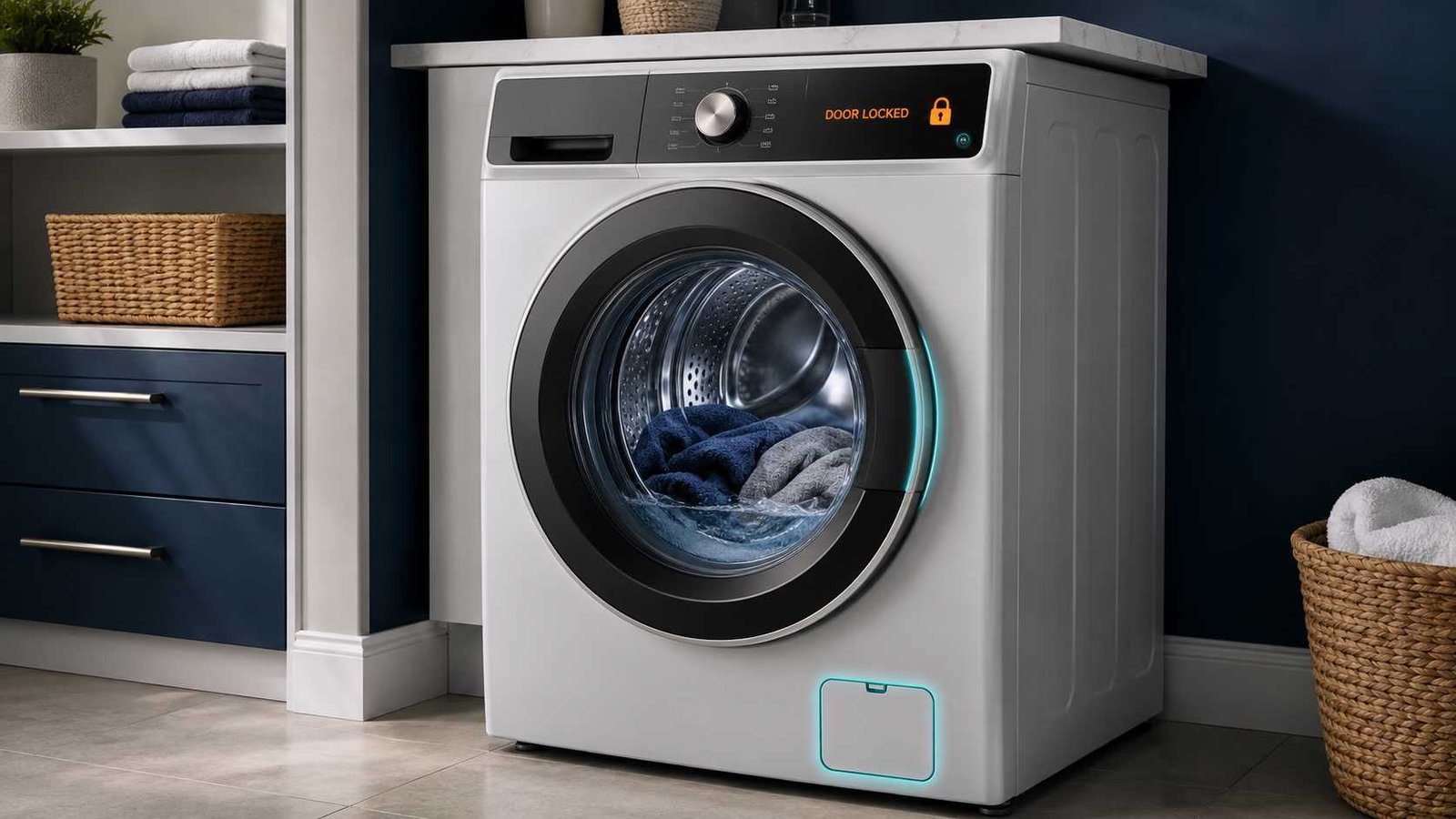
 A washing machine door that will not unlock is often responding to a safety condition rather than a broken handle. The machine may still detect water, drum movement, excessive temperature, or an active wash setting. A drainage problem is especially likely when water remains visible through a front-load washer door.
Start by waiting a few minutes after the cycle ends. Then check for water inside the drum and look for a lock symbol, drain error, or unfinished program. Do not pull the handle forcefully.
Stop using the washer and arrange service if the door opens while the drum is moving, the machine contains water, or a wash or spin cycle is active. That indicates the safety lock is not working correctly.
| Detail | What you need to know |
|---|---|
| Problem | Washing machine door or washer lid remains locked |
| Most likely cause | Water has not drained or the cycle has not fully ended |
| Safe first check | Wait several minutes and check for water inside |
| Other common causes | Hot water, Child Lock, extended tumbling, power interruption or a lock fault |
| Repair difficulty | Basic checks are usually easy; component diagnosis requires service |
| Can the washer still be used? | Only after the door unlocks normally and the underlying problem is resolved |
| Professional help needed | When it remains locked after draining, cooling and a model-approved reset |
Why Does a Washing Machine Door Stay Locked?
Modern washing machines use a safety interlock to prevent the door from opening at an unsafe time. The lock generally stays engaged while the drum is moving, water is above a safe level, or the temperature inside is too high.
A locked door immediately after a cycle does not always mean something has failed. Electrolux and AEG state that selected machines can take approximately three to five minutes to release the lock after a program ends. Whirlpool and Maytag also advise that unlocking may take up to five minutes while spinning and draining stop.
The cause is more likely to be a fault when the door remains locked for an extended period, water is left in the drum, an error code is displayed, or the washer repeatedly fails to complete its cycle.
Water remains inside the drum
A front-load washer usually will not release its door while it detects water inside. This prevents the water from spilling onto the floor.
Water may remain because of:
- A blocked pump filter
- A kinked or restricted drain hose
- A blocked household drain
- An interrupted program
- Excessive suds
- A failed drain pump
- A water-level sensing problem
Samsung and Bosch identify blocked pump filters and restricted drain hoses as common causes of washing machine drainage problems.
The cycle has not fully ended
The control panel may appear inactive even though the washer is completing a drain, cool-down, tumble or safety check.
Listen for pump operation or slow drum movement. Do not attempt to release the door until all movement has stopped.
The water or drum is still hot
A washer may keep the door locked after a high-temperature, sanitising or drying program. This protects the user from hot water, steam and heated door glass.
Samsung advises allowing hot water to cool before using an emergency draining procedure. On some models, cooling can take considerably longer than the normal end-of-cycle delay.
Child Lock or Control Lock is active
A key, padlock, CL or Child Lock symbol may indicate that the controls are locked. On selected machines, the feature can also affect door operation.
The button combination for turning it off is not universal. It may involve holding one or two marked buttons for several seconds. Use the instructions printed on the control panel or consult the manual for the exact model.
Do not copy a Child Lock sequence from a different washer. The same brand may use different controls across product series and countries.
An extended-care option is still running
Features such as Fresh Hold, Tumble Fresh, anti-crease, remote operation or extended tumbling may continue after the main wash has finished.
Selected Maytag washers remain locked during Fresh Hold until the option is cancelled. Similar features on other brands may behave differently.
The power was interrupted
A power cut or control problem can leave the electronic lock in an unfinished state. Restoring power or completing a model-approved reset may release it, provided the machine does not contain water and is not too hot.
A mechanical or electrical part has failed
When the drum is empty and cool but the door remains locked, possible faults include:
- Door-lock or interlock assembly
- Door strike or latch
- Door handle
- Drain pump
- Water-level sensor or pressure system
- Wiring connection
- Main electronic control
These are possible causes rather than confirmed diagnoses. Internal testing can involve mains-powered components and should be completed by a qualified appliance professional.
Before Trying to Open the Door
Complete these checks first:
- Confirm that the drum has stopped moving.
- Wait at least several minutes after the program ends.
- Look through the glass for water.
- Check whether the door glass feels unusually hot.
- Look for a drain, door or lock error on the display.
- Check for a Child Lock or Control Lock symbol.
- Keep towels and a shallow container nearby if manual draining may be required.
Safety warning: Never force the door or use an emergency release while water is visible above the bottom edge of the door. Escaping water may be hot and can flood the room.
Bosch operating guidance warns against opening a washer when water can be seen through the glass and against reaching into a drum that is still turning.
How to Unlock a Washing Machine Safely
Work through the following steps in order. Stop when the door opens normally.
1. Wait for the normal lock delay
Wait three to five minutes after the cycle appears to finish.
The exact delay varies by washer. During this time, the machine may still be draining, slowing the drum or allowing the lock mechanism to cool. Listen for the release click before pulling the handle.
2. Pause or cancel the program
Press the washer’s Start/Pause, Pause/Cancel or equivalent control once.
Wait for the drum to stop and the lock symbol to disappear. Some Whirlpool and Maytag front-load models use two presses of Pause/Cancel, but this should not be treated as a universal sequence.
Do not repeatedly press controls while the washer is responding. Give it time to complete the safety process.
3. Turn off Child Lock or Control Lock
Look for a key, padlock or Child Lock marking beside one or more buttons.
Follow the button-hold instruction printed on the panel. When no instruction is visible, locate the official manual using the full model number.
Child Lock is not the same as a failed physical door lock. Resetting or replacing the door interlock will not deactivate a control setting.
4. Run a drain program
When water is visible, use a program labelled:
- Drain
- Drain and Spin
- Spin
- Rinse and Spin
- Pump Out
The correct name varies by model.
A successful drain program should remove the water and allow the lock to release at the end. Maytag advises running Drain and Spin when a front-load washer remains locked, while selected Whirlpool compact washers use Rinse and Spin.
If the pump runs but the water level does not fall, stop the program. The washer may have a blocked filter, restricted hose or pump fault.
5. Perform a model-approved power reset
A reset may help when the drum is empty, the washer is cool and the controls have stopped responding.
A general safe approach is:
- Switch the washer off.
- Disconnect it from the electrical supply.
- Wait for the period stated in the manual.
- Restore power.
- Turn the machine on and wait for the lock to release.
Reset periods vary. LG guidance for selected front-load washers recommends waiting one to two minutes, while some Whirlpool and Maytag instructions specify approximately two to five minutes.
A reset will not correct a physical blockage or failed drain pump. It should not be used as a substitute for removing water safely.
6. Drain the washer manually
Use manual draining only when:
- The control-panel drain program does not work
- Water is still visible
- The washer is switched off and disconnected
- The water has cooled
- The model manual confirms the procedure
Many front-load machines have a small access cover near the lower front of the cabinet. Depending on the model, it may contain an emergency drain hose, pump-filter cap or both.
A typical documented procedure is:
- Switch off and unplug the washer.
- Allow hot water to cool.
- Place towels and a low container in front of the machine.
- Open the lower service cover.
- Use the emergency drain hose when fitted.
- Drain the water in small amounts.
- Replace the hose cap securely.
- Check the manual before opening the pump filter.
- Refit all covers before restoring power.
Samsung confirms that selected front-load washers can be drained through an emergency hose and that the door should unlock once the water is removed. Bosch also instructs users to disconnect power before draining through the service area.
Not every washer has an emergency drain hose. Do not loosen a filter cap unless the manual confirms its location and procedure.
7. Use the emergency door release only when documented
Some washing machines have a manual release tab, lever or pull cord behind the lower service cover. Others do not.
Before using one:
- Confirm the full model number
- Find the official manual
- Drain all water
- Allow the appliance to cool
- Disconnect the electrical supply
- Follow the exact manufacturer procedure
Bosch manuals for selected models instruct users to drain the machine before pulling the emergency release. Miele documentation also shows that emergency-release designs differ significantly between machines.
Do not use a generic string, wire, screwdriver or prying method found in an unofficial video. It can damage the handle, seal, latch or safety mechanism.
What to Do When Water Is Still in the Washer
A locked door with visible water should be treated primarily as a drainage problem.
Check the drain hose
Inspect the hose behind the washer without disconnecting internal components.
Look for:
- Sharp bends
- Crushing behind the appliance
- Twisting
- Freezing in an unheated area
- A blocked household standpipe or sink connection
- Incorrect hose positioning
Straighten an obvious external kink, but do not pull the washer forward while it is running or full of water.
Check for a drain error
The display may show a brand-specific drain code, such as Samsung 5C or 5E, LG OE, Whirlpool F9 E1 or another model-dependent code.
The article for that exact error code should be followed because procedures and meanings can differ by brand and series.
Clean an accessible pump filter
Some front-load machines have a user-cleanable drain-pump filter. Others have no homeowner-accessible filter.
Only clean it when the owner’s manual confirms that it is designed for user access. Disconnect power, cool the water and drain the machine first.
Common obstructions include coins, lint, hair, small fabric items and other objects left in pockets. A filter that is difficult to turn should not be forced.
Stop if the washer continues filling
Turn off the water supply and disconnect the appliance if water continues entering while the washer is off or if the level keeps rising.
This may involve an inlet valve, water-level sensing or control fault and requires professional diagnosis.
Door Locked but No Water Is Visible
When the drum appears empty, consider these causes.
The washer is still hot
Allow additional cooling time after:
- Sanitary cycles
- Very hot washes
- Steam programs
- Washer-dryer drying cycles
- Cleaning or maintenance programs
Do not cool the door with water or attempt to defeat the temperature lock.
An optional program is active
Cancel extended tumbling, Fresh Hold, anti-crease, remote operation or another post-cycle option according to the control-panel instructions.
The control has stalled
Perform the manufacturer-approved power reset. Restore power and allow the washer time to complete its lock check.
The handle is not operating the latch
A loose or unusually light handle may indicate that the handle mechanism has broken. Do not keep pulling it. Repeated force can damage additional door parts.
The washer incorrectly detects water
A water-level sensor or pressure-system problem may tell the control that the tub is still full even when no water is visible. This requires technician-level testing.
Front-Load Door Versus Top-Load Lid Lock
A front-load washer uses a watertight side door and safety interlock. It normally stays locked whenever opening could release water.
A top-load washer uses a lid lock and lid strike. North American users often search for washer lid locked rather than washing machine door locked.
On top-load machines, the lid may remain locked while the basket slows or the control completes a safety sequence. Whirlpool and Maytag recommend a five-minute power interruption for selected top-load models with a lid that will not open.
Do not pry up a locked top-load lid. A damaged lid lock can prevent the next cycle from starting and may create a safety risk.
Possible Faulty Parts
| Possible part | What it does | Signs that may point to it | Repair level |
|---|---|---|---|
| Door-lock assembly | Secures the door and reports its position | Lock clicks repeatedly or remains engaged after draining | Professional |
| Door strike or latch | Connects the door to the lock | Visible damage or poor door alignment | Professional |
| Door handle | Moves the latch mechanism | Handle feels loose or has no resistance | Professional |
| Drain pump | Removes water from the tub | Humming, no drainage or repeated drain error | Professional |
| Pump filter | Protects the pump from debris | Water drains slowly or not at all | User-accessible on selected models |
| Pressure or water-level system | Reports the water level | Door stays locked despite an empty drum | Professional |
| Electronic control | Manages the cycle and lock | Unresponsive controls or repeated unexplained locking | Professional |
| Wiring connection | Carries power and signals | Intermittent operation or recurring lock faults | Professional |
A faulty part should not be selected only from the symptom. Diagnosis may require resistance checks, live electrical testing or cabinet disassembly, which are outside safe homeowner troubleshooting.
What Not to Do
Do not:
- Pull the handle with excessive force
- Pry around the door with a tool
- Bypass the lock switch
- Insert wire or string around the door
- Remove internal electrical panels
- Test live voltage
- Open the filter while hot water remains
- Tip a washer that is full of water
- Reach into a moving drum
- Use the appliance when its door can open during operation
Miele warns that forcing a locked door can damage its locking mechanism.
When to Call an Appliance Technician
Arrange professional service when:
- The washer has drained and cooled but remains locked
- The door does not release after the documented reset
- The handle, strike or latch is broken
- The lock clicks repeatedly
- A door-lock error keeps returning
- The machine does not pump out water
- Water continues entering while the washer is off
- The washer incorrectly reports water in an empty drum
- There is burning, overheating or an electrical smell
- Water is leaking near electrical parts
- The door can open during washing or spinning
- Internal wiring or component testing is required
Do not use a washer with a safety lock that releases during an active cycle. Disconnect it and arrange repair.
How to Find the Correct Unlocking Procedure
Before using a manual release, find the washer’s full model number.
It may be printed:
- Inside the door opening
- Around the door frame
- Behind the door
- Under the lid
- On the rear cabinet
- Near the pump-filter cover
- On a rating plate beside the serial number
Enter the complete model number on the manufacturer’s official support website and download the owner’s manual.
Search within the manual for:
- Door will not open
- Door locked
- Emergency release
- Emergency drain
- Pump filter
- Power failure
- Child Lock
- Drain and Spin
Do not rely on a manual for a similar-looking washer. Control sequences and emergency-release designs can differ within the same brand.
Frequently Asked Questions
How long should a washing machine door stay locked after a cycle?
Many machines release within a few minutes, but the exact delay varies. Selected Electrolux, AEG, Whirlpool and Maytag models may take approximately three to five minutes while the drum stops, water drains or the lock cools. Hot programs and washer-dryer cycles can require longer.
Will unplugging the washing machine unlock the door?
It may reset an electronic lock when the drum is empty and cool, but it will not safely release a door while the washer still detects water or heat. The required disconnection period varies by model, commonly from about one to five minutes in official manufacturer guidance.
How do I open a washing machine that is full of water?
First try the washer’s Drain, Spin, Drain and Spin, or Pump Out program. If that fails, disconnect the appliance, let hot water cool and follow the model’s official emergency-draining instructions. Do not release the door until the water level is below the opening.
Can a blocked filter keep the washing machine door locked?
Yes. A blocked pump filter can prevent drainage, and the washer may keep the door locked because it still detects water. Only open and clean the filter when the manual confirms it is user-accessible and the machine has been safely drained.
Why is the door locked when the drum looks empty?
The washer may still be hot, an extended-care setting may be active, or the control may still receive an incorrect water-level signal. A failed lock assembly, sensor or electronic control is also possible.
Does Child Lock stop the washing machine door from opening?
It can on selected models, particularly some front-load washers. On other machines, it only disables the controls. Check the model manual for the meaning of the key, padlock or CL symbol and the correct deactivation sequence.
Can I force open a locked washer door?
No. Force can break the handle, latch, lock or door trim and may release hot water. Drain and cool the washer first, then use only a manufacturer-documented emergency release.
What should I do if clothes are trapped inside overnight?
Switch off the washer and disconnect it if there is an electrical fault, unusual smell or uncontrolled filling. If water remains, follow the approved drain procedure. Arrange prompt service when safe draining and resetting do not release the door.

Oliver Grant is a UK appliance diagnostics writer with 10 years of experience covering washing machines, boilers, dishwashers, and tumble dryers. He specializes in fault-code interpretation, model-specific checks, and clear guidance based on official technical documentation.