
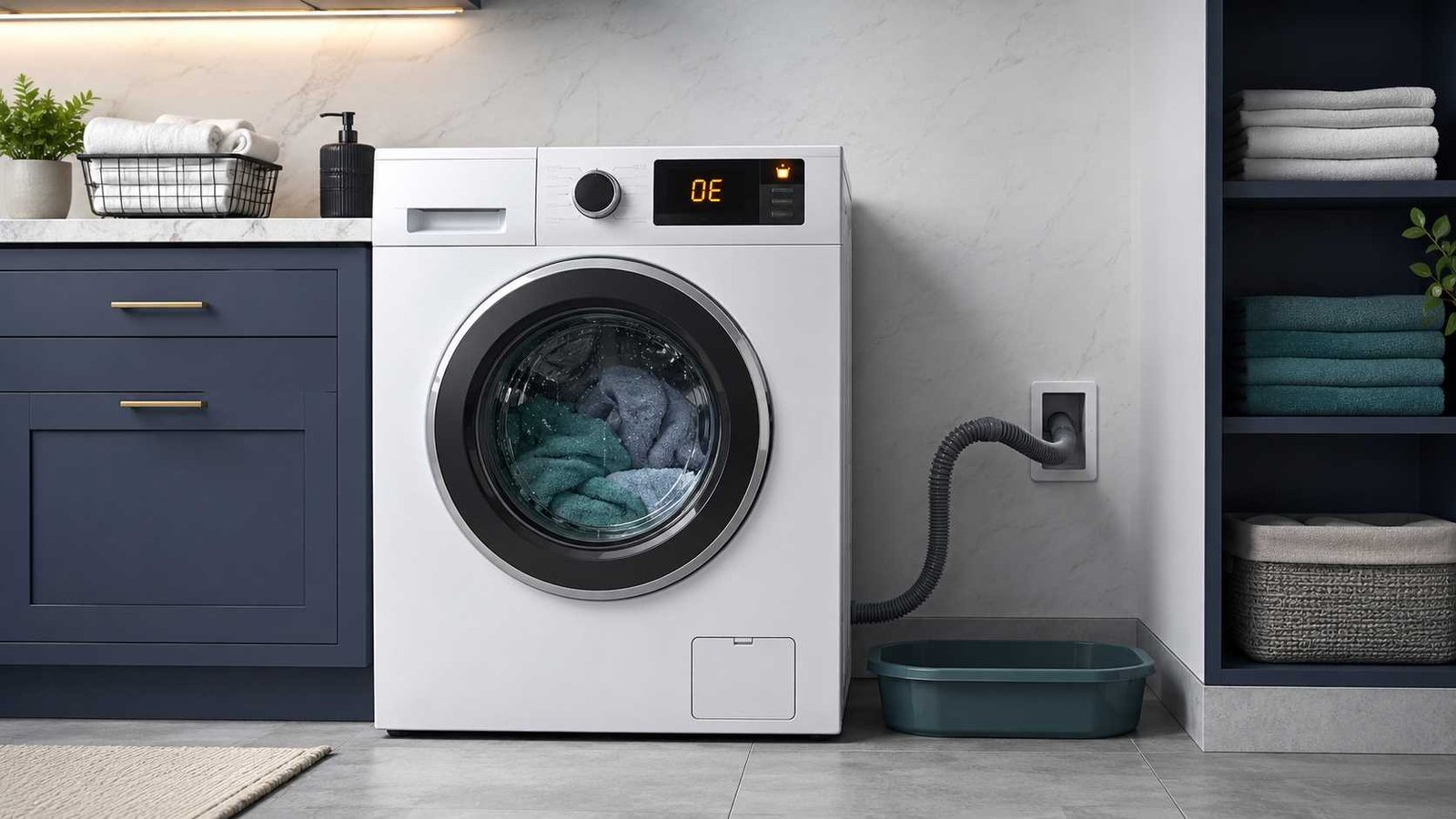
 The LG washer OE error code means the washing machine cannot drain its water normally. The most common causes are a kinked or blocked drain hose and, on front-load models, a clogged drain pump filter.
Start by switching off the washer and checking whether the drain hose is bent, crushed against the wall, frozen, or blocked. If your front-load washer has water remaining in the drum, use its emergency drain hose before removing the pump filter.
Do not keep restarting the washer while it is full of water. Stop using it immediately if water is leaking, you smell burning, the electrical breaker trips, or an internal repair would be required. A reset may clear the display after the drainage problem is corrected, but it will not remove a physical blockage.
LG OE Error Quick Answer
| Item | Answer |
|---|---|
| Error code | OE, sometimes read as 0E |
| Meaning | The washer cannot drain water within the expected time |
| Brand | LG |
| Appliance | Washing machine, washer-dryer combo, or washer section of selected laundry systems |
| Most likely causes | Kinked drain hose or clogged pump filter |
| Safe first check | Inspect the drain hose behind the washer |
| Repair difficulty | Easy for external checks; professional diagnosis may be needed for internal faults |
| Can the washer still be used? | Not until the water drains normally and the code stops returning |
| Professional help needed when | The pump is silent, the code returns, or internal parts require testing |
On selected newer LG front-load control systems, the same drainage condition may appear as OE, E03, or E21.
What Does OE Mean on an LG Washer?
OE is a drainage error. It indicates that the washer has attempted to remove water but has not detected normal drainage within the required time.
It does not automatically mean that the drain pump has failed. LG identifies a kinked drain hose and a clogged pump filter as the main starting points. A blocked household drain, excessive detergent suds, freezing, or an internal drainage problem may also prevent water from leaving the machine.
The display uses the letter O, not the number zero. However, OE can easily look like 0E on a segmented control panel.
Symptoms That May Appear With the OE Code
An LG washer with a drainage problem may:
- Stop before completing the cycle
- Leave water in the drum
- Leave clothes unusually wet
- Refuse to begin the final spin
- Drain more slowly than normal
- Make a humming or gurgling sound
- Display OE again after being restarted
- Keep the door locked while water remains inside
These symptoms do not identify one particular failed part. They show that the washer has not completed the drainage stage correctly.
Most Common Causes of the LG Washer OE Error
| Possible cause | What you may notice | Safe next action |
|---|---|---|
| Kinked drain hose | Slow or no water flow | Straighten the hose |
| Compressed hose | Washer is close to the wall | Move the machine only if it can be done safely |
| Clogged pump filter | Pump hums but water remains | Clean the filter on applicable front-load models |
| Blocked household drain | Washer hose drains normally when removed from the standpipe | Clear the building drain |
| Excessive detergent suds | Heavy foam or OE with a clean filter | Reduce detergent and run the appropriate cleaning cycle |
| Frozen hose or pump area | Problem begins during freezing weather | Thaw using LG’s warm-water guidance |
| Weak or jammed pump | Intermittent, noisy, or poor drainage | Arrange professional diagnosis |
| Internal hose or sensing fault | External checks are clear but OE returns | Contact a qualified technician |
1. Kinked or compressed drain hose
The drain hose may become trapped between the washer and the wall, crushed under the appliance, or bent sharply enough to restrict water flow.
Inspect the full visible length of the hose. Straighten gentle bends, but do not pull, cut, extend, or reposition it in a way that conflicts with the installation manual.
LG notes that placing a washer too close to the wall can compress the drain hose. Its US guidance recommends maintaining approximately 4 inches or 10 centimetres of rear clearance where the installation allows it. Always follow the dimensions in your own model’s manual.
2. Clogged drain pump filter
Front-load LG washers and washer-dryer combo units commonly have a removable drain pump filter behind a small lower service cover. It can collect lint, coins, buttons and other debris.
LG states that this user-accessible pump filter is present on front-load washers and combo units, but not on LG top-load washers. The cover may be on the left or right depending on the model.
3. Blocked household drain
The washer may be working correctly while the standpipe, sink connection or household waste pipe is blocked.
LG recommends separating the washer hose from the drain opening and running a drain or spin test. If water leaves the washer hose normally, the blockage is more likely to be in the household drain.
Only perform this test when the loose hose can be secured over a suitable container or drain. A full washer can release a large volume of water quickly.
4. Too much detergent
Excessive suds can produce air pockets around the pump. The pump may begin drawing air instead of moving water effectively, causing the washer to register a drainage problem even when the filter is not visibly blocked.
LG advises reducing detergent and running a Tub Clean cycle when the filter is clear but excessive suds may have contributed to the error. Use only detergent suitable for your washer and follow the quantity stated in its manual.
5. Frozen drainage system
In freezing conditions, water can freeze inside the outlet hose or pump area. This is more likely when the appliance is installed in an unheated garage, utility room or outdoor laundry space.
LG provides model-dependent thawing instructions using warm water and a warm towel. Do not use boiling water because it creates a burn risk and may damage components.
6. Drain pump or internal drainage fault
When the external hose, filter and household drain are clear, the washer may have:
- A jammed or weakened drain pump
- An obstruction in an internal hose
- A loose or damaged pump connection
- A water-level sensing problem
- A control-system fault
These are possible technician findings, not conclusions that can be confirmed from the OE code alone. Internal testing may involve mains-powered components and should be left to a qualified appliance technician.
Before Troubleshooting: Drain the Water Safely
Standing water must be handled before opening the filter.
Safety warning: Wash water may be hot. Switch off and unplug the washer before opening the lower service area. Keep children away and use towels with a shallow container.
For a front-load model with an emergency drain hose:
- Press the Power button to switch off the washer.
- Unplug it from the electrical outlet.
- Place towels around the lower front of the machine.
- Put a shallow tray or container beside the service cover.
- Open the service cover.
- Carefully pull out the small residual-water hose.
- Hold the hose over the container.
- Remove its cap slowly.
- Drain the water in stages if the container is small.
- Refit the hose cap securely after the flow stops.
Do not pull the small hose too far. LG warns that stretching it can create a kink and stop the remaining water from flowing.
Not every model has the same access arrangement. Check the owner’s manual when you cannot identify a user-accessible emergency hose.
How to Fix the LG Washer OE Error
Step 1: Inspect the rear drain hose
Switch off the washer and inspect the hose behind it.
Look for:
- Sharp bends
- Compression against the wall
- Twisting
- Crushing under the appliance
- Visible debris
- A frozen section
- Incorrect placement in the drain opening
Straighten the hose without forcing it. Do not push the washer back so closely that the hose becomes trapped again.
Step 2: Check the standpipe or sink connection
Confirm that the household drain is not overflowing or draining slowly.
Warning signs include:
- Water rising in the standpipe
- Gurgling from a nearby sink
- Water backing up during discharge
- The washer hose draining correctly when removed from the pipe
A plumbing blockage is not repaired by replacing the washer pump.
Step 3: Run a Spin or Spin Only test
After checking the hose, restore power and select the model’s Spin, Drain or Spin Only function.
LG’s commonly published front-load sequence is:
- Press Power.
- Select Spin Speed until High is chosen.
- Press Start/Pause.
Control layouts differ, and some washers use a cycle dial or touchscreen. Consult the model manual if the machine does not provide the buttons described above.
Step 4: Listen to the pump
During the first part of the test, listen near the lower section of the washer.
| Sound or result | What it may suggest |
|---|---|
| Humming with strong water flow | The pump is operating and the drain path is open |
| Humming with little or no flow | A filter, hose or drainage path may still be restricted |
| Rattling or grinding | Debris may be contacting the pump, or the pump may need inspection |
| No pump sound | The pump may not be starting; professional diagnosis may be needed |
| Water drains from hose but backs up in standpipe | The household drain is likely restricted |
A humming sound confirms that the pump motor has started, but it does not prove that the entire drainage system is clear.
Step 5: Clean the pump filter on a front-load washer
After draining the remaining water and unplugging the appliance:
- Place a towel under the filter.
- Turn the filter counter-clockwise.
- Remove it slowly.
- Clear lint, coins, buttons and other debris.
- Wash the filter using warm water and a soft brush or sponge.
- Inspect the accessible filter opening for loose debris without reaching deeply inside.
- Refit the filter.
- Turn it clockwise until it is firmly seated.
- Refit the emergency hose cap.
- Close the service cover.
A loose filter or hose cap can cause leakage during the next cycle.
Do not use these instructions on a top-load washer unless its model manual specifically shows a user-removable filter.
Step 6: Check for excess suds
If the filter is clean:
- Check whether foam remains in the drum.
- Confirm that you are using the correct detergent type.
- Reduce the amount used in future loads.
- Run the model’s Tub Clean or recommended empty cleaning cycle.
Do not add more detergent during this test.
Step 7: Consider freezing
When the hose is frozen:
- Switch off the washer.
- Remove the laundry where possible.
- Follow the thawing method in the model manual.
- Wrap the exposed drain hose with a warm towel.
- Never apply an open flame, heat gun or boiling water.
- Test drainage only after the hose and washer have thawed.
Some official LG instructions use warm water between approximately 50°C and 60°C inside the drum, followed by a waiting period. Because designs vary, verify the procedure in the manual for your exact washer before adding water manually.
Step 8: Run an empty test
Once the hose, filter and drain are clear:
- Reassemble every cap and cover.
- Check that the floor is dry.
- Restore power.
- Run an empty Rinse and Spin, Spin Only or short cycle.
- Watch the drain hose and filter cover for leaks.
- Confirm that water exits normally.
- Check whether OE returns.
If the error comes back, stop repeating cycles and arrange further diagnosis.
LG OE Error but the Filter Is Clean
A clean filter does not rule out every drainage problem.
Check the following next:
Drain hose
A soft obstruction may be farther along the hose and not visible from the ends. Do not insert sharp objects that could puncture it.
Household drain
Remove the washer hose from the standpipe only when its discharge can be controlled safely. Strong flow from the hose points toward a blocked building drain.
Detergent suds
Heavy foam can produce an OE code without a solid blockage. Reduce detergent and use the washer’s recommended cleaning cycle.
Intermittent pump operation
A weakening pump may work during one test and fail during the next. Note whether the pump becomes unusually noisy, stops mid-drain or works only after the washer has cooled.
Internal obstruction
Small clothing items or debris may enter an internal sump hose. Accessing these components normally requires disassembly and should be left to a technician.
How to Reset an LG Washer After Fixing OE
Reset the washer only after correcting the drain problem.
A commonly published LG control reset is:
- Switch the washer off.
- Unplug it or switch off its circuit breaker.
- While power is disconnected, hold Start/Pause for about five seconds.
- Restore power.
- Run an empty drain or spin test.
Some LG guidance uses a different sequence, including holding both Power and Start separately. Procedures can vary by model and region, so the owner’s manual should take priority.
A reset does not clean the filter, straighten the hose, remove excess suds or repair a failing pump. If OE returns, continue with drainage troubleshooting rather than repeatedly resetting the controls.
Front-Load and Top-Load Differences
Front-load LG washers
Front-load models commonly provide:
- A lower service cover
- A small emergency drain hose
- A removable pump filter
- A Spin Only pump test
The exact location may be on the lower left or lower right.
Top-load LG washers
LG top-load washers generally do not have the same user-accessible front pump filter. Troubleshooting focuses on:
- The outlet hose
- Hose positioning
- Hose kinks
- A blocked household drain
- Freezing
- Whether water leaves during a spin test
Do not search for or dismantle a front filter that the model does not have.
OE, E03 and E21 Differences
On many LG washers, the display shows OE.
On selected newer front-load models, E03 or E21 may describe the same inability-to-drain condition. LG groups these codes together in its newer front-load error-code guidance.
Do not confuse:
- OE with IE, which concerns water entering the washer
- OE with UE, which concerns an unbalanced load
- Washer OE with an error shown on the dryer section of a combined laundry system
Check which appliance or control section is displaying the code.
Parts That May Need Professional Inspection
If the safe checks do not solve the problem, a technician may inspect:
| Component | Why it may be checked |
|---|---|
| Drain pump | It may be jammed, weak or electrically inoperative |
| Internal drain hose | A hidden object may restrict flow |
| Sump connection | Debris may block the path from the drum |
| Pump wiring | A damaged or loose connection may prevent operation |
| Water-level sensing system | The washer may not correctly detect that water has drained |
| Main control system | It may not operate or interpret the drainage circuit correctly |
Do not order a pump based only on the OE code. LG uses different parts across models, markets and production revisions. Parts should be matched using the complete model and serial information.
When to Call a Technician
Arrange qualified service when:
- OE returns after the hose and filter are clear
- The pump remains completely silent
- The pump works only intermittently
- Grinding continues after accessible debris is removed
- Water leaks from beneath the appliance
- The electrical breaker trips
- There is a burning or overheated smell
- The drain hose or filter housing is damaged
- The washer requires internal disassembly
- You cannot drain the standing water safely
LG’s current front-load guidance states that a recurring OE error after the recommended checks may require repair service.
Safety Warnings
Disconnect electrical power: Unplug the washer before opening the filter area or handling standing water.
Beware of hot water: Water released through the emergency drain hose may be hot. Allow it to cool before draining.
Control flooding: Use a shallow container and drain the washer in stages.
Do not force the door: A front-load door may remain locked while the machine contains water.
Avoid internal electrical work: Do not test live voltage, bypass safety devices or handle internal wiring.
Stop after the safe checks: A recurring code requires diagnosis rather than repeated operation.
Frequently Asked Questions
Can I continue using an LG washer with an OE error?
No. The washer has not completed drainage correctly. Repeated operation can leave more water in the machine and may increase the risk of leakage. Clear the drain problem and confirm normal operation with an empty test cycle first.
Does the OE code always mean the drain pump is bad?
No. LG identifies a kinked drain hose and clogged pump filter as common causes. A blocked household drain, frozen hose or excessive suds can produce the same error.
Why does my LG washer show OE when the filter is clean?
The blockage may be in the rear drain hose, household standpipe or an internal hose. Excessive detergent can also create air pockets that interfere with drainage. A weak or intermittent pump is another possibility.
How do I get the water out when OE appears?
On an applicable front-load washer, switch off and unplug the machine, open the lower service cover, and use the small emergency drain hose with a shallow container. Drain the water before removing the pump filter.
Where is the drain filter on an LG top-load washer?
LG states that the user-accessible drain pump filter described in its maintenance guidance is found on front-load and combo units, not top-load washers. Top-load owners should follow the model manual and begin with the outlet hose and household drain.
Can too much detergent cause an OE code?
Yes. LG explains that excessive suds can create air pockets that the pump cannot remove effectively. Reduce the detergent and run the recommended Tub Clean cycle after confirming that the filter and hose are clear.
Will unplugging the washer clear the OE error?
It may reset the control display, but it will not fix a blocked hose, dirty filter, frozen drain or faulty pump. Correct the drainage issue before performing a power reset.
Why does the pump hum but the washer does not drain?
The pump motor may be starting while water flow is restricted by the filter, hose or drain. A jammed or weakened pump is also possible. Clean the accessible drainage path first, then request service if normal flow does not return.
Daniel Brooks is a US-based appliance troubleshooting researcher with 12 years of experience studying washer, dryer, refrigerator, and dishwasher faults. He reviews manufacturer manuals and converts technical error codes into safe, practical guidance for homeowners.