
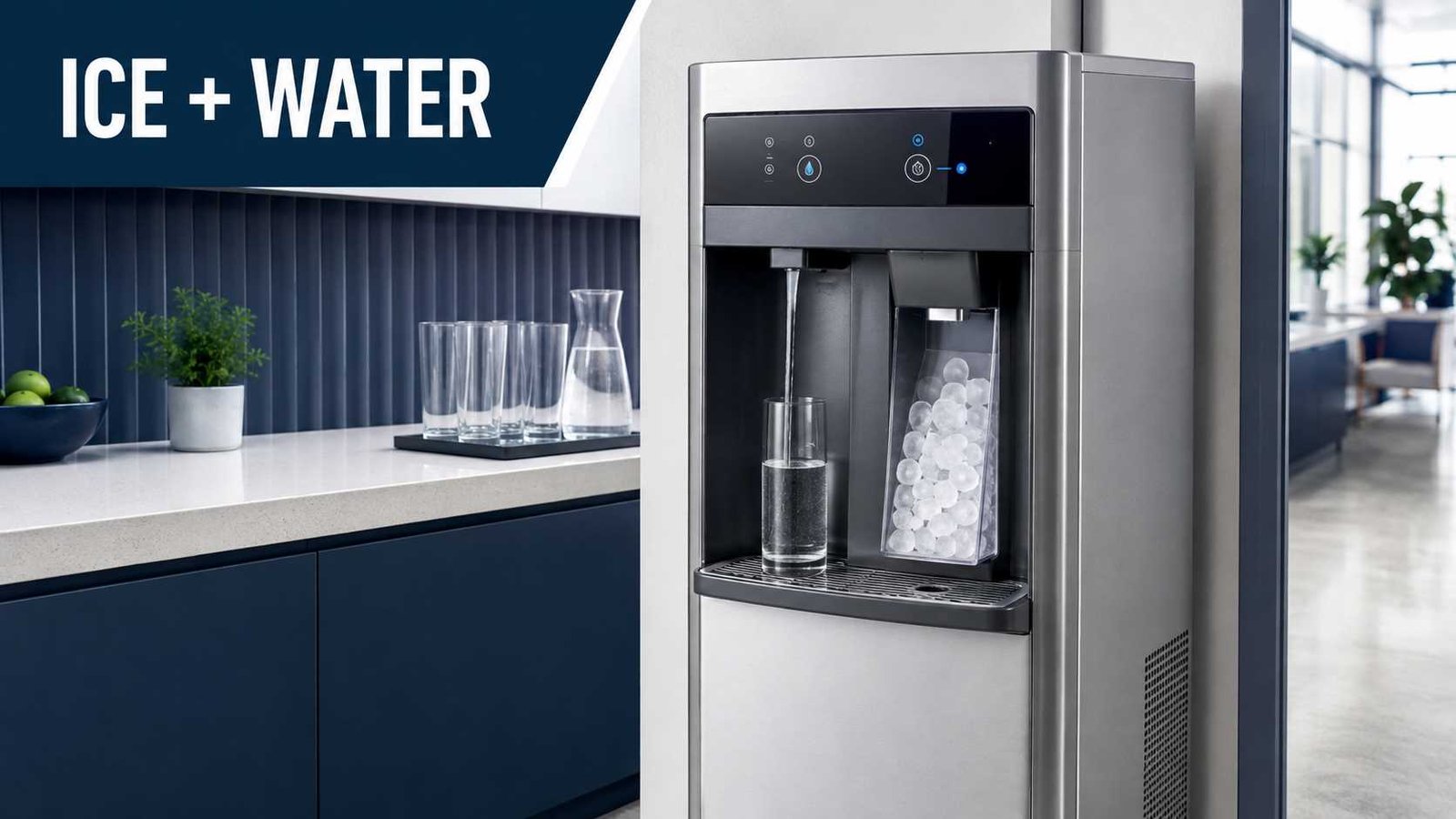
 An ice maker and dispenser machine combines ice production with convenient dispensing, and some models also dispense drinking water from the same appliance. These machines range from home water coolers that make bullet ice to large commercial dispensers producing hundreds of pounds of nugget-style ice per day.
Yes, you can buy a water dispenser with a built-in ice maker. The important part is checking exactly what a machine does before buying. Some products make ice but do not dispense drinking water. Others dispense water and ice but require a permanent water connection.
For example, Avalon currently sells both bottled and bottleless water coolers that produce up to 22 pounds of bullet ice per day. Commercial machines from Follett and Hoshizaki operate at much higher capacities.
If your existing machine has stopped making ice or dispensing water, first check its water supply, bottle or reservoir, external hose, ventilation and manufacturer maintenance instructions. Stop using it if there is an electrical problem, significant water leak, burning smell or other unsafe condition.
Ice Maker and Dispenser Machine at a Glance
| Feature | What to Know |
|---|---|
| Main purpose | Makes ice and dispenses it; some units also dispense drinking water |
| Home options | Reservoir-fed, bottled and bottleless models |
| Commercial options | High-output plumbed ice-and-water dispensers |
| Common ice types | Bullet, nugget, cubelet and conventional cubes |
| Water source | Internal reservoir, water bottle or direct plumbing |
| Does every model dispense water? | No |
| Does every model need plumbing? | No |
| Main buying factors | Output, storage, ice type, water source, size and maintenance |
| Safe first check when not working | Confirm water and power supply and look for external blockages |
| Internal refrigeration repair | Best left to qualified service personnel |
Is There a Water Dispenser With an Ice Maker?
Yes. A water dispenser and ice maker can be combined in one cabinet.
Avalon’s A20-B is one current example. It is a bottom-loading water cooler designed for 3- to 5-gallon bottles, dispenses three water temperatures and is rated to produce up to 22 pounds of bullet ice per day.
Avalon’s A21-B provides a similar concept without a water bottle. It connects to a household water supply and includes 1/4-inch tubing, an under-sink adapter with a shutoff valve, filtration components and other installation hardware. It is also rated for up to 22 pounds of bullet ice per day.
That makes the answer straightforward: you can have water dispensing and automatic ice production in the same machine.
What varies is how water gets into the appliance.
Ice Maker vs Ice Dispenser vs Water Dispenser
These terms are often mixed together in product listings, but they do not mean exactly the same thing.
Ice maker
An ice maker turns water into ice.
A countertop unit such as a GE Profile Opal, for example, makes nugget ice from water placed in its reservoir. GE states that its current Opal models do not require a water line. Some models can produce up to about 38 pounds of ice per day.
That does not automatically make the appliance a drinking-water dispenser.
Ice dispenser
An ice dispenser stores or moves finished ice and releases it directly into a glass or container.
A machine may manufacture its own ice and dispense it from the same cabinet, or a dispenser may be paired with another ice-making system.
Ice and water dispenser
This is the true combination many shoppers are looking for. One appliance can provide ice and drinking water.
Commercial examples include the Follett Champion range and Hoshizaki DCM series.
Main Types of Ice Maker and Water Dispenser Machines
1. Bottled water dispenser with an ice maker
A bottled unit draws water from a replaceable jug rather than the household plumbing.
This can be useful when:
- A permanent water line is unavailable
- The appliance may need to be moved
- You already receive bottled drinking water
- You do not want plumbing work
Avalon’s A20-B uses standard 3- to 5-gallon bottles and combines hot, cool and cold drinking water with bullet-ice production.
2. Bottleless ice-and-water dispenser
A bottleless machine connects directly to the household water supply.
This removes the need to replace large water bottles, but installation becomes more important.
Avalon’s A21-B includes a direct-water installation kit and dual filtration system. Avalon specifies a sediment filter and activated carbon block filter, with its product page listing a filter lifespan of 1,500 gallons or six months.
3. Reservoir-fed countertop ice maker
These are common compact home machines.
You pour potable water into an internal reservoir and the appliance makes ice. Plumbing may not be necessary.
GE specifically states that its Opal countertop ice makers do not require a water line because they use a built-in reservoir; selected models can also use a side tank.
Remember, however, that a reservoir-fed ice maker is not automatically a water dispenser.
4. Commercial ice-and-water dispenser
Commercial machines are designed for offices, healthcare environments, foodservice locations and other higher-demand applications.
Follett’s current Champion 7 countertop dispenser is rated for up to 125 pounds of ice production per day with 7 pounds of built-in ice storage.
Hoshizaki’s DCM-271BAK-OS is considerably larger in output, with a rating of up to 286 pounds of mini cubelet ice per day and 10 pounds of built-in storage. It can dispense ice or water hands-free.
5. Refrigerator ice and water dispenser
Many refrigerators use the same household water supply for both automatic ice production and door-mounted drinking-water dispensing.
This can be convenient because no separate appliance is needed, but performance depends on the refrigerator’s filter, water pressure, inlet system, tubing and ice-making components.
How Does an Ice Maker and Dispenser Machine Work?
The exact design varies, but the basic process is simple.
Water enters through a bottle, internal reservoir or household water connection. Part of that water is directed into the ice-making system. The appliance freezes it into its designed ice shape and transfers finished ice into a storage area.
When you request ice, the dispensing mechanism delivers it into your glass or container.
If the appliance also dispenses drinking water, another water path supplies the dispensing outlet.
This explains why one function can sometimes continue working while the other fails. A machine might still dispense water while its ice-making system has a problem, or it might make ice but have a blocked dispensing path.
Internal refrigeration components, electrical controls, valves and wiring should not be opened or tested by an untrained user.
What Is the Price of an Ice Maker Machine?
There is no single price because an inexpensive countertop ice maker and a commercial ice-and-water dispenser are very different products.
Here are useful current examples rather than a misleading universal average:
| Machine example | Type | Current manufacturer information |
|---|---|---|
| Avalon A20-B | Bottled water cooler + ice maker | $399.99 |
| Avalon A21-B | Bottleless water cooler + ice maker | $399.99 |
| GE Profile Opal + Side Tank | Countertop nugget ice maker | Listed from $449 on GE’s current range page |
| GE Profile Opal 2.0 Ultra + XL Side Tank | Premium countertop nugget ice maker | Listed at $549 on GE’s current range page |
| Follett Champion 7 | Commercial ice + water dispenser | Manufacturer requests a quote |
| Hoshizaki DCM-271BAK-OS | Commercial ice + water dispenser | Commercial pricing varies by supplier/install |
Prices checked August 12, 2026 and may change. Avalon currently lists the A20-B and A21-B at $399.99 each. GE’s current Opal range includes models at $449 and $549, depending on configuration.
Do not compare those prices without comparing functions. A premium countertop nugget ice maker may cost as much as a combination dispenser while still not providing a drinking-water dispensing function.
Commercial systems are another category entirely. Follett uses a quote system for its current commercial dispensers, and installation requirements can materially affect the total cost.
Which Brand Is the Best Ice Maker?
There is no single brand that is best for every use.
A better question is: Which brand makes the right type of machine for your situation?
| Use case | Brands worth comparing | Why |
|---|---|---|
| Home water cooler + ice maker | Avalon | Current bottled and bottleless combination options |
| Countertop nugget ice | GE Profile | Broad Opal nugget-ice range |
| Basic compact countertop ice | Frigidaire | Compact countertop ice-maker options |
| Office/commercial ice + water | Follett | Dedicated commercial combination dispensers |
| High-output commercial use | Hoshizaki | Broad commercial DCM ice-and-water range |
This is not a ranking of reliability. It is a practical grouping based on the types of products each manufacturer currently offers.
Before choosing a brand, look at local service availability, warranty terms, replacement filters, spare parts, required water connection and the specific model’s output.
How Much Ice Do You Actually Need?
Daily production figures can be confusing.
A machine rated for 125 pounds of ice per day does not necessarily contain 125 pounds of ice at one time.
For example, Follett’s Champion 7 can produce up to 125 pounds in a day but stores 7 pounds. Hoshizaki’s DCM-271BAK-OS can produce up to 286 pounds per day but stores up to 10 pounds internally.
Production tells you how much the machine can make over time.
Storage tells you how much finished ice it can hold at once.
For normal home use, commercial production figures are usually unnecessary. In an office, restaurant or shared workplace, recovery rate and daily production become much more important.
Which Ice Type Should You Choose?
Bullet ice
Bullet ice has a rounded, hollow shape and is common in compact machines.
Avalon’s current combination water coolers use bullet ice.
It is a practical choice for everyday cold drinks.
Nugget or cubelet ice
Nugget-style ice is softer and chewable compared with many traditional hard cubes.
GE Profile Opal machines are designed around nugget ice, while Follett uses its Chewblet nugget format and Hoshizaki offers cubelet or mini-cubelet commercial systems.
Conventional cubes
Traditional cube ice is widely used in refrigerators and commercial machines. It generally offers a different texture and melt profile from soft nugget ice.
Choose the ice type you actually enjoy rather than buying on production capacity alone.
Bottle, Reservoir or Direct Water Line?
Water supply is one of the most important decisions.
| Water source | Main advantage | Main limitation |
|---|---|---|
| Internal reservoir | No plumbing required | Must be refilled manually |
| Water bottle | Easy to install almost anywhere | Bottles must be purchased and replaced |
| Direct water line | Continuous water supply | Requires suitable plumbing and installation |
A reservoir machine makes sense for a countertop or temporary location.
A bottled combination dispenser is useful where a water cooler is already practical.
A bottleless machine is attractive for permanent home or office use because it removes the repeated job of changing bottles.
Does an Ice Maker and Dispenser Need a Water Line?
Not always.
This is one of the biggest misconceptions about these appliances.
GE states that its Opal countertop ice makers use a built-in reservoir and do not require a water line.
Avalon’s A20-B uses a 3- to 5-gallon bottle, so it also avoids a permanent household water connection.
Avalon’s A21-B, by contrast, is bottleless and is designed to connect to the household water supply using the included installation hardware.
Commercial machines commonly have more specific water, drainage, clearance and electrical requirements. Always follow the installation document for the exact model.
Features Worth Checking Before Buying
A large production number should not be the only reason to choose a machine.
Check these points before ordering:
- Does it actually dispense drinking water? Some products advertised around “ice dispensing” only dispense ice.
- Water source: Determine whether you need a reservoir, bottle or permanent water connection.
- Daily ice production: Match output to the number of people using the machine.
- Ice storage: Check how much ice is available at one time, not only the 24-hour production rating.
- Ice type: Bullet and nugget ice feel very different in a drink.
- Machine dimensions: Include ventilation clearance, not just cabinet dimensions.
- Filtration: For direct-water machines, check what filtration is included and the replacement schedule.
- Cleaning access: Ice and drinking-water surfaces require regular maintenance.
- Drain requirements: Check the installation manual, especially for commercial equipment.
- Hot-water function: Combination water coolers may also dispense hot water, creating a scalding risk around children.
- Replacement filters and parts: Check availability before buying an imported model.
- Local warranty and service: A low purchase price is less attractive if there is no service network in your country.
What If the Ice Maker and Dispenser Machine Is Not Working?
Do not start by opening the appliance.
Many problems can be checked from outside the machine.
1. Confirm the water supply
For a reservoir unit, make sure there is enough potable water.
For a bottled dispenser, check that the bottle is not empty and is seated correctly.
For a plumbed system, confirm the water shutoff valve has not been closed.
2. Look at the external water line
If the machine is supplied by tubing, look for obvious kinks, crushing or leakage.
Do not disconnect plumbing while the water supply is open.
3. Check the filter
A heavily restricted or overdue filter can reduce water flow on appliances that depend on filtration.
Follow the replacement interval specified for your exact model rather than assuming every filter lasts the same length of time.
4. Check ventilation
Countertop ice makers need airflow to remove heat.
GE’s troubleshooting information for its Opal Ice Maker Dispenser specifically warns that restricted airflow can interfere with normal ice production and instructs users to maintain clearance around applicable models.
5. Look for an accessible ice blockage
If the manufacturer provides a user-safe method for clearing the dispensing chute or repositioning the ice bin, follow those instructions.
Do not insert knives, screwdrivers or other sharp tools into a powered dispenser.
6. Clean or descale according to the manual
Mineral buildup can affect ice-making performance.
GE advises routine cleaning of its Opal machines and describes descaling as part of maintaining performance.
7. Use only the model-specific reset procedure
Reset instructions are not universal.
For certain Opal models, GE’s official support information recommends specific troubleshooting procedures when ice is not being produced. That does not mean the same sequence applies to Avalon, Follett, Hoshizaki or another machine.
When to stop troubleshooting
Disconnect the appliance and seek qualified service if you notice:
- Electrical arcing or repeated breaker trips
- Burning smell or overheating
- A significant or uncontrolled leak
- Damaged power wiring
- Internal refrigeration-system problems
- Compressor problems
- Repeated failure after approved cleaning and external checks
- A fault requiring internal electrical measurements
Do not bypass switches, safety devices or water controls.
What Is the Price to Repair an Ice Maker Machine That Is Not Working?
There is no responsible fixed repair price based only on the symptom “not working.”
A failed machine could have something as simple as an external water-supply problem or something requiring professional diagnosis of an internal component.
The correct repair estimate depends on:
Brand + exact model + symptoms + failed component + parts availability + labor rates + country.
Check warranty coverage before paying for repair. GE, for example, directs Opal owners to its support channel for warranty assistance and available replacement parts.
For a low-cost countertop machine, compare a written repair quote against replacement cost. For a commercial dispenser, professional diagnosis is usually much more important because the equipment itself is substantially more complex.
Cleaning and Maintenance Matter More Than You Might Expect
Any appliance that repeatedly handles water and stores ice needs regular cleaning.
A “self-cleaning” feature does not necessarily mean the machine never needs manual care.
GE recommends regular cleaning for its Opal ice makers and provides separate descaling guidance.
Follett’s current Champion documentation specifies cleaning and sanitizing during initial installation and at least every six months, with more frequent service where local water conditions require it.
Always use the cleaner, sanitizer, concentration and procedure specified for your particular machine.
Do not assume instructions for one brand apply to another.
Home vs Commercial Ice and Water Dispensers
| Feature | Home combination machine | Commercial combination machine |
|---|---|---|
| Typical users | Household or small office | Offices, foodservice, healthcare, high-use facilities |
| Water source | Bottle or household line | Usually installation-specific |
| Ice output | Moderate | High |
| Storage | Small to moderate | Depends on equipment |
| Installation | Often relatively simple | May require professional installation |
| Maintenance | Owner-level cleaning plus service when needed | Formal cleaning/service schedule more likely |
| Example | Avalon A20-B/A21-B | Follett Champion or Hoshizaki DCM |
A home machine rated for 22 pounds of ice per day and a commercial machine rated for 286 pounds per day belong to very different categories.
Buying the commercial machine simply because its number is larger can mean unnecessary cost, size, maintenance and installation requirements.
Regional Buying Considerations
Product names may look global while actual electrical and plumbing specifications are not.
Hoshizaki’s North American DCM-271BAK family, for example, is listed in Hoshizaki America’s range with 115V/60Hz electrical specifications. That is important because equipment intended for North America should not automatically be assumed suitable for the UK, Ireland, Australia or New Zealand.
Follett also provides separate specification documentation for some Canadian versions of its Champion machines, showing why regional documentation matters even between neighboring markets.
Before importing an ice-and-water dispenser, confirm:
Voltage, frequency, plug type, water fittings, drain requirements, certifications, replacement filters, warranty coverage and local service availability.
Is an Ice Maker and Water Dispenser Worth It?
A combination machine makes sense when you regularly use both drinking water and ice and want to reduce the number of separate appliances.
It can be particularly useful in:
- Family kitchens
- Home bars
- Offices
- Waiting areas
- Staff break rooms
- Small hospitality spaces
A bottled combination machine offers installation flexibility. A bottleless unit avoids repeated bottle changes. A commercial dispenser offers much higher output for shared use.
A separate countertop ice maker may still be the better choice if you already have filtered drinking water and only need additional ice.
The key is to buy for function first, not simply for the highest production number or most expensive brand.
FAQs
Is there a water dispenser with an ice maker?
Yes. Combination machines are available for both home and commercial use. Avalon currently offers bottled and bottleless home water coolers that also make bullet ice, while Follett and Hoshizaki offer higher-capacity commercial ice-and-water dispensers.
What is the price of an ice maker machine?
It depends on the type. As of August 12, 2026, Avalon lists its A20-B and A21-B combination water cooler/ice makers at $399.99. GE’s current premium countertop Opal lineup includes configurations listed at $449 and $549, although those products are primarily ice makers rather than full drinking-water dispensers. Commercial equipment may require a quote.
Which brand is the best ice maker?
There is no universal best brand. Compare Avalon for home water-cooler combinations, GE Profile or Frigidaire for countertop ice makers, and Follett or Hoshizaki when looking at commercial ice-and-water dispensing equipment. The right choice depends on output, ice type, plumbing, maintenance and local service.
Do ice makers need a water line?
Some do and some do not. Reservoir-fed machines can work without plumbing. Bottled machines draw water from a jug. Bottleless and many commercial machines connect to a water supply. GE states that Opal countertop ice makers do not require a water line, while Avalon’s A21-B is specifically designed for bottleless water-line installation.
Why does my water dispenser work but the ice maker does not?
The water-dispensing and ice-making functions do not necessarily use all the same components. Check water availability, ventilation, filter condition, cleaning requirements and any user-accessible ice blockage described in the owner’s manual. If basic checks fail, model-specific diagnosis may be required.
Why is my ice maker working but not dispensing ice?
An accessible chute blockage, incorrectly positioned ice bin or dispenser problem may be responsible. Follow the exact manufacturer’s troubleshooting procedure. GE, for example, publishes specific chute-jam instructions for applicable Opal Ice Maker Dispenser models. Those instructions should not be assumed to work on other brands.
Does a self-cleaning ice maker still need cleaning?
Usually, yes. Automated sanitation or cleaning features do not eliminate every manufacturer maintenance requirement. GE recommends routine cleaning for Opal machines, and Follett specifies scheduled cleaning and sanitizing for its Champion commercial dispensers.
How much ice should a machine make per day?
It depends heavily on the machine class. Avalon’s current home combination units are rated for up to 22 pounds per day, Follett’s Champion 7 for up to 125 pounds, and Hoshizaki’s DCM-271BAK-OS for up to 286 pounds. These are manufacturer-rated capacities and should not be confused with the amount of finished ice stored at one time.

Daniel Brooks is a US-based appliance troubleshooting researcher with 12 years of experience studying washer, dryer, refrigerator, and dishwasher faults. He reviews manufacturer manuals and converts technical error codes into safe, practical guidance for homeowners.