
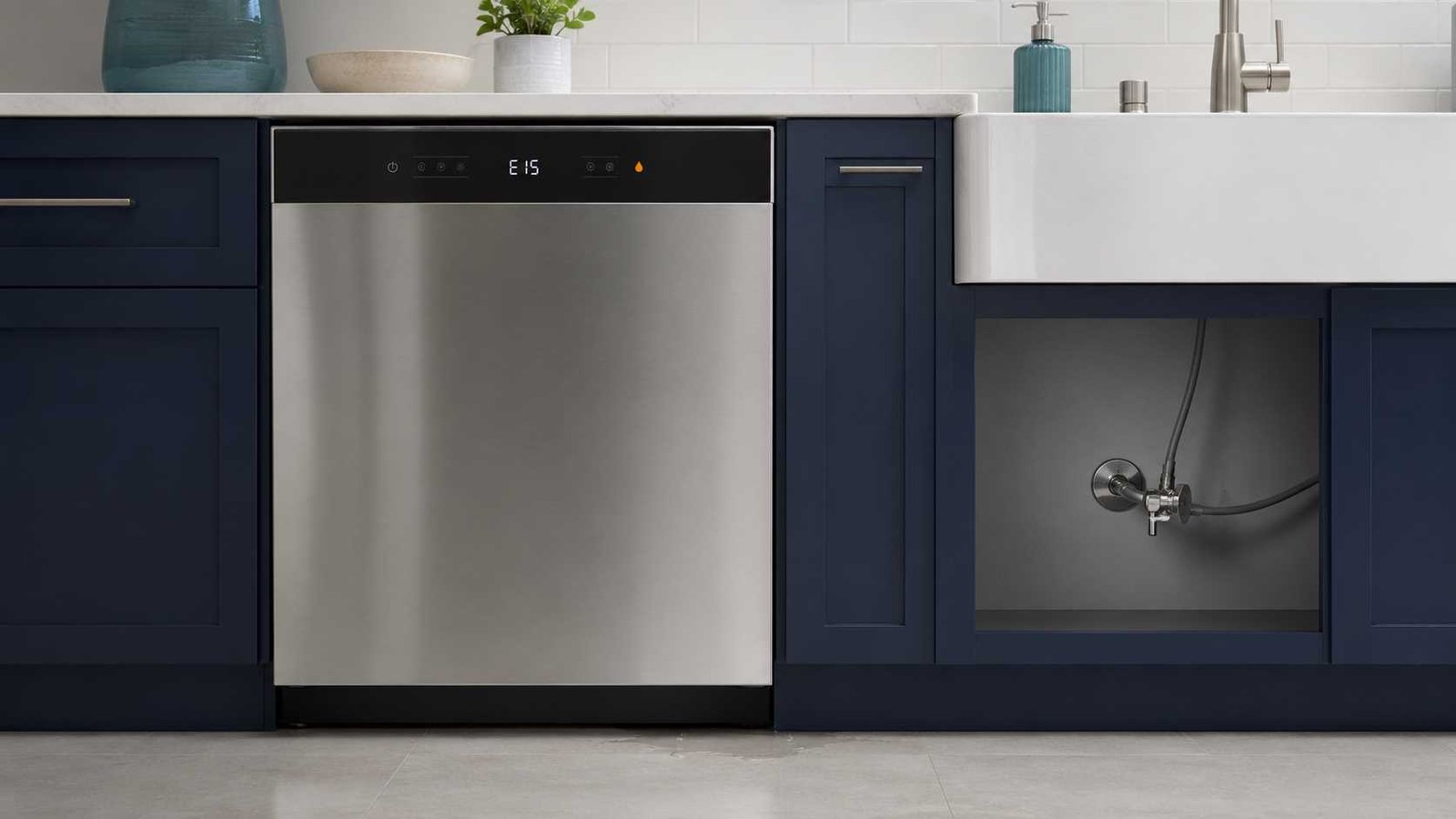
 The Bosch dishwasher E15 error code means the appliance’s leakage-protection system has been activated. On Bosch’s North American support pages, this is described more precisely as the safety switch detecting water in the base of the dishwasher. The code does not identify which component leaked; it only confirms that the protection system has responded to water where it should not normally be.
Turn off the dishwasher’s water supply first. Switch off the appliance without touching wet plugs, sockets or damaged wiring, and do not begin another wash cycle. You may inspect the floor, cabinet and accessible hoses for visible leakage, but Bosch recommends professional service when the source cannot be seen externally.
Safety warning: Do not keep using the dishwasher, bypass its leakage sensor, remove electrical panels or tilt a built-in appliance in an attempt to clear E15.
Bosch E15
| Item | Answer |
|---|---|
| Error code | E15 or E:15 |
| Appliance | Bosch dishwasher |
| Confirmed meaning | The water or leakage-protection system is activated |
| What was detected? | Water in the dishwasher’s base on models using the E15 code |
| Safe first action | Turn off the water supply and switch off the appliance |
| Can you continue using it? | No, not until the cause has been checked |
| Can a reset repair it? | No. A reset cannot stop or repair a physical leak |
| Safe homeowner checks | Look for water around the base and visible hose damage |
| Repair difficulty | Usually requires professional diagnosis if no external leak is visible |
| Related code formats | F15, E3100, E:30-00 and E:31-00 on selected platforms |
Bosch manuals specifically instruct users to turn off the water tap and contact customer service when E:15 activates.
What Does E15 Mean on a Bosch Dishwasher?
E15 is a water-protection fault, not a normal cleaning, filter or drainage reminder.
Many Bosch dishwashers have a lower base area beneath the visible washing tub. If water reaches this area, a safety mechanism can activate to reduce the risk of further leakage. Bosch describes E15 as water detected in the dishwasher base and says that the leakage-protection system has been triggered.
This distinction matters because there are two different places where a user may find water:
- Water inside the washing compartment: This may relate to drainage, filters or the drain pump.
- Water beneath the washing compartment in the appliance base: This is the condition associated with E15.
Cleaning the filter may be useful maintenance, but Bosch assigns a blocked-filter condition to codes such as E22. Codes E24 and E25 are used for selected drainage and pump problems. They should not automatically be treated as equivalent to E15.
What Should You Do Immediately?
1. Do not start another cycle
Do not test the dishwasher by repeatedly pressing Start or selecting a short programme. Another fill cycle could release more water if a hose, connection or internal water-carrying component is leaking.
2. Turn off the dishwasher’s water supply
Close the dedicated dishwasher shutoff valve or water tap where it is safely accessible. Bosch gives this as the primary action for E15 in official support pages and appliance manuals.
Do not force a seized valve. A plumber may be needed if the supply cannot be closed safely.
3. Switch off the dishwasher safely
Use the appliance’s power button if the surrounding area is dry. Disconnect the electrical supply only when you can do so without touching water, a wet plug or damaged cabling.
For a hardwired dishwasher or an inaccessible wet connection, use the appropriate circuit breaker only when you know which circuit controls the dishwasher. Contact a qualified electrician or appliance professional when safe isolation is uncertain.
Bosch manuals warn that moisture ingress can create an electric-shock risk and that damaged appliances or power cords must not be operated.
4. Check the surrounding area
Look for water:
- On the floor in front of the dishwasher
- Along the cabinet edges
- Beneath the nearby sink
- Around visible supply and drain-hose connections
- Near the dishwasher’s water shutoff valve
Protect the flooring and keep children and pets away from the area. Do not reach beneath the dishwasher when the floor or appliance connections are wet.
5. Record the complete code and model number
Take a photograph of the control-panel display before switching the appliance off. Also record the Bosch E-Nr., FD number and serial number if available.
On Bosch dishwashers, the rating label is normally on the top or side edge of the door and becomes visible when the door is opened. Bosch uses the E-Nr. to provide the correct manual, technical support and compatible replacement parts.
Safe Checks You Can Perform
Bosch’s advice differs slightly by region. US and Canadian guidance tells users to turn off the water inflow and contact support. Bosch UK additionally permits checking around the dishwasher base and inspecting visible hoses for kinks or damage. Bosch New Zealand recommends not attempting an at-home repair because of health and safety concerns.
Stay within the following external checks.
Check for a visible hose leak
Inspect only the sections of the inlet and drain hoses that are already accessible beneath the sink or beside a freestanding dishwasher.
Look for:
- Moisture around threaded connections
- A split or rubbed hose surface
- Dripping beneath a joint
- A hose that has been crushed or sharply bent
- Water around the AquaStop housing or supply connection
Do not cut, open or immerse an AquaStop housing. Bosch manuals state that the housing can contain an electrically operated valve and that the supply hose must not be cut.
Check nearby plumbing
Water beneath a dishwasher does not always originate inside the appliance. Inspect the sink trap, taps, disposal connection where fitted, and nearby pipe joints for visible moisture.
This does not change the meaning of E15: the dishwasher has still detected water in its base. However, identifying an external plumbing leak may help explain how water reached the appliance area.
Examine the visible door area
With the dishwasher switched off, look for:
- Food residue on the accessible door seal
- A visibly displaced seal
- Damage around the door edge
- Evidence that water escaped from the front during the last cycle
Do not remove the inner door panel or attempt to replace sealing components without model-specific instructions.
Note any unusual foam
Record whether the tub contained excessive foam when the code appeared. Do not add more detergent or run a rinse cycle while E15 is active.
Foam alone does not prove the cause. A service technician may still need to establish how water reached the base.
What Can Cause Bosch Dishwasher E15?
The code itself does not reveal the failed part. It reports the result: the water-protection system has activated.
| Possible area | What you may notice | Recommended action |
|---|---|---|
| Accessible inlet-hose connection | Dripping or moisture under the sink | Turn off the supply and arrange repair |
| Visible hose damage | Split, abrasion, kink or wet hose | Do not operate the dishwasher |
| Door or front-edge leakage | Water marks at the lower front | Clean only accessible residue; book service if leakage occurred |
| Internal water-path leak | E15 with no visible external source | Professional inspection required |
| Water entering from nearby plumbing | Moisture beneath sink or cabinet | Repair the plumbing source and have the dishwasher checked |
| Protection switch or float issue | Code remains although no water is visible externally | Technician-level diagnosis required |
Bosch’s UK guidance confirms that visible hose damage can contribute to E15 behaviour, but it recommends an engineer when the fault is not visible.
An internal inspection may involve hoses, valves, seals, pump or sump assemblies, and the base safety mechanism. This is a diagnostic possibility rather than a Bosch-confirmed list of E15 causes for every model. Bosch requires the appliance’s E-Nr. when identifying compatible components because parts vary between models.
Can You Reset a Bosch Dishwasher E15 Error?
There is no universal Bosch E15 reset sequence that repairs the fault.
Bosch’s E15 instructions do not tell users to press and hold a particular button or switch the breaker off briefly. Instead, they tell the user to shut off the water supply and contact support or arrange service.
This is important because Bosch does recommend short power resets for some other dishwasher errors. On the official US error-code page, several electronic or power-related codes include breaker-reset instructions, while E15 does not.
Some Bosch manuals also provide a general two-minute power cycle for an unspecified technical error. On the same troubleshooting page, E:15 receives separate instructions: turn off the water tap and call customer service. The general reset should therefore not replace the specific E15 response.
Why E15 may disappear temporarily
The display may clear after the electrical supply has been interrupted or after moisture in the base changes. That does not confirm that the leak has been repaired.
Do not treat a cleared display as permission to run repeated test cycles. The underlying source may leak again only during filling, washing, heating or draining.
Should You Tilt the Dishwasher to Clear E15?
Online advice often suggests tilting the dishwasher to empty water from its base. This may cause the safety mechanism to reset temporarily, but it does not identify or repair the source of the water.
Bosch’s official E15 instructions reviewed for the US, Canada, UK and New Zealand do not recommend tilting as the standard homeowner solution. They instead direct users to shut off the water and arrange support, with the UK allowing only limited external inspection.
Tilting is especially unsuitable for an integrated or built-under dishwasher because:
- The appliance may be secured to the worktop or cabinets.
- Water could move towards electrical components.
- Hoses or wiring may be strained.
- The dishwasher could tip unexpectedly.
- Kitchen flooring and cabinetry may be damaged.
- The code may clear while the original leak remains.
Do not pull out or tilt a built-in dishwasher unless the work is being carried out by someone competent to isolate, disconnect and reinstall it safely.
What If E15 Returns After the Dishwasher Dries?
A returning code strongly suggests that the underlying condition has not been resolved.
The timing can provide useful information to a technician:
- E15 appears soon after filling: Note a possible supply-side or filling-stage leak.
- E15 appears during washing: Note a possible leak that occurs only while water is circulating.
- E15 appears near draining: Note whether water also backs up beneath the sink.
- E15 appears intermittently: Record the selected programme, load and approximate stage.
- E15 appears immediately at startup: Do not assume it is only a control fault; the protection system may still be active.
These observations do not identify a particular component on their own. Give them to the service provider along with the E-Nr. and full code.
What If the Filter Is Clean?
A clean filter does not rule out E15 because E15 is not primarily a filter-blockage code.
Bosch identifies E22 as a blocked-filter condition on relevant models. It associates E24 and E25 with drainage restrictions, a blocked pump or an incorrectly secured pump cover. E15 instead concerns the activated water-protection system.
Clean the filter as routine maintenance only when your model manual explains how to do so safely. Do not expect filter cleaning alone to clear water from the hidden base or repair a leak.
Why Does the Drain Pump Keep Running?
Some dishwashers may continue attempting to remove water while a protection fault is active. However, the official E15 pages reviewed do not define continuous pump operation as a separate E15 diagnostic test.
Do not repeatedly press buttons or interrupt and restart the appliance. Turn off the water supply, isolate the dishwasher safely and report both the E15 display and continued pumping to the service provider.
Bosch E15 Code Variations
The displayed format varies by dishwasher generation and market.
| Display | Officially documented meaning |
|---|---|
| E15 or E:15 | Water-protection system activated |
| F15 | Water-protection system activated on selected regional models |
| E3100 | Safety switch detected water in the base on selected North American platforms |
| E:30-00 | Water-protection system activated on newer platforms |
| E:31-00 | Water-protection system activated on newer platforms |
Bosch New Zealand groups E15 and F15 together. Bosch’s US code directory assigns the same base-water detection meaning to E3100. Newer European and North American manuals use E:30-00 and E:31-00 for an activated water-protection system.
Do not assume that every similar-looking extended code has the same meaning. For example, Bosch’s current US directory describes E3200 as a water-flow problem rather than the same base-leak condition. Confirm the full code in the manual for your E-Nr.
When Should You Call a Technician?
Arrange professional service when:
- E15 returns after the appliance has been switched off.
- There is water beneath or around the dishwasher.
- No external leak can be found.
- The dishwasher must be removed from cabinetry.
- The inlet hose or AquaStop assembly is damaged.
- Water appears near a plug, socket or electrical connection.
- An internal panel must be removed.
- The dishwasher continues pumping or does not respond normally.
- A replacement hose, valve, seal, pump or safety component may be required.
- You cannot safely isolate the water or electrical supply.
Bosch explicitly recommends service when the fault is not externally visible, while several regional Bosch pages advise professional repair for any E15 or F15 event.
Important Safety Rules
- Do not run another programme to see whether the code returns.
- Do not bypass or hold down the base safety switch.
- Do not work on wet electrical connections.
- Do not cut, open or immerse an AquaStop hose housing.
- Do not remove panels while the dishwasher is connected to electricity.
- Do not tilt an integrated dishwasher.
- Do not reuse a visibly damaged water hose.
- Do not order a component by appearance alone; confirm compatibility with the full E-Nr.
Bosch manuals warn that incorrect repairs are dangerous and should be performed by trained specialists using suitable parts.
Frequently Asked Questions
Is Bosch dishwasher E15 safe to ignore?
No. E15 means the water or leakage-protection system has activated. Turn off the water supply, switch off the dishwasher safely and do not run another cycle until the cause has been checked.
Does E15 always mean water is visible on the kitchen floor?
No. Bosch states that the safety switch can detect water in the dishwasher’s base. That water may be hidden beneath the main washing compartment, so the surrounding floor can appear dry.
Can a blocked filter cause E15?
A blocked filter has its own code on many Bosch models, commonly E22. E15 specifically concerns an activated water-protection system, so filter cleaning should not be treated as the main E15 repair.
Will switching the breaker off reset E15?
It may change the display temporarily, but Bosch does not give a breaker reset as the official E15 solution. The E15 instruction is to turn off the water inflow and seek support.
Can I use the dishwasher after the code disappears?
Do not restart it solely because the display has cleared. A disappearing code does not prove that the source of the water has been repaired.
Is F15 the same as E15?
On selected regional Bosch dishwashers, yes. Bosch New Zealand states that E15 or F15 means the water-protection system is activated. Always verify the code in the manual for your specific E-Nr.
Is E3100 the same as E15?
On selected newer North American Bosch controls, E3100 has the same official description: the safety switch detected water in the base and activated leakage protection.
Where can I find my Bosch dishwasher model number?
Open the dishwasher door and inspect its top and side edges. The model number, called the E-Nr., is printed or engraved on the rating label.

Oliver Grant is a UK appliance diagnostics writer with 10 years of experience covering washing machines, boilers, dishwashers, and tumble dryers. He specializes in fault-code interpretation, model-specific checks, and clear guidance based on official technical documentation.