
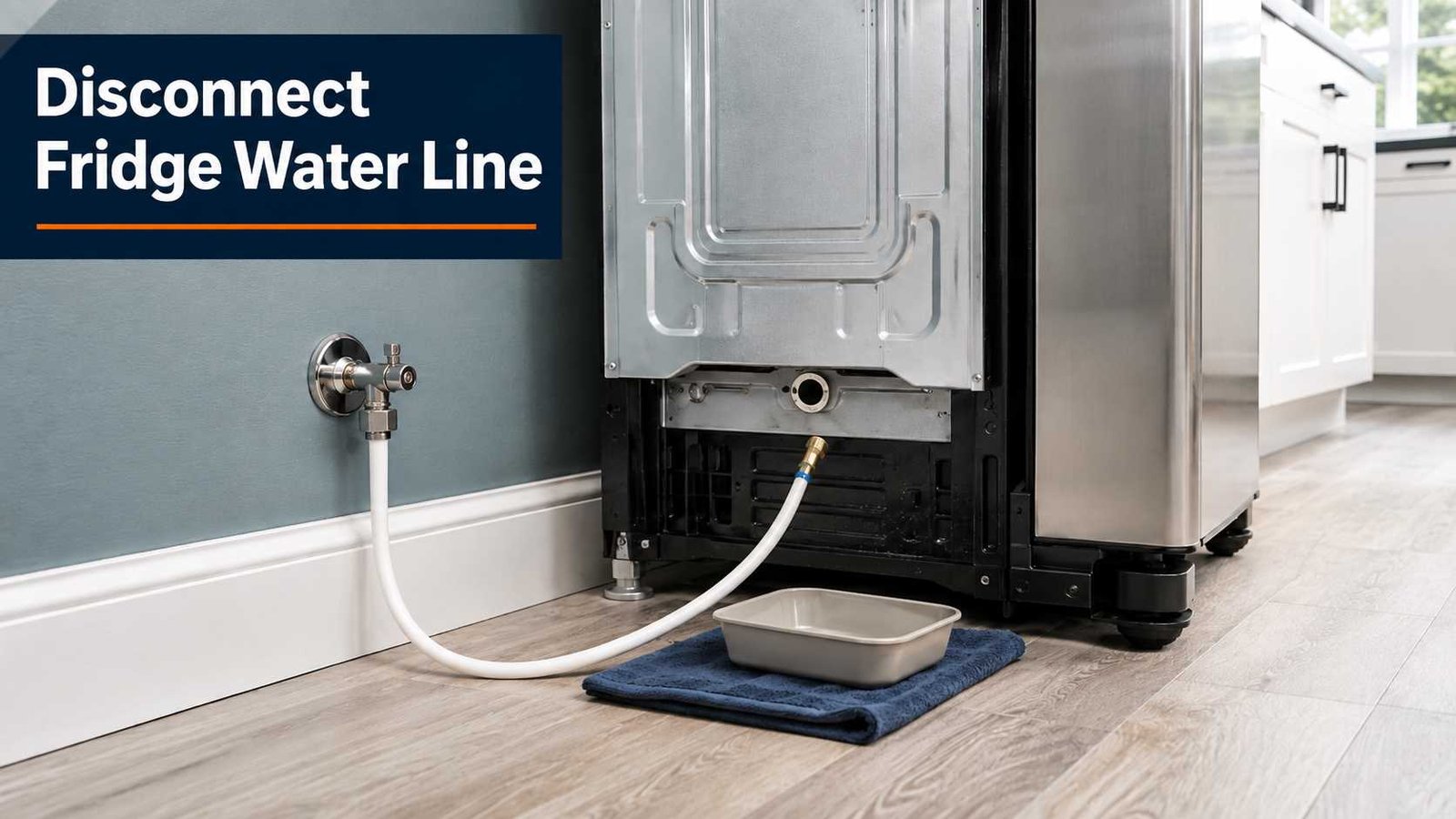
 If you need to move, replace or service a refrigerator, disconnecting the water line is usually straightforward. The important part is doing things in the right order.
First, turn off the ice maker and shut off the refrigerator’s water supply. Then confirm that water has actually stopped flowing before touching the connection. Unplug the refrigerator before working behind it.
After that, identify the fitting. A refrigerator may use a threaded compression connection or a plastic quick-connect coupling. These do not release in the same way.
Samsung, Whirlpool, Maytag and GE all emphasize isolating the water supply before refrigerator water-line work. Samsung also specifically distinguishes between plastic quick-connect and copper compression connections.
Important: If you close the shutoff valve but the dispenser continues producing a steady stream of water, do not disconnect the supply line. The water may not actually be shut off.
| Item | What to do |
|---|---|
| First step | Turn off the ice maker |
| Water supply | Close the refrigerator shutoff valve |
| Check | Make sure steady water flow has stopped |
| Electrical safety | Unplug the refrigerator |
| Prepare for water | Put down towels and a bowl or bucket |
| Common connections | Compression fitting or quick-connect fitting |
| After removal | Drain and secure the loose tubing |
| Stop DIY work if | The valve leaks, will not close, or the connector is damaged |
What You Need Before Disconnecting the Water Line
For a normal refrigerator water-line disconnection, you may need:
- Towels
- A bowl or small bucket
- Flashlight
- Adjustable wrench or suitable pliers for some compression connections
- Cardboard or another floor protector
- Tape for securing the loose hose or power cord
Samsung specifically recommends having towels and a bowl or bucket ready because some water can remain in the tubing after the supply has been shut off.
You normally do not need to open refrigerator panels, touch electrical wiring or disassemble the water inlet valve for a basic water-line disconnection.
Step 1: Turn Off the Ice Maker
Turn the ice maker off before shutting down its water supply.
Depending on the refrigerator, this may involve:
- An On/Off control
- A wire shutoff arm
- A switch near the ice maker
- A control-panel setting
Maytag notes that the exact ice-maker shutoff mechanism varies between refrigerators. GE also recommends switching the ice maker off before shutting off its water supply.
If you cannot find the control, check the owner’s manual for your exact model instead of guessing.
Step 2: Find and Close the Refrigerator Water Shutoff Valve
The dedicated water valve may not be directly behind the refrigerator.
Common locations include:
- Behind the refrigerator
- Under the kitchen sink
- Inside a nearby cabinet
- In a basement
- In a crawl space
GE identifies the area under the sink, basement, crawl space and adjacent cabinetry as common locations. Maytag provides similar guidance.
If You Have a Wheel-Style Valve
Turn it clockwise until it closes.
If You Have a Lever-Style Ball Valve
Maytag instructs users to rotate the lever about 90 degrees so it sits perpendicular to the pipe when closed.
Do not use excessive force on an old, seized or corroded valve.
Step 3: Make Sure the Water Is Really Off
This step is easy to skip, but it can prevent a flooded kitchen.
If your refrigerator has a water dispenser:
- Hold a large container under the dispenser.
- Operate the dispenser.
- Allow the remaining pressure and water to discharge.
- Check that the steady water flow stops.
Maytag recommends testing the dispenser after closing the valve. If water continues flowing steadily, the refrigerator’s supply may still be open.
A brief amount of residual water is normal. Continuous supply is not.
If you cannot positively stop the water, do not disconnect the tubing.
Step 4: Unplug the Refrigerator
Once the water is isolated, disconnect the refrigerator from power before working behind it.
Whirlpool instructs users to unplug the appliance when preparing refrigerator water-line work, while Samsung’s refrigerator replacement guidance also has the refrigerator unplugged before the water line is disconnected.
Pull the refrigerator only as far as necessary for safe access.
Protect wood, laminate, vinyl and other easily damaged flooring with cardboard or another suitable floor protector.
A full-size refrigerator is heavy. If it must be moved significantly, get another person to help rather than trying to control it alone. Whirlpool recommends two-person handling for refrigerator installation and removal work.
Step 5: Locate the Water Connection
Look near the lower rear of the refrigerator.
GE says the water connection on many refrigerators is near the bottom at the back, although its exact position can be on either side depending on the model.
Place a towel underneath the connection and keep a bowl nearby before loosening anything.
Now identify which type of connector you have.
Compression Fitting vs Quick-Connect Fitting
This is the most important distinction in the process.
| Connection | What it may look like | Typical release method |
|---|---|---|
| Compression fitting | Tubing entering a threaded metal fitting with a nut | Loosen the compression nut |
| Quick-connect fitting | Plastic tubing entering a small plastic coupler | Depress or operate the release collar/coupler as specified for the model |
Do not assume that every plastic water tube uses a push-fit connector. Plastic tubing can also be attached with compression hardware.
Samsung’s installation guidance, for example, shows both copper and plastic tubing being used with compression components in some installations.
That is why identifying the connector itself, not simply the tubing material, matters.
How to Disconnect a Compression-Fitting Water Line
If your line connects with a threaded compression nut:
- Make certain the water supply is off.
- Unplug the refrigerator.
- Put a towel and bowl below the connection.
- Support the fitting so you are not twisting attached tubing or refrigerator components.
- Use the appropriate wrench or tool to loosen the compression nut counterclockwise.
- Once loose, separate the supply tube carefully.
- Let residual water drain into the bowl.
Samsung’s current refrigerator replacement instructions tell owners with a copper line to loosen the compression connection and then empty the remaining water into a bowl.
Do Not Force the Nut
If the nut is badly corroded, rounded off or completely seized, increasing force may damage the valve, tube or household plumbing.
Stop and get plumbing help if the fitting starts twisting with the pipe or valve.
How to Disconnect a Quick-Connect Refrigerator Water Line
Some refrigerators use a plastic coupling that releases when its collar or coupler is depressed.
Samsung provides a good example. On selected models, it instructs users to press or hold the coupler while separating the water tube. Samsung also warns against excessive force because the coupler may break.
A general procedure is:
- Confirm the water is off.
- Place a towel underneath the fitting.
- Look for the release collar or coupler around the tubing.
- Follow your refrigerator’s manual for that connector.
- Depress the release mechanism as directed.
- Pull the tube straight out rather than twisting or jerking it.
- Drain remaining water into a container.
Do not pry a plastic coupler apart with a screwdriver unless your model instructions specifically call for that procedure.
Why Model Instructions Matter
Even within one manufacturer, refrigerators can use different coupler arrangements.
Samsung’s current setup guide describes one plastic connection by pushing the connector sections together to release it, while separate Samsung door-removal instructions tell users to press and hold a coupler while withdrawing the hose.
Use the instructions for your actual model when they differ from this general guide.
What If Water Comes Out After Disconnecting the Line?
A small amount of trapped water is expected.
Let it drain into your bowl or towel.
What you should not see is water continuing to flow under household pressure.
If that happens:
- Do not leave the open line unattended.
- Recheck the shutoff valve.
- Close the home’s main water supply if necessary and if you know how to do so safely.
- Contact a plumber if the local valve will not isolate the refrigerator line.
Do not attempt to stop a pressurized open line with tape or by holding your finger over it.
What If the Refrigerator Water Line Won’t Disconnect?
Quick Connector Will Not Release
Do not yank the tubing.
Try relieving pressure first and confirm that you are operating the correct release collar. Some couplers require the tubing to be pushed slightly inward before the collar releases cleanly.
If the connector is cracked, distorted or jammed, stop before breaking it.
Compression Nut Is Stuck
Do not keep adding force indefinitely.
Corrosion can effectively lock a fitting together. If the shutoff valve or household pipe begins moving while you turn the nut, plumbing damage could follow.
Shutoff Valve Will Not Close
This is no longer simply a refrigerator-disconnection problem.
Frigidaire’s installation guidance specifically treats a missing or corroded shutoff valve as a condition that can prevent safe removal of an existing refrigerator by its installation teams.
Have the valve repaired or replaced before disconnecting the refrigerator.
Tubing Is Split or Brittle
Do not plan to reconnect visibly damaged tubing.
GE advises contacting a plumber when leakage appears to originate from the household copper water line itself.
Can You Disconnect the Line at the Shutoff Valve Instead?
Sometimes.
A refrigerator water supply normally runs between a household shutoff valve and the appliance connection. Depending on the installation and what you are trying to accomplish, either end may be the practical disconnection point.
For example, disconnecting at the refrigerator may make sense when:
- Replacing the refrigerator
- Servicing the appliance
- Leaving the household supply tubing in place
Disconnecting at the household valve may make sense when:
- Replacing the entire supply hose
- Removing old refrigerator tubing
- Changing the plumbing arrangement
Either way, close and verify the water supply first.
What to Do With the Loose Water Line
If you are moving the refrigerator, do not leave the hose dragging across the floor.
Samsung recommends securing the disconnected hose to the refrigerator so it stays out of the way during moving.
Also secure the power cord.
Avoid:
- Kinking the tube
- Crushing it under refrigerator wheels
- Pulling the refrigerator by the water line
- Leaving an open household supply where it could accidentally be turned on
If the household plumbing will remain disconnected for an extended period, ask a plumber about the appropriate way to safely cap or terminate that specific supply.
Can a Refrigerator Run Without a Water Line?
Usually, the refrigeration system itself can continue cooling without a connected household water supply, but water-dependent features will not operate normally.
These may include:
- Automatic ice making
- Door water dispenser
- Some automatic-fill features
Keep the ice maker turned off when no water supply is connected.
One Samsung refrigerator manual specifically warns that leaving the line disconnected while ice making remains active can cause the refrigerator’s water valve to buzz.
Consult the manual if your refrigerator has unusual water-dependent functions.
Before Reconnecting the Refrigerator
Inspect everything before restoring water.
Check for:
- Cracked tubing
- Kinks
- Corrosion
- Damaged threads
- Broken quick-connect collars
- Worn or distorted fittings
- Evidence of previous leakage
After reconnecting according to the manufacturer’s instructions, restore the water and carefully inspect every accessible connection.
Samsung specifically instructs users to turn the supply back on and check connection areas for water drops or leaks after installation.
Do not push the refrigerator fully back against the wall until you know the connection is dry.
When to Call a Plumber or Appliance Technician
Stop DIY troubleshooting if:
- The shutoff valve will not completely stop the water
- The shutoff valve is leaking or heavily corroded
- Household plumbing moves when you loosen the fitting
- A plastic connector breaks
- Tubing snaps off inside a connector
- Water continues leaking after reconnection
- The refrigerator’s internal water valve appears damaged
- Access requires electrical or major appliance disassembly
- You cannot identify how the model-specific fitting releases
Use a plumber for household supply valves, pipes and supply-line plumbing.
An appliance technician is more appropriate when the problem is inside the refrigerator, such as an appliance water valve, internal tubing or dispenser system.
Safety Checklist
Before disconnecting:
- Turn off the ice maker.
- Close the refrigerator water supply.
- Confirm steady water flow has stopped.
- Unplug the refrigerator.
- Protect the floor.
- Put towels and a container under the connection.
- Identify the fitting before applying tools.
- Stop if the shutoff valve leaks or will not close.
- Avoid opening electrical or refrigeration-system components.
Frequently Asked Questions
Do I have to shut off the water before disconnecting a refrigerator?
Yes. Close the dedicated refrigerator water supply and confirm that water flow has stopped before opening the connection. Manufacturer guidance from Samsung, Maytag, Whirlpool and GE supports shutting off the water first.
Where is the water shutoff valve for a refrigerator?
Common locations include under the kitchen sink, behind the refrigerator, in an adjacent cabinet, basement or crawl space.
Why is water still coming out after I closed the valve?
Some residual water can remain in the line. A continuing steady flow, however, suggests the water has not been fully isolated. Do not disconnect the supply until that issue is resolved.
How do I release a plastic refrigerator water-line connector?
It depends on the connector. Some quick-connect fittings release by depressing a collar or coupler while pulling the tubing out. Samsung uses this arrangement on selected models. Check the instructions for your exact refrigerator before applying force.
Can I disconnect a copper refrigerator water line myself?
A simple accessible compression connection can often be disconnected after the water and power are safely shut off. Stop if the fitting is corroded, seized or causes the household plumbing to twist.
Do I need to unplug the refrigerator?
Yes, particularly when you will be reaching behind or working around its connection area. Manufacturer installation guidance commonly specifies disconnecting power during refrigerator water-line work.
Should I turn off the ice maker if the refrigerator has no water connection?
Yes. GE recommends turning the ice maker off before shutting down its water supply, and Samsung documentation warns against leaving ice making active when the water line is disconnected.
What should I do if the shutoff valve is corroded?
Do not force it. Have the valve evaluated or replaced by a plumber before disconnecting a pressurized water line. Frigidaire’s installation guidance specifically flags corroded shutoff valves as unsuitable for normal refrigerator removal/installation work.

Daniel Brooks is a US-based appliance troubleshooting researcher with 12 years of experience studying washer, dryer, refrigerator, and dishwasher faults. He reviews manufacturer manuals and converts technical error codes into safe, practical guidance for homeowners.