
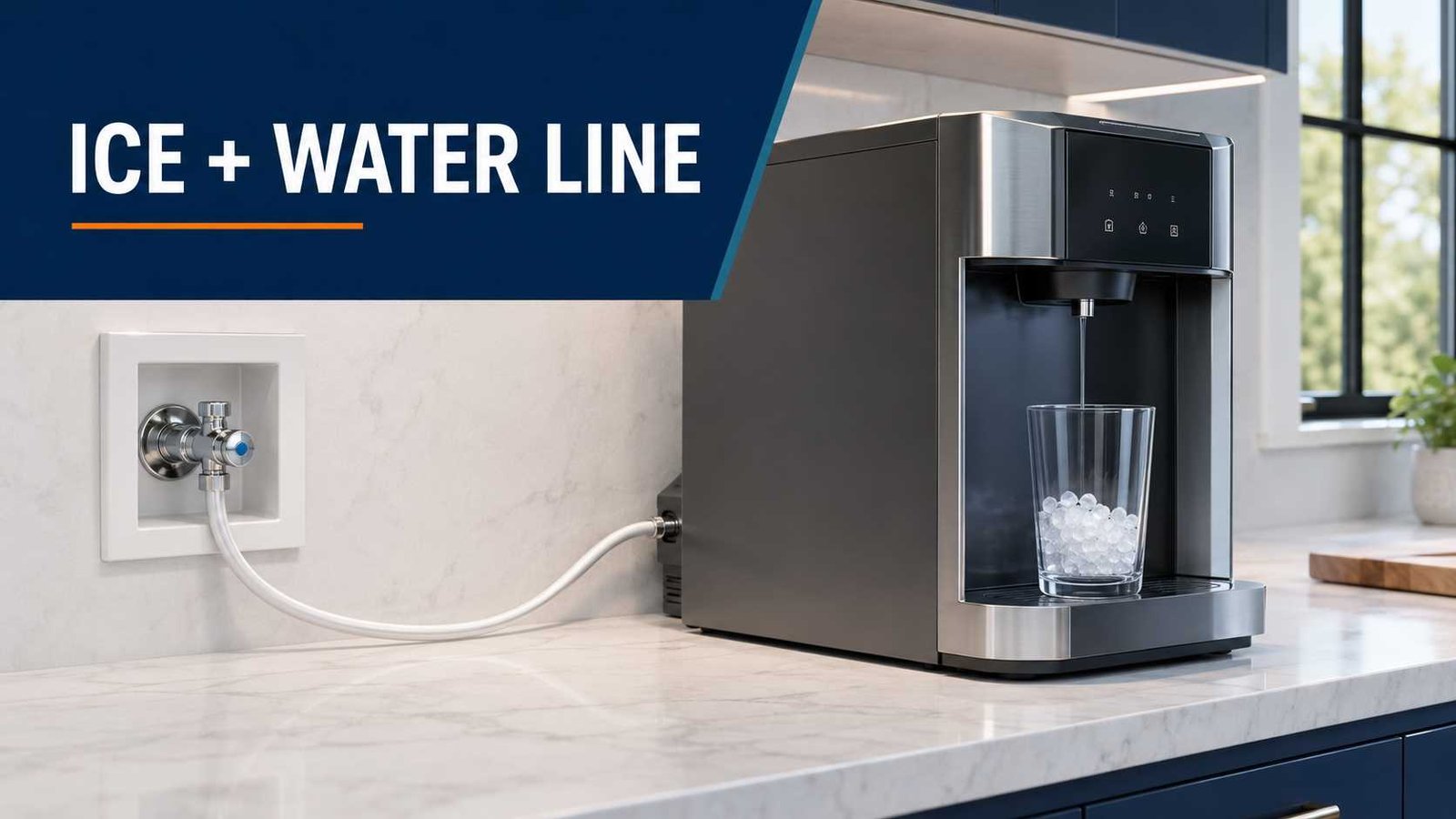
 An ice maker and water dispenser with a water line can provide ice and drinking water without repeatedly filling a reservoir or replacing a water bottle. This setup is common in refrigerators, but direct-plumbed countertop ice-and-water dispensers are also available.
The important part is identifying what type of machine you are buying. Many popular portable countertop ice makers are filled manually and do not connect to household plumbing. True plumbed countertop ice-and-water machines exist, but many are designed for offices, healthcare facilities, hospitality settings, and other commercial applications.
Before buying one, check the water connection, drain requirement, available space, electrical supply, and whether the dispensed water is actually chilled.
Safety note: Connect an appliance only according to its model-specific installation instructions. If installation requires modifying household plumbing, adding a drain, or making electrical changes beyond a normal appliance connection, use a suitably qualified installer.
| Setup | Water Line Needed? | Makes Ice? | Dispenses Water? | Drain May Be Needed? |
|---|---|---|---|---|
| Refrigerator with ice and water | Usually yes | Yes | Yes | Usually no separate appliance drain |
| Plumbed countertop ice-and-water dispenser | Yes | Yes | Yes | Often |
| Portable countertop ice maker | Usually no | Yes | Usually no | Usually no |
| Bottleless countertop water dispenser | Yes | No | Yes | Depends on model |
| Countertop ice maker with refillable side tank | No permanent line | Yes | Depends on model | Usually no building drain |
A refrigerator commonly uses one household water line for both its ice maker and water dispenser. GE states that applicable refrigerators have one supply line entering the refrigerator, while internal water lines distribute water to the ice maker and dispenser.
Can You Get a Countertop Ice Maker and Water Dispenser With a Water Line?
Yes. Countertop machines that connect directly to a potable-water supply and provide both ice and drinking water are available.
One current example is the Scotsman HID207 Meridian Compact Ice and Water Dispenser. Scotsman lists it as a compact ice-and-water machine with up to 196 pounds of rated ice production per 24 hours under its specified test conditions and seven pounds of storage. The machine is intended as commercial equipment rather than as a small portable kitchen ice maker.
Hoshizaki also offers countertop-capable machines. Its current DCM-271BAK is an ice-and-water dispenser that can sit on a countertop or optional stand. Hoshizaki specifies a water inlet and drain connection for this model.
This distinction matters because searches for countertop ice makers also return many portable machines that use manually filled reservoirs.
Do the Ice Maker and Water Dispenser Use the Same Water Line?
In a Refrigerator
Usually, yes.
On refrigerators designed with both an automatic ice maker and water dispenser, one household water supply commonly enters the refrigerator. Water is then directed internally to the two functions.
GE specifically explains that its applicable refrigerators have one water supply line going to the refrigerator water valve, even though two internal plastic water lines may leave that valve for the ice maker and dispenser.
Whirlpool similarly states that a refrigerator needs a cold-water supply for its ice maker and water dispenser to operate. Its current guidance for applicable models specifies 1/4-inch outside-diameter soft copper or PEX between the shutoff and refrigerator. Always check the installation instructions for your exact refrigerator rather than assuming that specification applies universally.
So you normally do not run one household line for the ice maker and another household line for the dispenser.
With Two Separate Countertop Appliances
The situation changes if you have a separate ice machine and separate bottleless water dispenser.
Do not simply split the line with a tee and assume both appliances will operate correctly. Each appliance may have requirements for:
- Water pressure
- Flow
- Tubing size
- Shutoff arrangement
- Filtration
- Drainage
- Installation clearances
Check both installation manuals before deciding how the supply should be divided.
Do Ice Makers Need a Water Line?
Not all of them.
There are two basic designs homeowners are likely to encounter.
Plumbed Ice Makers
A plumbed ice maker receives water automatically from a household or commercial potable-water supply.
This is typical of:
- Refrigerator ice makers
- Built-in undercounter ice machines
- Commercial countertop ice dispensers
- Combination ice-and-water dispensers
The benefit is continuous automatic filling. Once correctly connected, you normally do not have to refill a water reservoir every time the machine needs more water.
Reservoir-Fill Countertop Ice Makers
Portable countertop machines commonly hold their own water supply.
For example, GE’s Opal countertop ice-maker support documentation describes filling its side-tank reservoir with water. GE also explains that water from the side tank flows into the machine’s lower reservoir for ice production. This is a refillable system rather than a permanent household plumbing connection.
That makes reservoir machines useful for renters, small kitchens, RV-style applications, or locations where installing a permanent water connection is inconvenient.
The tradeoff is that someone has to keep the reservoir filled.
How Does a Plumbed Ice Maker and Water Dispenser Work?
The basic water path is simple:
Potable cold-water supply → shutoff valve → supply tubing → appliance inlet → internal water controls → ice maker and/or drinking-water outlet
The appliance controls when water is admitted for ice production and when water is supplied to the dispenser.
The exact internal arrangement varies by appliance. Homeowners generally do not need to open the machine or work on internal valves simply to connect an approved external supply line.
For a refrigerator, Whirlpool advises checking that the water supply is turned on and that the line is not kinked. A restricted supply line can reduce water flow to the ice and water systems.
Countertop Ice Maker and Water Dispenser With Water Line Options
There is a useful buying distinction between true combination machines and ordinary consumer countertop ice makers.
1. Scotsman HID207
The Scotsman HID207 is a genuine compact ice-and-water dispenser rather than a portable reservoir ice maker. Scotsman’s current product page lists touch-free and push-button versions and identifies the machine as part of its commercial ice-and-water range.
Its March 2024 installation manual states that the appliance requires power, water and a drain. The manual specifies a potable-water connection using 1/4-inch OD poly tubing and a separate cabinet drain. It also recommends a hand shutoff valve within sight of the machine.
This is a good example of why buying a direct-plumbed machine requires more planning than buying a portable countertop ice maker.
2. Hoshizaki DCM-271BAK
The Hoshizaki DCM-271BAK is another true ice-and-water combination machine.
Hoshizaki says it can be installed on a countertop or optional stand, produces mini cubelet-style ice, and dispenses either ice or water. Its specifications include a water inlet and a separate drain connection.
Again, this is commercial-style equipment. It should not be confused with a small plug-in portable ice maker.
3. Portable Reservoir Machines
If permanent plumbing is not practical, a reservoir machine can be much easier to place.
GE’s Opal range illustrates this design. The user fills the machine’s reservoir or optional side tank instead of installing a permanent household water connection.
For many homes, that convenience may matter more than having automatic water supply.
What Is a Good Countertop Water Dispenser That Connects to a Water Line?
If you need filtered drinking water but do not actually need the machine to make ice, you have many more choices.
These products are often called:
- Bottleless water dispensers
- Point-of-use dispensers
- POU water coolers
- Direct-connect water dispensers
- Mains-fed dispensers in the UK and Ireland
Avalon A8
Avalon’s A8 is one current water-only example. It is a countertop bottleless dispenser offering hot and cold water, filtration, and an installation kit. Avalon lists its removable drip tray as requiring no drain.
This type of machine makes sense when the priority is continuous filtered drinking water rather than ice production.
Brio Countertop POU Dispensers
Brio also sells countertop bottleless dispensers. The manufacturer describes these machines as connecting directly to an existing water supply and passing the water through their filtration systems.
Brio currently offers several filtration configurations, including standard multi-stage and reverse-osmosis options. Drain requirements can differ, particularly with reverse-osmosis systems, so the exact model specification still needs to be checked.
Which One Should You Choose?
The answer depends on what you actually want:
| Your priority | More suitable type |
|---|---|
| Ice + drinking water from one unit | Plumbed ice-and-water dispenser |
| Ice without plumbing | Reservoir countertop ice maker |
| Filtered hot/cold water | Bottleless countertop water dispenser |
| Refrigerator ice + chilled water | Refrigerator with ice/water system |
| High ice demand | Commercial ice-and-water dispenser |
| Easy installation and portability | Reservoir machine |
A water-only dispenser is usually simpler than a combination ice machine because it does not have an ice-production system.
Check These Things Before Buying
Water Connection
Do not assume every machine uses the same fitting.
For comparison, the Scotsman HID207 manual specifies a 1/4-inch OD potable-water connection, while Hoshizaki lists different inlet plumbing hardware for the DCM-271BAK.
Use the exact appliance manual as the deciding source.
Drain Requirement
This is one of the easiest details to miss.
The Scotsman HID207 requires a drain. Its manual shows separate potable-water and cabinet-drain connections and specifies that the drain tubing must run toward the building drain.
Hoshizaki also specifies a drain outlet for the DCM-271BAK.
By comparison, Avalon lists the A8 water dispenser’s drip tray as no drain.
So a water line does not automatically mean a drain is required, and a countertop design does not automatically mean a drain is unnecessary.
Water Pressure
Every plumbed appliance has an operating range.
Do not add pumps, restrictors, regulators, or unusual plumbing arrangements based on a generic internet recommendation. Use the limits in the specific machine’s documentation.
Hoshizaki, for example, publishes a defined operating water-pressure range for the DCM-271BAK.
Water Temperature
An appliance described as an ice-and-water dispenser does not necessarily provide refrigerated drinking water.
Check whether the water outlet is:
- Ambient
- Chilled
- Hot
- Room temperature
- Multi-temperature
Water-only bottleless dispensers often specifically advertise temperature options. The Avalon A8, for example, provides hot and cold output.
Filtration
Some machines include filtration, some accept optional filters, and others expect filtration to be installed upstream.
Also consider ongoing filter replacement cost and availability.
Do not assume an ice machine’s filter removes every possible contaminant. Check the certifications and claims for the actual filter being used.
Ice Type
Combination dispensers may make:
- Nugget ice
- Cubelet ice
- Standard cubes
- Other proprietary forms
Scotsman identifies its HID207 as a nugget ice-and-water machine, while Hoshizaki describes the DCM-271BAK’s output as mini cubelet ice.
Production Versus Storage
Daily ice production and ice storage are different numbers.
A machine may make a large quantity over 24 hours while keeping only a relatively small amount ready inside its storage section at one time.
For example, Hoshizaki lists substantially higher daily production than storage capacity for the DCM-271BAK.
This matters when comparing machines for offices, events, healthcare settings, or busy households.
Space and Ventilation
Do not judge a machine solely from its front dimensions.
Ice machines produce heat and often require ventilation clearance. Scotsman’s HID207 documentation specifically discusses airflow and placement requirements for the air-cooled unit.
Check:
- Width
- Depth
- Height
- Side clearance
- Rear clearance
- Space above the unit
- Access for cleaning and servicing
Electrical Supply
Electrical versions vary by country and product.
For example, the current North American Scotsman HID207 specifications list 115 V, 60 Hz, single-phase power, and Hoshizaki’s North American DCM-271BAK is also specified for 115 V/60 Hz.
Do not import a North American appliance and assume it is suitable for a UK, Irish, Australian or New Zealand electrical supply. Buy a version approved and specified for your market.
Refrigerator vs Countertop Ice-and-Water Dispenser
| Feature | Refrigerator System | Plumbed Countertop Combination Unit |
|---|---|---|
| Main purpose | Food storage plus ice/water | Ice and drinking water |
| External water supply | Usually one line | Dedicated connection |
| Drain | Generally not a separate building drain | Often required |
| Ice capacity | Household level | Can be much higher |
| Counter space | None | Required |
| Installation | Refrigerator hookup | May require commercial-style plumbing |
| Portability | Low | Low once permanently plumbed |
| Best fit | Home kitchen | Office, hospitality, healthcare or high-demand area |
For a normal home where a refrigerator already has an ice maker and dispenser, the refrigerator system is usually the simplest route.
A separate countertop combination machine becomes more attractive when higher ice output, a second dispensing location, or dedicated ice-and-water service is needed.
Common Problems After Connecting a Water Line
No Water Reaches the Appliance
First verify that the shutoff valve is open and that the supply line is not bent or kinked.
GE and Whirlpool both include water-supply checks among their first steps when refrigerator ice or water functions are not operating normally.
Water Dispenses Slowly
A restricted supply line or filter can reduce flow.
GE notes that a clogged refrigerator water filter can prevent or reduce water reaching the dispenser and ice maker on applicable models.
Water Works but the Ice Maker Does Not
That does not necessarily mean the household supply is bad.
Because the functions may divide after water enters the refrigerator, a fault in the ice-maker branch can prevent ice production while the dispenser still works. GE gives a frozen ice-maker fill tube as one example and recommends technician attention where ice-maker removal is required.
Ice Maker Works but Water Does Not
The reverse situation can also occur when the external supply is working but a dispenser-specific component, filter, frozen section, or control problem prevents water dispensing.
Do not assume the household water line is faulty simply because one function has stopped.
Air After Installation
Newly installed refrigerator water systems may contain air.
GE advises purging the dispenser after installation on applicable models so the reservoir and water lines can fill correctly.
Follow your own appliance’s instructions because recommended flushing procedures vary.
Leaking Connection
If water appears around the supply connection:
- Stop dispensing water or making ice.
- Close the appliance water shutoff if necessary.
- Inspect the accessible external tubing for a kink, loose connection, or visible damage.
- Follow the installation manual before retightening or replacing fittings.
- Call a plumber or appliance professional if the source cannot be identified safely.
Do not continue operating a machine while water is leaking around electrical equipment.
Safe Installation Checklist
Before putting a plumbed ice maker or water dispenser into service:
- Confirm that the supply is potable water.
- Read the exact model’s installation manual.
- Check the specified inlet fitting and tubing.
- Confirm the required water-pressure range.
- Install or identify an accessible shutoff valve where required.
- Check whether the appliance requires a drain.
- Make sure tubing is not kinked or crushed.
- Confirm adequate ventilation clearance.
- Use the electrical supply specified for your regional model.
- Turn on the water carefully and inspect accessible connections for leaks.
- Flush or prime the system according to the manufacturer’s instructions.
Scotsman’s HID207 manual specifically calls for potable water, a drain, and a nearby shutoff arrangement, illustrating why reading the installation documentation before purchasing can prevent an expensive installation surprise.
Regional Terminology
In the United States and Canada, common terms include water line, bottleless dispenser, direct-connect dispenser and point-of-use dispenser.
In the United Kingdom and Ireland, shoppers may see terms such as mains-fed, plumbed-in or mains-connected dispenser.
In Australia and New Zealand, plumbed-in and mains-connected are also commonly understandable descriptions.
The more important issue is not the terminology but the regional model. Voltage, plumbing connections, certifications and installation instructions can differ even when machines look similar.
Frequently Asked Questions
Can I find a countertop ice maker and water dispenser with a water line?
Yes. True countertop or countertop-capable ice-and-water machines are available. Current examples include the Scotsman HID207 and Hoshizaki DCM-271BAK. Both are closer to commercial equipment than to small portable household ice makers, and both have installation requirements beyond simply filling a reservoir.
Do the ice maker and water dispenser use the same water line?
On many refrigerators with both functions, yes. One household water line enters the refrigerator and the water is distributed internally. GE confirms this arrangement for refrigerators covered by its support guidance.
Do all ice makers need a water line?
No. Refrigerator and built-in automatic ice makers commonly use a permanent water supply, while many portable countertop machines use refillable reservoirs. GE’s Opal side-tank system is one documented example of the refillable approach.
Can I connect a portable countertop ice maker directly to plumbing?
Only if the manufacturer specifically designed that model for a direct water connection. Do not modify the reservoir, tubing or internal water system of an ordinary portable machine to create an unsupported plumbing connection.
Does a countertop ice maker and water dispenser need a drain?
Some do. Scotsman’s HID207 and Hoshizaki’s DCM-271BAK both have specified drain connections. Other water-only countertop dispensers may not; Avalon, for example, specifies no drain for the A8 drip tray.
What is a good countertop water dispenser that connects to a water line?
For water rather than ice production, the Avalon A8 is one direct-connected countertop example with hot and cold dispensing, while Brio offers a broader range of countertop point-of-use dispensers with multiple filtration configurations. Choose according to temperature options, filtration needs, installation requirements and locally available support rather than assuming one model is right for everyone.
Is a bottleless water dispenser the same as an ice-and-water dispenser?
No. Bottleless means the dispenser receives water directly from plumbing instead of a replaceable bottle. It does not necessarily make ice. A true ice-and-water dispenser contains an ice-making system as well.
Can I split my refrigerator water line to feed another appliance?
It may be technically possible in some installations, but do not assume a simple tee is suitable. The added appliance can change flow and pressure requirements, and each appliance may require its own approved connection or shutoff arrangement. Check both manufacturers’ installation requirements and local plumbing requirements before modifying the supply.

Daniel Brooks is a US-based appliance troubleshooting researcher with 12 years of experience studying washer, dryer, refrigerator, and dishwasher faults. He reviews manufacturer manuals and converts technical error codes into safe, practical guidance for homeowners.