
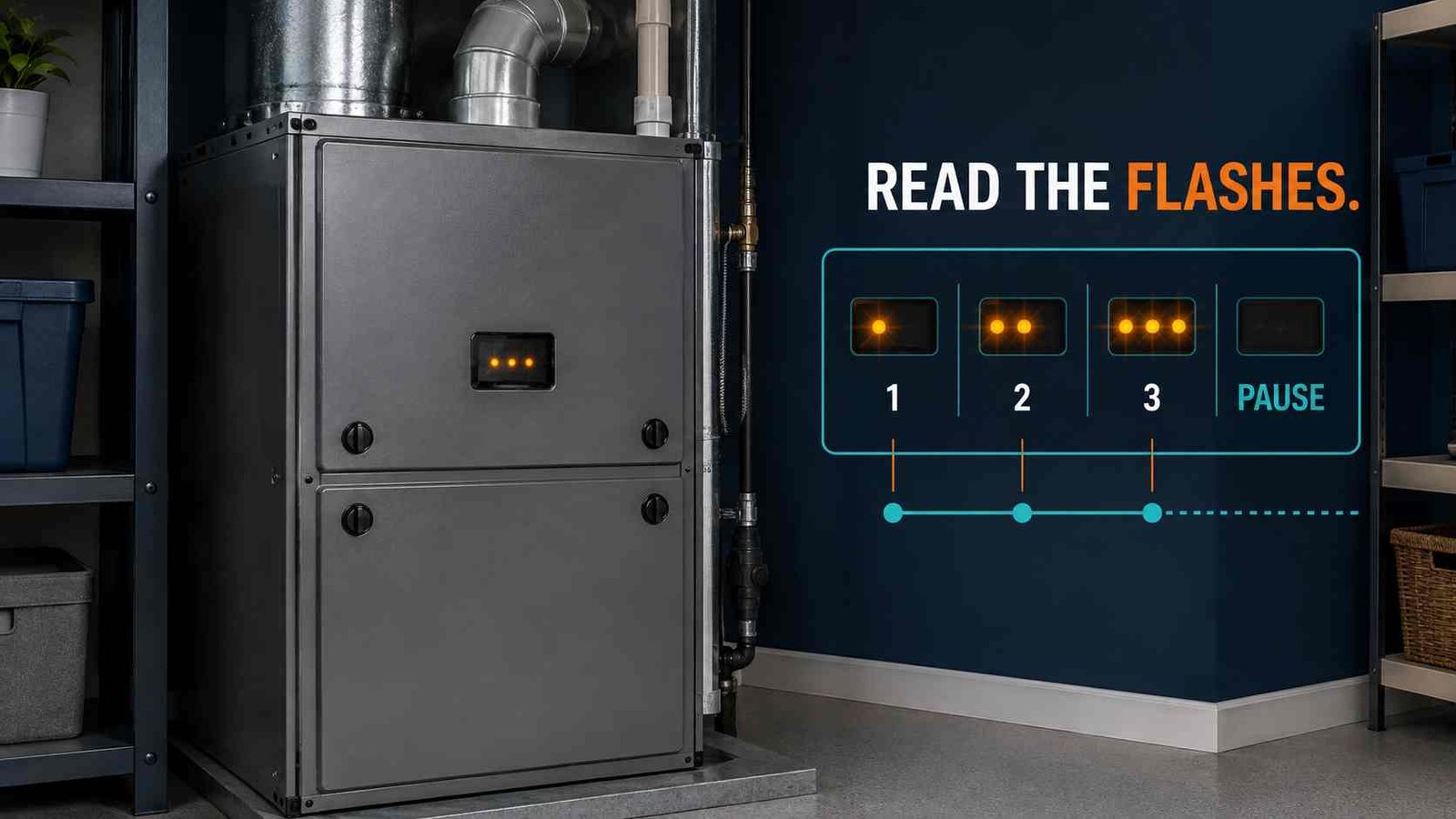
 A blinking light on a furnace can indicate normal operation, an active heating cycle, or a fault that has stopped the burners. The colour and number of flashes are not enough by themselves because furnace blinking light codes vary by brand, model, and installed control board.
Before switching off the furnace, watch the light through the viewing window and record several complete repetitions. Count the flashes, note any long pause, and check whether some flashes are shorter or longer than others. Then compare the pattern with the code chart attached to the furnace or the manual for its exact model.
Stop using the furnace and leave the building if you smell gas or a carbon-monoxide alarm sounds. Do not reset rollout switches, bypass safety devices, adjust the gas valve, or test internal wiring yourself.
Quick Answer
| Item | Guidance |
|---|---|
| Indicator | One or more LEDs or a digital diagnostic display |
| Possible meaning | Normal status, heating demand, stored warning, or active fault |
| First safe step | Record the full pattern before switching off power |
| How to identify the code | Compare it with the service label or exact model manual |
| Can colour identify the fault? | No. Red, green, and amber meanings vary by model |
| Can the furnace still operate? | Sometimes, but repeated shutdowns or safety faults require attention |
| Safe homeowner checks | Thermostat, filter, vents, power switch, breaker, and accessible exterior vent openings |
| Do not attempt | Gas work, live electrical testing, internal wiring, flame adjustment, or safety-switch bypassing |
| Professional help | Required for ignition, flame, pressure-switch, limit, rollout, gas, venting, or control-board faults |
What Does a Blinking Furnace Light Mean?
The diagnostic light is connected to the furnace control board. It communicates information about the operating sequence and any problem detected by the control.
Depending on the furnace, the light may indicate:
- Normal standby operation
- A current call for heat
- Burner operation
- Failure to ignite
- Loss of flame
- Restricted airflow or overheating
- A pressure-switch or venting fault
- Incorrect voltage, polarity, or grounding
- An open safety switch
- A control-board problem
A blinking light does not automatically mean the furnace has failed. On selected Trane furnaces, for example, a slow green blink can mean there is no current call for heat, while faster continuous blinking can indicate active heating. Certain Lennox controls also use slow and fast heartbeat patterns for normal operating conditions.
Here is what matters: never interpret a furnace code from colour or flash count alone.
Stop Immediately in These Situations
Most furnace-code checks are not emergencies. The following conditions are different.
You Smell Natural Gas or Propane
A gas leak may smell like rotten eggs or sulphur because an odour is added to otherwise odourless fuel.
Do not operate electrical switches, use a flame, attempt a furnace reset, or remain inside looking for the source. Leave the building immediately and contact emergency services or your gas supplier from outside. Canadian government safety guidance instructs occupants who detect a gas odour to leave immediately and call emergency services.
A Carbon-Monoxide Alarm Sounds
Leave the building and move into fresh air. Call local emergency services from outside and do not re-enter until qualified responders say it is safe.
Carbon monoxide is colourless and odourless. Fuel-burning appliances, including furnaces, may produce dangerous CO when they malfunction or are incorrectly vented.
You See Soot, Scorching, or Flame Outside the Burner Area
Turn the heating system off only if you can do so without approaching a dangerous condition. Leave the area and arrange professional service.
Visible soot, unusual burning odours, scorched furnace surfaces, or flames appearing where they should not may indicate a combustion or flame-rollout problem.
The Furnace Repeatedly Trips a Safety Fault
Codes involving flame rollout, an open high-limit switch, overheating, or flame detected when the gas valve should be closed are not suitable for repeated homeowner resets.
Do not manually reset a rollout switch. The switch may have opened because of a serious combustion, venting, or heat-exchanger problem.
The Breaker Trips Again
A household breaker may be reset once after confirming that no burning smell, water damage, or visible electrical damage is present.
When it trips again, leave it off and call a qualified technician or electrician. Repeatedly resetting a breaker can expose an unresolved electrical fault.
How to Read Furnace Blinking Light Codes
1. Confirm That You Are Looking at the Furnace
A central HVAC system may include a furnace, air handler, heat pump, humidifier, and thermostat. Each device can have its own lights or messages.
The furnace is normally the indoor metal cabinet connected to the home’s ductwork. Gas furnaces also have a combustion vent, which may be metal or plastic depending on the furnace design.
2. Locate the Diagnostic Viewing Window
Many furnaces have a small clear window in the front access panel. The control-board LED can be observed through this window without removing the door.
Carrier advises homeowners to look through the furnace-door window, match the flash sequence with the chart on the panel, and provide the code to the technician.
Do not remove a panel merely to obtain a better view. Opening the door may activate a safety interlock, switch off the furnace, or erase the active code on some controls.
3. Record the Pattern Before Switching Off Power
Use a phone to record 20 to 30 seconds of video. A video is often more reliable than trying to remember the count.
Record:
- LED colour
- Number of lights
- Number of flashes
- Short or long flashes
- Length of the pause
- Whether two lights flash together or alternately
- Whether the sequence changes during startup
- What the furnace does before it stops
This step matters because diagnostic memory is not handled the same way on every control.
A Carrier service manual for selected furnace models states that interrupting power or removing the blower door before recording the code can erase the control’s status memory. A reviewed Lennox control, by comparison, stores its most recent error codes even when furnace power is switched off.
The safest rule is simple: record first, reset later.
4. Watch More Than One Repetition
A single group of flashes may be mistaken for part of a longer pattern. Watch until the same sequence repeats at least two or three times.
For example:
flash – flash – flash – long pause – repeat
This can be read as three flashes on a control that uses a single-digit format. It does not mean the same fault on every furnace.
5. Identify the Pattern Format
Furnace controls commonly use one of the following systems.
| Pattern type | Example | How to read it |
|---|---|---|
| Single repeated count | Three quick flashes followed by a pause | Code 3 on that specific control |
| Short-and-long flashes | Three short flashes, then four long flashes | Code 34 on compatible controls |
| Heartbeat pattern | Continuous slow or fast blinking | May show normal status or heating demand |
| Two-light sequence | Red and green lights flashing together or alternately | Compare both lights with the model chart |
| Digital display | Letters, numbers, or both | Record the complete displayed code |
These examples explain how patterns are counted. They are not universal code definitions.
6. Find the Correct Code Chart
The most reliable chart is usually found:
- On the inside or outside of the furnace access panel
- On a service label near the viewing window
- In the installation, service, or homeowner manual
- In the manufacturer’s model-number document lookup
- In an official brand diagnostic tool
Do not rely on a chart that lists only the brand. A manufacturer may use several control systems across different model families.
Goodman’s official diagnostic lookup, for example, asks for the brand, furnace model, communicating status, and the condition of multiple diagnostic lights. Rheem’s standard furnace chart specifically excludes some modulating, LXE, and two-stage products. These limitations show why an exact model match is necessary.
Understanding the Different Flash Formats
Single-Digit Repeated Flashes
A control may flash rapidly a set number of times, remain off for several seconds, and then repeat.
A reviewed Lennox furnace control uses this method. Its documentation describes error codes as rapid flashes followed by a three-second pause. It also uses separate heartbeat patterns for normal status.
Do not stop counting because the first few flashes appear familiar. Some controls can display ten or more flashes.
Short-and-Long Two-Digit Codes
Some Carrier-family controls produce a two-digit code:
- Short flashes represent the first digit
- Long flashes represent the second digit
Three short flashes followed by four long flashes would therefore be read as code 34 on a control that uses this format.
The applicable Carrier service document also directs technicians to use the service label on the blower-compartment door for the actual code explanation.
Slow and Fast Heartbeat Patterns
A heartbeat is a regular repeating blink rather than a counted fault sequence.
Depending on the control:
- A slow heartbeat may mean idle, cooling, or continuous fan operation
- A fast heartbeat may mean there is an active call for heat
- Continuous rapid flashing may indicate burner operation
- Another model may assign different meanings
Do not confuse a heartbeat with a one-flash code. A heartbeat normally continues at a steady rate without a noticeably longer code-separating pause.
Multiple Diagnostic LEDs
Some control boards have separate status, fault, communication, or stage LEDs.
Record exactly what each light is doing. For example:
- Green light steady
- Red light flashing three times
- Both lights alternating
- One light off
A chart for a one-light control cannot safely be applied to a board with several LEDs.
Seven-Segment Displays
Newer furnaces may use a small display rather than a basic blinking LED. It may show:
- Operating status
- Letters and numbers
- Stored faults
- Airflow information
- Startup stages
Write down every character in the order displayed. A zero can easily be confused with the letter O, while a five may resemble the letter S.
Why the Light Colour Is Not Enough
Online explanations sometimes claim that green means normal, amber means flame, and red means failure. That may be correct for a particular furnace, but it is not a universal HVAC standard.
A red Lennox diagnostic LED can use a slow heartbeat to show normal operation. Trane explains that a green light may blink slowly or quickly depending on whether there is a call for heat. Other furnaces use red only for faults, while some use a single amber light for both operating status and failures.
Always consider four details together:
- Light colour
- Number of flashes
- Flash speed
- Pause or repetition pattern
Common Furnace Fault Categories
The exact flash number varies, but the fault categories below appear across many furnace-control systems.
| Fault category | Possible furnace behaviour | Safe homeowner action | Technician-level diagnosis |
|---|---|---|---|
| Ignition failure | Inducer starts, but burners do not light | Record code and check thermostat, power, filter, and external vents | Igniter, gas supply, gas valve, wiring, control sequence |
| Flame lost or not proven | Burners light briefly and shut off | Stop repeated resets and arrange service | Flame sensor, grounding, burner condition, gas pressure |
| Pressure-switch fault | Inducer runs but ignition does not continue | Check accessible exterior vent openings for snow or debris | Pressure switch, tubing, inducer, condensate, vent design |
| High-limit or overheating fault | Burners stop while blower continues | Replace dirty filter and open blocked registers | Limit circuit, blower operation, heat exchanger, airflow |
| Rollout-switch fault | Furnace may lock out and run the blower | Leave the system off and call a technician | Burners, venting, heat exchanger, combustion |
| Polarity or grounding fault | Furnace may not ignite or may behave inconsistently | Do not alter wiring | Electrical supply, grounding, transformer, control |
| Low-voltage or board fault | No response, intermittent operation, or unusual codes | Check breaker and external switch only | Transformer, fuse, wiring, board inputs and outputs |
| Normal status | Furnace may be idle or heating normally | Confirm the pattern with the exact chart | Usually no repair required |
A code identifies the condition detected by the control. It does not always prove which component has failed.
For example, a pressure-switch code does not automatically mean the pressure switch is defective. The switch may be responding correctly to a blocked vent, inducer problem, condensate obstruction, damaged tubing, or another airflow condition.
Safe Checks a Homeowner Can Perform
Complete only the external checks that do not involve opening the burner compartment, touching wiring, or working with gas.
1. Check the Thermostat
Confirm that:
- The mode is set to Heat
- The set temperature is above the current room temperature
- The fan is set to Auto rather than On, unless continuous fan operation is intended
- The thermostat display is working
- Replaceable thermostat batteries are not low
Wait several minutes after changing the setting. Furnaces may have built-in delays.
2. Check the Furnace Power Switch
Many furnaces have a nearby switch that resembles a normal light switch. Make sure it has not been switched off accidentally.
Do not operate it when gas is smelled, smoke is present, or electrical damage is visible.
3. Check the Household Breaker
Look for the breaker labelled Furnace, Heating, HVAC, or Air Handler.
When it has tripped, reset it once by moving it fully to Off and then back to On. Do not continue resetting it if it trips again.
4. Inspect the Air Filter
A heavily restricted filter can reduce airflow, contribute to overheating, and cause the high-limit switch to open.
Replace the filter when it is visibly loaded with dust, using the correct dimensions and airflow direction. Do not install a filter with a different resistance rating unless the furnace or HVAC documentation allows it.
Carrier and Trane list thermostat settings, furnace power, filters, and open registers among the basic checks homeowners can make before arranging service.
5. Open Supply Registers and Return Grilles
Make sure:
- Supply registers are open
- Furniture, rugs, and curtains are not blocking them
- Return grilles are unobstructed
- Objects are not stored directly against the furnace
Closing several registers does not necessarily save energy and can restrict the airflow needed by the furnace.
6. Check Accessible Exterior Vent Terminals
High-efficiency furnaces often use plastic intake and exhaust pipes that terminate through an outside wall or roof.
From ground level, check for visible:
- Snow
- Ice
- Leaves
- Animal nesting material
- Wind-blown debris
- Objects stored against the openings
Do not climb onto a roof or insert tools into the pipes. Health Canada advises checking furnace exhaust vents during and after snowstorms to ensure that ice, snow, and debris are not blocking them.
7. Note What Happens During Startup
Without removing panels, listen and observe:
- Does the thermostat call for heat?
- Does a small motor begin running?
- Is there clicking?
- Do the burners appear to light through the approved viewing port?
- Does the flame disappear after a few seconds?
- Does the main blower start?
- Does the furnace shut down before the room warms?
This information can help a technician interpret the code. Do not place your face close to a burner window and do not remove safety panels to watch the sequence.
Should You Reset a Furnace With a Blinking Light?
There is no universal furnace reset procedure.
Some temporary lockouts clear after a timed delay. Others may clear when the thermostat demand ends. Some manufacturers allow a power cycle, while particular safety faults require inspection before the furnace should be restarted.
Before Any Reset
- Photograph or record the complete code
- Find the furnace model number
- Read the code chart
- Check for gas odour, CO alarm, soot, scorching, or unusual heat
- Complete only the safe external checks
- Read the manufacturer’s reset instructions
When a Basic Reset May Be Reasonable
A single reset may be reasonable when:
- There is no gas smell or CO alarm
- The code does not involve rollout or another combustion safety condition
- The manual permits a homeowner reset
- A simple cause, such as an incorrectly fitted panel or power interruption, has been corrected
- The furnace has not been repeatedly locking out
Set the thermostat to Off and use only the external switch or breaker method specified by the manufacturer. Do not remove wires, press internal service buttons, or operate the gas valve.
When Not to Reset
Do not reset the furnace when:
- A rollout code is displayed
- The code states flame is present when the gas valve should be closed
- The furnace has overheated repeatedly
- There is soot, scorching, smoke, or a burning smell
- A CO alarm has sounded
- Gas is smelled
- The breaker keeps tripping
- The same lockout returns after one reset
Repeated resetting does not repair the cause. It may also erase useful diagnostic information or repeatedly attempt an unsafe ignition sequence.
What to Do When the Basic Checks Do Not Work
The Code Returns After Replacing the Filter
Leave the new filter installed if it is the correct type and all registers are open. A continuing limit or airflow fault may involve the blower, ductwork, coil, heat exchanger, limit circuit, or furnace setup.
These checks require professional testing.
The Exterior Vents Look Clear
A pressure-switch code can still be caused by an internal vent restriction, condensate drainage problem, inducer fault, damaged tubing, incorrect vent installation, or an actual switch failure.
Do not blow into pressure tubing, bypass the switch, or jumper its electrical terminals.
The Burners Light and Then Shut Off
This symptom may be associated with flame-proving, grounding, gas-pressure, burner, or venting problems.
Although online guides often suggest cleaning a flame sensor, accessing it requires opening the combustion area. An incorrect procedure can damage a fragile component or overlook the actual cause. Professional diagnosis is the safer next step.
The Furnace Is Heating Despite the Flashing Light
The light may represent normal operation, a non-shutdown warning, a stored fault, or an intermittent problem.
Compare it with the model chart. Arrange service when the code identifies a safety condition, keeps returning, or appears with unusual cycling, weak heat, soot, smells, or noise.
There Is No Diagnostic Light
An unlit LED may indicate:
- Furnace power is off
- A panel interlock is open
- A breaker has tripped
- A low-voltage fuse or transformer has failed
- The control board has failed
- The model does not use a visible status LED
Check the thermostat, external switch, breaker, and proper panel position. Leave internal electrical diagnosis to a technician.
The Code Chart Is Missing
Record the complete furnace model number from the available paperwork or accessible exterior label. Search the manufacturer’s official literature database or contact the manufacturer or installing contractor.
Do not use a chart from a similar-looking furnace. Replacement control boards can also use a different code system from the original board.
Brand and Model Differences
Carrier and Bryant
Selected Carrier-family controls use two-digit codes made from short and long flashes. The first digit is represented by short flashes and the second by long flashes.
Other Carrier and Bryant models may use different boards or communicating controls, so the panel label remains the deciding source.
Lennox
Reviewed Lennox controls demonstrate several formats, including:
- Slow heartbeat for normal idle, fan, or cooling
- Fast heartbeat or rapid flashing during heating
- Counted rapid flashes for faults
- Stored error history
The code meanings and memory functions depend on the installed control.
Trane and American Standard
Trane explains that blinking can be normal and that green-light speed may change according to operating status. A separate fault sequence may occur when the furnace detects a problem.
Record both colour and speed rather than assuming every flashing light is an error.
Rheem and Ruud
Rheem publishes different diagnostic references for standard furnaces and package units. Its standard chart expressly excludes some modulating, LXE, and two-stage furnaces.
Confirm the model family before using any Rheem or Ruud flash-count list.
Goodman and Amana
Goodman’s official diagnostic system requires the user to choose the brand and model before entering the status of the diagnostic LEDs. This model-based process is more reliable than a generic Goodman or Amana chart copied without its original limitations.
Parts a Technician May Need to Test
The code and symptoms may lead an HVAC technician to inspect the following components.
| Component or system | Possible relationship to the code |
|---|---|
| Igniter | Furnace does not light after the inducer starts |
| Flame sensor or flame-proving circuit | Burners light and then shut off |
| Pressure switch and tubing | Ignition sequence stops before the igniter operates |
| Draft inducer | Insufficient airflow through the combustion system |
| Intake or exhaust vent | Obstruction, incorrect slope, leakage, or installation fault |
| Condensate system | Water restriction affecting a condensing furnace |
| High-limit switch | Overheating or restricted airflow |
| Rollout switch | Abnormal burner flame or combustion condition |
| Blower motor and controls | Weak airflow or repeated overheating |
| Gas valve and gas supply | Burners do not light despite an ignition attempt |
| Transformer or low-voltage fuse | Control is unresponsive or loses low-voltage power |
| Control board | Incorrect sequencing, missing outputs, or board self-fault |
A technician may need combustion instruments, pressure measurements, live-voltage testing, flame-signal measurements, or gas-pressure testing. These are not homeowner procedures.
Regional Terminology and Safety Differences
United States and Canada
Furnace commonly means a central forced-air heating appliance. Many residential gas furnaces use a 120-volt electrical supply and distribute heated air through ducts.
US and Canadian models may appear similar but can have different certification, model, control, fuel, and installation requirements.
United Kingdom and Ireland
In UK homes, the main central-heating appliance is usually called a boiler. It heats water for radiators or underfloor heating rather than sending heated air through ducts. Energy Saving Trust states that boilers are the most common heating type in UK homes.
A UK or Irish boiler showing a blinking light should be checked using a boiler-specific fault-code guide.
Australia
A comparable appliance may be described as a ducted gas heater or ducted gas heating system. Australian government guidance says that householders may clean accessible air-intake filters, while servicing should be completed by a licensed technician.
New Zealand
Heating systems may include ducted gas heaters, gas space heaters, central heat pumps, or hydronic systems. Use the terminology and service information supplied for the exact appliance.
Gas and electrical licensing requirements differ by country and jurisdiction. Internal repairs should be handled by a properly qualified local professional.
When to Call an HVAC Professional
Arrange professional service when:
- The same code returns after one permitted reset
- The furnace repeatedly fails to ignite
- Burners light and then shut off
- A pressure-switch code remains after accessible exterior vents are confirmed clear
- A high-limit or overheating code returns with a clean filter and open registers
- A rollout code appears
- The furnace displays flame when the gas valve should be off
- The breaker trips again
- The control board has no light despite confirmed external power
- The furnace cycles rapidly or cannot maintain temperature
- There is water inside or around a condensing furnace
- The vent pipe is loose, cracked, sagging, or damaged
- There are soot marks, unusual combustion sounds, or burning smells
- The code chart cannot be matched confidently to the model
Give the technician:
- Furnace brand
- Complete model number
- LED colour
- Exact flash sequence
- Video of the pattern
- Thermostat setting
- What happens during startup
- Any recent filter, thermostat, power, or HVAC work
Frequently Asked Questions
What does a blinking red light on a furnace mean?
It may indicate normal status, an active heating cycle, or a fault. Red does not have one universal meaning. Count the flashes and compare the complete pattern with the code chart for the exact furnace model.
How do I count furnace flash codes?
Watch for a group of flashes followed by a clearly longer pause. Count the flashes in one full group and confirm that the sequence repeats. Also note whether the flashes are short, long, slow, or fast.
What does three blinking lights on a furnace mean?
Three flashes can indicate different conditions on different models. On one control it may relate to ignition or flame loss, while another manufacturer may assign three flashes to a limit or pressure fault. Use the furnace service label or exact manual.
Is a slow blinking furnace light normal?
It can be. Selected controls use a slow heartbeat to indicate standby, continuous fan, or cooling. Confirm the meaning in the model-specific chart before assuming a repair is needed.
Should I switch off the furnace to clear the light?
Record the pattern first. Switching off power may erase the current code on some controls. Reset only when the manufacturer allows it and there is no gas, carbon-monoxide, combustion, rollout, overheating, or electrical danger.
Can a dirty filter cause a furnace fault code?
Yes. A heavily restricted filter can reduce airflow and contribute to furnace overheating, which may open a high-limit switch. However, a continuing limit code can also involve the blower, ductwork, coil, furnace setup, or safety circuit.
Why does the code return after I reset the furnace?
A reset may clear the lockout without correcting its cause. The code can return when the control again detects ignition failure, weak flame, overheating, restricted venting, an electrical problem, or another unresolved condition.
Can I keep using the furnace when the light is blinking?
Only when the exact chart confirms that the pattern represents normal operation or a non-dangerous status. Stop using the furnace when there is a gas smell, CO alarm, rollout code, soot, scorching, repeated overheating, repeated lockout, or an unexplained combustion fault.
Daniel Brooks is a US-based appliance troubleshooting researcher with 12 years of experience studying washer, dryer, refrigerator, and dishwasher faults. He reviews manufacturer manuals and converts technical error codes into safe, practical guidance for homeowners.