
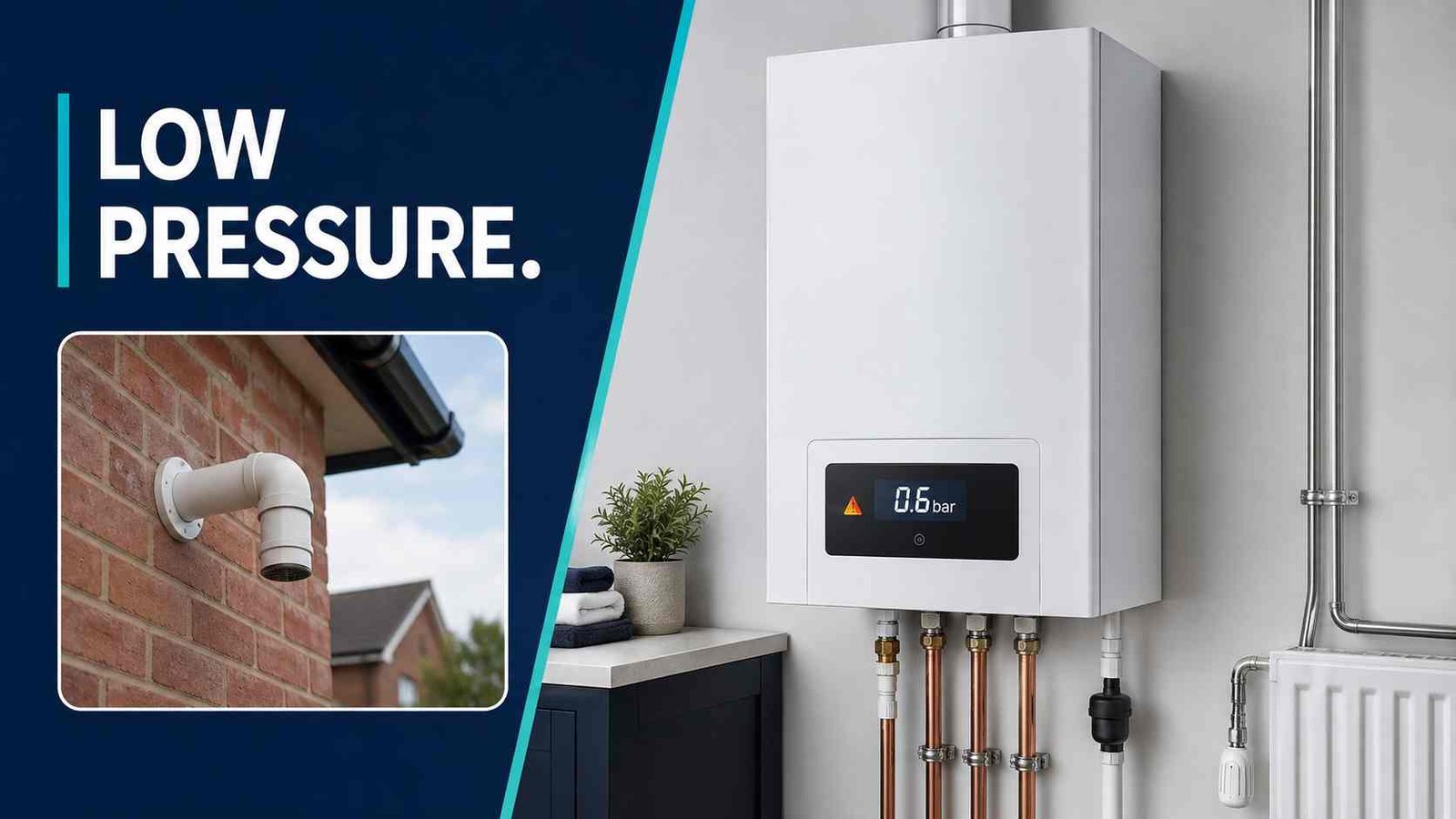
 If your boiler keeps losing pressure after you top it up, water may be escaping from the sealed heating circuit or the system may not be controlling pressure correctly. A one-time pressure drop can happen after bleeding a radiator, but repeated pressure loss should not be treated as normal.
Start by allowing the heating system to cool, recording the pressure reading and checking visible radiator valves, pipe joints, floors and ceilings for signs of water. You can also look at the boiler’s external pressure-relief discharge pipe for dripping.
Do not remove the boiler casing, operate a safety valve or attempt to repair internal components. Stop using the appliance if there is a substantial leak, a gas smell, a carbon-monoxide alarm or any reason to suspect the boiler is unsafe.
Quick Answer
| Item | Guidance |
|---|---|
| Problem | Boiler pressure repeatedly falls below its normal operating range |
| Appliance type | Mainly sealed combi and system boilers |
| Typical UK cold pressure | Often around 1 to 1.5 bar, but check the exact manual |
| Common causes | Radiator or pipe leak, pressure-relief valve discharge, expansion-vessel fault or pressure loss after radiator bleeding |
| Safe first check | Check the pressure when cold and inspect visible joints for dampness, rust or staining |
| Can the boiler still be used? | Not if it has locked out, is leaking heavily or is suspected to be unsafe |
| Homeowner repair difficulty | External observation is simple; internal diagnosis is professional work |
| When to call an engineer | When pressure falls again after repressurising, rises sharply when hot or no external leak can be found |
Worcester Bosch states that many of its systems should read between 1 and 1.5 bar when cool. Baxi gives a broader normal operating range of 1 to 2 bar. These figures demonstrate why the pressure range in the exact boiler manual should take priority over a generic number.
What Boiler Pressure Means
The pressure gauge measures the water pressure inside the closed central-heating circuit. It does not usually measure the incoming mains-water pressure that supplies taps and showers.
In a sealed system, the boiler, radiators and heating pipes contain a fixed volume of water. The pressure normally rises slightly when that water heats and expands. It should fall again as the system cools.
Some movement is therefore expected. A large or repeated change is more important than a small difference between a cold and warm reading.
Worcester Bosch advises that a pressure increase of more than approximately 1 bar between a cold system and a fully heated system may indicate that the expansion vessel needs professional attention.
Is the Boiler Pressure Actually Too Low?
Check the gauge when the central heating is switched off and the system has cooled. Comparing one cold reading with another cold reading gives a more useful result than comparing a cold reading with one taken while the radiators are hot.
Many UK boilers operate at approximately 1 to 1.5 bar when cold, although some manufacturers specify a wider range. A reading below 1 bar commonly indicates low pressure, but the boiler manual and the coloured zones on the gauge should be followed.
Modern boilers may display:
- A digital pressure value
- A low-pressure symbol
- A warning message
- A manufacturer-specific fault code
- A lockout that prevents heating or hot-water operation
Do not assume that the same fault code has the same meaning on every brand or model.
Most Common Reasons a Boiler Keeps Losing Pressure
1. A leaking radiator valve or visible pipe joint
A small leak from a radiator valve, compression joint or exposed heating pipe can gradually reduce the amount of water in the system.
Look for:
- Dampness around radiator valves
- Green, white or rusty deposits
- Flaking paint
- Discoloured flooring
- Stains on skirting boards
- Water marks on ceilings below heating pipes
A hot pipe can cause a small amount of escaping water to evaporate before it forms an obvious puddle. Baxi therefore recommends looking for rust, corrosion and staining as well as visible dripping.
Do not tighten or dismantle a joint unless you are trained and authorised to perform that work.
2. A concealed heating-system leak
Heating pipes may run beneath floors, behind walls or above ceilings. A concealed leak can lower pressure without leaving water near the boiler.
Possible clues include:
- A damp patch that returns after drying
- Warped flooring
- Peeling paint
- Unexplained ceiling staining
- A musty smell
- Pressure that drops steadily without visible boiler leakage
Worcester Bosch specifically advises considering possible leaks in underfloor pipework when a heating system repeatedly loses pressure.
3. Water escaping through the pressure-relief valve
A sealed heating system includes a safety valve that releases water if pressure becomes too high. Its discharge pipe normally runs from the boiler to the outside of the building.
If this external pipe is wet or dripping when the boiler has not recently discharged because of overpressure, the pressure-relief valve may be passing water. The valve itself may be faulty, contaminated by debris or unable to reseal correctly.
Checking the end of the external pipe is a safe observation. Do not operate, test, clean or dismantle the pressure-relief valve yourself.
4. An expansion-vessel problem
The expansion vessel helps absorb the increase in water volume as the heating system warms.
When the vessel loses its air charge or its internal diaphragm fails, pressure may rise sharply while the heating is operating. The pressure-relief valve may then release water. After the system cools, the pressure can fall below the boiler’s minimum level.
A common pattern is:
- Pressure appears normal when the system is cold.
- It rises unusually high when the radiators heat.
- Water may discharge outside.
- Pressure falls too low after cooling.
Expansion-vessel testing, recharging and replacement involve internal boiler work and should be left to a qualified heating engineer.
5. Pressure loss after bleeding radiators
Bleeding a radiator releases trapped air, but it may also release a small amount of water. This reduces the contents of the sealed heating circuit and can lower the gauge reading.
Check the boiler pressure after bleeding one or more radiators. A single drop following this work may be expected. Pressure that continues falling after the system has been correctly refilled indicates a separate problem.
6. Recent heating-system work
Pressure can drop after:
- Replacing a radiator
- Removing a radiator for decorating
- Draining part of the heating system
- Replacing a valve
- Servicing or repairing the boiler
- Bleeding several radiators
The system may need to be filled and vented correctly after this work. Contact the person who completed the repair if pressure continues to fall.
7. A leak inside the boiler
Internal seals, water-carrying components and connections can deteriorate or loosen. An internal leak may produce dripping underneath the boiler, but a small leak may not always be obvious from outside.
Do not remove the casing to search for it. Vaillant advises arranging inspection by a Gas Safe registered engineer when an internal boiler leak is suspected.
8. A faulty pressure sensor or gauge
Sometimes the displayed pressure does not accurately represent the actual system pressure. A pressure sensor may be blocked, disconnected or faulty, or an analogue gauge may stick.
Signs may include:
- The reading does not change during an approved filling procedure
- The boiler displays a low-pressure fault despite an apparently normal gauge
- The gauge remains fixed as the system heats and cools
- The display changes suddenly rather than gradually
Vaillant lists pressure-sensor faults among the possible causes associated with its F.22 low-water-pressure condition. Sensor diagnosis requires professional testing.
What the Pressure Pattern May Indicate
These patterns cannot confirm a diagnosis, but they can help an engineer narrow down the likely fault. They are based on manufacturer descriptions of leaks, expansion-vessel behaviour and pressure-relief discharge.
| Pressure behaviour | Possible explanation |
|---|---|
| Falls slowly over several days | Small radiator, pipe or concealed-system leak |
| Drops after bleeding radiators | Water and air released during bleeding |
| Rises sharply while heating | Expansion vessel may not be absorbing expansion correctly |
| Rises high, then falls low when cold | Water may have discharged through the relief valve |
| Drops shortly after repressurising | Active leak, relief-valve discharge or another unresolved fault |
| Outside discharge pipe is wet | Pressure-relief valve may be passing water |
| Gauge never moves during filling | Filling device may not be operating, or the gauge or sensor may be faulty |
| Drops to zero rapidly | A significant leak or incorrect reading requires prompt professional investigation |
Safe External Checks
Perform only checks that do not require removing covers, dismantling fittings or touching gas and electrical components.
1. Let the heating system cool
Switch off the central heating and allow the radiators and pipes to cool before comparing pressure readings or checking for water.
Hot pipes and heating water can cause burns.
2. Record the cold pressure
Write down or photograph the reading. Record the date and time.
Repeat the check under similar cold conditions. This shows whether pressure is genuinely falling rather than changing because the water is warming and cooling.
3. Inspect radiator valves
Use a dry tissue around accessible radiator valves and visible connections. A tissue may reveal a small amount of moisture that is difficult to see.
Do not force, tighten or loosen the valve.
4. Check exposed heating pipes
Look around visible pipe joints and where pipes enter floors or walls. Pay attention to corrosion, staining and damaged paint, not just obvious drips.
5. Look underneath the boiler
Without removing the casing, check for:
- Drips
- Dampness
- Mineral deposits
- Corrosion
- Water marks on the wall or worktop
If water is actively leaking from the boiler, turn it off when safe to do so and arrange professional inspection.
6. Check the outside discharge pipe
Locate the pipe that terminates outside from the boiler’s pressure-relief system. Look for dripping or fresh water marks.
Do not confuse it with the plastic condensate pipe, which may normally carry condensate while a condensing boiler operates. When uncertain which pipe is which, ask an engineer rather than touching either one.
7. Check the filling controls are closed
Only do this when the boiler manual clearly identifies the filling device and its normal closed position.
Do not force a valve, guess which control is part of the filling loop or operate an unidentified fitting.
8. Compare cold and hot pressure
Record the pressure before heating starts and again when the radiators are fully warm.
A small increase is expected. A rise greater than approximately 1 bar on relevant Worcester systems may indicate an expansion-vessel issue requiring an engineer. Other manufacturers may specify different limits.
Can You Repressurise the Boiler Yourself?
Many manufacturers allow homeowners to repressurise selected sealed heating systems, but the correct method depends on the appliance and filling arrangement.
Possible designs include:
- An external braided filling loop
- An internal filling key
- A keyless filling lever
- A filling device installed elsewhere in the heating system
Worcester Bosch documents keyed, keyless and external filling arrangements, while Vaillant notes that the filling loop may be located at the appliance or elsewhere in the system.
Before adding water:
- Find the exact boiler model number.
- Read the official user manual.
- Confirm that the instructions allow homeowner repressurisation.
- Let the heating system cool.
- Identify the correct filling device from the manual.
- Follow the model-specific procedure exactly.
- Stop at the cold pressure specified by the manufacturer.
- Make sure the filling controls are returned fully to their closed positions.
Stop and call an engineer if:
- You cannot identify the filling device
- The valves are stuck
- Water leaks while filling
- The pressure does not rise
- The pressure rises too quickly
- The gauge behaves unexpectedly
- The pressure falls again soon afterwards
Do not copy instructions for a different brand or model. A valve sequence that is correct for one boiler may be wrong for another.
Why Repressurising Is Not a Permanent Repair
Adding water restores the system pressure, but it does not repair a leaking valve, concealed pipe, failed expansion vessel or passing safety valve.
Worcester Bosch states that its heating systems may need topping up once or twice a year, but recommends contacting the installer when repressurisation is needed much more frequently. This is manufacturer guidance rather than a universal rule for every system.
Repeatedly adding fresh water may also dilute the chemical inhibitor used to protect the heating circuit. The important next step is finding out why the original water was lost.
Should You Reset the Boiler?
Correct the pressure problem before attempting a reset.
A reset may clear a low-pressure lockout after the system has been safely returned to the correct pressure, but it cannot repair a leak or faulty component. Follow the reset procedure in the exact model manual.
Do not repeatedly reset a returning fault. If the error comes back, record the code and arrange professional diagnosis. Vaillant advises following the system manual when repressurising before resetting a low-pressure condition.
Parts an Engineer May Need to Check
| Component | Why it may be checked | Homeowner action |
|---|---|---|
| Expansion vessel | Pressure rises excessively when hot and falls when cold | Record hot and cold readings only |
| Pressure-relief valve | Water is discharged outside or pressure will not hold | Observe the outside pipe only |
| Pressure sensor or gauge | Reading is fixed, inconsistent or conflicts with a fault code | Report the behaviour |
| Internal seals and joints | Water appears beneath the boiler | Do not remove the casing |
| Automatic air vent | Internal seepage or pressure loss may be present | Engineer inspection |
| Heating pipes and radiator valves | Visible or concealed water loss | Check externally for dampness |
| Filling device | System may not fill correctly or may have been left open | Follow the manual; do not dismantle |
| Pump or circulation components | Certain model-specific faults may combine low pressure with circulation problems | Engineer diagnosis |
The exact part depends on the boiler model and test results. Do not order components based only on the pressure pattern.
Sealed and Open-Vented Systems
This guide mainly applies to sealed heating systems with a visible pressure gauge or digital pressure reading.
Many combi and system boilers use a sealed circuit. Older heat-only systems may use a feed-and-expansion cistern rather than a homeowner-operated filling loop.
Do not apply sealed-system filling instructions to a boiler that has no pressure gauge or whose manual describes an open-vented arrangement.
Brand and Model Differences
Worcester Bosch
Relevant Worcester systems may use an external filling loop, a keyed filling link or a keyless filling link. Worcester commonly specifies approximately 1 to 1.5 bar when the system is cool, but the exact model instructions should be followed.
Vaillant
On applicable Vaillant boilers, F.22 indicates low water pressure in the system. Vaillant also lists possible pressure-sensor, wiring, pump and expansion-vessel causes, depending on the boiler arrangement. The code should be confirmed against the exact model.
Baxi
On selected Baxi models, E118 means that water pressure is below 0.5 bar. Newer Baxi product families may use other codes, including A.02.06 or H.02.07 for low heating-circuit pressure.
Ideal Heating
Ideal advises considering system leakage, filling-loop condition and expansion-vessel operation when pressure repeatedly falls. Exact displays and operating ranges vary by model.
Regional Safety Differences
In Great Britain, anyone employed to work on a domestic gas appliance must be Gas Safe registered and competent for that type of work. HSE advises turning off an appliance and leaving it unused when it is suspected to be unsafe.
In Ireland, gas-boiler servicing and repair must be carried out by a Registered Gas Installer.
In Australia, licensing rules differ by state. Energy Safe Victoria advises using a licensed Type A gasfitter for gas-heater servicing and repairs.
In New Zealand, plumbing and gasfitting work should be carried out by a person licensed for the relevant work.
In the United States and Canada, hydronic boiler pressure is commonly displayed in psi rather than bar. System design, building height and local codes affect the required pressure, so UK filling figures should not be applied automatically. In British Columbia, regulated boiler work may require a Technical Safety BC licensed contractor.
When to Stop Troubleshooting
Arrange professional help when:
- Pressure falls again after one correct repressurisation
- The system requires frequent topping up
- Pressure rises sharply while the heating is on
- The outside discharge pipe is dripping
- Water is visible beneath the boiler
- A ceiling, floor or wall shows signs of a concealed leak
- The pressure gauge does not respond while filling
- A low-pressure fault repeatedly returns
- Internal boiler access would be required
- You cannot identify the correct filling device
- You are a tenant and do not have permission to operate the filling controls
Contact the installer who worked on the system if the problem began shortly after a repair, radiator replacement or boiler service.
Important Boiler Safety Warnings
Do not remove the boiler casing. Internal gas, combustion, electrical and hot-water components require appropriate training and authorisation.
Do not operate the pressure-relief valve as a test. It is a safety component and may fail to reseal after being disturbed.
Do not keep adding water indefinitely. Repeated pressure loss means the underlying problem has not been corrected.
Do not use the boiler if you suspect it is unsafe. Turn it off when safe to do so and arrange inspection by the appropriately registered professional in your country.
Treat a gas smell or carbon-monoxide alarm as an emergency. Avoid electrical switches or flames, leave the area and follow your local gas-emergency procedure. HSE advises opening doors and windows and calling the UK gas emergency service when a gas leak is suspected.
Frequently Asked Questions
Why does my boiler keep losing pressure with no visible leak?
A concealed pipe leak, an internal boiler leak, a passing pressure-relief valve or an expansion-vessel problem may cause pressure loss without an obvious puddle. Check visible joints and the outside discharge pipe, but do not remove the boiler casing.
Is it normal for boiler pressure to drop slightly?
A small one-time drop may occur after bleeding radiators or heating-system work. A slight change between hot and cold readings is also normal. Pressure that repeatedly falls below the manufacturer’s range needs investigation.
How often should I top up boiler pressure?
Worcester Bosch states that its systems may normally need topping up once or twice a year and recommends contacting the installer when it is required much more frequently. Other systems may differ, so follow the manufacturer’s manual.
Why does the pressure rise when the heating is on?
Heating water expands, so some increase is normal. A large rise followed by very low pressure after cooling may point to an expansion-vessel or pressure-relief-valve problem.
Can bleeding radiators make the boiler lose pressure?
Yes. Bleeding releases air and sometimes water from the sealed circuit. Check the pressure afterwards and follow the model’s approved filling instructions if it is below the specified range.
Is it safe to use a boiler with low pressure?
A boiler may lock out when pressure is too low. Do not keep operating or resetting it if the pressure continues to fall. Never use an appliance you believe may be unsafe.
Can I fix a faulty expansion vessel myself?
No. Expansion-vessel testing, recharging or replacement requires access to internal boiler components and should be completed by a qualified heating engineer.
Why is the external boiler pipe dripping?
If the pipe is the pressure-relief discharge pipe, dripping may mean the safety valve has opened or is not sealing correctly. Do not manipulate the valve. Ask an engineer to determine why water is being discharged.

Oliver Grant is a UK appliance diagnostics writer with 10 years of experience covering washing machines, boilers, dishwashers, and tumble dryers. He specializes in fault-code interpretation, model-specific checks, and clear guidance based on official technical documentation.