
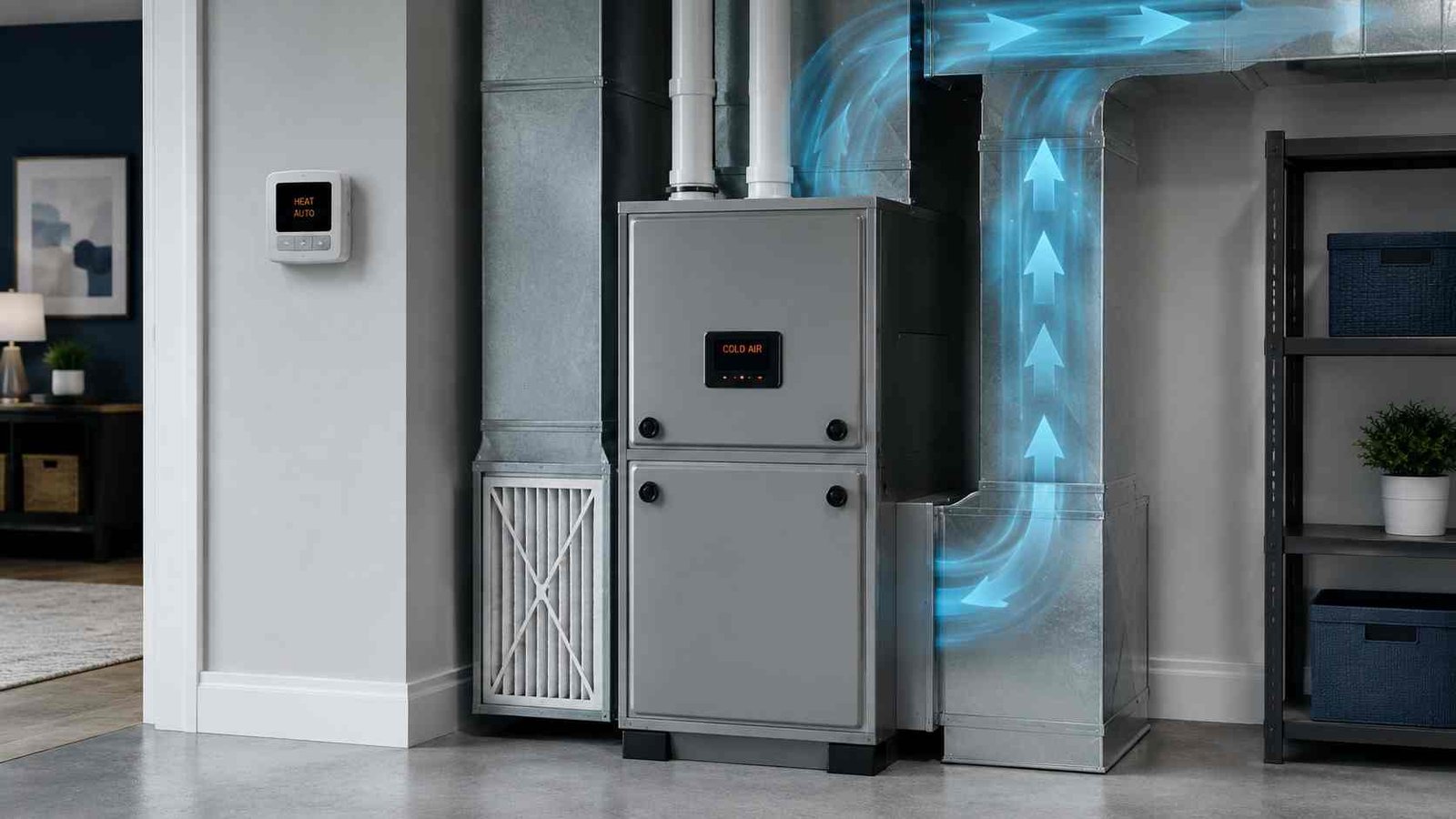
 A furnace that starts but blows cold air may have a simple thermostat or airflow problem. It can also mean that the blower is running while the burners, electric heating elements, or ignition system are not producing heat.
First, confirm that the thermostat is set to HEAT and the fan is set to AUTO. Next, inspect the air filter and make sure supply vents and return grilles are open and unobstructed.
Stop using the furnace immediately if you smell gas, hear a carbon monoxide alarm, see soot or smoke, or develop symptoms such as headache, dizziness, nausea, or confusion. Leave the building and contact the appropriate emergency service, gas utility, or qualified heating professional from a safe location. Carbon monoxide cannot be seen or smelled and may be produced by a malfunctioning fuel-burning furnace.
| Item | Details |
|---|---|
| Problem | Furnace starts and moves air, but the air is cold or becomes cold |
| Most common simple cause | Thermostat fan set to ON or restricted airflow from a dirty filter |
| Safe first check | Set the thermostat to HEAT and AUTO, then inspect the filter |
| Other possible causes | Overheating, ignition failure, flame-sensor fault, blocked condensate drain, fuel interruption or failed heating component |
| Can you keep using it? | Only briefly while checking basic settings, provided there are no gas, smoke, electrical or carbon-monoxide warnings |
| Repair difficulty | Easy for thermostat, filter and vent checks; professional diagnosis for internal faults |
| Reset advice | Use only a model-approved reset and do not reset the furnace repeatedly |
| Professional help | Required for gas, combustion, electrical, ignition, control-board or internal component work |
Is Cold Air From a Furnace Ever Normal?
A brief period of cool airflow does not always indicate a fault. Air sitting inside the ducts can cool between heating cycles. When the blower first starts, it may push this unheated air through the vents before warmer air arrives.
Some furnaces delay the main blower until the heat exchanger has warmed. Others may produce a short cool period at the beginning or end of the cycle. Lennox states that a short burst of cool air at startup can be normal, but continuous cold airflow requires investigation.
The situation is probably not normal when:
- The air remains cold throughout the heating cycle
- The furnace never raises the room temperature
- Warm air changes to cold air after a few minutes
- The burners repeatedly start and stop
- The blower runs continuously
- The problem returns after a reset
- The thermostat displays a warning or fault
- A furnace status light flashes repeatedly
Safety Check Before Troubleshooting
Do not begin normal troubleshooting when there are signs of a gas, combustion or electrical hazard.
Leave the building if you smell gas
Do not operate switches, thermostats, plugs, phones or flames near a suspected gas leak. Leave the property and contact your gas supplier or emergency service from outside.
Do not try to locate the leak, relight the appliance or adjust a gas valve unless the furnace manufacturer specifically identifies a safe homeowner control and you fully understand the instructions.
Respond immediately to a carbon-monoxide alarm
Carbon monoxide is a colourless, odourless and poisonous gas produced by incomplete fuel combustion. A malfunctioning furnace, damaged vent or blocked flue can allow it to enter the home.
Leave the building and seek emergency assistance if:
- A carbon-monoxide alarm activates
- Several people or pets become ill at the same time
- Symptoms improve after leaving the home
- Anyone experiences headache, nausea, dizziness, weakness or confusion
Do not use the furnace again until it has been inspected and declared safe by a qualified professional.
Switch the system off and request service if you notice:
- Soot around the furnace or vent
- Smoke
- A burning electrical smell
- Scorch marks
- Unusual banging, booming or rumbling
- Repeated circuit-breaker trips
- Water reaching electrical components
- Damaged intake or exhaust pipes
- Abnormal burner operation visible through a manufacturer-provided viewing window
Safety warning: Never bypass a furnace door switch, pressure switch, flame sensor, limit switch or other safety control. Do not test live voltage, open a burner compartment, clean internal burners, adjust gas pressure or dismantle the flue system.
What the Timing of the Cold Air Can Tell You
The point at which the air becomes cold can help narrow the possible cause.
| What happens | Possible explanation |
|---|---|
| Air is cool briefly, then becomes warm | Normal unheated duct air or normal blower timing |
| Air is warm, then becomes cold | Furnace may be overheating or losing the burner flame |
| Air stays cold for the complete cycle | Thermostat setting, ignition, fuel or heating-component problem |
| Blower runs between heating cycles | Thermostat fan may be set to ON |
| Heat returns after changing the filter | Restricted airflow may have triggered an overheat limit |
| Heat returns only after a reset | Furnace may be entering a safety lockout |
| Only one room remains cold | Closed register, damaged duct, zoning issue or airflow imbalance |
| Furnace lights and shuts down quickly | Flame-sensing, airflow, burner or control problem may be present |
These patterns are clues rather than confirmed diagnoses. Several faults can produce similar symptoms.
Common Reasons a Furnace Starts but Blows Cold Air
1. Thermostat Fan Is Set to ON
This is one of the easiest causes to correct.
When the fan setting is ON, the blower may run continuously, including when the furnace is not heating. Air moving through the ducts between heating cycles will feel cool or close to room temperature.
Change the fan setting to AUTO. In AUTO mode, the furnace normally controls when the blower runs. Trane and Lennox both identify the ON setting as a common reason for cold air between heating cycles.
Also confirm that:
- The system mode is HEAT
- The target temperature is above the current room temperature
- A programmed schedule has not lowered the setting
- Thermostat batteries are not weak
- The screen does not show cooling, fan-only or vacation mode
Give the system a few minutes to respond after changing the setting.
2. The Air Filter Is Dirty
A clogged filter reduces the amount of air passing through the furnace. The heat exchanger can then become too hot.
A safety limit may shut down the burners while allowing the blower to keep running so the furnace can cool. The result is warm air followed by cold air, repeated short cycles or a blower that continues after the flame stops.
Turn the furnace off using its normal controls before removing the filter. Check:
- Whether the filter is covered with dust
- Whether it is the correct size
- Whether it is installed in the airflow direction shown on the filter
- Whether packaging or another obstruction remains in the filter slot
Replace a disposable filter with the size and type specified by the furnace or filter-cabinet manufacturer. Clean a reusable filter only according to its instructions, and let it dry fully before reinstalling it.
ENERGY STAR recommends checking filters regularly because a dirty filter makes the system work harder and can contribute to equipment damage or premature failure.
3. Supply Vents or Return Grilles Are Blocked
A furnace needs adequate return and supply airflow.
Make sure furniture, curtains, rugs, storage boxes and other objects are not covering return grilles. Open normal supply registers unless the installer or zoning-system instructions say otherwise.
Closing too many vents does not necessarily save energy. It can restrict airflow and contribute to furnace overheating or repeated shutdowns. Carrier advises checking that room vents are open and unobstructed when diagnosing overheating and short cycling.
Do not reach deep into ducts or remove permanent grilles where wiring, sharp metal or powered dampers may be present.
4. The Furnace Is Overheating
Restricted airflow can make the furnace too hot. A high-limit safety control may then stop the burners while keeping the blower on.
Possible reasons include:
- Dirty air filter
- Incorrect filter
- Blocked return grille
- Too many closed supply registers
- Dirty internal blower components
- Duct restriction
- Failed blower motor or speed control
- Faulty limit switch
Changing a dirty filter and opening ordinary vents are reasonable homeowner checks. Internal airflow testing, blower adjustment and limit-switch diagnosis require a qualified HVAC technician.
Repeated overheating should not be treated as a normal operating condition. It can stress furnace components and may indicate a serious airflow or control problem.
5. The Furnace Is Not Igniting
The blower and ignition system do not always fail together. The fan may operate even when the furnace cannot light its burners.
Possible causes include:
- Failed electronic igniter
- Pilot-light problem on an older furnace
- Dirty or damaged burner
- Gas-supply interruption
- Ignition control fault
- Pressure-switch fault
- Safety lockout
Modern gas furnaces normally use electronic ignition. Igniter, burner and ignition-control work requires access to combustion and electrical components and should be handled by a qualified technician.
Do not use a match or lighter unless the furnace has a standing pilot and its exact manufacturer instructions clearly permit homeowner relighting. Many modern furnaces do not have a pilot that can be manually lit.
6. The Flame Starts but Does Not Stay Lit
A gas furnace may ignite successfully and then shut its burners down after only a few seconds.
The flame sensor is designed to confirm that a safe burner flame is present. If the control does not receive the expected signal, it shuts off the gas supply to prevent unburned gas from accumulating. The blower may continue and send cold air through the vents.
Possible causes include:
- Contaminated flame sensor
- Damaged flame sensor
- Poor electrical connection
- Burner or grounding problem
- Control-board fault
- Unstable gas supply
Do not remove, clean or reposition the flame sensor unless you are legally qualified and following the manufacturer’s service documentation. The symptom does not prove that the sensor itself has failed.
7. Fuel Is Not Reaching the Furnace
A natural-gas, propane or oil furnace cannot produce heat without an adequate fuel supply.
Safe external checks may include:
- Confirming whether there is a known utility outage
- Checking whether other gas appliances operate normally
- Checking the propane or heating-oil tank level
- Reviewing an account or supplier notification
- Checking for an empty cylinder on an approved LPG installation
Do not loosen fuel connections, dismantle a regulator or adjust an unfamiliar shutoff valve. Contact the gas supplier or heating technician when the supply status is uncertain.
8. A Condensate Drain Is Blocked
High-efficiency condensing furnaces produce water during normal operation. The water must drain through the furnace’s condensate system.
A blockage in the drain, trap, pump or related safety circuit may prevent the furnace from igniting or cause it to lock out. The blower may still operate.
Possible signs include:
- Water around the furnace
- A full condensate-pump reservoir
- Gurgling sounds
- A drain-related fault code
- Heating that returns temporarily after a reset
Do not operate the furnace when water is contacting wiring or electrical controls. Condensate systems vary considerably, so use the model manual or arrange professional service rather than disconnecting hoses or switches.
9. The Intake, Exhaust or Pressure-Switch Circuit Has a Fault
Many high-efficiency gas furnaces use dedicated intake and exhaust pipes. The furnace checks airflow through the combustion system before allowing ignition.
An obstruction, damaged pipe, strong wind condition, condensate restriction or pressure-switch circuit fault may stop the heating sequence.
From outside and at ground level, you may visually check for an obvious accumulation of snow, leaves or debris around accessible vent openings. Do not:
- Climb onto a roof
- Insert tools into the pipe
- Take the vent apart
- Cover either opening
- Bypass a pressure switch
- Continue resetting a recurring vent-related fault
Professional diagnosis is required when an error returns after obvious external obstructions have been safely cleared.
10. The Ductwork Is Leaking or Disconnected
The furnace may be producing warm air while the duct system loses that heat before it reaches the room.
A damaged return duct may pull cold air from an attic, basement, garage or crawlspace. A disconnected supply duct can release heated air outside the living area.
Duct problems are more likely when:
- One room is colder than the others
- Airflow is weak at selected vents
- The furnace runs for long periods
- Temperatures vary significantly between floors
- The problem began after building or attic work
Trane identifies leaky ductwork as a cause of heat loss and unwanted cold-air entry.
A technician can measure airflow and inspect concealed ducts without guessing which furnace component has failed.
11. An Electric Furnace Heating Component Has Failed
An electric furnace does not use a gas burner. It normally uses high-current electric heating elements controlled by relays, sequencers or an electronic control.
The blower may work even if one or more heating stages do not energize.
Possible causes include:
- Failed heating element
- Faulty sequencer
- Heating relay problem
- Control-board fault
- Thermostat or low-voltage wiring problem
- Failed safety limit
- Electrical supply problem
These components operate at dangerous voltage and current levels. Do not remove panels or test them yourself.
If a breaker has tripped, do not reset it repeatedly. A second trip, burning smell or visible heat damage requires professional electrical and furnace inspection.
12. The System Is Actually a Heat Pump
Some homeowners refer to any ducted heating system as a furnace, even when the primary heat source is a heat pump.
Heat-pump air often feels less intensely hot than gas-furnace air. The system may still be heating the home correctly. A heat pump may also briefly deliver cooler air during a defrost cycle.
You may have a heat pump if the outdoor unit runs during heating mode. Dual-fuel systems combine a heat pump with a gas furnace, so their operating sequence can be more complex.
Request service if:
- The room temperature continues falling
- Defrost appears to continue for an unusually long time
- The outdoor unit is heavily iced
- Auxiliary heat never operates when required
- The system switches repeatedly between heat sources
- Cold air continues outside normal defrost periods
Safe Furnace Troubleshooting Steps
Complete only the checks that apply to your equipment.
Step 1: Check for immediate danger
Stop if you detect gas, smoke, soot, electrical burning, water on electrical parts, a carbon-monoxide alarm or illness symptoms.
Step 2: Confirm the thermostat settings
Set:
- Mode to HEAT
- Fan to AUTO
- Temperature several degrees above the current room temperature
Replace thermostat batteries if the display is weak or blank and the model uses replaceable batteries.
Step 3: Allow the heating sequence to begin
Wait several minutes. Do not keep raising and lowering the temperature.
Observe:
- Whether the blower begins immediately or after a delay
- Whether the air eventually becomes warm
- Whether heating stops after a few seconds
- Whether the blower continues after the heat stops
Step 4: Inspect the filter
Turn the system off normally. Remove the filter only if it is designed for routine homeowner access.
Replace or clean it according to the manufacturer’s instructions.
Step 5: Check vents and return grilles
Open ordinary supply registers and remove objects blocking return airflow.
Do not alter balancing dampers, powered zone dampers or installation settings.
Step 6: Check the external fuel situation
Confirm whether the utility supply is available or the propane or oil tank is empty. Do not open fuel lines or adjust internal gas controls.
Step 7: Look for an error code
Check the thermostat, furnace display or manufacturer-provided viewing window.
Record:
- Exact code
- Number and colour of flashes
- Whether the light is steady or repeating
- What happens before the fault appears
- Furnace model number from the rating label, without removing sealed panels
Flash patterns and codes are model-specific. Do not interpret one brand’s code using another brand’s chart.
Step 8: Decide whether one reset is appropriate
Consult the furnace owner’s manual. If it permits a normal power reset and no safety warning is present, follow the exact model instructions once.
Do not reset the furnace repeatedly. A lockout normally exists because the control detected an unsafe or unsuccessful operating condition.
Step 9: Stop if the problem returns
Request professional service when the furnace:
- Returns to cold airflow after one reset
- Overheats again after a filter change
- Attempts ignition repeatedly
- Lights and shuts down within seconds
- Shows the same fault again
- Trips its breaker
- Leaks water
- Produces abnormal noise or odour
Why Repeated Furnace Resets Are a Bad Idea
A reset may clear the stored lockout, but it does not repair the cause.
For example, a reset cannot permanently correct:
- An unstable burner flame
- A damaged igniter
- Restricted combustion venting
- A blocked condensate system
- A failed flame-sensing circuit
- A faulty high-limit control
- An unsafe electrical connection
Brivis advises that an ignition-lockout code can be reset, but it is likely to return unless the underlying condition has been corrected. Its ducted-heating documentation also shows that reset sequences and fault meanings vary between controller and model families.
A recurring reset dependency is useful information for the technician. It is not a normal method of operating the furnace.
What to Do When the Thermostat and Filter Are Fine
Record the furnace’s operating sequence before arranging service.
A useful description might be:
The thermostat calls for heat. The furnace starts, I hear ignition, warm air comes from the vents for two minutes, then the heat stops while the blower continues. The status light flashes four times.
Also record:
- Thermostat setting
- Indoor and outdoor temperature
- Filter condition
- Exact display or flash pattern
- Whether the flame appears briefly through an approved viewing window
- Whether the furnace was recently serviced
- Whether the filter, thermostat or ductwork was recently changed
- Whether the problem affects every room
- Whether a reset temporarily restores heat
Do not open the furnace to obtain this information.
Parts a Technician May Test
The symptom alone does not prove that a particular part is faulty. Depending on the furnace type and operating sequence, a technician may test:
| Component | Why it may be checked |
|---|---|
| Igniter | Furnace does not establish a burner flame |
| Flame sensor | Burners light and then shut down |
| High-limit control | Heat stops while the blower continues |
| Pressure switch | Ignition sequence does not proceed |
| Condensate safety | Condensing furnace enters lockout |
| Gas valve | Fuel is not released correctly |
| Burner assembly | Flame is unstable or ignition is delayed |
| Blower motor or control | Airflow is too low or incorrectly timed |
| Thermostat circuit | Furnace receives an incorrect heat or fan command |
| Control board | Operating sequence or safety inputs are mismanaged |
| Electric heating element | Electric furnace moves air without sufficient heat |
| Sequencer or relay | Electric heating stages do not energize |
Gas valves, burners, flame sensors, electrical elements, control boards and safety switches are not homeowner-replacement recommendations.
Regional and Model Differences
United States and Canada
The word furnace commonly refers to a forced-air gas, oil, propane or electric heating appliance. High-efficiency models may use electronic ignition, diagnostic lights, pressure switches, condensate drains and plastic intake or exhaust pipes.
Instructions differ by brand, model series and thermostat configuration.
Australia and New Zealand
Comparable whole-home equipment is often called ducted gas heating or a ducted gas heater.
Brivis, for example, uses model-specific codes for overheating, ignition failure, repeated lockout, pressure-switch faults and condensate restrictions. Those codes must not be applied to other brands.
Gas-heater work should be completed by an appropriately qualified gasfitter. Energy Safe Victoria states that gas-heater repair is not a DIY task and recommends professional servicing and carbon-monoxide safety checks.
United Kingdom and Ireland
Many properties use boilers and radiators rather than a North American-style furnace. Similar equipment may be described as a warm-air heating system.
Gas-appliance work should be completed by a professional legally qualified for the appliance, fuel and location. Gas Safe Register guidance also recommends proper servicing and carbon-monoxide protection for fixed gas appliances.
When to Call a Furnace Technician
Arrange professional diagnosis when:
- The thermostat and filter checks do not restore heat
- Burners do not ignite
- Burners ignite and quickly shut down
- The blower continues delivering cold air
- The furnace overheats repeatedly
- A fault returns after one approved reset
- Water is collecting around a condensing furnace
- The circuit breaker trips
- An intake or exhaust fault is displayed
- The furnace makes booming, grinding or electrical buzzing noises
- The home has significant room-to-room temperature differences
- You cannot identify whether the equipment is a furnace or heat pump
Use a technician qualified for the furnace’s fuel and system type. Gas and combustion work may also be subject to national, state, provincial or local licensing requirements.
How to Reduce Future Cold-Air Problems
Check the filter regularly and replace or clean it when needed. Keep return grilles and supply vents clear. Avoid storing items against the furnace or around combustion-air and exhaust openings.
Schedule professional heating-system maintenance before the main heating season. ENERGY STAR recommends pre-season checks that cover thermostat operation, electrical connections, controls, condensate drainage, gas or oil connections, burner combustion and the heat exchanger.
Keep smoke and carbon-monoxide alarms installed and maintained according to their instructions. An alarm is an important backup measure, but it does not replace correct furnace installation, ventilation and servicing.
Frequently Asked Questions
Why does my furnace blow cold air for the first few minutes?
The furnace may be clearing cool air that remained in the ducts between heating cycles. The airflow should become warm after the furnace completes its normal startup sequence. Continuous cold air or a falling room temperature is not normal.
Can a dirty filter make a furnace blow cold air?
Yes. A dirty filter can restrict airflow and cause the furnace to overheat. A safety limit may shut off the burners while the blower continues running to cool the furnace.
Why does my furnace blow warm air and then cold air?
The furnace may be losing its flame or overheating after startup. Common possibilities include restricted airflow, flame-sensing problems, burner faults, control problems or a safety limit opening. A technician should diagnose the operating sequence if filter and vent checks do not help.
Should the furnace fan be set to ON or AUTO?
Use AUTO for normal heating unless your HVAC professional has recommended another setting. ON allows the blower to run between heating cycles, which can make room-temperature air feel cold.
Can I keep using a furnace that blows cold air?
Do not continue operating it if there is a gas smell, carbon-monoxide alarm, soot, smoke, electrical burning smell, repeated breaker trip or unusual combustion noise.
Without those warning signs, you can briefly check the thermostat, filter and vents. Switch the system off and arrange service if it continues blowing cold air.
Why does my furnace work after a reset and then fail again?
The reset may temporarily clear an ignition, airflow, pressure, condensate or safety lockout. The underlying fault remains, so the furnace shuts down again when it detects the same condition.
Do not continue resetting it.
Why is only one room receiving cold air?
The issue may involve a closed register, leaking or disconnected duct, insulation problem, zone-control fault or airflow imbalance rather than the main furnace. Check the accessible register, then request duct or zoning inspection if the problem continues.
Is it a furnace problem or normal heat-pump operation?
Heat-pump air can feel cooler than gas-furnace air while still heating the home. A heat pump may also provide temporarily cooler air during defrost. It requires service if the room temperature keeps falling or cold airflow continues outside normal defrost operation.
Daniel Brooks is a US-based appliance troubleshooting researcher with 12 years of experience studying washer, dryer, refrigerator, and dishwasher faults. He reviews manufacturer manuals and converts technical error codes into safe, practical guidance for homeowners.