
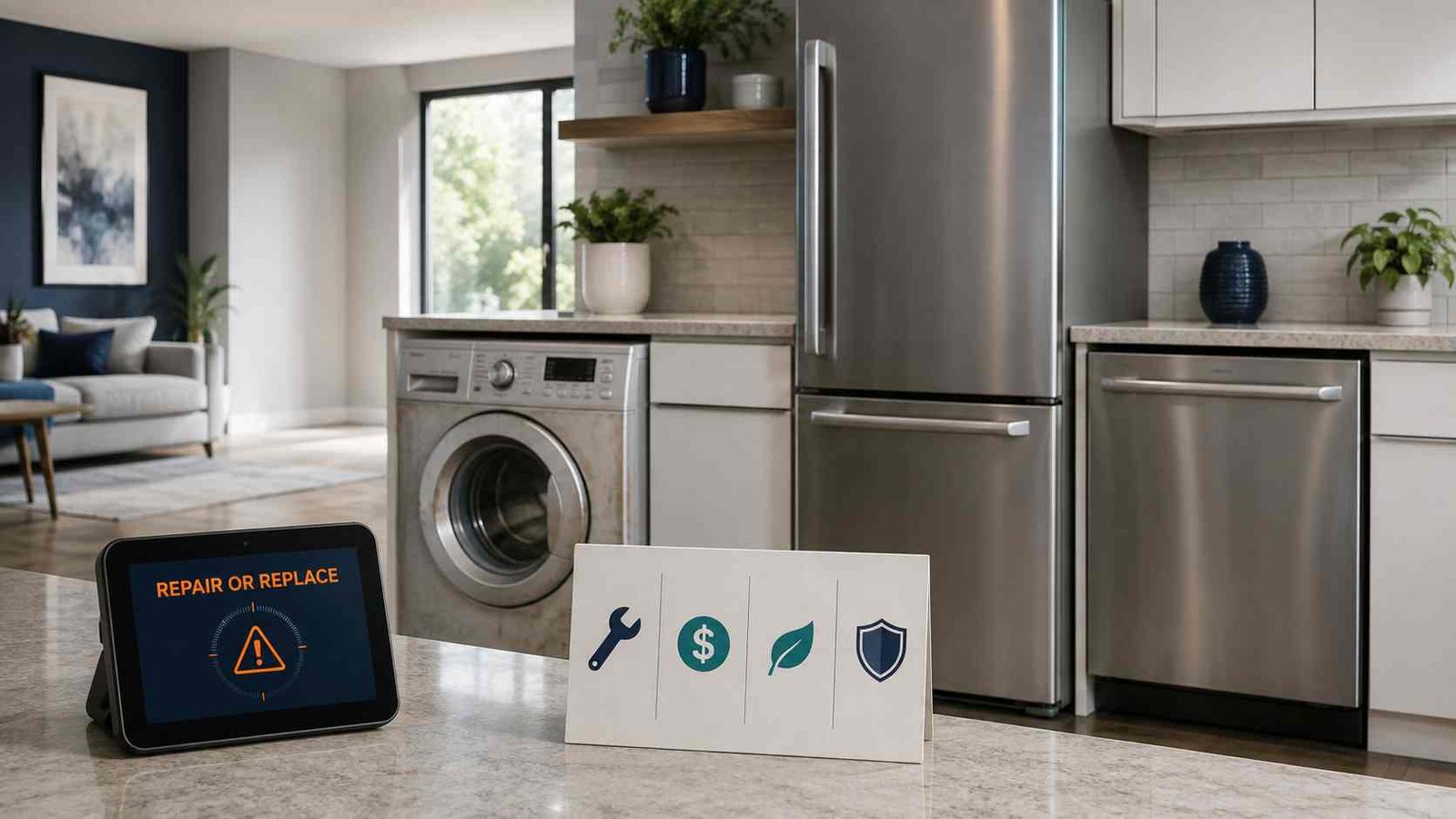
 Deciding whether to repair or replace an appliance requires more than comparing one repair estimate with the price displayed on a new machine. Start by checking the appliance’s warranty, recall status and exact fault. Then compare the complete repair cost with the total installed cost of a genuinely comparable replacement.
A relatively young appliance with an isolated, repairable fault is often worth fixing. Replacement becomes more sensible when breakdowns are recurring, important parts are unavailable, the appliance presents a safety risk or the repair cost is close to the real replacement cost.
Stop using the appliance immediately if it produces smoke, sparks, a burning smell, signs of overheating, a gas smell, a major leak or repeated circuit-breaker trips. Do not continue operating it merely to test whether the problem returns.
| Decision factor | Repair may make sense when | Replacement may make sense when |
|---|---|---|
| Safety | The fault has been identified and the appliance can be made safe | There is an unresolved fire, shock, gas or serious leak risk |
| Warranty | Repair is covered at little or no cost | Coverage has expired and the repair is expensive |
| Recall status | The recall provides an approved free repair | The official recall remedy requires replacement, refund or disposal |
| Appliance age | The unit is relatively young and otherwise reliable | It is near the end of its useful service period |
| Repair cost | The total repair is well below replacement cost | Repair approaches the total installed price of a comparable appliance |
| Repair history | This is the first significant failure | The appliance has needed several recent repairs |
| Parts | The correct part is available with a reasonable warranty | Parts are discontinued, restricted or significantly delayed |
| Efficiency | The appliance has reasonable energy and water use | A replacement would produce meaningful, measurable operating savings |
| Installation | Replacement is simple and inexpensive | Built-in alterations, plumbing or electrical work make replacement costly |
| Household needs | The existing size and features remain suitable | Capacity, accessibility or performance no longer meets the household’s needs |
Start With Safety, Recalls and Warranty Coverage
Cost should not be the first consideration when an appliance could be unsafe.
Stop Using an Appliance With Dangerous Symptoms
Disconnect the appliance from power when it is safe to do so if you notice:
- Smoke or visible scorching
- Sparks or electrical arcing
- A persistent burning smell
- A melted plug, cord or socket
- Repeated breaker or fuse operation
- Water reaching electrical parts
- Severe overheating
- A major uncontrolled leak
- Unusual movement that could make the appliance fall or tip
For a gas appliance, leave the area and follow the local gas-emergency procedure if you smell gas. Do not operate switches, unplug equipment or create a flame near a suspected gas leak.
Refrigerant, compressor, combustion, gas, microwave high-voltage and internal electrical work should be left to an appropriately qualified professional. A reset is not a safe response to smoke, overheating or repeated electrical protection trips.
Search for an Official Product Recall
Find the appliance’s full model and serial numbers before deciding. These are normally printed on a rating plate inside a door opening, behind a drawer, on the rear panel or around the door frame.
Search the official recall database for the country where the appliance was sold. A recall notice may instruct owners to stop using the appliance and contact the manufacturer for an approved repair, replacement, refund or other remedy. Follow that notice rather than arranging an unrelated private repair. Official databases include the CPSC in the United States, GOV.UK product-safety alerts, Health Canada, ACCC Product Safety in Australia and Product Safety New Zealand.
Check Every Form of Coverage
Review:
- Manufacturer warranty
- Retailer guarantee
- Extended warranty
- Service contract
- Home warranty
- Credit-card purchase protection
- Relevant consumer-law rights
An extended warranty or service contract is separate from the warranty automatically supplied with the product. The US Federal Trade Commission recommends comparing the additional contract with existing warranty coverage and reading its limits, exclusions and claim requirements carefully.
Do not assume an expired manufacturer warranty automatically means you must pay. Depending on the country, purchase date and nature of the fault, statutory consumer rights may continue beyond a voluntary warranty.
Australia’s consumer guarantees can provide a repair, replacement or refund when a product does not meet required standards, and those rights may continue after a written warranty expires. New Zealand’s Consumer Guarantees Act also provides remedies for qualifying faulty appliances.
In the UK, the Consumer Rights Act provides remedies for faulty goods, including repair or replacement in qualifying circumstances. Ireland’s CCPC states that consumer rights relating to faulty goods apply regardless of a separate guarantee or warranty.
Consumer rules differ by location and circumstances. Use the appropriate official authority for your country rather than relying only on a retailer’s store policy.
Get an Accurate Diagnosis Before Deciding
A symptom does not always identify the failed part.
For example, a refrigerator that is not cooling could have an airflow obstruction, door-seal issue, fan fault, sensor problem, defrost failure or sealed-system problem. The repair costs and likely outcomes would be very different.
Before comparing repair and replacement:
- Record the complete model number.
- Write down the error code or exact symptom.
- Note when the problem started.
- Photograph leaks, damaged areas or display messages.
- Find previous repair invoices.
- Check the warranty and recall status.
- Obtain an itemised diagnosis where practical.
Ask the repairer whether the estimate includes:
- Call-out or diagnostic fee
- Labour
- Parts
- Taxes
- Delivery or special-order charges
- Removal of the old component
- Additional return visits
- Testing after repair
- Repair warranty
Also ask whether the diagnosed failure is isolated or whether related components show significant wear.
A diagnosis such as “control problem” is not detailed enough for an expensive decision. Ask which component is suspected, how the conclusion was reached and whether further testing could change the estimate.
Calculate the True Repair Cost
Use the complete amount you are likely to pay, not only the advertised price of one part.
Repair-Cost Worksheet
| Repair expense | Estimated amount |
|---|---|
| Diagnostic or call-out fee | |
| Replacement part | |
| Labour | |
| Taxes | |
| Shipping or special-order fee | |
| Return visit | |
| Related recommended work | |
| Total repair cost |
A higher repair estimate can still be reasonable when it includes a long parts-and-labour warranty. A cheaper estimate with no meaningful warranty may expose you to another full bill if the same problem returns.
Check whether the diagnostic charge will be credited toward the repair. Also confirm what happens if the first part does not solve the fault.
Calculate the Real Replacement Cost
The store price is rarely the complete cost of replacing an appliance.
Include:
- Price of a comparable appliance
- Sales tax or VAT
- Delivery
- Installation
- Removal and recycling
- New hoses, cords, plugs or venting
- Door-reversal charges
- Stacking or mounting kit
- Cabinet or countertop alterations
- Plumbing changes
- Gas connection work
- Electrical circuit changes
- Required trim kit
- Temporary food, laundry or accommodation costs
- Rebates and retailer credits
Replacement-Cost Worksheet
| Replacement expense | Estimated amount |
|---|---|
| Comparable new appliance | |
| Delivery | |
| Installation | |
| Removal or recycling | |
| Required accessories | |
| Plumbing, gas or electrical work | |
| Cabinet or countertop changes | |
| Taxes | |
| Less rebates or credits | |
| Total installed replacement cost |
Compare like with like. A basic freestanding dishwasher should not be compared with a premium integrated replacement unless the size, capacity, installation and required features are equivalent.
Built-in ovens, integrated refrigerators, range hoods and built-in microwaves can be especially expensive to replace when the original dimensions or trim system are no longer available.
How the 50% Appliance Rule Works
A commonly used rule of thumb suggests considering replacement when the repair reaches approximately half the cost of a comparable new appliance. It is a useful starting point, but it is not an official safety or financial standard.
Use this formula:
Repair percentage = Total repair cost ÷ Total installed replacement cost × 100
Example
- Total repair cost: $420
- Total installed replacement cost: $1,200
Calculation:
$420 ÷ $1,200 × 100 = 35%
A 35% result leans toward repair, but it does not settle the decision. You must still consider the appliance’s condition, repair history, parts availability, safety and remaining useful service.
When Repairing Above 50% Can Still Make Sense
Repair may remain reasonable when:
- The appliance is relatively new
- Replacement requires major cabinet alterations
- A matching appliance is needed in a fitted kitchen
- The repair includes a strong warranty
- The appliance is a durable premium model
- A comparable replacement has a long delivery delay
- The repair is covered partly by a warranty or consumer remedy
When Replacing Below 50% Can Make Sense
Replacement may be sensible even when the repair is below 50% if:
- Several other components are deteriorating
- The appliance has failed repeatedly
- The part is used, unreliable or unavailable
- The repair warranty is very limited
- The appliance no longer suits the household
- There is a continuing safety concern
- A significantly more efficient replacement has a reasonable payback
- The current fault has caused hidden water or heat damage
The percentage should organise the decision, not make it for you.
Consider Age Without Relying on a Fixed Lifespan
Appliance age matters, but there is no universal replacement age.
Two appliances of the same age may have very different remaining service lives. Their condition depends on:
- Frequency of use
- Load size
- Installation quality
- Ventilation
- Water hardness
- Voltage quality
- Cleaning and maintenance
- Previous repairs
- Local temperature and humidity
- Availability of correct parts
Do not replace an appliance only because it has reached a number shown in a general lifespan chart. Likewise, do not approve a major repair only because the appliance is technically younger than an estimated average.
Ask a more useful question:
Does the condition of the entire appliance support the cost of this repair?
A single worn pump in an otherwise sound dishwasher is different from a pump failure accompanied by rust, door-hinge damage, recurring leaks and a deteriorating control panel.
Review Its Repair History
One isolated failure is less concerning than several faults within a short period.
Create a simple repair record:
| Date | Problem | Repair performed | Cost | Warranty |
|---|---|---|---|---|
Look for patterns:
- The same code repeatedly returns
- Multiple electrical parts have failed
- Leaks continue from different areas
- The appliance becomes noisier after each repair
- Performance has gradually declined
- Parts are increasingly difficult to obtain
- Repairs solve one problem but reveal another
Do not automatically treat routine maintenance as a breakdown. Replacing a refrigerator water filter, cleaning a dryer vent or clearing a dishwasher filter is not the same as replacing a major mechanical or electronic component.
Check Parts Availability and Repair Support
A repair is practical only when the correct part can be obtained and installed safely.
Before authorising work, ask:
- Is the part new, refurbished or used?
- Is it supplied or approved by the manufacturer?
- Is there a parts warranty?
- Is the part currently available?
- How long is the expected delay?
- Could a model revision make it incompatible?
- Is programming or manufacturer software required?
- Will the appliance remain supported after this repair?
A low estimate is not useful if the part is indefinitely back-ordered. However, a short delay may be acceptable for a reliable built-in appliance that would be expensive to replace.
Do not purchase a component based only on appearance. Similar-looking control boards, valves, sensors and motors may have different electrical ratings, software or connectors.
Compare Energy and Water Use
Energy efficiency matters most when the savings are measurable.
In the United States, the yellow EnergyGuide label shows estimated energy use and operating cost for covered appliances. The operating-cost figure is an estimate based on typical use and a national average energy price, so actual household costs can differ.
Canada’s EnerGuide appliance label shows annual energy consumption in kilowatt-hours and compares the model with similar products. Canadian and US labels may use similar test methods, but their comparison ranges can differ.
Australia and New Zealand use Energy Rating Labels that display an efficiency star rating and estimated energy consumption. Some label formats are changing during the transition to updated requirements, so compare the actual consumption figure as well as the number of stars.
In Ireland, EU energy labels use an A-to-G scale for covered categories. Depending on the appliance, consumption may be stated per year or per 100 cycles. A large appliance with a better efficiency class can still use more total energy than a smaller model, so compare both capacity and consumption.
Calculate the Simple Energy Payback
Use:
Annual savings = Current annual operating cost − Replacement annual operating cost
Then:
Simple payback period = Net replacement cost ÷ Annual savings
For this calculation, net replacement cost means the total installed replacement cost minus the repair expense you would otherwise pay.
Example
- Installed replacement cost: $1,200
- Avoided repair: $400
- Net replacement cost: $800
- Estimated annual utility saving: $80
$800 ÷ $80 = 10 years
A ten-year payback may be too long to justify replacement based on energy savings alone, particularly if the current appliance can be repaired reliably.
Energy savings can strengthen a replacement decision, but vague claims such as “new appliances are always cheaper to run” are not enough. Compare official labels for similar capacities and use your local energy rate.
How the Decision Changes by Appliance Type
Refrigerators and Freezers
A cooling failure needs prompt attention because stored food may become unsafe.
Repair may make sense when the problem is an isolated fan, sensor, seal, relay or defrost-related fault and the rest of the appliance is in good condition. Replacement becomes more attractive when the unit has recurring temperature problems, extensive cabinet damage, unavailable sealed-system parts or several ageing systems.
Compressor, refrigerant and sealed-system work requires suitable equipment and qualified handling. Do not puncture refrigerant tubing or attempt to install a compressor yourself.
Washing Machines
Consider the condition of the drum, bearings, suspension, door seal, cabinet and controls.
An isolated drain-pump, inlet-valve, door-lock or accessible hose problem may support repair. Replacement may be more reasonable when a major structural failure is combined with corrosion, severe vibration, repeated leaks or several electronic faults.
Stop using a washer that leaks toward an electrical outlet or moves violently during operation.
Clothes Dryers
First distinguish an appliance fault from an airflow problem. A restricted vent can increase drying time and heat buildup even when the dryer itself is operational.
Cleaning an accessible lint filter is a normal homeowner task. Internal electrical testing, gas-valve work and safety-device bypassing are not.
Replacement may make sense when major drum, motor, control and heating problems overlap, but a straightforward belt, roller, thermostat or heating-component repair may be economical on an otherwise sound dryer.
Dishwashers
Check for cabinet and flooring damage as well as the appliance fault.
An isolated pump, valve, seal or latch problem can often be repaired. Repeated leaks, tub damage, corrosion and several control or heating failures make replacement more likely.
Do not operate a dishwasher that leaks into wiring, cabinetry or the floor below.
Ovens and Ranges
Built-in dimensions can make replacement more expensive than expected.
A replaceable heating element, igniter or sensor may justify repair. A badly corroded appliance, damaged cavity, recurring electrical failure or unavailable electronic control may favour replacement.
Gas, live electrical and combustion work requires qualified service. Never bypass a door lock, flame-safety device, fuse or thermal protector.
Microwaves
Countertop microwave replacement can cost less than a substantial internal repair. Built-in models are different because trim kits, ventilation and cabinet dimensions may add considerably to the replacement cost.
Microwaves contain high-voltage components that can remain dangerous after disconnection. Internal microwave diagnosis and repair should not be treated as a normal do-it-yourself project.
Air Conditioners, Boilers and Furnaces
Heating and cooling equipment requires a separate assessment because capacity, installation design, fuel type, climate, refrigerant, combustion safety and seasonal energy use affect the decision.
Do not rely on a simple appliance percentage rule for these systems. Obtain a qualified diagnosis and a full installed replacement quote. Gas, combustion and refrigerant work should only be performed by people who meet local licensing and qualification requirements.
Repair Usually Makes More Sense When
Repair generally has a stronger case when:
- The appliance is still covered by a warranty or consumer remedy.
- The fault is isolated and clearly diagnosed.
- The rest of the appliance is in good condition.
- Correct parts are readily available.
- The repair includes meaningful parts-and-labour coverage.
- There have been few previous breakdowns.
- Replacement requires expensive alterations.
- The current appliance still meets the household’s needs.
- Energy and water use remain reasonable.
- The repair cost is well below the installed replacement cost.
Replacement Usually Makes More Sense When
Replacement has a stronger case when:
- The official recall remedy requires it.
- The appliance has an unresolved safety risk.
- Important parts are discontinued or unavailable.
- The same fault repeatedly returns.
- Several major systems are deteriorating.
- Repair costs are close to a comparable installed replacement.
- The repair carries little or no warranty.
- The appliance has caused repeated water, heat or electrical damage.
- Capacity or features no longer meet the household’s needs.
- A measured efficiency improvement provides a reasonable payback.
When to Get a Second Opinion
Consider another diagnosis when:
- The repair is expensive
- The technician cannot identify a specific fault
- The diagnosis changes without new test results
- Several costly parts are being suggested at once
- The estimate is not itemised
- Replacement is recommended without considering installation costs
- The repair price is close to the replacement price
- Warranty or recall status is unclear
- A sealed-system, compressor or major control failure is suspected
Tell the second repairer what has already been checked, but allow an independent diagnosis rather than asking them merely to approve the first estimate.
Repair-or-Replace Decision Worksheet
Complete this before making the final decision.
| Question | Your answer |
|---|---|
| Appliance type and model | |
| Approximate age | |
| Exact symptom or error code | |
| Recall checked? | |
| Warranty or consumer remedy available? | |
| Total repair estimate | |
| Repair warranty | |
| Previous repair costs | |
| Correct parts available? | |
| Comparable replacement price | |
| Delivery and installation | |
| Removal and recycling | |
| Required alterations | |
| Total installed replacement cost | |
| Repair percentage | |
| Estimated annual utility saving | |
| Appliance still meets household needs? | |
| Unresolved safety concerns? | |
| Final decision |
Safe Disposal and Recycling
Do not leave an unwanted appliance where children can enter it or become trapped. Secure or remove doors where local disposal guidance requires it.
Refrigerators, freezers, air conditioners and other refrigerant-containing appliances require appropriate recovery and disposal. Do not cut refrigerant lines or dismantle the sealed system.
Use a manufacturer take-back programme, retailer collection service, licensed recycler or local authority facility. Ask how the appliance and refrigerant will be handled rather than assuming curbside collection is suitable.
Bottom Line
Repair a relatively young, otherwise dependable appliance when the fault is isolated, the correct part is available and the total repair cost is comfortably below the true replacement cost.
Replace when the appliance is unsafe, repeatedly unreliable, unsupported or expensive to repair compared with a fully installed equivalent.
Before paying for either option, check the model number, official recall status, warranty, consumer rights and complete written costs. Those checks often change the decision more than the appliance’s age alone.
Frequently Asked Questions
What is the 50% rule for appliance repair?
The rule suggests considering replacement when a repair reaches about 50% of the cost of a comparable new appliance. Use the total installed replacement cost rather than the shelf price. The rule is only a starting point and should be considered alongside safety, age, reliability, warranty and parts availability.
Is a ten-year-old appliance worth repairing?
It may be. Age alone does not settle the question. A ten-year-old appliance with one isolated fault and a strong repair history may be worth fixing, especially when replacement requires costly installation work. Repeated failures, corrosion, unavailable parts or multiple worn systems make replacement more sensible.
Should I repair an appliance that keeps breaking?
Add the cost of recent repairs to the current estimate and review whether the failures are connected. Several significant breakdowns within a short period suggest that the appliance’s overall reliability is declining. Replacement may offer better value even when the current repair is not especially expensive.
Should I repair an appliance that is still under warranty?
Contact the warranty provider or retailer before authorising private work. An unauthorised repair may not be reimbursed and could complicate a later claim. Check whether the warranty covers diagnosis, labour, parts, transport and removal.
Does an expired warranty mean I must pay for the repair?
Not always. Statutory consumer rights may apply separately from a voluntary manufacturer warranty, depending on the country, product, purchase date and type of fault. Australia, New Zealand, the UK and Ireland all provide consumer remedies for qualifying faulty goods under their respective rules.
Should I replace an appliance to save energy?
Compare official energy labels and calculate the likely annual saving. Replacement makes more financial sense when the efficiency difference is substantial and the payback period is reasonable. Small estimated savings may not justify replacing an appliance that can be repaired reliably.
Is it safe to use an appliance while waiting for repair?
That depends on the fault. Stop using it if there is smoke, a burning smell, overheating, sparks, repeated breaker operation, a gas smell, a serious water leak or an official stop-use recall. Ask the manufacturer or qualified repairer when the safety of continued use is uncertain.
Should I obtain more than one repair estimate?
A second estimate is useful for expensive repairs, unclear diagnoses, sealed-system work, major electronic faults or recommendations involving several parts. Compare the diagnosis, included work, repair warranty and total price rather than choosing only the lowest quote.

Ahmad Raza is the website administrator and content operations manager at Error Code Vault. With 11 years of experience in technical publishing, he manages site accuracy, author verification, source quality, updates, user feedback, and editorial compliance.