
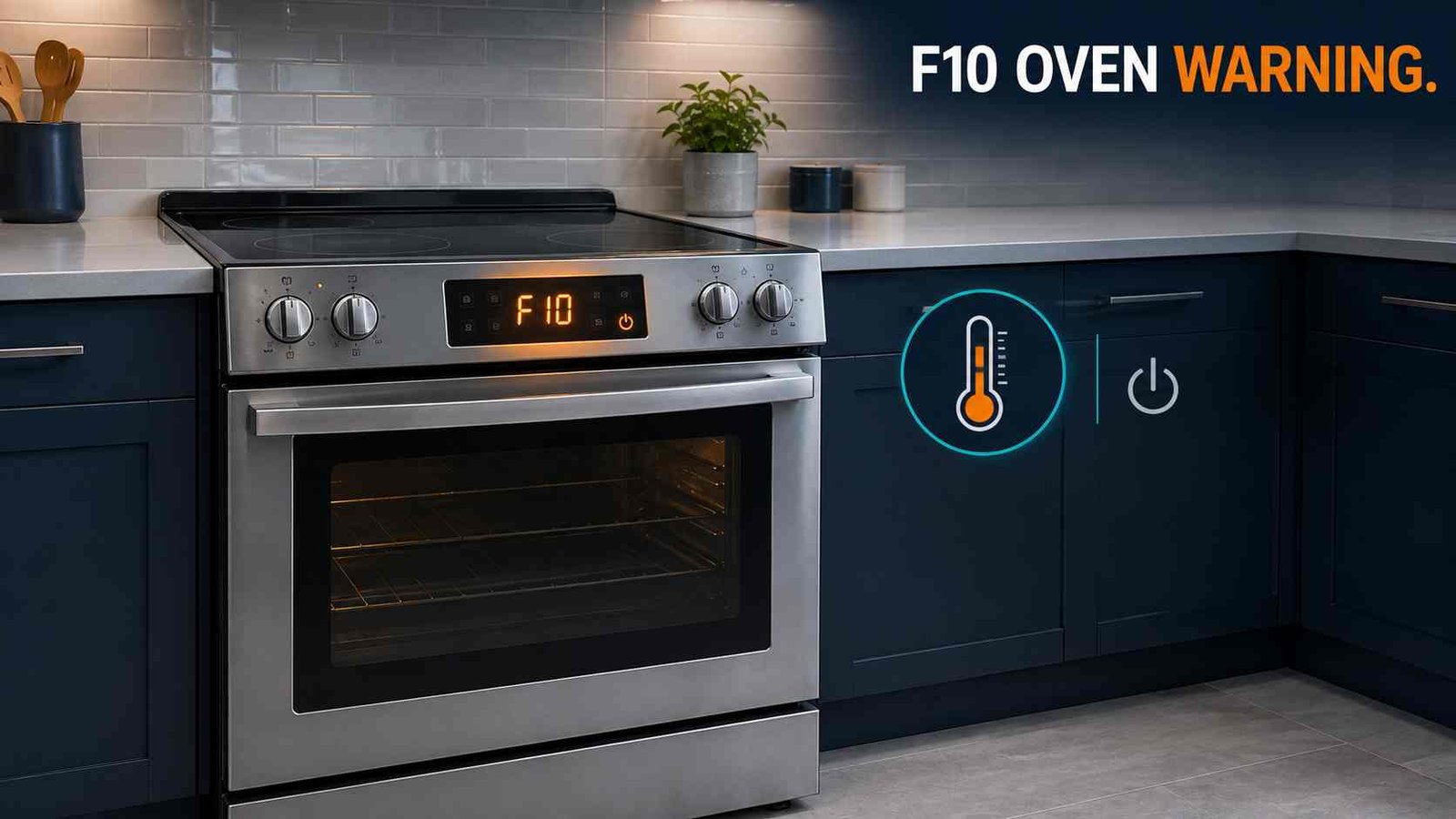
 The Frigidaire oven F10 error code means the control has detected a possible thermal runaway or higher-than-normal oven temperature. The warning can appear when the oven is genuinely overheating, but it may also be triggered by a faulty temperature sensor, damaged sensor wiring, or a control-board problem.
Turn the oven off and let it cool. If it continues heating after you press Cancel or Off, disconnect power at the circuit breaker and do not use it again until it has been inspected. Frigidaire recommends a power reset of up to 30 seconds, but repeated F10 warnings require service rather than repeated resets.
Safety warning: Keep the appliance disconnected if it continues heating when no cooking cycle is running, produces smoke or a burning smell, or displays F10 again immediately after power is restored.
Frigidaire F10
| Item | Answer |
|---|---|
| Error code | F10 |
| Official meaning | Thermal runaway or higher-than-normal oven temperature |
| Brand | Frigidaire |
| Appliance | Selected ranges, standard ovens and wall ovens |
| Safe first action | Turn the oven off and allow it to cool |
| Official reset | Disconnect power for up to 30 seconds |
| Possible causes | Abnormal temperature, failed RTD sensor, sensor-circuit problem, stuck relay or electronic control fault |
| Can the oven still be used? | Not while it is overheating or if F10 returns |
| Repair difficulty | Basic reset is user-level; internal diagnosis is technician-level |
| Call for service when | Heating continues, F10 returns, or the code appears while the oven is cold |
What Does F10 Mean on a Frigidaire Oven?
Frigidaire describes F10 as a thermal runaway warning. On standard range ovens and wall ovens, it means the control is detecting a temperature above the expected range. The manufacturer instructs owners to turn the oven off, let it cool and seek support if the problem continues.
Thermal runaway does not identify one specific failed part. It describes the condition detected by the control. There are two broad possibilities:
- The oven is actually becoming too hot.
- The control is receiving an incorrect temperature signal.
That distinction matters. An oven that continues heating after cancellation may have a control or relay fault. An F10 code on a cold oven is more likely to involve the temperature-sensing circuit or electronic control, although proper testing is still required.
Is the Oven Really Overheating?
Before resetting the appliance, note what was happening when the code appeared.
Signs of genuine overheating
The oven may actually be overheating when:
- Food burns much earlier than expected.
- The outside control area becomes unusually hot.
- The oven continues heating after Cancel or Off is pressed.
- F10 appears during preheating, baking or self-cleaning.
- There is a strong hot-electrical or burnt smell.
- The heating elements remain visibly active when no cycle should be running.
Do not open panels or reach near a heating element to investigate. Turn the oven off and disconnect its power if heating does not stop.
Signs of a false temperature signal
The temperature reading may be incorrect when:
- F10 appears soon after the appliance is switched on.
- The oven cavity is cold when the warning appears.
- The code returns immediately after a reset.
- F10 appears intermittently without unusual heat.
- The oven has recently been moved, serviced or had its sensor replaced.
A service sheet for one Frigidaire electronic oven-control platform explains that an open RTD sensor or wiring problem may initially appear as F10 because the control interprets the signal as a runaway condition. This behavior is platform-specific and should not be assumed for every model.
What to Do Immediately When F10 Appears
1. Press Cancel, Clear or Off
Use the normal control-panel key to cancel the cooking cycle. Button wording differs by model.
Watch the oven from a safe distance. The elements should stop being actively heated, although the cooling fan may continue running while the appliance cools.
2. Disconnect power if heating continues
If the oven continues heating after cancellation:
- Switch its circuit breaker off.
- Leave the breaker off.
- Do not restart the oven to see whether the problem happens again.
- Arrange professional service.
Frigidaire service documentation warns that continued overheating after power is reapplied can indicate an electronic oven-control problem.
3. Allow the appliance to cool
Do not begin a reset while the oven is still excessively hot. Frigidaire’s current owner guidance says to turn the oven off and allow it to cool before using it again.
Avoid forcing open a door that remains locked after self-cleaning. The lock may stay engaged until the oven reaches a safer temperature.
4. Respond safely to smoke or fire
If there is a fire inside the oven, turn the oven off and keep the door closed. If flames escape the appliance, leave the home and call the local emergency service.
Do not pour water into the oven.
How to Reset a Frigidaire Oven After F10
A reset can clear a temporary control error. It cannot repair a defective sensor, damaged wiring or a stuck relay.
- Cancel the cooking cycle.
- Wait until the oven has cooled.
- Disconnect power for up to 30 seconds.
- Restore power.
- Check whether the normal clock or standby display returns.
- Do not immediately start a high-temperature or self-clean cycle.
- Stop using the appliance if F10 returns.
Frigidaire says an electric range can be disconnected by unplugging it or switching the circuit breaker off and back on. For a built-in wall oven or an appliance whose plug is not safely accessible, use the correct circuit breaker rather than pulling the appliance out.
Important: A reset is appropriate only after the oven has stopped heating. If it heats with no cycle selected, keep the breaker off.
Common Causes of the Frigidaire Oven F10 Code
1. An actual runaway-temperature condition
The control may be correctly responding to excessive heat. This is the most urgent version of the fault because the oven may continue heating beyond its selected temperature.
Possible reasons include a control relay remaining closed or the electronic control continuing to power a heating circuit.
2. Faulty RTD oven-temperature sensor
Frigidaire ovens commonly use a resistance temperature detector, or RTD sensor, to report oven temperature to the control.
A sensor that produces an incorrect resistance signal can make the control calculate the wrong temperature. Depending on the model and type of sensor-circuit failure, the appliance may show F10, F30 or F31.
Frigidaire service documentation lists the RTD sensor probe as one component to check when diagnosing F10.
3. Sensor wiring or connector problem
The sensor connects to the electronic control through a wiring circuit. A loose connector, broken conductor or damaged connection can distort or interrupt the signal.
On the documented Frigidaire control platform, an open probe circuit may initially produce F10 before the control identifies a more specific probe fault. (Cloudinary)
This diagnosis normally requires resistance and continuity testing with the appliance disconnected. Because reaching the circuit may involve removing panels and working near mains wiring, it should be handled by a qualified appliance technician.
4. Stuck relay
The electronic oven control uses relays to switch heating circuits. If a relay sticks closed, a heating element may remain energised longer than commanded.
A model-specific Frigidaire service sheet lists a potentially shorted relay as one possible cause of an F10 runaway condition.
A stuck relay is especially concerning when the oven heats after the cycle has been cancelled or when no cooking cycle is selected.
5. Failed electronic oven control
The electronic oven control, sometimes called the EOC, processes the sensor reading and controls oven functions.
The board may be suspected when:
- The sensor circuit tests correctly.
- F10 remains with a cold oven.
- The appliance continues heating after power is restored.
- The warning repeatedly returns after the official reset.
Control-board diagnosis and replacement are technician-level work. Do not attempt to repair individual board relays or bypass the control.
6. Temporary electronic error
A power disturbance or temporary control error can occasionally produce a warning that clears after a power reset.
The code should not be dismissed as temporary if it returns. Repeated resetting may hide the pattern without correcting the underlying fault.
7. Incorrect pizza-shield position on selected ovens
Frigidaire gives separate advice for models with the Stone-Baked Pizza feature. On these ovens, F10 can occur when the Pizza Shield is on the incorrect rack position.
Frigidaire currently advises confirming that the oven rack and Pizza Shield are in position 7, while noting that some models may vary. Owners should follow the Use and Care Guide for their exact model before repositioning the accessory.
This explanation does not apply to standard ovens without the Stone-Baked Pizza feature.
Troubleshooting F10 by Symptom
| What happens | What it may suggest | Recommended action |
|---|---|---|
| Oven is extremely hot when F10 appears | Genuine over-temperature condition | Cancel the cycle, disconnect power if heating continues and arrange service |
| F10 appears while the oven is cold | Sensor circuit or electronic control fault | Perform one power reset; book service if the code returns |
| F10 returns immediately after reset | Persistent component or circuit problem | Stop resetting and arrange diagnosis |
| Oven heats with no cycle selected | Possible stuck relay or control failure | Switch off the breaker and leave it off |
| F10 appears during self-cleaning | Excessive heat or temperature-control problem | Cancel if possible, allow full cooling and do not repeat self-clean |
| F10 remains after sensor replacement | Wiring, connector, incorrect part or control problem | Have the full circuit and part compatibility checked |
| F10 appears during Stone-Baked Pizza preheat | Pizza Shield may be misplaced on supported models | Check the model guide and correct rack position |
Safe Checks a Homeowner Can Perform
You can collect useful information without opening the appliance.
Check whether the oven is hot or cold
This is one of the most helpful details for the technician. Note whether F10 appeared:
- During preheating
- During normal baking
- During self-cleaning
- After cooking had ended
- Immediately after restoring power
- While the oven had been unused and cold
Record how the appliance responds to Cancel
Note whether:
- The beeping stops
- The heating stops
- The display clears
- The cooling fan continues
- The code returns
The cooling fan running after cancellation is not by itself proof that the oven is still heating. Fans may continue while internal parts cool.
Check the visible sensor probe
Some ovens have a slim metal temperature-sensor probe visible on the rear wall inside the cavity.
With the appliance cool and power disconnected, look for obvious signs that the probe is:
- Bent against a rack or oven wall
- Loose at its mounting point
- Heavily damaged
- Covered by material that should not be present
Do not unscrew the probe, pull its wires through the oven wall or remove a rear panel.
Find the complete model number
The full model number is needed to identify:
- The correct manual
- The applicable fault-code table
- The correct temperature sensor
- The correct electronic control
- Whether the oven has a special pizza feature
- Whether the appliance uses separate relay and display boards
Do not order a part using only the Frigidaire brand and F10 code.
Parts That May Be Involved
| Component | Function | When it may be suspected |
|---|---|---|
| RTD temperature sensor | Reports cavity temperature to the control | F10 appears while cold or the sensor signal is outside the model’s specified range |
| Sensor wiring and connectors | Carry the temperature signal | The code is intermittent, the sensor has been replaced, or the circuit is open |
| Electronic oven control | Reads the sensor and controls heating | Heating continues without a command or F10 persists with a correct sensor circuit |
| Relay board | Switches heating loads on models using a separate board | A heating circuit remains active due to a relay fault |
Some Frigidaire service sheets show an RTD value of approximately 1,091 ohms at 75°F or 24°C. That figure comes from particular control platforms and should not be treated as a universal specification. A technician should use the technical sheet supplied for the exact model.
What Not to Do
Do not:
- Continue cooking after a repeated F10 warning.
- Run self-cleaning to test whether the code returns.
- Repeatedly cycle the breaker while the oven is overheating.
- Touch or test live wiring.
- Remove the rear cover or control panel while power is connected.
- Bypass the sensor or a safety device.
- Replace parts without confirming model compatibility.
- Use temperature calibration to hide an F10 warning.
Temperature calibration is intended for a small, consistent baking-temperature difference. It is not a safe workaround for a runaway-temperature fault.
Model and Regional Differences
Frigidaire’s dedicated F10 support page applies specifically to electric ranges, while its broader error-code guide also covers standard range ovens and wall ovens. That means the exact controls, access method and affected components can differ.
Current US and Canadian Frigidaire support information provides substantially similar F10 guidance: disconnect power for up to 30 seconds and arrange service if the fault remains.
Owners in the United Kingdom, Ireland, Australia or New Zealand may have an imported North American appliance or a locally distributed model with different documentation. Check the rating label and model-specific manual before using North American parts or electrical information.
There is no single diagnostic-mode button sequence that applies to every Frigidaire oven. Do not use an online key combination unless it is documented for your exact control platform.
When to Call a Technician
Arrange professional service when:
- F10 returns after one proper reset.
- The oven continues heating after Cancel or Off.
- The oven heats when no cycle is selected.
- The code appears while the cavity is cold.
- There is smoke, scorching or a burnt-electrical smell.
- The control area becomes unusually hot.
- F10 started after a sensor or control replacement.
- Internal resistance or wiring tests are needed.
- The appliance has suffered severe overheating.
Provide the technician with the model number, when the code appeared, whether the oven was hot or cold, and whether heating stopped when the cycle was cancelled.
Frequently Asked Questions
Can I use my Frigidaire oven after an F10 code?
Do not continue using it while it is overheating or if the code returns after resetting. Allow it to cool, perform one manufacturer-recommended power reset and stop using it if F10 reappears.
How do I stop a Frigidaire oven from beeping F10?
Press Cancel, Clear or Off, depending on the control panel. If the oven keeps heating or the alarm cannot be cleared, switch off its circuit breaker. Do not restore power until the oven has cooled.
Will unplugging the oven clear F10?
Disconnecting power for up to 30 seconds may clear a temporary error. It will not correct a faulty sensor circuit, stuck relay or failed control board. Frigidaire recommends service when the problem continues.
Does F10 always mean the temperature sensor is bad?
No. The sensor is one possible cause. Model-specific service documentation also lists sensor wiring, a shorted relay and electronic oven-control faults as possible causes.
Why does F10 appear when the oven is cold?
The electronic control may be receiving an incorrect signal from the temperature sensor circuit, or the control itself may be faulty. On at least one documented Frigidaire platform, an open probe circuit may initially be interpreted as an F10 runaway condition.
What should I do if the oven keeps heating after I press Cancel?
Switch off the oven’s circuit breaker and leave it off. Continued uncontrolled heating may indicate a relay or electronic-control failure and requires professional diagnosis.
Can F10 happen after replacing the oven sensor?
Yes. The code may remain if the replacement part is incorrect, a connector is loose, the wiring circuit is damaged or the electronic control is faulty. Confirm the full model number and have the complete sensor circuit checked.
Does the Frigidaire Gallery F10 code have the same meaning?
F10 generally refers to thermal runaway or an excessive-temperature warning, but Gallery models use different control platforms and features. Follow the Use and Care Guide and service information for the complete model number rather than assuming every Gallery oven uses the same parts or diagnostic procedure.

Daniel Brooks is a US-based appliance troubleshooting researcher with 12 years of experience studying washer, dryer, refrigerator, and dishwasher faults. He reviews manufacturer manuals and converts technical error codes into safe, practical guidance for homeowners.