
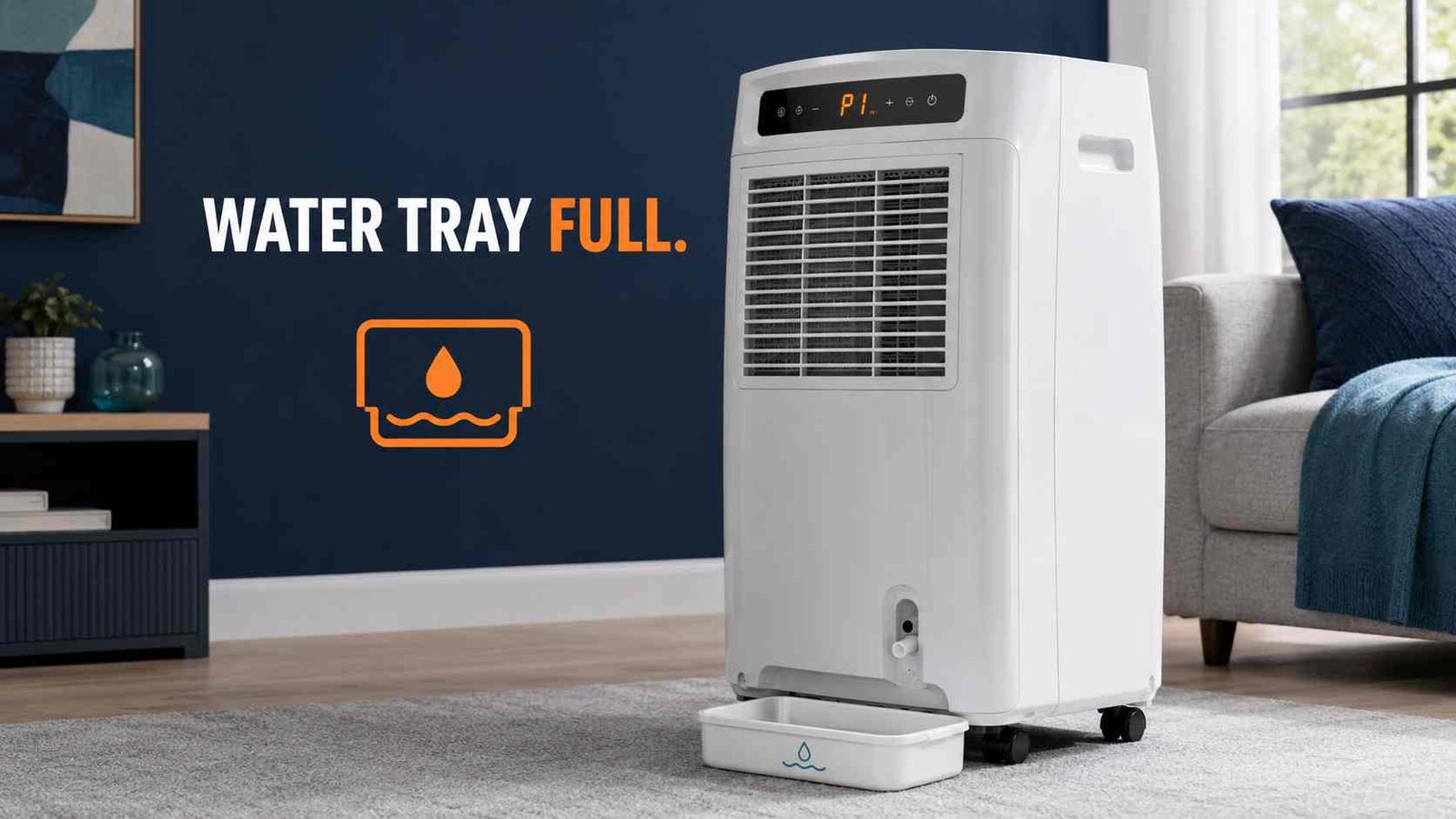
A P1 error on a Midea portable air conditioner usually means the bottom water collection tray is full. Turn the unit off, disconnect it from power, and drain the tray through the lower drain outlet shown in your model’s manual. Refit the drain plug firmly before restarting the appliance.
When P1 appears, cooling and dehumidification may stop even though the fan continues running. This is normal protection behaviour on documented Midea portable models. If the code comes back immediately after the tray has been completely drained, stop repeatedly restarting the air conditioner and arrange service.
Do not assume that P1 always means a full water tray. Midea also uses P1 for pressure, defrost, or temperature-related protection on some fixed and commercial air-conditioning systems.
Midea P1
| Item | Details |
|---|---|
| Error code | P1 |
| Brand | Midea |
| Most common appliance | Portable air conditioner |
| Usual portable-model meaning | Bottom water tray is full |
| Safe first action | Turn off, unplug, and drain the bottom tray |
| Can cooling continue? | Usually no; the fan may continue |
| Homeowner difficulty | Low if the correct drain outlet is accessible |
| Reset method | Drain the tray, reinstall the plug, and restart |
| Professional help required | If P1 returns, no water drains, the unit leaks, or it is not a portable model |
What Does P1 Mean on a Midea Air Conditioner?
On many Midea portable air conditioners, P1 is a protection code indicating that collected condensate has reached the limit of the bottom tray.
The air conditioner removes moisture from indoor air while cooling or operating in Dry mode. Some of that moisture may be evaporated and discharged through the exhaust system. When moisture accumulates faster than the unit can manage it, water collects in the internal bottom tray.
Once the water reaches a predetermined level, the appliance displays P1 to help prevent an overflow.
Official Midea documentation for several portable models describes the same basic response:
- Stop the appliance.
- Drain the collected water.
- Reinstall the bottom drain plug.
- Restart the unit.
- Request service if P1 returns.
Identify Your Air Conditioner Before Draining It
The first step is determining which type of Midea air conditioner you own.
Standard portable air conditioner
A standard portable model normally:
- Stands on the floor
- Has wheels or castors
- Uses an exhaust hose connected to a window
- Has one or more drain outlets on the rear
- Plugs directly into a wall outlet
On these models, P1 most often means the lower collection tray needs draining.
Midea Duo portable air conditioner
Midea Duo models are also portable units, although their hose and internal airflow design can look different from conventional portable air conditioners.
Official Duo documentation still uses P1 for a full bottom tray on documented models. The position of each drain connection can vary, so use the diagram for your exact model.
Midea PortaSplit
The PortaSplit has separate indoor and outdoor sections connected by a flexible line. It should not be treated exactly like a conventional single-cabinet portable air conditioner.
The official UK PortaSplit manual groups P1 with EH44 and instructs the user to drain the indoor unit. If this condition occurs frequently, Midea recommends contacting service.
Wall-mounted, floor-standing, ducted, or commercial system
Do not remove plugs or attempt portable-unit drainage instructions on a fixed Midea system unless its manual specifically identifies P1 as a condensate issue.
On other Midea equipment, P1 can indicate:
- Suction-pipe low-pressure protection
- Anti-cool-air or defrost protection
- Another model-specific operating protection
These conditions may involve refrigerant pressure, sensors, airflow, water circulation, controls, or system operating conditions. They require model-specific diagnosis.
What Happens When a Portable Midea AC Shows P1?
On a documented Midea portable model, the following sequence occurs when the bottom tray reaches its set level:
- The unit beeps eight times.
- P1 appears on the digital display.
- Air-conditioning and dehumidification stop.
- The fan motor continues operating.
- Normal operation can resume after the tray is drained and the appliance is restarted.
The running fan can make it seem that the air conditioner is still working. However, it may only be circulating room air because active cooling has stopped.
How to Drain a Midea Portable Air Conditioner Safely
The exact plug location and hose arrangement vary. Keep the user manual nearby and look for a label such as bottom drain, bottom tray drain, or collection tray drain.
1. Turn off the air conditioner
Use the power button to stop the unit.
2. Disconnect it from power
Unplug the appliance before touching a drain plug or dealing with collected water.
Do not handle the plug with wet hands. Keep the electrical outlet and power cord dry.
3. Keep the unit upright
Do not lay the air conditioner on its side. Moving or tilting it unnecessarily can spill water internally and may affect the refrigeration system.
Carefully roll the unit to a suitable drain location when its manual instructs you to do so.
4. Prepare for the water
Place a shallow tray under the lower drain outlet, or position the appliance where water can be released safely.
The outlet may sit very close to the floor. A deep bucket may not fit beneath it.
5. Locate the bottom drain plug
Check the lower rear section of the cabinet. Some models have another drain outlet higher up, so confirm that you have found the plug for the bottom collection tray.
Do not remove random caps or fasteners.
6. Remove the plug slowly
Pull out or unscrew the plug according to the manual.
Allow all accessible water to drain. Do not insert a screwdriver, wire, or sharp object into the drain opening.
7. Reinstall the plug firmly
A loose or incorrectly fitted plug can cause water to leak onto the floor the next time the air conditioner operates.
Midea specifically instructs users to reinstall the bottom plug securely before using the appliance again.
8. Return the unit to its operating position
Place it on a stable, level floor. Reconnect the exhaust hose if it was moved or disconnected.
9. Restore power and restart
Switch the appliance on normally.
The P1 code should clear once the tray has been drained and normal operation resumes. If the compressor does not start immediately, allow for the appliance’s built-in restart protection rather than repeatedly pressing the power button.
Which Drain Outlet Clears the P1 Code?
Portable Midea air conditioners may have more than one drain connection.
| Drain point | Typical purpose | Does it normally clear P1? |
|---|---|---|
| Upper rear outlet | Continuous drainage during Dry mode on selected models | Not necessarily |
| Middle outlet | Pump drainage or heating-mode drainage on certain models | Model-dependent |
| Lower bottom outlet | Draining the main bottom collection tray | Usually yes on portable models |
On one official Midea portable manual, the higher outlet is used for continuous drainage during dehumidification, while the lower plug drains the tray associated with P1.
Port positions are not identical across every Midea model. Check the rating label for the model number, then use that model’s drainage diagram.
How to Reset the Midea P1 Error
For portable models reviewed in official Midea documentation, P1 is not cleared through a universal remote-control combination or diagnostic button sequence.
The normal reset procedure is:
- Turn the air conditioner off.
- Unplug it.
- Drain the correct bottom tray.
- Reinstall the drain plug firmly.
- Restore power.
- Restart the unit normally.
This is a drainage correction followed by a restart, not a software reset.
Official manuals do not establish one button sequence that applies to every portable, Duo, PortaSplit, wall-mounted, or commercial Midea system.
Why Does the P1 Error Keep Coming Back?
A P1 code that returns once after several days of humid operation may simply mean that the appliance has collected more moisture.
A code that returns immediately or repeatedly needs closer attention.
The bottom tray was not completely drained
A small drain pan can fill before the internal tray is empty. Empty the external pan and continue draining until the water stops.
The wrong drain outlet was opened
Removing an upper Dry-mode plug may not empty the lowest part of the appliance.
Confirm the bottom tray drain location in the manual.
A continuous drain hose is kinked
Where continuous drainage is supported, the hose must slope toward the drain and remain free of kinks.
A raised hose end, tight bend, blockage, or poor connection can prevent gravity drainage. Midea’s portable manual advises keeping the hose directed downward and unobstructed.
The room is very humid
Portable air conditioners can produce more condensate during humid weather, in a damp basement, or while operating in Dry mode.
Frequent water accumulation is not automatically evidence of a failed component. However, the unit should not repeatedly enter P1 shortly after complete drainage.
The appliance is not level
A portable air conditioner should stand on a stable, even surface. An uneven position may affect water movement inside the tray and can also increase noise or vibration.
An internal drainage or detection problem may exist
Possible technician-level issues can include:
- Restricted internal drainage
- A damaged drain connection
- A condensate pump problem on equipped models
- A water-level sensing fault
- Loose internal connections
- A control-board problem
These are possible categories, not a diagnosis. The cabinet must not be opened merely because P1 appeared.
P1 Appears but No Water Comes Out
No water from the drain does not prove that the tray is empty.
Check the following without dismantling the appliance:
- Confirm that the unit is a portable Midea air conditioner.
- Verify the exact model number.
- Check the manual’s drain diagram.
- Make sure you opened the lowest collection-tray outlet.
- Keep the unit upright on a level floor.
- Look only for visible external obstruction around the outlet.
- Refit the plug and try one normal restart.
Do not push a tool into the opening or remove the rear cabinet.
Arrange service when P1 immediately returns even though no water drains from the correct outlet.
The Fan Runs but the Air Conditioner Does Not Cool
This behaviour can be normal while P1 protection is active.
On documented portable models, the cooling and dehumidifying process stops while the fan continues running. Drain the bottom tray before judging whether the appliance has another cooling fault.
If P1 disappears but cooling still does not resume, check the basic operating conditions:
- Select Cool mode.
- Set the temperature below room temperature.
- Make sure doors and windows are closed.
- Check that the air filter is clean.
- Confirm that the exhaust hose is connected and not blocked.
Persistent failure to cool after P1 has cleared may be a separate problem.
Midea PortaSplit P1 or EH44
On a PortaSplit, P1 or EH44 means the indoor section needs to be drained according to the PortaSplit manual.
Use the drain point shown for that product rather than following a generic portable-air-conditioner illustration. Prepare a shallow container, disconnect the unit safely, and reinstall the drainage plug after emptying it.
Contact Midea service if the code occurs frequently.
When P1 Does Not Mean a Full Water Tray
Here is the main limitation of any general Midea P1 guide: the code is reused across different equipment platforms.
| Midea system family | Documented P1 meaning | Correct response |
|---|---|---|
| Portable air conditioner | Bottom tray full | Drain the lower tray |
| PortaSplit | Indoor unit requires drainage | Follow PortaSplit instructions |
| Selected commercial Full DC R32 system | Suction-pipe low-pressure protection | Professional HVAC diagnosis |
| Selected top-discharge split heat pump | Anti-cool-air or defrost protection | Check the exact system manual |
A commercial Midea P1 low-pressure document lists possible refrigerant shortage, pressure-switch, blockage, heat-exchange, water-flow, and PCB causes. These checks involve refrigerant circuits, electrical controls, pressure measurement, or commercial water systems. They are not homeowner procedures.
Another official technical manual identifies P1 as anti-cool-air or defrost protection on the covered heat-pump units.
Parts a Technician May Inspect
The parts requiring attention depend entirely on the model and confirmed P1 meaning.
For a portable unit with a repeated tray-full condition, a technician may inspect:
| Area | Why it may be checked |
|---|---|
| Internal drain path | To find restrictions or poor water flow |
| Bottom tray | To check damage or incorrect drainage |
| Water-level detection system | To confirm that the tray level is being sensed correctly |
| Condensate pump | Applicable only to models fitted with one |
| Wiring and connectors | To identify loose or damaged connections |
| Control board | Considered only after basic drainage causes are ruled out |
On commercial or split systems where P1 is pressure-related, diagnosis may include refrigerant pressure, heat exchangers, switches, pumps, sensors, pipework, and controls.
These tests require suitable tools and training.
Can You Continue Using the Air Conditioner?
Do not continue using a portable Midea air conditioner in cooling or Dry mode while P1 remains displayed.
Drain the tray before restarting. Continuing to run or repeatedly resetting the unit can increase the chance of leakage or conceal an unresolved drainage fault.
Stop using the appliance completely when you notice:
- Water reaching the power cord or outlet
- A damaged plug or cable
- Burning smells
- Smoke
- Loud electrical buzzing
- Repeated breaker trips
- Water leaking from the cabinet rather than the drain outlet
Disconnect power only when it is safe to do so.
When to Call a Technician
Arrange professional help when:
- P1 returns immediately after complete drainage.
- The correct drain outlet releases no water.
- Water leaks from underneath or through the cabinet.
- The drain plug or outlet is cracked or damaged.
- The appliance repeatedly fills unusually quickly.
- P1 remains after a normal restart.
- A PortaSplit repeatedly displays P1 or EH44.
- The appliance is wall-mounted, floor-standing, ducted, VRF, hydronic, or commercial.
- Refrigerant, internal wiring, sensors, pressure switches, or control boards require testing.
Midea’s portable documentation states that service should be requested if the protection code repeats.
Safety warning: Do not open the cabinet, bypass the water-level protection, test live voltage, loosen refrigerant connections, or pierce tubing. Always unplug a portable unit before cleaning, draining, or basic servicing. Refrigerant-system repairs should be handled by an appropriately qualified technician.
Frequently Asked Questions
Is P1 a serious Midea air-conditioner fault?
On a portable model, P1 is usually a water-level protection condition rather than evidence of a major failure. Drain the bottom tray. It becomes a service issue when the code does not clear or keeps returning.
How do I clear P1 on a Midea portable air conditioner?
Turn the unit off, unplug it, empty the bottom water tray through the correct lower drain outlet, reinstall the plug firmly, and restart the appliance.
Why is my Midea AC still blowing air with P1 displayed?
The fan may continue even though cooling and dehumidification have stopped. This is documented as normal behaviour on selected Midea portable models.
Can I leave a drain hose connected all the time?
Some models support continuous drainage in specific modes, but the correct outlet and hose arrangement vary. Follow the manual for your exact model. A hose connected to an upper outlet may not drain the bottom P1 tray.
Why does P1 return after I drain the unit?
The wrong outlet may have been opened, the tray may not have emptied fully, the unit may be uneven, or there may be a drainage or water-level detection problem. Stop repeated resetting if P1 returns immediately.
Does P1 mean the same thing on a Midea split air conditioner?
No. On some fixed or commercial Midea systems, P1 refers to pressure, defrost, or another operating protection. Check the full model number before troubleshooting.
How often should a Midea portable AC be drained?
There is no single schedule for every model or room. Some self-evaporating units need little manual drainage during normal cooling, while humid conditions and Dry mode can produce more collected water.
Can I tilt the air conditioner to remove the remaining water?
Do not tilt it unless the manual for your exact model specifically instructs you to do so. Keep the unit upright and use the documented drain outlet.

Emily Carter is an Australian home-appliance safety editor with 9 years of experience researching washers, air conditioners, refrigerators, and coffee machines. She checks troubleshooting steps for accuracy, regional model differences, and homeowner safety before publication.