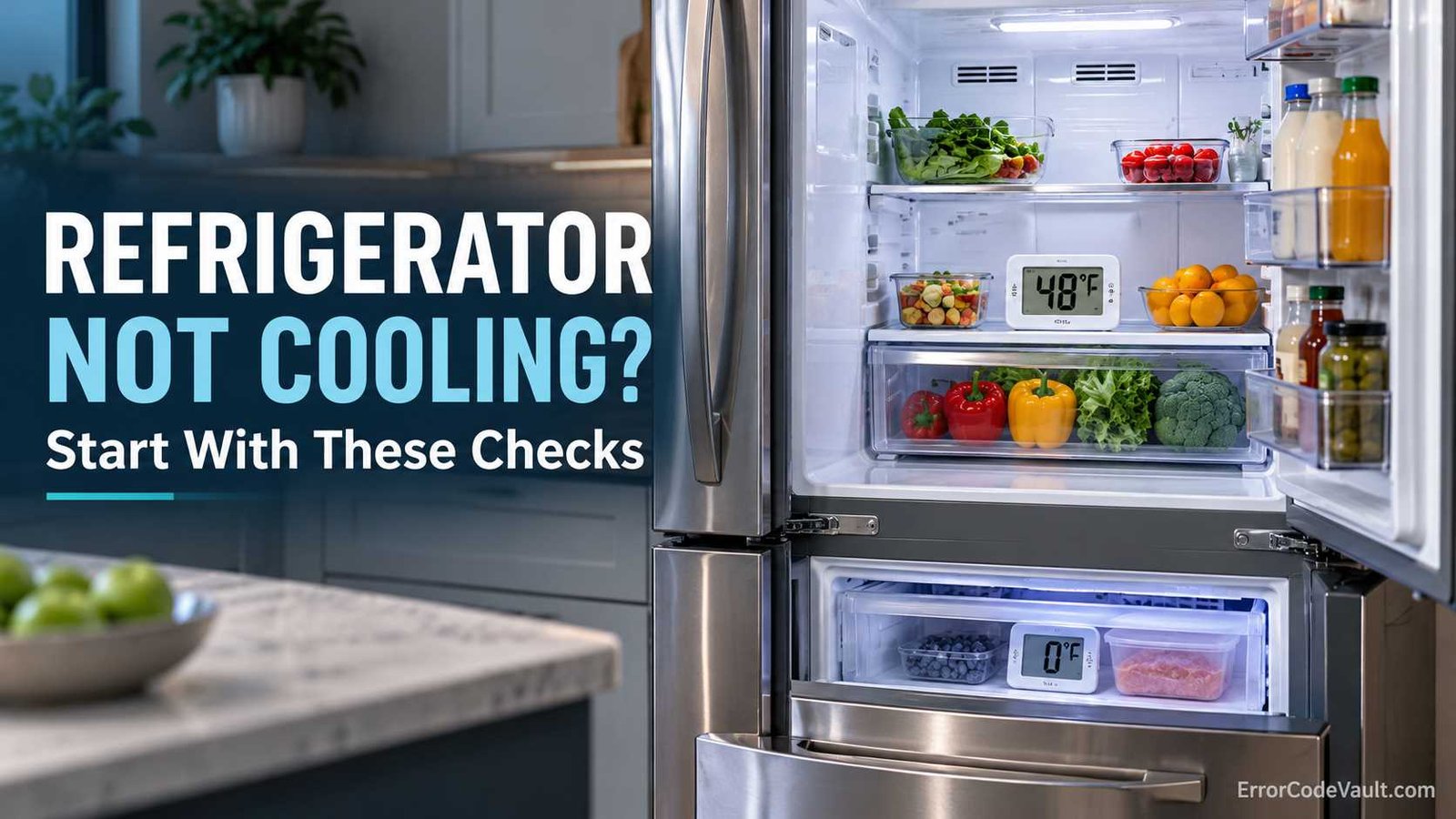
 If your Whirlpool refrigerator fridge is not cooling, check whether cooling is switched on, whether food blocks the air vents, and whether the doors close completely. Then compare the fresh-food and freezer temperatures. A freezer that stays cold while the fridge warms suggests a different problem from a refrigerator with both compartments warm.
Protect food before troubleshooting. Move perishables into another refrigerator or a cooler maintained at 40°F (4°C) or below. If perishables have been above 40°F for two hours or longer, discard them; in ambient temperatures above 90°F (32°C), the limit is one hour. During a power outage, a closed refrigerator usually keeps food cold for about four hours. Never taste food to judge safety.
First, Check the Temperature and Cooling Controls
Use a separate appliance thermometer to measure the refrigerator rather than relying only on the temperature shown on the control panel. Whirlpool commonly recommends a setting of 37°F (3°C) for the refrigerator and 0°F (-18°C) for the freezer on compatible electronic-control models. Keep refrigerated food at or below 40°F (4°C). Controls and recommended dial positions can differ, so use the manual for your exact model.
- Confirm cooling is on. A display can light up while cooling is disabled. Some Whirlpool refrigerators have Cooling Off, Showroom or Demo mode, which may keep the lights working without operating the cooling system.
- Return accidental setting changes to normal. Use the model’s recommended setting instead of immediately selecting the coldest option. The coldest setting does not make a warm refrigerator cool down faster.
- Check both sections. Record temperatures from the fresh-food compartment and freezer, then note whether the freezer still keeps food fully frozen.
- Allow time after a known interruption. Following installation or a power outage, Whirlpool advises allowing up to 24 hours for full temperature stabilization. That recovery period does not extend safe food-storage limits.
If you see Cooling Off or Showroom on the display, consult the use-and-care guide for that exact Whirlpool refrigerator. There is no safe universal button combination to recommend for every control panel.
Whirlpool Refrigerator Warm but Freezer Cold
On many Whirlpool refrigerator-freezer models, air cooled around the freezer evaporator circulates into the fresh-food section. If that airflow is restricted, the freezer can remain cold while milk, vegetables and other refrigerated items get warm. Some newer designs use different evaporator and airflow arrangements, so treat this symptom as a clue, not proof of a failed part.
Look for blocked refrigerator and freezer vents
Identify the visible supply and return vents in both compartments. Move tall containers, freezer bags and overfilled bins away from them, leaving space around packages for air movement. Whirlpool specifically warns that overcrowding and blocked return airflow can cause warm spots.
Close the doors and track actual temperatures. If the fridge begins cooling again, restricted airflow was a reasonable explanation. If there is no improvement, do not keep rearranging food indefinitely.
Check for heavy frost on the freezer’s rear wall
A thick, persistent sheet of frost near the freezer’s interior rear panel can restrict air circulation. It may result from humid air entering through a poorly sealed door or from a defrost-system problem. A little frost near newly introduced food is not enough to identify a defective heater or sensor.
Do not remove the rear panel, break off ice with a knife, or direct a heat gun at the liner. Recurring heavy frost calls for professional assessment of the defrost system and door sealing.
Could the evaporator fan or air damper be faulty?
Depending on the model, an evaporator fan moves cold air and an air damper regulates how much enters the fridge. A fan, damper or associated control fault can leave the refrigerator compartment warm. However, fans often stop when a door is open or during normal operating cycles, so a quiet fan is not a reliable diagnosis by itself.
If vents are clear and the freezer stays cold, give a technician the model number and both thermometer readings. Those details help determine whether airflow parts are even present in your particular design.
What if the Whirlpool Freezer and Fridge Are Both Not Cooling?
Begin with the power supply. Check whether the interior light or display works, whether the power cord is seated securely in the specified wall outlet, and whether the household breaker has tripped. A lit display shows that some power is available, not that the compressor is operating. Never use an extension cord to bypass a questionable outlet.
Confirm Cooling Off or Showroom mode has not been enabled. Next, make sure accessible outside ventilation openings are not blocked and the appliance has the installation clearance required by its manual. If both sections remain warm with cooling enabled, possibilities include a condenser fan, compressor start component, temperature-control fault or sealed-system issue. None can be identified from warm air alone.
Match the Symptom to a Sensible Next Step
| What you observe | Possible explanation | Next action |
|---|---|---|
| Freezer cold, fridge warm | Restricted air transfer, frost, fan or damper issue on applicable models | Clear vents, inspect visible frost, then monitor both temperatures |
| Both sections warm; lights off | Power supply interruption | Check plug and breaker safely; contact an electrician for outlet problems |
| Both sections warm; display lit | Cooling disabled or a cooling-system fault | Check operating mode and settings; arrange service if still warm |
| Door ajar or gasket has gaps | Warm room air entering | Remove obstructions and clean the gasket |
| Heavy frost repeatedly returns | Door air leak or defrost problem | Check closure and book professional diagnosis |
| Warm after a recent installation | Normal temperature recovery or an installation problem | Keep doors closed, monitor food safety and allow model-specified stabilization time |
Inspect Door Seals, Air Circulation and Condenser Access
Check that shelves, bins and food packages are not stopping the doors from closing flush. Wipe the door gasket with mild soapy water, then look for folded, torn or detached sections. You can gently pull a thin piece of paper trapped in the closed door to compare resistance around the perimeter. An uneven result suggests an area worth inspecting; it is not a definitive test of gasket performance.
Dust accumulation around accessible condenser ventilation can also affect cooling. Whirlpool advises checking condenser cleanliness where applicable, but coil locations and access differ by model. Unplug the refrigerator before any cleaning expressly described in the owner’s manual. Never remove electrical covers, touch moving fans or bend refrigerant tubing.
Installation location matters. Some Whirlpool household refrigerators are designed for ambient temperatures around 55°F to 110°F (13°C to 43°C); other models have garage-ready features or different limits. Check the rating and installation information for your model before assuming a garage or unheated utility room is suitable.
How Long Should a Whirlpool Refrigerator Take to Get Cold?
Whirlpool commonly instructs owners to allow 24 hours after installation for the refrigerator to cool completely. Temperature changes after a large grocery load or frequent door openings may also take time to settle. When adjusting settings, Whirlpool recommends waiting about 24 hours before deciding whether another change is needed.
That is an appliance-performance timeline, not a food-safety allowance. After a power cut lasting four hours or longer, FoodSafety.gov advises discarding refrigerated perishables. If you know food has remained at a safe temperature, evaluate it using appropriate official guidance. Frozen food that still contains ice crystals or is at 40°F (4°C) or lower may be safe to cook or refreeze, even if some thawing occurred.
Should You Reset a Whirlpool Refrigerator That Is Not Cooling?
Only use a reset or cooling-on procedure documented for your model. A model-approved restart may clear an operating-mode issue, but it will not repair a blocked vent, faulty fan, refrigerant leak or other physical defect. Do not repeatedly unplug and reconnect the refrigerator hoping to force the compressor to start.
If the panel shows an alert or error code, note its exact letters and numbers before acknowledging it. A power-outage alert may explain why temperatures rose, but clearing the alert does not prove that cooling has recovered.
When a Whirlpool Refrigerator Needs a Technician
Arrange qualified service when both compartments remain warm after normal controls and airflow have been checked; when the freezer stays cold but the refrigerator remains above 40°F (4°C); when thick frost repeatedly builds up; or when the appliance makes persistent clicking noises without cooling. Stop use immediately if you notice a burning smell, sparking, a damaged supply cord or an overheating outlet. Electrical supply faults belong with a qualified electrician.
Before booking a repair, record the full model number, refrigerator and freezer temperatures, control-panel message, recent outages and whether frost is visible. Whirlpool side-by-side, top-freezer and French-door refrigerators can have different cooling layouts, so a diagnosis or part number from another Whirlpool model may not apply to yours.
The safest sequence is to protect food, verify temperatures and cooling mode, clear visible vents, confirm door closure, and compare freezer performance with fridge performance. If those checks do not restore safe cooling, leave internal electrical and sealed-system diagnosis to a professional.
Daniel Brooks is a US-based appliance troubleshooting researcher with 12 years of experience studying washer, dryer, refrigerator, and dishwasher faults. He reviews manufacturer manuals and converts technical error codes into safe, practical guidance for homeowners.