
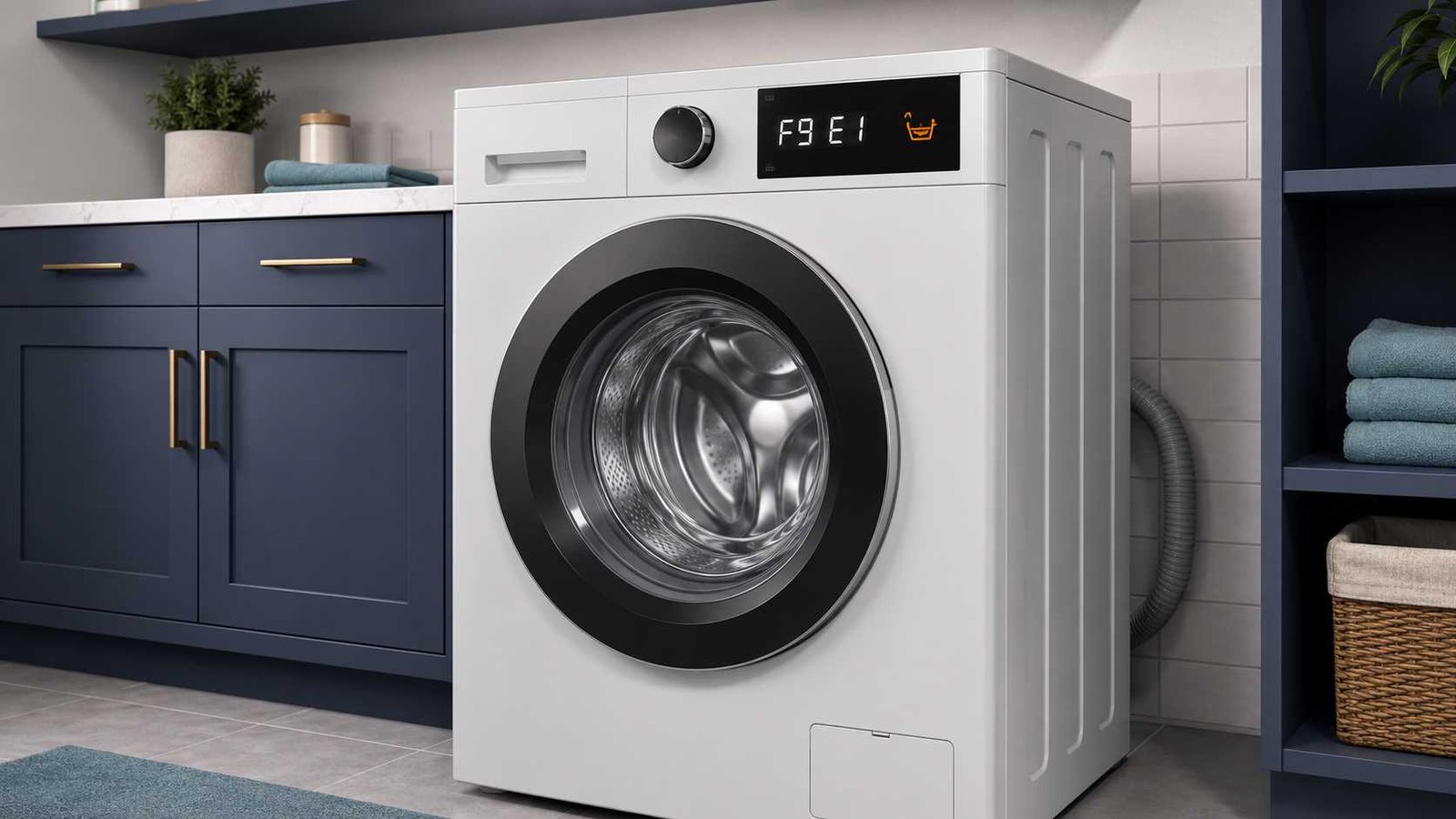
 The Whirlpool Washer F9 E1 error code means the machine is taking too long to drain or cannot drain properly. Whirlpool commonly describes this as a long drain condition. On some front-load models, the code appears when draining takes longer than expected, typically more than eight minutes.
Start by switching off the washer and checking the external drain hose for kinks, crushing or incorrect placement in the standpipe. On models with an owner-accessible pump filter, a blocked filter is another common cause.
Do not continue running normal wash cycles while water remains in the drum. Stop using the washer immediately if it is leaking, repeatedly tripping the breaker, producing a burning smell or making a harsh grinding noise.
Whirlpool F9 E1
| Item | Details |
|---|---|
| Error code | F9 E1 or F9E1 |
| Meaning | Long drain or drain pump system problem |
| Appliance | Selected Whirlpool washers and washer-dryers |
| Most likely area | Drain hose, standpipe, pump filter or household drain |
| First safe check | Switch off the washer and inspect the external drain hose |
| Repair difficulty | Easy for external checks; professional diagnosis may be needed |
| Can the washer still be used? | Not until it drains normally and the code stays cleared |
| Call for service when | The code returns after all manual-approved checks |
What Does F9 E1 Mean on a Whirlpool Washer?
F9 E1 indicates that the washer has detected an abnormally long drain time. The control expected the water level to fall within a certain period, but the machine did not drain quickly enough.
Whirlpool identifies the code as:
- Long Drain on supported top-load washers
- Long Drain Time on supported front-load washers
- A washer-dryer that is not draining on time, or at all, on supported all-in-one models
- A possible blocked drain pump on selected laundry towers
Depending on the model and display, you may see:
- F9 E1
- F9E1
- F09 E01
- DRN or drn
Some Whirlpool owner documentation uses both F9 followed by E1 and F09 followed by E01 for a drain pump system error. Top-load guidance may use DRN for the same general long-drain condition.
Is It Safe to Keep Using the Washer?
Do not start another full wash cycle while the washer still contains water or repeatedly displays F9 E1. Continuing to fill a machine that cannot drain may lead to overflowing, leakage, very wet clothes or additional strain on the pump.
Turn off and disconnect the washer before cleaning an accessible pump filter.
Stop troubleshooting and arrange professional help when:
- Water is leaking near the power outlet or electrical connections.
- The washer trips its breaker.
- You notice smoke, overheating or a burning smell.
- The pump makes a loud grinding or scraping noise.
- The door remains locked with water inside and the manual’s drain procedure does not work.
- Accessing the suspected blockage would require removing sealed cabinet panels.
Do not force open a front-load washer door while water remains above the bottom of the door opening.
Most Common Causes of Whirlpool F9 E1
| Possible cause | Typical clue | Safe homeowner action |
|---|---|---|
| Kinked or crushed drain hose | Washer hums but drains slowly | Straighten the external hose |
| Hose pushed too far into standpipe | Water drains and then returns | Correct the hose depth |
| Airtight standpipe connection | Irregular draining or siphoning | Leave the required air gap |
| Blocked household drain | Utility sink fills or drains slowly | Clear the household drain |
| Clogged pump filter | Water remains after the cycle | Clean only when the manual provides access |
| Blocked door-seal drain holes | Water collects inside the bellow | Remove visible lint safely |
| Excess detergent suds | Excess foam or very wet clothing | Use the correct amount of HE detergent |
| Pump or internal drainage fault | Code returns after all basic checks | Arrange professional diagnosis |
1. Kinked, Pinched or Blocked Drain Hose
The drain hose can become trapped behind the washer, folded during installation or clogged with lint and debris. Even a partial restriction may allow some water through while still causing the cycle to exceed its permitted drain time.
Whirlpool advises checking that the hose is not kinked, pinched or blocked. The household drainpipe or utility sink must also be clear.
2. Incorrect Drain-Hose Installation
A hose pushed too deeply into the standpipe may cause siphoning or allow drained water to return to the tub.
For North American models covered by Whirlpool’s guidance, the hose should not normally extend more than 4.5 inches or approximately 114 mm into the standpipe or laundry tub. It should be secured with the supplied U-shaped hose form rather than taped into an airtight connection.
Whirlpool’s general North American front-load guidance gives a standpipe height range of approximately 39 to 96 inches. Certain all-in-one models use a different lower minimum of 24 inches. Always follow the installation instructions for the exact model instead of treating one measurement as universal.
3. Clogged Drain Pump Filter
Some Whirlpool front-load washers and washer-dryers have a filter that catches lint, coins, buttons and other small objects before they enter the drain pump.
The filter may be behind a lower dispenser or storage drawer on selected models. Other models use a different location or do not provide routine owner access.
Do not assume that every Whirlpool washer has a removable filter. Check the owner’s manual before removing panels or trim.
4. Blocked Door-Seal Drain Holes
Selected front-load and all-in-one machines have small drainage holes inside the rubber door seal, also called the bellow. Lint or detergent residue can obstruct these holes and prevent water from returning to the drain system properly.
5. Excessive Detergent Suds
Too much detergent can slow drainage and interfere with spinning. Use only detergent marked for high-efficiency machines where required, measure it carefully and adjust the amount for the load size, soil level and water conditions.
Whirlpool specifically lists excessive suds as a possible reason for delayed draining on front-load washers.
6. Blocked Household Plumbing
The washer may be working correctly, but the standpipe, laundry tub or household drain may not accept water quickly enough.
Watch the drain while the machine attempts to empty. Water rising in the utility sink or backing up around the standpipe points toward a plumbing restriction rather than a washer control problem.
How to Fix Whirlpool Washer F9 E1 Safely
Step 1: Turn Off and Disconnect the Washer
Press Power to stop the machine, then unplug it where the plug can be reached safely.
Do not touch the plug with wet hands. If water is present around the outlet, do not approach the electrical connection. Isolate the circuit only when this can be done safely and arrange professional assistance.
Step 2: Check for Water Inside
Look through the door or into the tub.
When a significant amount of water remains, prepare for controlled drainage. Do not immediately unscrew a pump filter because the retained water may spill rapidly across the floor.
Use the emergency drain hose only when the owner’s manual identifies one and explains its use.
Step 3: Inspect the External Drain Hose
Pull the washer forward only when this can be done without injury or damaging the flooring.
Check that the hose is:
- Not trapped between the washer and wall
- Not sharply bent
- Not twisted or flattened
- Securely connected
- Free from visible blockage
- Installed at the height required in the model’s manual
Do not place strain on the water inlet hoses or power cord while moving the machine.
Step 4: Check the Standpipe or Utility Sink
Confirm that the hose has not been pushed too deeply into the drain.
For models covered by the common North American instructions, no more than about 4.5 inches of hose should enter the standpipe. Keep an air gap around the hose opening. Do not seal the hose to the pipe with tape.
Run water into the utility sink or have the household drain checked if it empties slowly.
Step 5: Review Detergent Use
Check whether you used:
- Non-HE detergent in an HE washer
- More detergent than recommended
- Extra detergent for a small load
- A detergent that produces unusually heavy foam
Allow excess foam to settle. Once the drainage problem has been corrected, follow the model manual for a rinse, drain or spin cycle.
Step 6: Clean the Pump Filter When the Manual Allows It
Only continue when the owner’s manual confirms that the filter is intended for user access.
A common Whirlpool front-load procedure is:
- Disconnect power.
- Place towels and a wide, shallow container below the filter area.
- Drain residual water through the small emergency hose when fitted.
- Turn the filter slowly to release any remaining water.
- Remove lint, coins or visible debris.
- Rinse the filter with water.
- Reinstall it firmly and correctly.
- Secure the drain tube and close the access drawer.
Water may continue to escape as the filter loosens, so empty the container as often as necessary. Whirlpool’s illustrated instructions also warn that this filter arrangement applies only to some models.
Do not reach deeply into the pump housing, turn internal parts with a tool or operate the washer while the filter is removed.
Step 7: Check the Front-Load Door Seal
Gently pull back the lower section of the rubber seal.
Remove visible lint, threads or detergent residue from the small drain openings without using sharp objects. Avoid pulling the seal away from its retaining ring.
Step 8: Reassemble and Test
Confirm that:
- The filter is fully seated.
- The emergency drain hose is capped.
- The lower drawer or cover is secure.
- The external drain hose is correctly positioned.
- The floor and plug area are dry.
Restore power and select the manual-approved drain-and-spin or rinse-and-spin function.
Remain near the machine during the test. Stop the washer if water leaks from the filter, hose or cabinet.
How to Clear or Reset the F9 E1 Code
Correct the drainage problem before attempting a reset. A reset may clear the display, but it cannot remove a hose blockage, clean the filter or repair a failed pump.
On some Whirlpool front-load models, the owner’s manual instructs the user to correct the cause, touch Power once to clear the code, then reselect and restart the cycle. The exact button behaviour varies by control panel.
Whirlpool’s general washer reset method is:
- Turn the washer off.
- Unplug it for five minutes.
- Reconnect power.
- Select a short drain or rinse-and-spin test.
For a hard-wired machine, Whirlpool advises turning off the correct circuit for five minutes before restoring it. A five-minute power cycle is also specifically documented for selected Whirlpool laundry towers displaying F9E1.
Do not use random diagnostic button combinations found online. Service-mode sequences vary by control system and may produce misleading results when applied to the wrong model.
What to Do When the Filter Is Clean
A clean filter does not prove that the drain system is working correctly.
The Pump Hums but No Water Leaves
A humming sound may mean that the pump is receiving a command but cannot move water. Possible reasons include:
- A blockage farther inside the drain system
- A restricted outlet hose
- An object obstructing the pump impeller
- A mechanically damaged pump
Do not dismantle the pump or apply power while touching its components.
The Washer Drains, but Very Slowly
Check the entire external hose and household drain. A partial restriction can pass water while still causing an eight-minute drain timeout.
Also check for excessive suds, an incorrectly installed standpipe hose or water returning to the tub.
The Washer Drains Normally, but F9 E1 Returns
A returning code may require technician-level testing. Whirlpool’s consumer guidance does not identify one guaranteed failed part. It directs owners to arrange service when the documented checks do not resolve the error.
The Error Started After Installation or Moving
Recheck:
- Hose depth in the standpipe
- Hose height
- Kinks behind the cabinet
- Whether the hose was altered or extended
- Whether the standpipe opening was taped closed
- Whether the household drain can handle the discharge rate
Installation-related hose problems are among the first issues listed in Whirlpool’s guidance for both front-load and top-load washers.
Possible Faulty Parts
F9 E1 does not automatically confirm a failed drain pump.
When the external hose, household drain, detergent use and manual-approved filter checks are correct, a technician may need to inspect:
| Area | Why it may be checked |
|---|---|
| Drain pump | It may be jammed, worn or unable to move enough water |
| Internal drain path | A sock, coin or debris may be trapped beyond the filter |
| Pump connection | A loose or damaged connection may interrupt pump operation |
| Water-level sensing system | The control may not correctly detect that the tub has emptied |
| Electronic control | The pump command or drain monitoring may be affected |
These are diagnostic possibilities, not confirmed failed parts. Whirlpool’s owner-facing guidance recommends service when the error returns after the approved troubleshooting steps.
Front-Load, Top-Load and All-in-One Differences
| Washer type | Main official checks |
|---|---|
| Front-load washer | Drain hose, pump filter on some models and door-seal drain holes |
| Top-load washer | Drain hose position, kinks, blockage and household drain |
| All-in-one washer-dryer | Pump filter, bellow drain holes and drain-hose routing |
| Laundry tower | Manual-approved pump cleaning and five-minute power cycle |
Do not transfer a filter-cleaning procedure from one washer type to another. Filter position and owner access can differ even between visually similar machines.
Regional Guidance
The F9 E1 information in this guide is best supported for Whirlpool washers sold in the United States and Canada.
Whirlpool’s current Australian and New Zealand ranges include different model families from many North American WFW and WTW machines. Their drain arrangements, voltage, control panels and fault-code systems may differ. Use the model number to obtain the correct local owner’s manual before applying North American hose measurements or filter instructions.
For models sold in the United Kingdom or Ireland, confirm the code in the local manual. Do not assume that F9 E1 has the same meaning or reset procedure on every Whirlpool-branded platform.
When to Call a Technician
Arrange service when:
- F9 E1 returns after the hose and filter checks.
- The pump runs continuously without removing water.
- The washer is silent during a drain command.
- The filter cannot be opened or is not accessible.
- An object appears trapped beyond the filter.
- The washer leaks after the filter has been reinstalled.
- Internal panels, wiring or electrical testing would be required.
- The household drain is clear but the washer still drains slowly.
- The code appears immediately at the start of every cycle.
Provide the model number, full code, cycle being used and a description of the pump sound when booking service.
How to Prevent F9 E1 From Returning
Check clothing pockets before washing. Coins, hair clips and small items can enter the drainage system.
Use the correct detergent and measure it rather than pouring directly from the container.
Keep the drain hose free from crushing when pushing the washer back into position.
Clean an owner-accessible pump filter at the interval described in the model manual or whenever draining begins to slow.
Watch for early signs such as longer drain periods, wet clothing, repeated drain attempts or gurgling from the standpipe.
Frequently Asked Questions
Can I run the washer again after seeing F9 E1?
Run only a controlled drain or test cycle after correcting the likely cause. Do not begin another full wash while water remains in the drum or the washer still drains slowly.
Does F9 E1 always mean the drain pump has failed?
No. It means the washer detected a long drain. Hose installation, a clogged filter, excessive suds or a blocked household drain may cause the same code.
Where is the Whirlpool washer drain pump filter?
On selected front-load models, it may be behind a lower storage or dispenser drawer. Other washers have a different arrangement or no owner-accessible filter. Check the exact model manual before removing anything.
Why does F9 E1 return when the filter is clean?
The restriction may be in the drain hose, household standpipe or an internal section beyond the filter. The pump may also be unable to move water correctly, or further technician-level diagnosis may be required.
Can too much detergent cause F9 E1?
Yes. Whirlpool states that excessive suds may delay drainage. Use the recommended amount of HE detergent where required.
How long should I unplug the washer to reset it?
Whirlpool’s general washer reset guidance uses a five-minute power disconnection. However, follow the exact manual because some controls clear the code through the Power button after the underlying problem has been corrected.
Why is the washer door still locked?
A front-load washer may keep the door locked while water remains inside or while it is attempting to drain. Do not force it open. Allow the approved drain process to finish or follow the emergency-drain instructions in the owner’s manual.
Is F9 E1 the same as F09 E01?
On selected Whirlpool front-load models, both formats identify a drain pump system or long-drain error. Always confirm the meaning in the manual for the exact model.
Daniel Brooks is a US-based appliance troubleshooting researcher with 12 years of experience studying washer, dryer, refrigerator, and dishwasher faults. He reviews manufacturer manuals and converts technical error codes into safe, practical guidance for homeowners.