
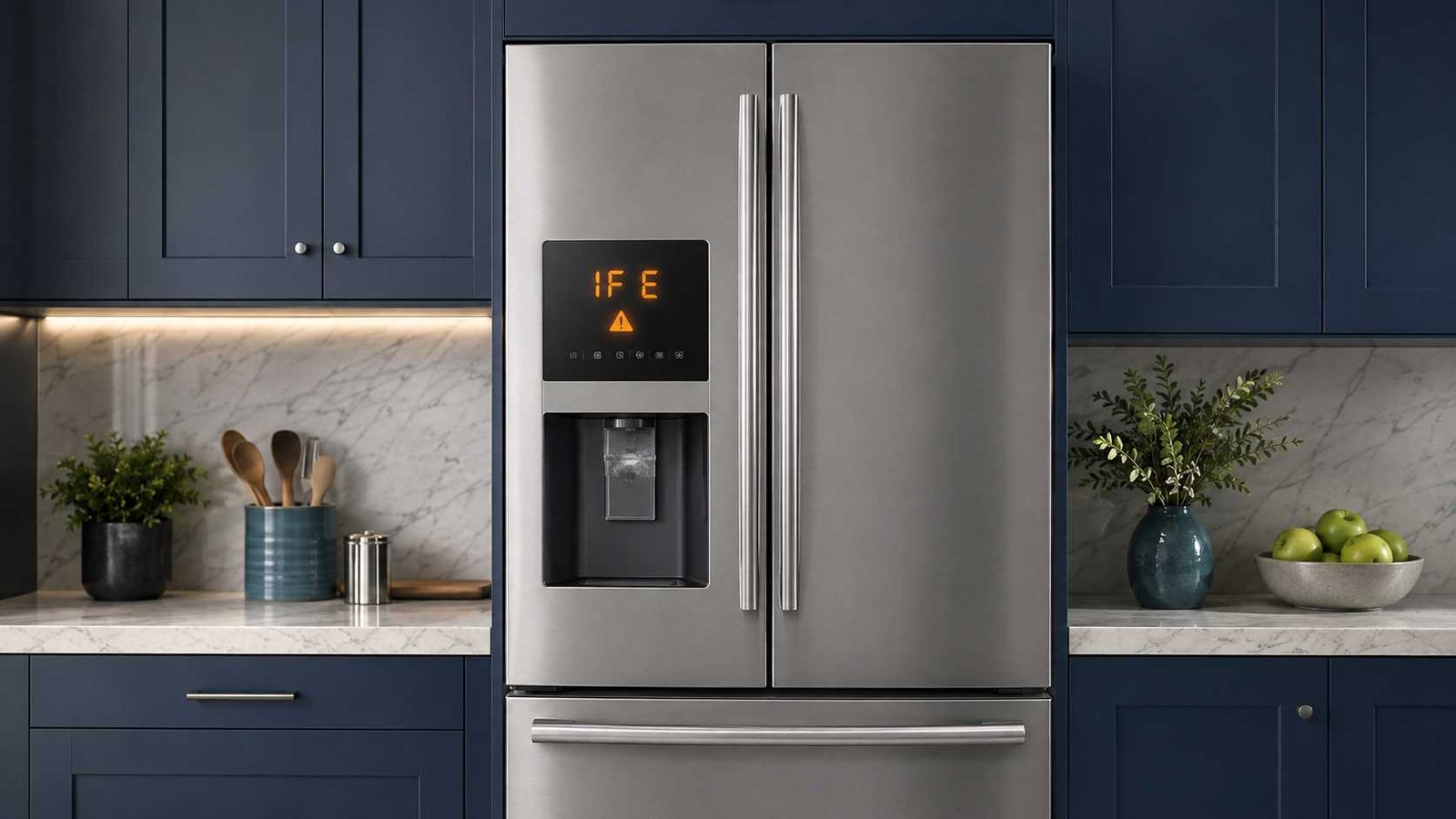
The LG Refrigerator IF E error code usually points to a problem with the ice maker fan. LG officially lists this fault as IF or F1. The fan moves cold air from the freezer to the ice-making compartment, and the code can appear when frost or ice prevents the fan from turning normally.
Start by checking whether the doors close fully, the door seals are clean and undamaged, and food is not blocking an internal vent. If frost is causing the fault, LG recommends a complete manual defrost lasting at least eight hours.
Do not remove internal panels, test live wiring or use a hair dryer to melt ice. Stop using the refrigerator for food storage if it is no longer maintaining safe temperatures.
LG IF E Quick Answer
| Item | Details |
|---|---|
| Error code | IF, F1 or a similar-looking IF E/1F display |
| Meaning | Ice maker fan problem |
| Appliance | Selected LG refrigerators with an ice maker fan |
| Most common cause | Frost or ice restricting the fan |
| Safe first check | Check doors, gaskets, vents and visible frost |
| Recommended action | Complete a natural manual defrost if frost is suspected |
| Defrost time | At least 8 hours with the appliance unplugged |
| Recovery time | Allow 24–48 hours after restarting |
| Can it still be used? | Only while safe refrigerator and freezer temperatures are maintained |
| Repair difficulty | Basic checks are homeowner-friendly; fan diagnosis is technician-level |
| Call for repair when | The code returns after a complete defrost or cooling performance declines |
What Does IF E Mean on an LG Refrigerator?
LG’s official error-code information describes IF or F1 as an ice maker fan fault. This fan circulates cold air from the freezer to the ice maker. When the fan becomes blocked or cannot operate normally, ice production may stop and the error appears.
The code is sometimes searched as:
- IF E
- 1F E
- E IF
- IF
- F1
- 1F
Digital characters can make the letter I look like the number 1. LG’s public support documentation normally labels this fault IF or F1. If your display contains additional characters, check the owner’s manual for the complete model-specific code.
Do Not Confuse IF With Other LG Refrigerator Codes
Several LG codes involve fans or ice-making components, but they do not all mean the same thing.
| Code | Area involved | General meaning |
|---|---|---|
| IF or F1 | Ice maker fan | Fan is restricted or not operating normally |
| FF | Freezer fan | Problem with freezer air circulation |
| rF | Refrigerator fan | Problem with fresh-food compartment air circulation |
| IS or 1S | Model-dependent ice maker circuit | Ice maker fan motor or sensor connection issue on listed systems |
| It | Ice maker mechanism | Ice maker motor fault |
LG describes the FF code as a freezer-fan problem and rF as a refrigerator-fan fault. Its error list separately identifies IS/1S and It, so these codes should not automatically be treated as IF faults.
Common Symptoms of an IF E Error
The error code may appear with one or more of these symptoms:
- The ice maker stops producing ice.
- Ice production becomes slower than normal.
- Existing ice starts melting or sticking together.
- A buzzing, scraping or intermittent fan noise is heard.
- Frost appears near the ice-making compartment or its air passage.
- The error disappears after power is restored but returns later.
- The ice compartment feels warmer than expected.
A fan problem does not prove that the refrigerator’s main cooling system has failed. However, you should not assume that food remains safe. Check the actual compartment temperatures with an appliance thermometer.
Most Likely Causes
1. Frost or Ice Around the Ice Maker Fan
Frost buildup is the first condition highlighted in LG’s IF/F1 troubleshooting guidance. Ice can stop the fan blade from turning or restrict the path that carries cold air to the ice maker.
This can happen after warm, humid air repeatedly enters the refrigerator. A brief power interruption or unplugging may silence the code temporarily, but it will not remove a substantial ice blockage.
2. Refrigerator Door Not Closing Completely
A food package, shelf, ice bin or drawer may prevent a door from closing. Even a small opening allows warm air and moisture to enter.
Check that:
- Nothing extends beyond the front edge of a shelf.
- Drawers are pushed in fully.
- Door bins are correctly installed.
- The ice bin is seated properly.
- Both doors remain closed without being held.
3. Dirty, Damaged or Poorly Sealing Gasket
A loose or damaged door gasket can allow humid room air into the appliance. LG advises checking the gaskets, door alignment and refrigerator levelling when frost keeps developing.
Clean the gasket with a soft cloth and mild soapy water. Look for tears, hardened sections, folds or areas that do not contact the cabinet evenly.
Do not pull, cut or remove the gasket unless your model’s instructions specifically permit it.
4. Blocked Internal Air Vent
Food placed directly against an air vent can interfere with normal airflow. LG advises making sure that refrigerator vents are unobstructed after defrosting.
Move packages slightly away from the rear and upper air outlets. Do not insert anything into a vent.
5. Refrigerator Is Not Level or Doors Are Misaligned
Poor levelling can affect how the doors close and seal. If one door sits lower than the other or opens by itself, check the installation and levelling instructions for the exact model.
Because refrigerators are heavy and can tip, obtain help before moving the appliance. Do not adjust hinges or lift the cabinet unless the owner’s manual provides a safe procedure.
6. Failed Ice Maker Fan or Related Electrical Fault
If there is no visible frost, or the code returns after a complete natural defrost, the fan may not be operating correctly.
At that point, internal diagnosis may involve the fan assembly and its electrical connections. This is technician-level work because access can require panel removal and testing near electrical components. LG directs users to arrange repair when the recommended defrost and external checks do not solve the fault.
Safe Checks Before Defrosting
Complete these checks before switching off the refrigerator.
Check the Temperatures
Use an appliance thermometer rather than relying only on the control-panel setting.
US food-safety guidance recommends maintaining the refrigerator at 40°F or below and the freezer at approximately 0°F. UK Food Standards Agency guidance recommends keeping a fridge between 0°C and 5°C.
Move perishable food to another working refrigerator or a well-packed insulated cooler if the temperature is rising.
Inspect the Doors
Open and close each door slowly. Confirm that:
- No container is touching the door.
- The ice bin is fully installed.
- Drawers do not project forward.
- The gasket lies flat against the cabinet.
- The door does not spring open again.
Look for Visible Frost
Check the accessible areas around the ice bin, ice-room door and visible air outlets.
Do not remove internal covers or push tools into the air passage. Visible ice supports the possibility of a frozen fan, but the absence of visible ice does not rule out an obstruction behind a panel.
Check the Vents
Move food away from accessible air outlets. Leave enough space for cold air to circulate around stored items.
How to Defrost an LG Refrigerator Showing IF E
LG’s IF/F1 instructions recommend a full manual defrost when frost or ice is suspected.
Before You Begin
Arrange safe storage for food. An unplugged refrigerator may keep food cold for only about four hours if its doors remain closed. An eight-hour open-door defrost therefore requires another refrigerator, freezer or an insulated cooler with enough ice or frozen gel packs.
Manual Defrost Steps
- Switch off and unplug the refrigerator.
Disconnect it directly from the wall outlet if the plug can be reached safely. - Remove food and stored ice.
Transfer refrigerated and frozen food to temperature-controlled storage. Empty the ice bin. - Open the refrigerator and freezer doors.
Keep them open so frost can melt naturally. - Place towels around and inside the appliance.
Use towels to catch meltwater and protect the floor. Replace wet towels as needed. - Wait at least eight hours.
LG specifies a minimum eight-hour defrost period. Heavy internal frost may require longer. - Dry the compartments.
Wipe away all accessible water with a clean, dry towel. - Check the doors, gaskets and vents again.
Confirm that vents are clear and the doors close completely. - Reconnect the refrigerator.
Plug it directly into its normal grounded wall outlet. - Allow 24–48 hours for normal operation.
Temperatures and ice production may take time to stabilise after restarting.
What Not to Use for Defrosting
Do not attempt to speed up the process with:
- A hair dryer
- Heat gun
- Portable heater
- Candle or open flame
- Boiling water
- Knife, screwdriver or ice pick
- Steam cleaner
- Unapproved electrical appliance
An LG owner’s manual warns against mechanical or other methods that accelerate defrosting unless the manufacturer recommends them. It also specifically warns against using a hair dryer inside the refrigerator, damaging the refrigerant circuit or allowing unqualified people to repair the appliance.
Safety warning: Disconnect power before cleaning. Stop immediately if you notice smoke, a burning smell, a damaged power cord, unusual electrical noise or water entering an electrical area. Contact an authorised service provider.
Will Resetting Clear the IF E Code?
A power interruption may clear the display temporarily, but it does not necessarily correct the cause.
There is no single IF E button-reset sequence that can safely be applied to every LG refrigerator. Control panels and key combinations vary. A combination found online may activate another feature or diagnostic function on a different model.
For a suspected frozen fan, the meaningful reset occurs after:
- The refrigerator has been unplugged.
- The frost has melted completely.
- Moisture has been dried.
- The doors and airflow paths have been checked.
- Power has been restored.
If the code disappears and stays away, frost was likely restricting the fan. If it returns, repeated resets are unlikely to provide a lasting solution.
What to Do if IF E Returns After Defrosting
The Code Returns Immediately
An immediate return suggests that the refrigerator still detects abnormal fan operation. The fan may remain obstructed, or the fan assembly may require professional testing.
Do not repeatedly unplug and reconnect the appliance.
The Code Returns After Several Days
A delayed return can indicate that frost is forming again.
Recheck:
- Door closure
- Gasket condition
- Refrigerator levelling
- Ice-bin installation
- Food blocking a vent
- Frequent or prolonged door opening
Recurring frost may also have an internal cause that cannot be confirmed without service access.
There Is No Visible Frost
The blockage may be behind a cover, or the fault may not be caused by ice. Since fan access normally involves internal disassembly, arrange service rather than removing panels.
Cooling Performance Is Declining
Move perishable food to safe storage and request repair promptly. Do not wait for the ice maker symptoms to worsen if the refrigerator or freezer temperature is already rising.
Can You Still Use the Refrigerator With IF E Showing?
The refrigerator may continue cooling while the ice maker fan is affected, but this varies by design and fault severity.
You may continue using it temporarily only when:
- The refrigerator remains at or below 40°F or within the recommended 0–5°C range.
- The freezer remains close to 0°F or −18°C.
- There is no burning smell, smoke, water near electrical parts or abnormal electrical noise.
- The doors close and seal properly.
Turn off the ice maker if your model provides a normal user-accessible ice-maker switch and the owner’s manual allows it. This will not repair the fan, but it can prevent continued attempts to make ice while you monitor the appliance.
Do not rely on the refrigerator for perishable food if measured temperatures are unsafe.
Food Safety During the Defrost
Because LG recommends leaving the appliance unplugged and open for at least eight hours, food should be moved before defrosting.
Use:
- Another working refrigerator or freezer
- An insulated cooler
- Frozen gel packs
- Bagged ice in leak-resistant containers
Keep cold food at or below 40°F or 4°C. US guidance says an unopened refrigerator generally holds a safe temperature for about four hours without power. Perishable refrigerated food held above 40°F or 4°C for more than two hours may need to be discarded. Never taste food to judge whether it is safe.
Frozen food may be refrozen when it still contains ice crystals or remains at 40°F or below, although quality can change.
Parts a Technician May Inspect
Depending on the exact model and findings, professional diagnosis may involve:
| Component or area | Why it may be checked |
|---|---|
| Ice maker fan and blade | To confirm that the fan turns and is not damaged |
| Fan housing and air passage | To locate concealed frost or physical obstruction |
| Door and ice-room seals | To check for moisture entering the ice compartment |
| Wiring and connectors | To confirm the fan receives and returns the expected signals |
| Control circuit | To determine why the fan fault continues when the fan and airflow path are clear |
This is not a universal parts list. Component design and access differ by model, country and production revision.
Do not order a fan using only the words “LG IF E error.” Use the complete model and serial information from the refrigerator’s rating label, then verify the compatible component through LG or an authorised parts supplier.
Model and Regional Differences
The IF/F1 meaning is consistent across several current LG regional support pages, including the United States, United Kingdom, Australia and New Zealand.
However, these details may differ:
- The way the code appears on the display
- Whether the model has an in-door ice compartment
- The location of the ice maker fan
- Door and gasket design
- Model-specific reset or diagnostic controls
- Replacement fan assembly
- Warranty and service arrangements
In the UK, Ireland, Australia and New Zealand, the appliance may be described as a fridge freezer rather than a refrigerator. The fault meaning remains tied to the ice maker fan on the models covered by LG’s guidance.
When to Call a Technician
Arrange professional service when:
- IF or F1 returns after a complete eight-hour defrost.
- The error appears immediately after restarting.
- There is no visible frost but the code remains.
- Grinding, scraping or repeated fan-starting noises continue.
- The refrigerator or freezer is warming.
- Water has reached an electrical area.
- The plug, outlet or power cord is damaged.
- A panel must be removed to reach the fan.
- The appliance is still under warranty.
- You are unsure whether the displayed code is IF, IS, FF or another fault.
Do not attempt live-voltage testing, wiring repair, refrigerant work or control-board replacement.
Frequently Asked Questions
Is LG IF E the same as F1 or 1F?
LG officially lists the ice maker fan fault as IF or F1. On a segmented display, the letter I can resemble the number 1. If an extra E appears, confirm the complete display in the manual for your model.
How long should I unplug an LG refrigerator for the IF error?
For possible frost around the fan, LG recommends leaving the refrigerator unplugged with its doors open for at least eight hours. A brief unplugging may clear the display but may not melt the hidden ice.
Will the IF E code clear itself?
It may disappear after the obstruction melts and normal fan operation resumes. If the underlying frost, sealing problem or fan fault remains, the code may return.
Can a dirty door gasket cause the IF error?
A dirty gasket does not directly prove that the fan has failed. However, a poor door seal can allow warm, moist air inside and contribute to frost formation. LG recommends checking the gasket, door closure and appliance levelling when frost is present.
Why did IF E return after I defrosted the refrigerator?
The defrost may have been too short, moisture may still be entering through a door or seal, airflow may be restricted, or the fan may have an internal fault. A recurring code after a full defrost should be professionally diagnosed.
Can I use a hair dryer on the frozen fan area?
No. LG warns against using a hair dryer inside the refrigerator and against unapproved methods of accelerating defrosting. Allow the frost to melt naturally with the refrigerator unplugged.
Does IF E mean the entire refrigerator has stopped cooling?
Not necessarily. The code identifies an ice maker fan problem, but you should measure refrigerator and freezer temperatures because the effect can vary. Move food if safe temperatures are not being maintained.
Which replacement fan do I need?
The correct fan depends on the full refrigerator model and production revision. Do not select a part based only on the error code. Confirm compatibility using the appliance rating label and an authorised parts source.
Daniel Brooks is a US-based appliance troubleshooting researcher with 12 years of experience studying washer, dryer, refrigerator, and dishwasher faults. He reviews manufacturer manuals and converts technical error codes into safe, practical guidance for homeowners.
1 thought on “LG Refrigerator IF E Error Code: Ice Maker Fan Troubleshooting”