
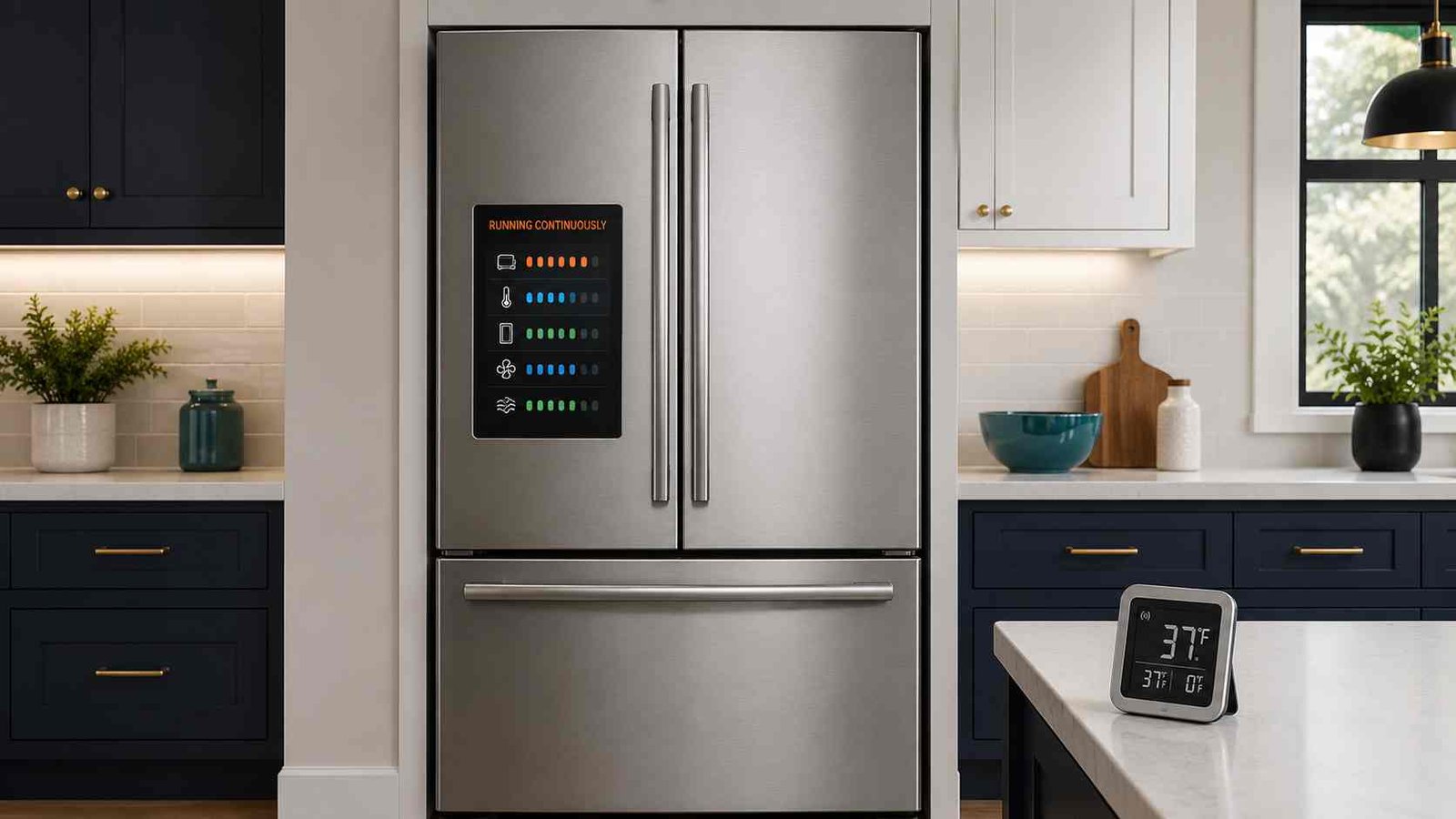
 A refrigerator that runs continuously is not necessarily broken. Many modern refrigerators use variable-speed or inverter compressors that operate quietly for long periods instead of switching fully on and off. Hot weather, frequent door opening, newly added groceries, or a recent installation can also increase run time.
The first safe check is not the sound. Measure the actual refrigerator and freezer temperatures. If the refrigerator remains at a safe temperature and the appliance has no unusual noise, frost, burning smell, or cooling problem, extended operation may be normal.
Do not continue storing perishable food in the appliance if the temperature is too warm. Disconnect the refrigerator and arrange professional help if you notice a burning smell, electrical overheating, repeated loud clicking, or damaged wiring.
| Item | Details |
|---|---|
| Appliance | Refrigerator or fridge freezer |
| Main symptom | Compressor or fan appears to run almost continuously |
| May be normal when | Temperatures are correct and the appliance uses a variable-speed compressor |
| Common causes | Hot weather, frequent door opening, cold settings, poor door sealing, blocked airflow or recent food loading |
| Safe first check | Measure refrigerator and freezer temperatures |
| Refrigerator target | 40°F or 4°C and below in North America; 5°C or below in many other regions |
| Freezer target | About 0°F or −18°C |
| Repair difficulty | Basic external checks are usually easy |
| Can it still be used? | Usually, if temperatures remain safe and there are no electrical or mechanical warning signs |
| Professional help needed | When temperatures remain too warm, frost returns, airflow is weak or abnormal noises continue |
Is It Normal for a Refrigerator to Run Continuously?
It can be normal for a refrigerator to run for most of the day. The important questions are:
- Is it maintaining the correct temperature?
- Is the sound normal for that refrigerator?
- Has anything recently increased the cooling demand?
- Does the appliance use a variable-speed compressor?
Some modern refrigerators run their compressors at a low speed for long periods. This can use less energy than repeatedly starting a fixed-speed compressor.
Older refrigerators are more likely to have clear on-and-off cycles. Newer French-door, inverter and high-efficiency models may rarely become completely silent because a compressor or circulation fan is still operating.
Normal situations that increase run time
Your refrigerator may run longer than usual after:
- Initial installation
- Moving or transporting the appliance
- A power outage
- Adding a large grocery load
- Placing warm food inside
- Frequent door opening
- Leaving a door open for several minutes
- Activating fast-cool or fast-freeze mode
- A sudden rise in room temperature
- Hot or humid weather
A newly installed or recently relocated refrigerator may need approximately 24 to 48 hours to stabilize. Avoid repeatedly changing the controls during this period.
Check the Actual Temperature First
Do not diagnose continuous operation by sound alone. Check whether the appliance is maintaining a safe temperature.
Use a refrigerator or appliance thermometer. Position it in the main food-storage area and follow the thermometer manufacturer’s instructions. Keep the doors closed as much as possible while checking.
Recommended temperatures are:
| Region | Refrigerator guidance | Freezer guidance |
|---|---|---|
| United States and Canada | 40°F or 4°C and below | Around 0°F or −18°C |
| United Kingdom and Ireland | 5°C or below | Around −18°C |
| Australia and New Zealand | 5°C or colder | Around −18°C |
The exact control-panel number may not equal the measured temperature. On some models, a higher dial number means colder operation. On others, the display shows the requested temperature directly. Check the user manual before adjusting the control.
Runs continuously but temperatures are correct
If temperatures are correct, the refrigerator may be operating normally. Consider whether:
- It uses an inverter or variable-speed compressor
- The room is unusually warm
- The doors have been opened frequently
- Warm groceries were recently added
- Fast-cool or fast-freeze mode is active
- You are hearing a fan rather than the compressor
Continue monitoring the temperature. Do not replace parts based only on long run time.
Runs continuously and temperatures are too warm
Continuous running becomes more concerning when the refrigerator cannot reach a safe temperature.
Possible causes include:
- A door that does not close properly
- A leaking door gasket
- Blocked internal vents
- Restricted ventilation around the cabinet
- Heavy frost affecting airflow
- A fan problem
- A temperature-sensor fault
- A defrost-system fault
- A compressor, inverter or sealed-system problem
Start with the safe external checks below. Internal electrical and refrigeration-system testing should be left to a qualified technician.
Common Reasons a Refrigerator Keeps Running
1. The temperature setting is too cold
An unnecessarily cold setting increases cooling demand. The refrigerator may run for longer even though it is working correctly.
Check the recommended setting in the user manual. Make one small adjustment and allow enough time for the temperature to stabilize before changing it again.
Do not set the refrigerator colder to compensate for warm food until you have checked the door seal and airflow.
2. The doors are opened frequently
Every door opening lets cold air escape and allows warm, humid air to enter. The refrigerator must then run longer to restore the temperature.
This is especially noticeable during:
- Meal preparation
- Parties or large gatherings
- Grocery loading
- Hot weather
- Periods when children frequently open the doors
Plan what you need before opening the refrigerator and avoid leaving the door open while arranging food.
3. A door is not closing completely
A container, shelf, drawer or food package may prevent the door from closing.
Check for:
- Bottles extending beyond a shelf
- Overfilled door bins
- Misaligned drawers
- Ice buildup around the freezer drawer
- Packaging caught between the door and cabinet
- A refrigerator that is not standing correctly
The doors should close smoothly without needing excessive force.
4. The door gasket is dirty, loose or damaged
The flexible gasket around the door helps keep warm air out. Food residue, grease, deformation or physical damage can create an air leak.
Inspect the entire gasket. Clean it gently using warm water and mild detergent, then dry it.
Look for:
- Cracks
- Torn areas
- Hardened sections
- Loose corners
- Visible gaps
- Condensation near one part of the door
A damaged gasket usually needs model-compatible replacement. Do not assume every gasket fits every refrigerator.
5. Internal air vents are blocked
Refrigerators rely on controlled airflow between compartments. Food placed directly against an air vent can prevent cold air from circulating properly.
Keep food packages clear of:
- Rear-wall vents
- Freezer air outlets
- Return-air openings
- Temperature sensors where visible
- Fan covers
Do not pack shelves so tightly that air cannot move around the food.
6. Warm food or groceries were recently added
A large grocery load can keep the refrigerator running for many hours. The same applies when warm leftovers are placed inside.
Allow hot food to stop steaming before refrigeration, but do not leave perishable food at room temperature for an unsafe period. Divide large quantities into shallow containers so they cool more efficiently.
7. The refrigerator does not have enough ventilation
Heat removed from the food compartments must be released into the room. Restricted ventilation can increase run time and reduce cooling performance.
Check that:
- The refrigerator has the clearance required by its installation manual
- Ventilation openings are not blocked
- The appliance is not pressed tightly against a wall
- Dust and stored objects are not covering external vents
- The refrigerator is not enclosed in a cabinet that lacks the specified airflow
Required clearances vary by model. Use the installation guide rather than relying on a universal measurement.
8. The refrigerator is near a heat source
An oven, cooker, radiator, boiler, direct sunlight or an unusually hot garage can increase the cooling load.
Some refrigerators are not designed for unheated or extremely hot garages. Check the appliance’s permitted ambient-temperature or climate-class range in the manual.
9. The condenser area is dirty
Dust on an accessible condenser or ventilation grille can reduce heat transfer and increase run time.
However, condenser design varies. Some refrigerators have exposed rear coils, some use a lower condenser area, and others have enclosed or low-maintenance systems.
Only clean the condenser if the user manual permits homeowner access.
Before cleaning:
- Switch off and unplug the refrigerator.
- Protect the floor if the appliance must be moved.
- Avoid pulling, bending or crushing water lines.
- Do not remove service panels unless the manual specifically identifies them as user-accessible.
- Do not touch refrigerant tubing, wiring or electrical components.
Use a soft brush or vacuum attachment only where the manufacturer recommends it.
10. Frost is restricting airflow
Heavy frost around the freezer’s rear wall or air vents can restrict airflow. The freezer may remain cold while the refrigerator compartment becomes warm.
Frost can develop because of:
- A door left partly open
- A damaged gasket
- Humid air entering the compartment
- Blocked vents
- A possible automatic-defrost problem
Do not chip ice with a knife, screwdriver or sharp tool. This can puncture refrigerant tubing or damage the liner.
If the manufacturer permits manual defrosting, follow the exact instructions in the user manual. Recurring frost usually requires professional diagnosis.
11. An interior light stays on
A light that remains on after the door closes produces heat and may increase run time.
On models with a visible mechanical door switch, press it gently and confirm that the light switches off. Do not bypass, tape down or remove a door switch.
Some modern refrigerators use concealed or magnetic sensors, so this check may not apply.
Safe Step-by-Step Troubleshooting
Step 1: Identify what you are hearing
A refrigerator contains several moving components. The sound may be coming from:
- The compressor
- The condenser fan
- The evaporator fan
- The ice maker
- A water valve
- An automatic damper
- A defrost-related component
A steady low hum or soft fan sound can be normal. Grinding, scraping, repeated loud clicking, harsh buzzing or a sudden increase in noise deserves closer attention.
Step 2: Measure both compartment temperatures
Check the refrigerator and freezer rather than judging cooling by touch.
If both compartments are at safe temperatures, monitor the appliance before assuming a fault.
If either compartment is too warm, protect perishable food and continue with the checks below.
Step 3: Review the control settings
Confirm that:
- The controls were not accidentally changed
- Fast-cool or fast-freeze mode is not still active
- Vacation, showroom or demo mode is not enabled
- The temperature is not set unnecessarily cold
- The control lock has not prevented an intended adjustment
Control names differ by model.
Step 4: Check that every door closes correctly
Open and close each door and drawer. Remove anything that interferes with closing.
Check whether the cabinet is stable. Some models require a slight rearward tilt or specific levelling adjustment for reliable door closing. Follow the installation manual.
Step 5: Inspect and clean the gaskets
Clean visible residue and check for damage or gaps.
Do not apply petroleum jelly, oil or adhesive unless the manufacturer specifically recommends it. These materials may damage some gasket compounds.
Step 6: Clear the internal vents
Move food away from vent openings. Avoid placing large containers tightly against the rear wall.
Do not remove an internal fan cover or rear freezer panel.
Step 7: Consider recent use
Ask whether the refrigerator was recently:
- Installed
- Moved
- Reconnected after an outage
- Filled with groceries
- Left open
- Switched to a colder mode
Allow around 24 hours after a minor adjustment and up to 24 to 48 hours after installation or major loading, provided the temperature is moving toward the safe range.
Step 8: Check the surrounding environment
Look for restricted ventilation, strong sunlight or a nearby heat source.
If the refrigerator is in a garage, utility room or outdoor building, compare the room temperature with the permitted range in the manual.
Step 9: Clean only manufacturer-approved areas
Vacuum accessible external grilles and permitted condenser areas after disconnecting power.
Stop if access requires removing a service panel, disconnecting wiring or working near the compressor.
Step 10: Monitor the result
After completing the checks:
- Close the doors
- Avoid unnecessary opening
- Recheck the temperature after stabilization
- Listen for changes in the sound
- Look for returning frost or condensation
If the refrigerator still runs continuously and remains too warm, arrange professional service.
Should You Reset the Refrigerator?
A reset may help after a temporary control problem or power disturbance, but it is not a general repair for continuous running.
A power reset will not correct:
- A leaking gasket
- Blocked vents
- Dirty condenser surfaces
- A failed fan
- Heavy recurring frost
- A defective temperature sensor
- A sealed-system problem
There is no universal refrigerator reset sequence. Some manufacturers allow the appliance to be switched off or unplugged briefly, while connected models may have a control-panel reset.
Use the instructions for the exact model. Do not repeatedly unplug the refrigerator while it is trying to cool.
What If the Basic Checks Do Not Work?
The pattern of symptoms can help a technician narrow down the problem.
| Symptom | Possible explanation |
|---|---|
| Refrigerator runs continuously but both compartments are cold | Normal variable-speed operation, very cold settings or high cooling demand |
| Freezer is cold but refrigerator is warm | Restricted airflow, frost buildup, damper issue or evaporator-fan problem |
| Both compartments are warm | Door leak, condenser problem, fan fault, sensor issue, compressor or sealed-system fault |
| Heavy frost returns after defrosting | Door-sealing problem or automatic-defrost fault |
| Compressor runs but airflow is weak | Possible evaporator-fan problem or frost restriction |
| Repeated clicking with poor cooling | Compressor-start, inverter, control or compressor problem may require diagnosis |
| Refrigerator is unusually hot around the cabinet | Heat release may be normal, but poor ventilation or cooling trouble should be checked |
| Temperatures fluctuate widely | Door sealing, sensor, airflow, control or defrost problems may be involved |
These symptoms do not confirm a failed part. Similar faults can produce the same behaviour, and component testing varies by model.
Parts That May Require Professional Diagnosis
| Component or system | Possible signs | Homeowner action |
|---|---|---|
| Door gasket | Condensation, visible gaps or warm air leakage | Clean and inspect externally |
| Evaporator fan | Weak airflow, freezer cold but refrigerator warm | Do not remove internal panels |
| Condenser fan | Poor cooling, unusual rear or lower-cabinet noise | Keep external vents clear |
| Temperature sensor or thermistor | Incorrect or unstable temperatures | Professional testing required |
| Defrost system | Recurring heavy frost and restricted airflow | Observe symptoms only |
| Air damper | One compartment too cold and the other warm | Professional diagnosis may be needed |
| Main control or inverter board | Irregular compressor or fan operation | Do not test live electronics |
| Compressor | Continuous operation with weak or no cooling | Qualified service required |
| Sealed refrigeration system | Poor cooling despite normal airflow and clean external areas | Refrigeration-qualified technician required |
Do not test live voltage, bypass switches, open sealed electrical covers or attempt refrigerant work.
Is the Food Still Safe?
Continuous running itself does not make food unsafe. The internal temperature determines the risk.
Keep the refrigerator at:
- 40°F or 4°C and below in the United States and Canada
- 5°C or below in the United Kingdom and Ireland
- 5°C or colder in Australia and New Zealand
The freezer should remain near 0°F or −18°C.
Move perishable food to another working refrigerator or an insulated cooler with ice if the temperature is rising above the recommended range.
Food safety depends on how warm the food became and how long it remained warm. When in doubt, follow your national food-safety authority’s advice. Do not taste food to decide whether it is safe.
When to Call a Technician
Arrange qualified service when:
- The refrigerator cannot maintain a safe temperature
- Heavy frost returns after a safe defrost
- Airflow remains weak after clearing vents
- A fan produces grinding or scraping sounds
- The compressor repeatedly clicks but does not cool
- Both compartments remain warm
- The appliance displays an error code
- Water is reaching electrical areas
- The power cord, plug or outlet shows heat damage
- You smell burning or see smoke
- Basic external checks do not improve the problem
Disconnect the appliance if there is smoke, a burning smell, visible electrical damage or unsafe overheating. Do not remove covers to investigate.
How to Reduce Unnecessary Run Time
You can reduce avoidable cooling demand by:
- Using the manufacturer’s recommended temperature setting
- Keeping door openings short
- Checking that doors close completely
- Cleaning door gaskets
- Keeping food clear of internal vents
- Allowing space for air circulation
- Following installation-clearance requirements
- Keeping the refrigerator away from strong heat sources
- Cleaning only manufacturer-approved condenser areas
- Checking temperatures with an appliance thermometer
- Allowing time after grocery loading or control changes
A refrigerator should be judged by temperature stability, food condition, noise and overall performance rather than compressor run time alone.
Frequently Asked Questions
Should a refrigerator run 24 hours a day?
Some modern refrigerators can run almost continuously at a low speed, especially in hot weather or after adding food. This may be normal if both compartments maintain the correct temperatures.
How often should a refrigerator compressor switch off?
There is no universal cycle length. It depends on the compressor design, room temperature, door use, food load, control setting and refrigerator model.
Why does my refrigerator run constantly but stay cold?
The appliance may use a variable-speed compressor, the controls may be set very cold, or recent use may have increased cooling demand. Check the manual and measure the actual temperatures before assuming a fault.
Why does the freezer stay cold while the refrigerator is warm?
Cold air may not be reaching the refrigerator compartment. Possible causes include blocked vents, frost buildup, an evaporator-fan issue or a model-specific air-damper problem.
Can dirty condenser coils make a refrigerator run continuously?
Dust on a user-accessible condenser can reduce heat transfer and increase run time. However, not all refrigerators have coils that homeowners should access. Follow the exact maintenance instructions for the model.
Will resetting the refrigerator stop continuous running?
Only if the cause is a temporary electronic issue. A reset will not fix blocked airflow, a leaking gasket, recurring frost, a failed fan or a sealed-system problem.
Is it safe to use a refrigerator that never shuts off?
It may be safe when temperatures remain correct and there are no abnormal smells, electrical issues, loud noises or cooling problems. Stop using it for perishable food if temperatures rise above the safe range.
Does a refrigerator use more electricity when it runs continuously?
Long operation can increase consumption, but run time alone does not show how much electricity is being used. A variable-speed compressor may run for longer at low power. Compare energy use only after confirming correct temperatures and operating conditions.
Daniel Brooks is a US-based appliance troubleshooting researcher with 12 years of experience studying washer, dryer, refrigerator, and dishwasher faults. He reviews manufacturer manuals and converts technical error codes into safe, practical guidance for homeowners.